




Table of Contents
[ Show/Hide ]- • What is a forex broker?
- • What does a forex broker actually do?
- • What happens when you place a forex trade?
- • Is a forex broker always just an intermediary?
- • Market Maker, STP and ECN: what do the labels mean?
- • How do forex brokers make money?
- • Forex broker vs exchange: what is the difference?
- • Why the broker's legal entity matters
- • How do you check whether a forex broker is regulated?
- • What forex broker fees should you compare?
- • How should you evaluate broker execution?
- • Which forex account type should you choose?
- • What should you check about leverage and margin?
- • Which trading platform and tools should you check?
- • What should you check about deposits and withdrawals?
- • What should you check before opening a forex broker account?
- • What are common forex broker red flags?
- • How do forex rebates fit into broker selection?
- • What is a forex broker? Practical takeaway
- • FAQ
- • Risk warning and disclaimer
- • Sources and methodology
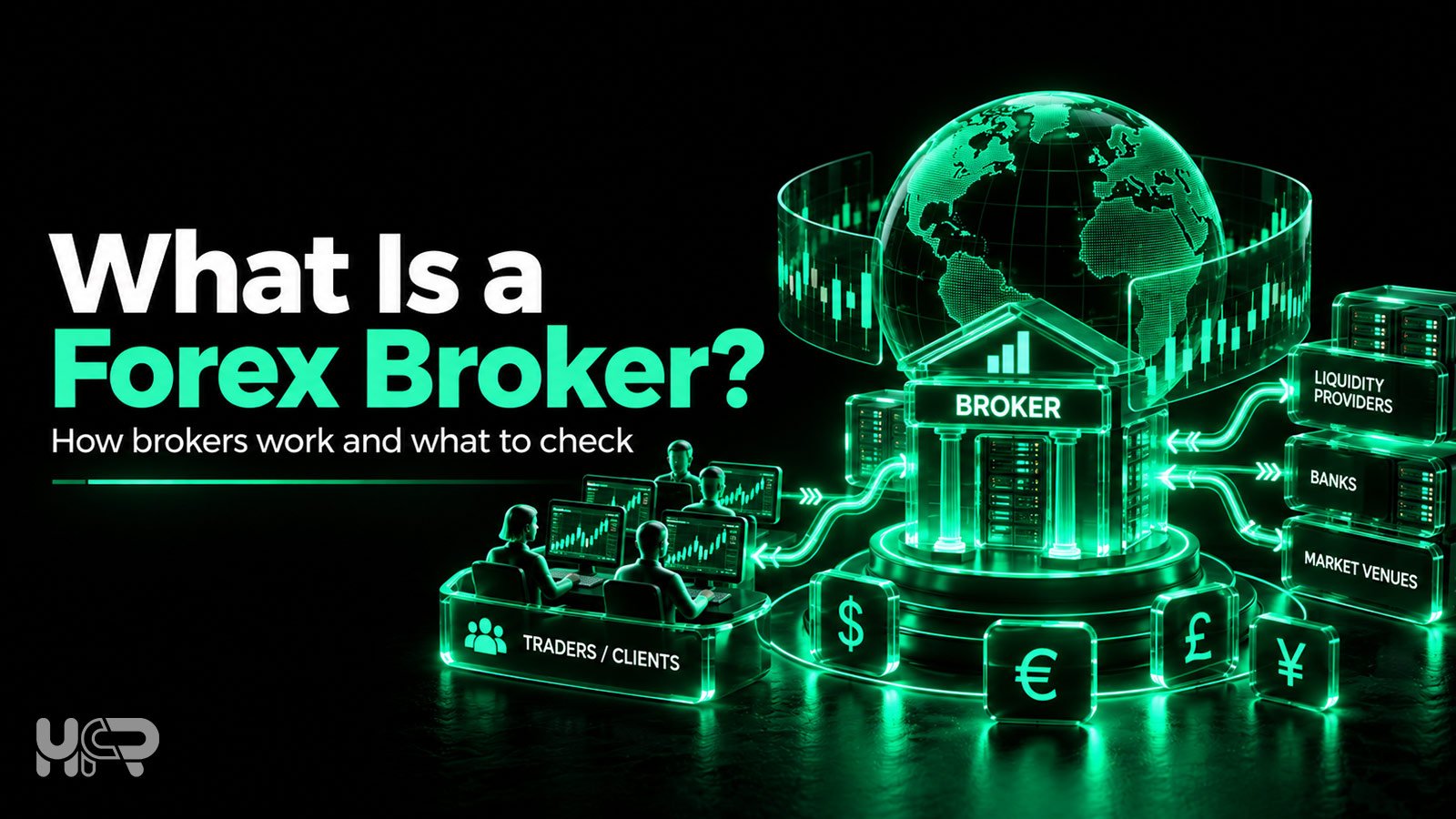
A forex broker is more than the app or platform used to place a trade. The broker provides the trading account, displays available Bid and Ask prices, handles orders, applies margin requirements and sets the conditions under which positions are opened and closed. Depending on the product, legal entity, jurisdiction and execution arrangement, the broker may also act as the contractual counterparty to the trade.
That makes broker selection about more than the advertised spread. Before opening or funding an account, check the exact legal entity, its regulatory status, total trading costs, execution policy, leverage and margin rules, and the conditions for deposits and withdrawals. Account protections can also differ between jurisdictions and entities.
This guide explains what a forex broker is, how retail forex brokers work, what happens after an order is placed and what to verify before opening and funding an account.
What is a forex broker?
A forex broker is a financial-services firm that provides retail clients with access to foreign-exchange or related CFD trading through a trading account and platform. It provides available prices, processes orders, applies margin requirements and sets the account’s trading conditions. Its exact role depends on the product, legal entity, jurisdiction and execution arrangement.
Retail forex is commonly traded over the counter (OTC) rather than through one central exchange. The broker or another provider therefore forms part of the contractual and execution structure. A broker may act as principal, hedge exposure externally, route orders, or combine several methods. The arrangement is not the same for every firm or product.
For example, when a trader opens EUR/USD on a retail platform, the broker displays Bid and Ask prices, checks whether sufficient margin is available, processes the order under its execution policy and records the resulting position in the trading account.
What does a forex broker actually do?

A forex broker provides the account infrastructure and trading conditions needed to access retail forex or related CFD products. Its role is broader than supplying a trading app, and the exact functions depend on the product, legal entity and execution arrangement.
- Opens and maintains the trading account, including KYC checks, account currency and account-type settings.
- Provides Bid and Ask prices for available instruments. The difference between these prices is the spread.
- Provides platform access through web, desktop or mobile trading software.
- Receives and handles orders according to its execution policy and the selected order type.
- Checks margin requirements before and while leveraged positions are open.
- Records open and closed positions, entry prices, position sizes and transaction history.
- Calculates floating and realised profit or loss under the account’s pricing and conversion rules.
- Applies trading costs such as spreads, commissions, overnight financing, conversion charges or other disclosed fees.
- Processes deposits and withdrawals under its funding, verification and payment-method rules.
- Provides statements and account records showing trades, balances, costs and account activity.
These functions do not mean that every broker sends each retail order directly to a bank or external liquidity provider. The broker may act as principal, hedge exposure externally, route orders or combine several execution methods.
What happens when you place a forex trade?
When you click Buy or Sell, several checks and processing steps can occur before, during and after execution. The exact sequence depends on the broker, platform, order type and execution policy.

1. The broker displays a quote.
The platform shows the current Bid and Ask prices available for the instrument. These prices can change quickly during volatile or illiquid periods.
2. You submit an order.
You choose the instrument, position size and order type, such as a market, limit or stop order, then send the instruction through the trading platform.
3. The account is checked for available margin.
For leveraged trading, the broker checks whether the account has enough available margin to open the requested position.
4. The broker handles the order under its execution policy.
Depending on the arrangement, the broker may execute as principal, hedge exposure externally, route the order to another venue or liquidity source, or use a combination of methods. A retail order does not automatically go directly to a bank or the wider interbank market.
5. The order is executed or otherwise handled under the applicable rules.
Depending on the order type, execution method, liquidity and market conditions, an order may be filled, rejected, requoted or partially filled where the platform and terms allow it. The final execution price can also differ from the requested price.
6. The position appears in the trading account.
The platform records the executed price, position size, current unrealised profit or loss and margin being used.
7. Trading costs and financing are applied.
The position may incur spread, commission and, if held beyond the relevant rollover time, overnight financing or swap charges.
8. The position is closed.
Closing creates another execution event. The final profit or loss is realised after applicable trading costs. If margin conditions deteriorate before closure, the broker’s margin-call or stop-out rules may apply.
For more detail on price differences between requested and filled orders, see HFR’s guide to forex slippage. For the separate liquidation process, see margin call and stop out.
Is a forex broker always just an intermediary?
No. A forex broker is not always a neutral middleman that simply passes every retail order to a bank or liquidity provider. Depending on the product, legal entity, jurisdiction and execution arrangement, the broker may act as the contractual counterparty, route or hedge exposure externally, or combine several methods.
| Arrangement | General structure |
|---|---|
| Broker as principal / counterparty | The client trades under a contract with the broker, which may take the other side of the transaction and decide whether or how to hedge its exposure externally. |
| Agency-style handling | The broker may route or match orders with external liquidity sources rather than retaining the full market exposure itself. |
| Hybrid model | The broker can use different handling methods depending on factors such as instrument, order size, account or internal risk rules. |
These structures should not automatically be treated as better or worse. The more useful question is how the broker says it handles orders and manages conflicts of interest, which should be explained in its Client Agreement and Order Execution Policy.
In the United States, the CFTC specifically describes off-exchange retail forex as a market where the customer trades against the dealer rather than through a central exchange. That description is jurisdiction-specific and should not be applied automatically to every country or product.
Market Maker, STP and ECN: what do the labels mean?

Terms such as Market Maker, STP and ECN are commonly used to describe aspects of how a broker may price, execute or manage client orders. They are useful as broad concepts, but they are not standardised labels and should not be treated as a quality ranking.
| Label | General concept | What it does not prove |
|---|---|---|
| Market Maker / principal | The broker may act as the contractual counterparty and decide whether to retain or hedge some of the resulting exposure. | It does not automatically mean poor pricing, manipulation or worse execution. |
| STP | “Straight Through Processing” generally refers to orders or exposure being passed electronically to external liquidity sources with limited manual dealing intervention. | It does not prove that every order is routed externally or that the broker never acts as principal. |
| ECN | An Electronic Communication Network generally brings together prices or orders from multiple participants in an electronic matching environment. | It does not guarantee lower costs, faster execution or better fills. |
| Hybrid | A broker may combine internal execution, external hedging and routing depending on the order, instrument, account or risk policy. | It does not reveal the exact handling of a particular trade without further disclosure. |
The terms A-book and B-book are also used informally. A-book commonly refers to exposure that is externally hedged or routed, while B-book generally refers to exposure retained internally by the broker. Many firms can use both approaches as part of a hybrid risk-management model.
A Raw account is not automatically ECN, and a Standard account is not automatically Market Maker. Pricing structure and execution model are separate questions.
HFR’s Raw Spread vs Standard Account guide explains the pricing distinction in more detail.
How do forex brokers make money?
Forex brokers can earn revenue from several parts of the trading account, but not every broker uses every revenue source. The exact model depends on the legal entity, account type, instrument and pricing structure.
- Spread or spread markup: the broker may earn from the Bid-Ask difference or from a markup added to underlying pricing.
- Trading commission: some accounts charge a separate commission when a trade is opened, closed or both.
- Overnight financing or swap markup: positions held beyond the broker’s rollover time may incur financing charges or credits, sometimes with a broker adjustment.
- Currency conversion: conversion charges may apply when the account, instrument, deposit or withdrawal currency differs.
- Other account or service fees: inactivity, withdrawal, data or other disclosed charges may apply depending on the broker and account.
A broker acting as principal does not automatically mean it profits directly from every individual client loss. Exposure can be hedged, offset internally or managed through a hybrid model, depending on the broker’s execution and risk-management policy.
For cost comparison, review the full pricing schedule rather than the advertised spread alone. HFR explains how forex commission works, while the account-pricing section below explains why a narrow quoted spread does not necessarily mean a lower total cost.
Forex broker vs exchange: what is the difference?
A forex broker provides a trading account and handles client orders under its contractual and execution arrangements. An organised exchange is a trading venue where standardised products are bought and sold according to the exchange’s rules.
| Forex broker / OTC arrangement | Organised exchange |
|---|---|
| Retail forex or CFD trading commonly takes place directly with a broker or provider rather than on one central exchange. | Orders in exchange-traded products are submitted to an organised trading venue. |
| Pricing and execution depend on the broker, product and execution policy. | Trading follows the exchange’s market structure and contract rules. |
| The broker may act as counterparty, route exposure externally or use a hybrid model. | The exchange provides the venue rather than acting as a retail forex broker. |
The distinction is not absolute. Brokers can also provide access to exchange-traded products such as currency futures, while spot FX and many FX derivatives are primarily traded over the counter. BIS research describes the wider FX market as predominantly OTC, decentralised and fragmented.
Why the broker's legal entity matters
A broker’s brand name and legal entity are not always the same thing. One broker group can operate through several companies in different jurisdictions, and the entity assigned to an account can affect the rules and protections that apply.
- Which regulator oversees the account.
- What leverage limits apply.
- Whether negative balance protection or other retail-client protections are available.
- Which instruments and account types can be offered.
- How complaints and disputes are handled.
- Which client-money rules or compensation arrangements may apply.
- Whether the account qualifies for a specific HFR rebate programme.
The same broker brand may use one company for clients in the UK and another for clients elsewhere. The websites can look similar while the regulator, leverage, dispute process and account protections differ.
Before opening an account, identify the exact company named in the Client Agreement or Terms of Business. The next section explains how to verify that entity against the relevant regulator’s official records.
Regulation can impose conduct, disclosure, capital or client-money requirements, depending on the jurisdiction, but it does not guarantee that a broker cannot fail or that trading losses will be prevented.
How do you check whether a forex broker is regulated?
Do not rely only on a broker’s logo, licence badge or statement that it is “regulated”. Verify the exact legal entity and its permissions against the relevant regulator’s official records.
1. Identify the legal entity.
Find the company name in the Client Agreement, Terms of Business or account-opening documents.
2. Record the regulator and licence or reference number.
Note the regulator the broker says supervises that specific entity.
3. Search the regulator’s official register.
Use the regulator’s own website rather than relying only on a broker-provided link. In the UK, the FCA Firm Checker shows whether a firm is authorised and has relevant permissions. In the U.S., NFA BASIC provides registration, membership and disciplinary information for futures and retail forex firms and salespeople.
4. Match the details carefully.
Check the company name, reference number, website, contact information, regulatory status, and permitted activities. This also helps identify possible clone firms.
5. Check regulatory warnings and history.
Review warnings, restrictions, or disciplinary information where the official source provides it.
6. Confirm the same entity will hold your account.
The company shown in the final Client Agreement should match the entity you verified.
For a full entity-verification workflow, use HFR’s guide on how to check whether a forex broker is regulated.
What forex broker fees should you compare?
The advertised spread is only one part of a forex account’s cost. Compare the total cost that applies to the same instrument, trade size, holding period and account conditions.
| Cost | What to check |
|---|---|
| Spread | The difference between the Bid and Ask price. Check typical or average spreads where available, not only the minimum advertised figure. |
| Trading commission | Confirm whether commission is per side, round turn, per lot, per million notional or another basis. |
| Overnight financing/swaps | Rates can differ by instrument, direction, account and day, including triple-swap schedules where applicable. |
| Currency conversion | A conversion charge may apply when account, profit/loss or funding currencies differ. |
| Deposit and withdrawal fees | Check both broker charges and possible payment-provider or banking costs. |
| Inactivity or account fees | Some brokers charge fees after a defined period of inactivity or for specific services. |
A Raw account with a narrow spread is not automatically cheaper than a Standard account once commission is included. Likewise, a wider-spread account can sometimes have lower total cost depending on the trade and holding period.
For deeper cost comparisons, see Forex Commission Explained and Raw Spread vs Standard Account. If you need the quote mechanics first, HFR’s Bid vs Ask in Forex guide explains how the spread is formed, while What Is a Pip in Forex? explains how spread size is commonly expressed in pips.
How should you evaluate broker execution?
Broker execution should be assessed from the execution policy, order-handling rules, and actual trading conditions, not from claims such as “fast execution” alone. Speed matters, but it does not show how prices are determined or what happens when markets move quickly.
- Whether the account uses market execution, instant execution, or another method.
- Whether orders can receive positive as well as negative slippage.
- Whether requotes or order rejections are possible and under what conditions.
- Whether large orders can be partially filled.
- How stop-loss, take-profit, limit, and stop orders are triggered and executed.
- Whether spreads can widen during news, market openings, or low-liquidity periods.
- Whether the broker publishes execution-speed, slippage or price-improvement statistics.
- Whether platform or network latency can affect order handling.
Slippage is not the same as spread. HFR’s guide to forex slippage explains why a requested price can differ from the final execution price.
Which forex account type should you choose?
The right account type depends on how the broker prices trades, the instruments used, position size, holding period and eligibility rules. Account names are not standardised, so compare the actual costs and conditions rather than relying on labels alone.
| Account type | General structure | What to check |
|---|---|---|
| Standard/spread-based | Trading cost is commonly built mainly into the spread, with no separate forex commission on eligible instruments. | Typical spreads, swaps, minimum trade size and additional fees. |
| Raw/commission-based | Usually offers tighter quoted spreads with a separate trading commission. | Commission basis, average spread and total cost for the same trade size. |
| Cent/Micro | Uses smaller contract or balance denominations where available. | Minimum position size, instruments, leverage and whether conditions differ from full-size accounts. |
| Swap-free/Islamic | May remove or modify standard overnight swap treatment for eligible users or instruments. | Eligibility, holding-period rules, administration charges and excluded products. |
A Standard account is not automatically a Market Maker account, and a Raw account is not automatically ECN. Pricing structure and execution model are separate questions.
HFR’s Raw Spread vs Standard Account guide explains the pricing difference in more detail. You can also compare forex account types before choosing a specific broker account.
What should you check about leverage and margin?
Leverage changes how much margin is required for a given exposure. Higher available leverage can reduce the initial margin needed, but it can also increase the risk that a relatively small price movement creates a large gain or loss relative to the funds committed.
- Maximum leverage: confirm the limit for the exact legal entity and account, not only the broker’s highest advertised figure.
- Instrument-specific leverage: forex pairs, indices, metals, cryptocurrencies and other CFDs may have different limits.
- Margin requirements: understand how much margin is required to open and maintain positions.
- Margin-call rules: check when the broker may warn, restrict activity or require margin restoration.
- Stop-out level: confirm when the broker may begin automatically closing positions.
- Negative balance protection: verify whether it applies to the relevant legal entity, account type and client classification.
There is no universal leverage cap, margin-call threshold or stop-out level across all brokers and jurisdictions. Conditions can also vary by instrument and account.
HFR’s margin call and stop out guide explains what can happen as account equity and margin level fall.
Which trading platform and tools should you check?
A trading platform affects how orders are placed, monitored and managed, but the platform brand itself does not prove broker quality, execution quality or regulatory status. Availability can also vary by legal entity, account type and region.
- Web, desktop and mobile access.
- Support for MT4, MT5, cTrader or a proprietary platform where available.
- Market, limit, stop and other order types relevant to the products offered.
- Charting tools, indicators, timeframes and market data.
- Expert Advisors, algorithmic trading, scripts or other automation where supported.
- API access and any separate eligibility or pricing conditions.
- Demo access and whether demo conditions differ from live trading.
- Trade history, statements, realised/unrealised P/L and fee reporting.
Confirm that the required tools are available under the exact legal entity and account you intend to use rather than assuming every advertised feature is universal.
What should you check about deposits and withdrawals?
Deposit and withdrawal conditions can affect both cost and access to funds, so check them before funding an account. Methods and rules can vary by legal entity, country, account currency and payment provider.
- Funding methods, such as bank transfer, card, e-wallet or other supported options.
- Account currency and possible conversion costs.
- Minimum and maximum amounts for each method.
- Broker fees and possible bank, card-provider or payment-service charges.
- Processing procedures and cut-off times, without assuming every withdrawal will complete within a fixed period.
- KYC and source-of-funds requirements.
- Withdrawal-to-source rules where funds must first be returned to the original payment method.
- Currency conversion on withdrawal where applicable.
Withdrawal problems deserve particular attention. The CFTC has warned about fraudulent OTC forex dealers that became unresponsive or demanded additional payments when customers tried to withdraw funds. Any demand for extra “taxes”, undisclosed commissions or further deposits before funds can be released should be independently verified before more money is sent.
What should you check before opening a forex broker account?
Before opening or funding a forex broker account, check the broker, legal entity and account conditions together. A low spread or familiar platform should not replace basic due diligence.
1. Exact legal entity
Confirm the company that will hold your account, not only the broker brand.
2. Regulatory status
Verify the entity, licence or reference number, permissions and website details on the regulator’s official register.
3. Country eligibility
Check whether the broker, legal entity, and intended products are available in your country.
4. Account type
Compare Standard, Raw, Cent/Micro or swap-free options based on actual conditions rather than the account name.
5. Total trading costs
Review spreads, commissions, overnight financing, conversion charges and other applicable fees.
6. Execution policy
Check how orders are handled, whether slippage or requotes can occur and whether the broker acts as principal, routes orders or uses a hybrid model.
7. Leverage and margin rules
Confirm maximum leverage, instrument-specific requirements, margin-call conditions and stop-out levels.
8. Trading platforms
Make sure the required web, desktop, mobile, MT4, MT5, cTrader, automation or API features are available for the account.
9. Available instruments
Verify that the forex pairs, CFDs or other products you need are offered by the assigned entity.
10. Deposits and withdrawals
Check supported methods, currencies, fees, limits, verification requirements and withdrawal rules.
11. Client protections
Review client-money arrangements, negative balance protection, complaint procedures and any compensation scheme where applicable.
12. HFR eligibility
Only after the broker itself has been checked, confirm the HFR linking process, eligible accounts and instruments, rebate calculation basis, payment frequency and destination.
Once the entity and account conditions have been verified, you can compare forex brokers by published trading conditions, platforms, and current HFR rebate information.
What are common forex broker red flags?
Warning signs do not automatically prove that a broker is fraudulent, but they are reasons to stop and verify the firm, legal entity, and payment request before sending money.
- A legal entity or licence number that cannot be matched to an official regulator register.
- Website, email, phone or address details that do not match the regulator’s records. Clone firms can copy genuine company names and licence numbers while using different contact details.
- Guaranteed profits or unusually high-return claims.
- Pressure to deposit quickly or add more money after an initial deposit.
- Withdrawal rules that are unclear or difficult to locate before funding.
- Demands for additional payments, invented taxes or further deposits before funds can be withdrawn.
- An inaccessible or unclear Client Agreement, execution policy, or fee schedule.
- Regulation badges or claims that cannot be independently confirmed.
- Sales representatives who downplay leverage, liquidation or loss risk.
If these issues appear, pause the account-opening process and verify the broker independently using the relevant regulator’s official records before proceeding.
How do forex rebates fit into broker selection?

Forex rebates should be considered after the broker itself has been assessed. Start with the legal entity, regulatory status, account type, total trading costs, execution policy, leverage and margin rules, platform, instruments, deposits and withdrawals. A rebate does not make unsuitable broker conditions more appropriate.
Once those checks are complete, review the HFR conditions for the specific broker and account. Confirm the rebate rate and calculation basis, eligible accounts and instruments, whether a new account or partner-linking process is required, the applicable HFR partner code where relevant, payment frequency and payout destination.
Readers new to cashback can first review what forex rebates are and how the main calculation models work. Before comparing a specific broker offer, HFR’s guide to reading a forex rebate page explains how to check the rate, eligible account, instruments and payout terms. For rebate-specific broker selection, see how to choose a forex broker for cashback trading.
Some rebate programmes operate through partner or introducing-broker arrangements. HFR’s Introducing Broker guide explains that relationship separately from the broker’s own trading conditions.
Cashback may offset part of eligible trading costs after broker confirmation, but it does not change the broker’s regulation, execution conditions or trading risk.
What is a forex broker? Practical takeaway
A forex broker provides the trading account, pricing, order-handling infrastructure and account conditions through which retail clients access forex or related CFD markets. Its role can vary by product, legal entity, jurisdiction and execution arrangement.
When comparing brokers, focus first on the exact legal entity, regulatory status, execution policy, total trading costs, leverage and margin rules, account protections, funding conditions and withdrawal process. Labels such as ECN, STP, Raw or Standard can describe parts of the account structure, but they do not replace those checks.
Cashback should come later in the decision process. If you are comparing HFR-supported firms, use the forex broker comparison after confirming the broker’s own legal, pricing and account conditions.
FAQ
What is a forex broker?
A forex broker is a financial-services firm that provides an account and trading platform through which retail clients can access forex or related CFD markets. The broker provides prices, handles orders, applies margin requirements and records resulting positions. Its exact role depends on the product, legal entity and execution arrangement.
Is a forex broker the same as a trading platform?
No. The broker is the financial-services firm that provides the trading account and sets the applicable pricing, execution, margin and funding conditions. A trading platform is the software interface used to view prices and send orders. Platforms such as MetaTrader or cTrader can be offered by many different brokers, so the platform name does not identify the broker or its regulatory status.
Is a forex broker the other side of my trade?
It can be. In some OTC arrangements, the broker acts as the principal or contractual counterparty. In others, the firm may route or hedge exposure externally. Brokers can also use hybrid models. Check the Client Agreement and Order Execution Policy rather than relying only on labels such as ECN or STP.
How do forex brokers make money?
Forex brokers can earn revenue from spreads, trading commissions, overnight financing or swap markups, currency conversion and other disclosed account fees. Not every broker uses every revenue source, and pricing can vary by legal entity, account, platform and instrument.
Is an ECN broker better than a Market Maker?
Not automatically. ECN, STP and Market Maker describe aspects of how orders or exposure may be handled, but they do not by themselves determine regulation, total trading cost or execution quality. Legal documents, pricing and actual execution conditions are more useful than the marketing label alone.
How do I check if a forex broker is regulated?
Identify the exact legal entity named in the Client Agreement, record its regulator and licence or reference number, and search the regulator’s official register. Confirm the entity’s status, permissions, website and contact details before funding the account.
What forex broker fees should I compare?
Compare the Bid-Ask spread, trading commission, overnight financing or swaps, currency conversion, withdrawal charges and other applicable account fees. Use the exact account, legal entity and instrument because headline pricing may not apply universally.
Does a regulated forex broker guarantee my money is safe?
No. Regulation can impose requirements relating to conduct, disclosure, capital, client money and complaints, depending on the jurisdiction. It does not prevent trading losses or guarantee that a broker cannot experience operational or financial failure.
What should I check before opening a forex broker account?
Start with the legal entity and regulatory status. Then review total trading costs, execution policy, leverage and margin rules, account type, platform, available instruments, deposits and withdrawals, client protections and any HFR linking requirements that apply.
Does forex cashback change broker execution or trading risk?
Normally, no. HFR cashback is calculated separately from the broker’s normal trading conditions unless the specific arrangement states otherwise. It may offset part of eligible trading costs after confirmation, but it does not remove market, leverage, execution, slippage or broker risk.
Risk warning and disclaimer
Forex and CFD trading with leverage involves a high risk of loss. Regulation and account protections may provide legal or operational safeguards in some jurisdictions, but they do not prevent trading losses, execution problems, insolvency or broker failure. Conditions vary by legal entity, jurisdiction, account and instrument.
Cashback may help offset part of eligible trading costs after broker confirmation, but it does not reduce market risk, leverage risk, liquidation risk, execution risk, slippage risk, broker risk or the risk of loss.
This article is for educational and informational purposes only. It should not be treated as financial advice, investment advice, trading advice, legal advice or a recommendation to use any broker or trading product.
Sources and methodology
This article is a desk-based educational guide based on publicly available information. It was fact-checked on 29 September 2026 using primary regulatory and market-structure sources where possible, together with HFR’s own published material for HFR-specific rebate and comparison information. No live broker account, execution, deposit or withdrawal testing was carried out for this article.
For broker-side facts, priority should be given to the broker’s Client Agreement, Order Execution Policy, fee schedule and the relevant regulator register. Regulatory status should be checked against official records rather than broker marketing claims. Legal entities, permissions, account conditions and platform features can change.
HFR conditions should be verified separately against the current HFR broker pages. Cashback rates, eligible accounts and instruments, linking requirements, payment frequency and payment destination can change and should not be inferred from broker documents.
Disclosure: HighFxRebates may receive remuneration from supported brokers under partner or introducing-broker arrangements. Rebate eligibility, calculation and payment conditions remain subject to the applicable HFR and broker terms.
 9
9
Share Posts


Further Reading
- Weekly Market Recap, 19–25 October 2026: Gold and Silver Fall as Crypto Flows Diverge
- Bitcoin, Ethereum, Solana, Gold and Silver: Daily Technical Outlook After the October Pullback
- Why Forex Spreads Widen: News, Rollover, Liquidity and Volatility
- What is Proof of Reserves on a crypto exchange? What it shows and what it does not