




Table of Contents
[ Show/Hide ]- • How to Choose a Forex Broker for Cashback Trading
- • Why Forex Cashback Should Not Be the Only Broker Selection Factor
- • Check the Forex Broker Regulation and Entity Before Comparing Cashback
- • Compare Forex Account Types and Cashback Eligibility
- • Compare Spreads, Commissions, and Cashback Together
- • Check How the Cashback Is Calculated
- • Review Eligible Instruments Before Expecting Forex Cashback
- • Check Account Linking and Registration Rules
- • Understand Forex Rebate Payout Schedules and Payment Rules
- • Check Trading Platforms, Funding Methods, and Broker Support
- • Compare Brokers Using a Simple Checklist
- • Conclusion
- • FAQ
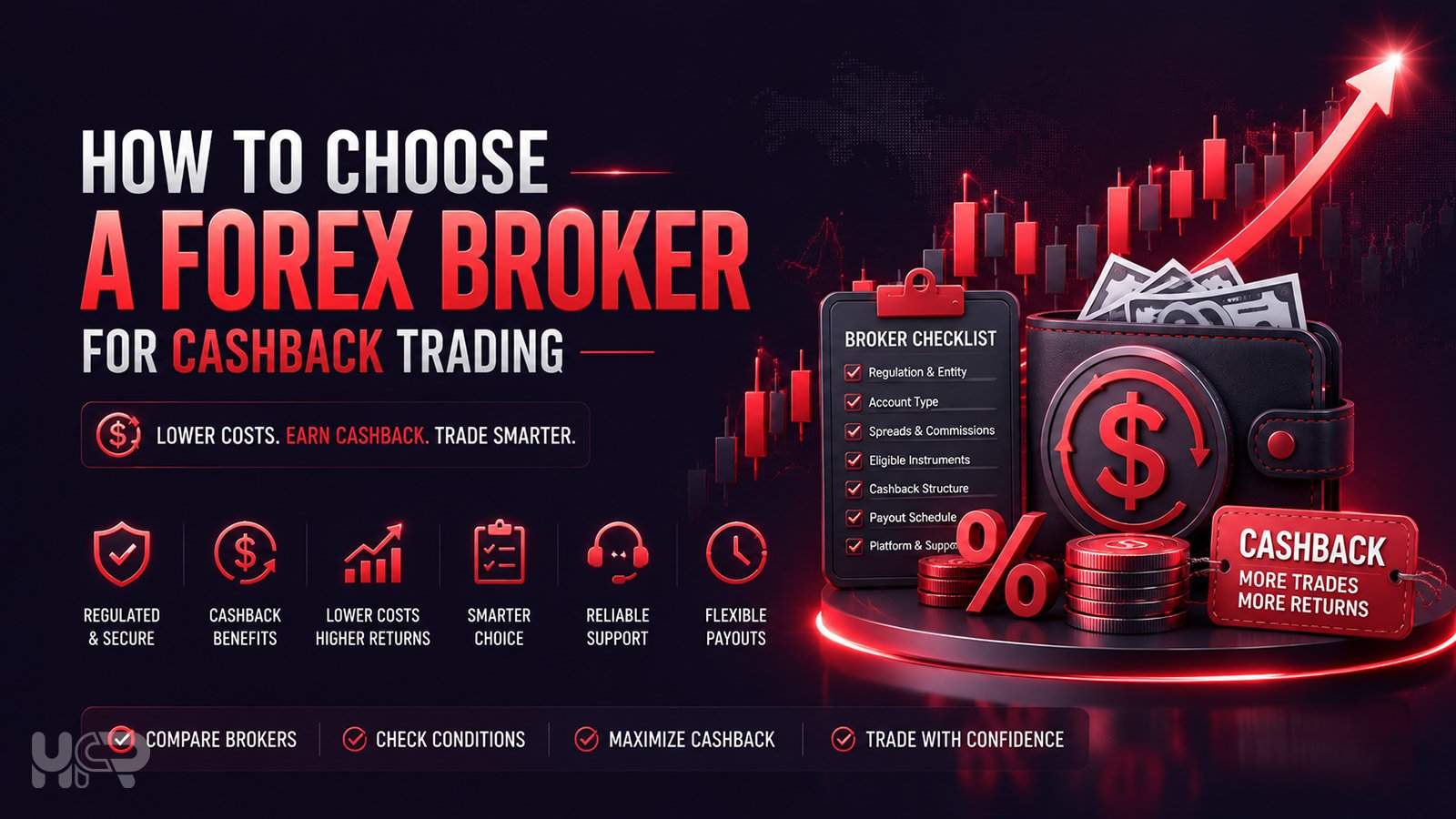
How to Choose a Forex Broker for Cashback Trading
Many traders compare forex brokers by looking at spreads, commissions, or account types, but they often miss one important cost-related question: how much of the trading cost may be returned through cashback or rebates. A high rebate rate can look attractive, but it does not always mean the broker is cheaper overall.
Forex cashback can help offset part of the eligible trading costs after trades are completed and confirmed by the broker. However, it does not change the spread shown on the platform, leverage, execution speed, or order pricing. The real value depends on the broker’s full cost structure, account type, eligible instruments, payout rules, and account linking process.
This guide explains how to choose a forex broker for cashback trading, what conditions traders should check before opening or linking an account, and how to avoid common mistakes when comparing rebate offers. Read on to see the main factors that matter before making a decision.
Why Forex Cashback Should Not Be the Only Broker Selection Factor
The highest cashback rate is not always the most cost-efficient option. A broker may offer a strong rebate, but that does not automatically mean the total trading cost is lower.
Traders should compare cashback together with spreads, commissions, swaps, funding costs, account rules, and broker reliability. For example, a broker with a higher rebate may still be more expensive if its spreads are wider, commissions are higher, or swap costs are less favorable for the trader’s strategy.
Cashback is only one part of the full trading cost. Broker quality also matters, including regulation, account rules, platform stability, funding methods, execution conditions, customer support, and payout schedule. A better approach is to treat cashback as a cost-offset after the main broker conditions are reviewed, not as the only reason to choose a broker.
Check the Forex Broker Regulation and Entity Before Comparing Cashback
Before comparing cashback rates, traders should first check which broker entity applies to their account. The same broker brand may offer different trading conditions under different regulators, countries, or regional websites.
Broker entity can affect regulation, client protections, leverage limits, available account types, funding methods, eligible instruments, and rebate eligibility. A cashback offer may look similar across a broker brand, but the actual account conditions can vary by entity.
Traders should confirm the broker entity before opening or linking an account. This helps avoid choosing a broker based only on a rebate rate without understanding the rules, protections, and trading conditions that apply to their region.
Compare Forex Account Types and Cashback Eligibility
Account type can have a major effect on cashback eligibility and total trading cost. Traders should not assume that every account under the same broker receives the same rebate rate.
A broker may offer several account types, such as Standard, Raw, ECN, Pro, Cent, Islamic, or bonus accounts. Each account type can have different spreads, commissions, trading conditions, and rebate rules.
For example, a Standard account may include trading costs inside the spread, while a Raw or ECN account may offer lower spreads with a separate commission. A Cent account may use smaller contract sizes, so cashback may be calculated proportionally. Islamic or swap-free accounts may remove swaps but include other fees or conditions.
Bonus accounts can also be different. Some brokers may allow cashback on promotional accounts, while others may restrict rebates when a bonus is active.
| Account Type | Cost Structure | Cashback Consideration |
|---|---|---|
| Standard | Spread included | Easier cost calculation |
| Raw / ECN | Low spread + commission | Compare spread + commission + rebate |
| Pro | Usually lower spread + commission | Check eligibility and trading volume rules |
| Cent | Smaller contract size | Cashback may be proportional |
| Islamic / Swap-free | Swap-free structure, conditions may apply | Check alternative fees and rebate eligibility |
| Bonus account | Promotional rules | Rebates may be restricted |
Before choosing an account, traders should check the broker’s rebate table and confirm whether that account type is eligible. Some accounts may receive the full listed cashback rate, while others may receive a reduced rate or no rebate at all.
The best account type is not always the one with the highest rebate. Traders should compare the full cost structure, including spread, commission, swaps, account rules, and cashback eligibility.
Compare Spreads, Commissions, and Cashback Together
When choosing a forex broker for cashback trading, traders should compare spreads, commissions, and cashback together. Looking at only one part of the cost can give an incomplete picture.
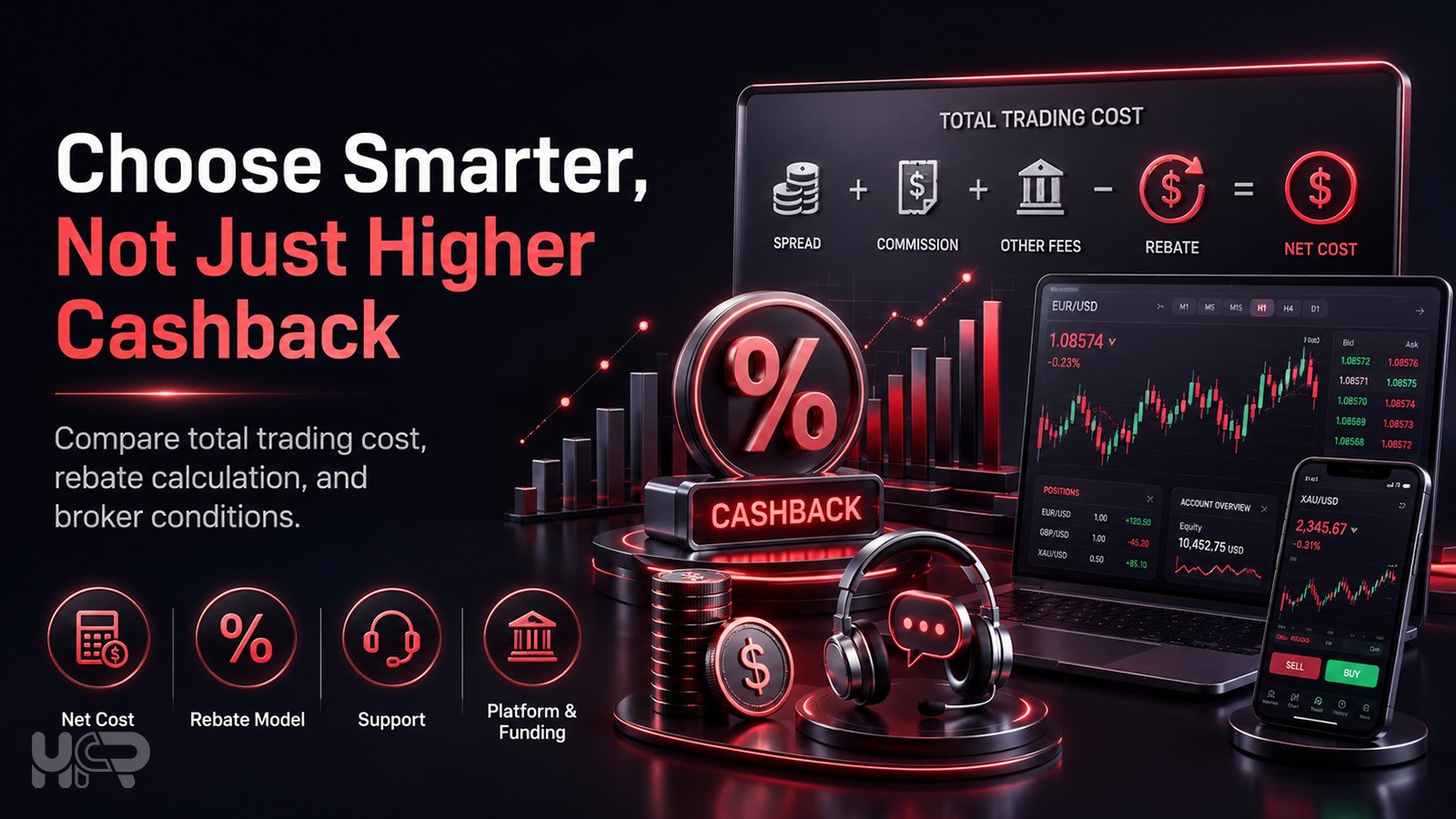
A broker with a lower spread may offer a lower rebate or no rebate at all. Another broker may offer higher cashback, but the spread or commission may also be higher. This is why the net trading cost matters more than the headline rebate rate.
A simple way to compare total cost is:
Total trading cost = spread + commission + swap + funding costs − cashback
This formula helps traders look beyond the rebate amount and compare the full cost structure. For example, if a broker offers a high rebate but also charges wider spreads, the final cost may not be lower. On the other hand, a broker with a smaller rebate may still be competitive if spreads and commissions are lower.
Traders should compare:
| Cost Factor | What to Check |
|---|---|
| Spread | Is the spread fixed, floating, low, or wider than competitors? |
| Commission | Is there a separate commission per lot or per side? |
| Swap | Are overnight costs relevant to your trading style? |
| Funding costs | Are there deposit, withdrawal, or currency conversion fees? |
| Cashback | How much rebate applies after eligible trades are confirmed? |
Minimum spreads should also be treated carefully. A spread shown as “from 0.0 pips” usually means the lowest possible spread under certain conditions, not the average spread on every trade.
To compare pricing models more clearly, traders should understand forex rebates vs low spreads before choosing a cashback broker.
Check How the Cashback Is Calculated
Before choosing a cashback broker, traders should understand how the rebate is calculated. Not all forex rebates use the same model, and the final amount can change depending on broker rules, account type, instrument, and trading volume.
Common cashback calculation models include:
| Rebate Model | How It Works |
|---|---|
| Fixed amount per lot | A set cashback amount is paid for each eligible lot traded |
| Pip-based rebate | Cashback is calculated using a pip-based value |
| Percentage of spread | The rebate is based on part of the spread paid |
| Percentage of commission | The rebate is based on part of the commission paid |
| Broker-approved custom model | The broker sets a specific rebate structure for eligible accounts or instruments |
Lot size is also important. If a rebate is shown as a per-lot rate, it usually refers to 1.00 standard lot. Smaller trade sizes normally receive proportional cashback.
For example:
| Trade Size | Usual Cashback Share |
|---|---|
| 1.00 lot | 100% of the full per-lot rebate |
| 0.10 lot | 10% of the full per-lot rebate |
| 0.01 lot | 1% of the full per-lot rebate |
This means a trader using 0.10 lot should not expect the same cashback as a trader using 1.00 lot. The rebate usually follows the eligible trading volume reported and confirmed by the broker.
Instrument category can also affect the calculation. Forex pairs, metals, indices, commodities, stocks, and crypto CFDs may not always have the same rebate rate. A cashback rate shown for one instrument category may not automatically apply to another.
Traders comparing per-lot rebate offers should understand the forex cashback per lot before estimating expected cashback.
Review Eligible Instruments Before Expecting Forex Cashback
A cashback rate shown for forex pairs may not automatically apply to metals, indices, commodities, stocks, or crypto CFDs. Instrument eligibility should be checked before trading because each broker can apply different rebate rules by asset category.
For example, a broker may offer one cashback rate for major forex pairs, a different rate for gold or silver, and another rate for indices or commodities. Some instruments may receive lower rebates, while others may not qualify for cashback at all.
This is especially important for traders who trade products such as Gold/XAUUSD. Gold often has different contract specifications, spreads, and rebate rules compared with major forex pairs like EUR/USD or GBP/USD. A trader should not assume that the same per-lot rebate applies to both.
Instrument eligibility can vary across:
| Instrument Category | Cashback Consideration |
|---|---|
| Forex pairs | Often the main rebate category, but rates may vary by broker |
| Metals | Gold and silver may have separate rebate rules |
| Indices | May use a different rebate model from forex |
| Commodities | Oil or energy products may have different rates |
| Stocks / Share CFDs | May be excluded or calculated differently |
| Crypto CFDs | Often depends on broker rules and regional availability |
Before choosing a broker for cashback trading, traders should review the broker-specific rebate table and confirm which instruments are eligible. This helps avoid confusion when one trade receives cashback, but another trade does not.
Check Account Linking and Registration Rules
Account linking is one of the most important steps when choosing a forex broker for cashback trading. Even if a broker supports rebates, cashback may not be tracked unless the trading account is opened or linked correctly.
Some brokers require traders to open a new account through the correct HighFxRebates link. If the account is opened directly on the broker’s website, through another partner, or through a different promotion, it may not automatically qualify for cashback through HighFxRebates.
Existing accounts can also have different rules. Some brokers may allow an existing account to be transferred under HighFxRebates, while others may require a new account. In some cases, IB transfer may not be available at all, depending on the broker’s internal policy.
Before opening or linking an account, traders should check:
| Linking Item | What to Confirm |
|---|---|
| Registration link | Does the broker require opening through the HighFxRebates link? |
| Existing account | Can an existing account be transferred under HFR? |
| IB transfer | Does the broker allow partner or IB transfer? |
| Account approval | Has the broker confirmed the account under HighFxRebates? |
| Rebate tracking | Will eligible trading volume be reported under HFR? |
Cashback can usually be tracked only after the broker confirms that the account is correctly linked under HighFxRebates. If the account is not confirmed, eligible trades may not be reported for rebate calculation.
Before opening or linking an account, traders should review common forex rebate mistakes to avoid tracking or eligibility problems.
Understand Forex Rebate Payout Schedules and Payment Rules
Rebate payout schedules can vary by broker. Some brokers may report and pay rebates daily, while others use weekly or monthly payout cycles. A trade may already be eligible, but cashback may not appear until the broker sends the confirmed trading report.
Traders should check the broker’s rebate page for payout schedule, payout destination, currency rules, minimum payout conditions, and processing requirements. This helps avoid confusion if a rebate is approved but not paid immediately.
Check Trading Platforms, Funding Methods, and Broker Support
A broker may have strong cashback rates, but traders should still check whether the platform, funding methods, and support options match their needs. Cashback is useful only if the overall broker setup works for the trader’s strategy and account requirements.
Platform choice is important. Some traders prefer MetaTrader 4 or MetaTrader 5, while others may want cTrader, TradingView, or a broker’s own web or mobile platform. Traders should confirm that the broker supports the platform they plan to use before opening or linking an account.
Funding methods should also be reviewed. Deposit and withdrawal options can vary by broker, country, payment provider, and account currency. Traders should check whether the broker supports suitable deposit methods, withdrawal rules, currency options, and processing times.
Support quality also matters. If there is an issue with account linking, rebate eligibility, payout timing, or broker confirmation, responsive support can help resolve the problem faster. Cashback is useful only when the broker’s platform, funding methods, support, and total trading cost also match the trader’s needs.
Compare Brokers Using a Simple Checklist
Before choosing a forex broker for cashback trading, traders should compare the full broker setup, not only the rebate rate. A practical checklist can help identify whether the broker, account type, instruments, and payout rules match the trader’s needs.
| Checklist Item | What to Check |
|---|---|
| Broker support | Is the broker supported by HighFxRebates? |
| Regulation and entity | Is the broker regulated under a suitable entity for your region? |
| Account type | Is the selected account type eligible for rebates? |
| Instrument eligibility | Are the instruments you trade included in the rebate table? |
| Spread and commission | What is the total cost before cashback? |
| Cashback calculation | Is the rebate fixed per lot, pip-based, or based on spread or commission? |
| Payout schedule | Are rebates paid daily, weekly, or monthly? |
| Existing account linking | Can an existing broker account be linked or transferred? |
| Bonus conditions | Does using a broker bonus affect rebate eligibility? |
| Trading platform | Does the broker support your preferred platform, such as MT4, MT5, cTrader, or TradingView? |
| Funding methods | Are the deposit and withdrawal methods suitable for your country and account currency? |
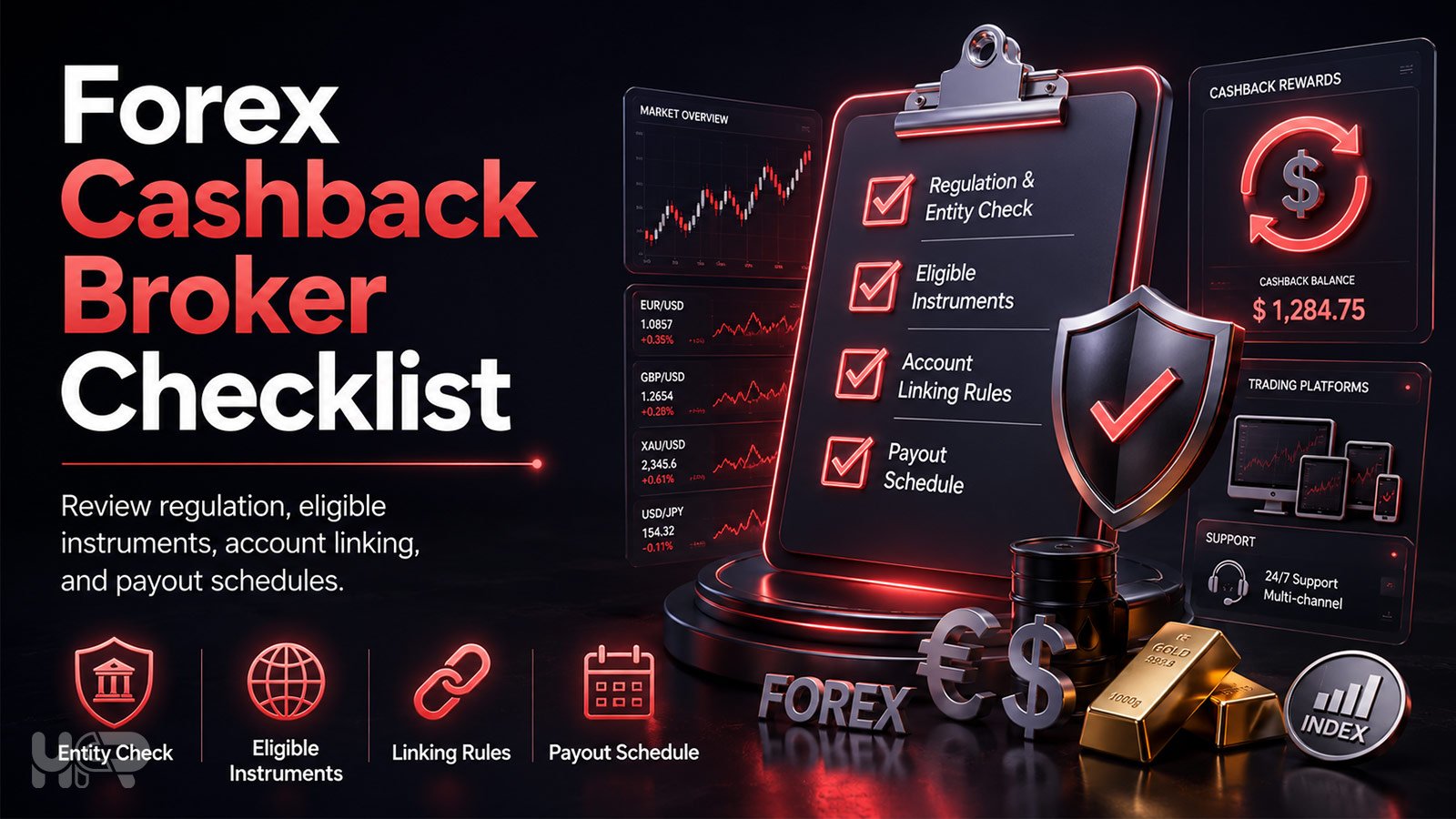
This checklist helps traders avoid choosing a broker based only on headline cashback. A broker may offer an attractive rebate rate, but the final value depends on account eligibility, spread and commission structure, instrument rules, payout timing, and correct account linking.
Traders can also use our forex broker cashback comparison to review supported brokers and compare rebate structures more easily.
After reviewing these factors, traders can use the forex rebates list on HighFxRebates to compare supported brokers, cashback rates, account types, payout schedules, and rebate conditions before opening or linking an account.
Conclusion
Choosing a forex broker for cashback trading should involve more than comparing the highest rebate rate. A better approach is to review the full broker structure, including regulation, broker entity, account type, spreads, commissions, eligible instruments, payout schedule, and account confirmation rules.
Forex cashback can help offset part of eligible trading costs after trades are completed and confirmed by the broker. However, it does not change spreads, execution speed, leverage, order pricing, or trading conditions. This means traders should still compare the real cost of trading before opening or linking an account.
Before choosing a cashback broker, traders should review the broker’s rebate page and confirm that their account type, region, trading instruments, and registration method match the rebate conditions. This can help reduce confusion around missing rebates, delayed payouts, or lower-than-expected cashback.
Before making a final decision, traders should compare the broker’s full cost structure with its rebate conditions so they can choose a setup that matches their trading needs more clearly.
FAQ
Should I choose a forex broker only because of cashback?
No. Cashback is only one part of the full cost structure. Traders should also compare regulation, broker entity, account type, spreads, commissions, swaps, instruments, platforms, funding methods, and payout conditions before choosing a broker.
Does higher cashback always mean lower trading costs?
No. A higher rebate rate may still come with wider spreads, higher commissions, higher swap costs, or stricter account rules. Total trading cost is more important than the headline cashback rate.
Can every broker account receive rebates?
No. Rebate eligibility depends on broker rules, account type, region, instrument category, and whether the account is correctly opened or linked under the rebate provider. Some account types or instruments may not qualify.
Do forex rebates affect execution or spreads?
No. Forex rebates do not change spreads, execution speed, leverage, or order pricing. They are calculated separately after eligible trades are completed and confirmed by the broker.
What should I check before opening a cashback broker account?
Before opening an account, check the broker’s regulation, account type, rebate rate, instrument eligibility, payout schedule, platform availability, funding methods, and whether you need to register through a specific rebate link.
Can bonuses affect cashback eligibility?
Yes, in some cases. Some bonus or promotional accounts may have different rebate rules or restrictions. Traders should check the broker’s terms or contact support before activating a bonus.
 6
6
Share Posts


Further Reading
- Why Forex Spreads Widen: News, Rollover, Liquidity and Volatility
- What is Proof of Reserves on a crypto exchange? What it shows and what it does not
- ActivTrades Review 2026: Accounts, Fees, Platforms, Regulation and Cashback
- Weekly market recap, 12–18 October 2026: Inflation, yields, gold and crypto