




Table of Contents
[ Show/Hide ]- • When Do Forex Swap Fees Apply?
- • Why Do Long and Short Swap Rates Differ?
- • Can a Forex Swap Be Positive or Negative?
- • How Are Forex Swap Fees Calculated?
- • Forex Swap Calculation Example
- • Why Is Forex Swap Tripled on Wednesday?
- • Do All Instruments Use Wednesday as the Triple-Swap Day?
- • Can You Avoid Swap by Closing Before Rollover?
- • Do Swap-Free Accounts Have Other Charges?
- • Does Forex Cashback Cover Swap Charges?
- • How Swap Changes the Total Cost of a Trade
- • How to Compare Broker Swap Rates
- • Final Words
- • FAQ
- • Sources and Methodology
- • Risk Warning and Disclaimer
A forex trade may appear inexpensive during the day but become more costly after the broker’s rollover time. When a leveraged position remains open through the overnight cut-off, the trading account may receive a swap charge or, in some cases, a swap credit. A larger adjustment may also appear on the broker’s scheduled triple-swap day.
Forex swap fees are overnight financing adjustments applied to eligible positions that remain open through rollover. The amount can depend on the instrument, long or short direction, position size, broker pricing and the number of financing days being applied. Swap-free accounts may replace standard swaps with administration or holding charges.
This guide explains how forex swaps work, how brokers calculate overnight financing, why triple swaps occur and whether forex cashback offsets these costs. It also explains how to compare broker swap rates as part of the total cost of holding a position.
Data checked: 3 August 2026. Swap rates, rollover times, triple-swap schedules and swap-free conditions can change. Check the broker’s current symbol or contract specification before opening or holding a position through rollover.

When Do Forex Swap Fees Apply?
Forex swap fees normally apply when an eligible forex or CFD position remains open through the broker’s rollover cut-off. The adjustment may be a charge or credit and is based on broker server time rather than the trader’s local midnight. The applicable time and rate are shown in the broker’s contract specification.
Swap is also known as rollover, overnight financing or overnight interest. It commonly applies to leveraged forex, CFD and rolling-spot positions, although the exact treatment depends on the broker, instrument and account type.
Long and short positions normally have separate swap rates. Either direction may receive a negative charge or, in some cases, a positive credit. Brokers can update these rates regularly, sometimes daily, as financing conditions and internal pricing change.
Swap is separate from the spread and commission. Brokers may also use different calculation methods, so the published contract specification is the main reference for the applicable rate and timing.
Why Do Long and Short Swap Rates Differ?
The swap amount can differ between long and short positions because financing conditions, broker adjustments and instrument-specific rules are not identical.
In a currency pair, one currency is bought while the other is sold. The difference between the financing conditions of those two currencies can influence the overnight adjustment. However, central-bank interest rates alone do not determine the exact retail swap charged or credited by a broker.
The final amount may also depend on:
- Whether the position is long or short
- Current market financing conditions
- The broker’s financing adjustment or markup
- Position size and contract size
- The number of rollover days applied
- The trading account type
- The instrument category
- The account currency and any required currency conversion
Two brokers can publish different swap rates for the same currency pair and direction because their pricing methods and financing adjustments can differ.
For practical cost calculations, the broker’s current contract specification, platform value or swap calculator should be treated as the main reference. Historical rates or general interest-rate comparisons may not reflect the amount applied to an open position.
Can a Forex Swap Be Positive or Negative?
A negative swap reduces the trading account balance, while a positive swap adds a financing credit, subject to the broker’s current contract specifications.
Long and short positions usually have separate swap rates. A long position may receive a negative rate while the short position receives a positive rate, or the opposite may apply. In some cases, both directions carry a negative swap.
Positive swap is not available for every instrument, account type or broker entity. Rates can also change while a position remains open because brokers may revise their pricing in response to market financing conditions, liquidity costs or internal financing adjustments.
A swap rate that was positive in the past does not guarantee that the same position will continue to receive a credit. Traders should check the current long and short rates in the platform or contract specification before holding a position through rollover.
Positive swap should not be treated as guaranteed income. The rate can change, and market losses, spread, slippage, commission and other trading costs can exceed any financing credit.
How Are Forex Swap Fees Calculated?
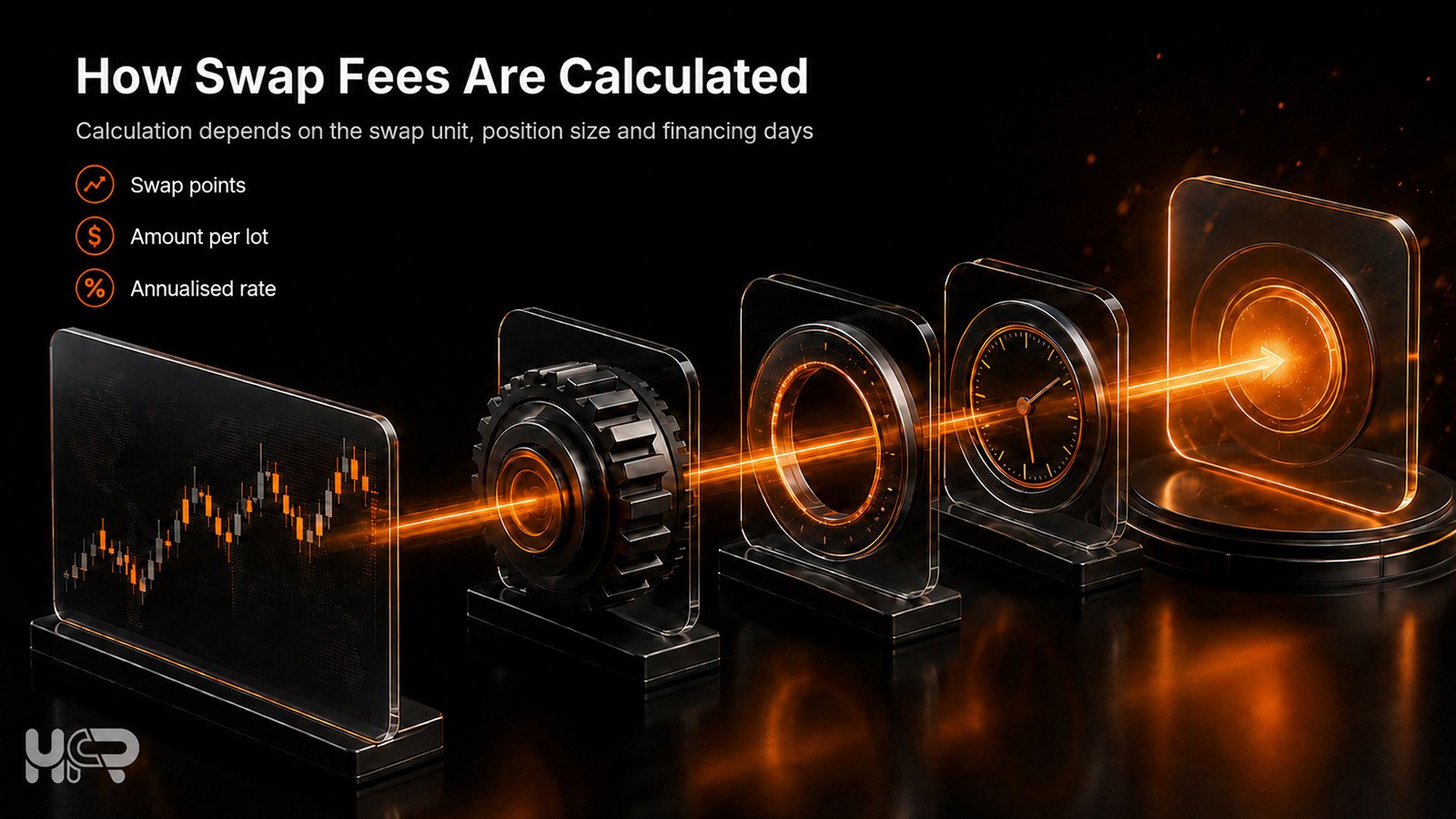
Forex swap may be calculated using points, pips, a fixed currency amount or an annualised percentage. The method depends on the broker, instrument and account type and should be stated in the symbol specification or broker documentation.
MetaTrader’s official symbol specification shows that brokers can set separate long and short values, use different calculation methods and apply day-specific multipliers. The exact formula still depends on the symbol settings, contract size, swap unit and conversion currency.
- Swap points
Many brokers publish separate daily swap values for long and short positions in points. A simplified formula is:
Estimated swap = lots × contract size × point size × swap points × financing days
The point value, position size, and applicable long or short rate determine the estimated adjustment. Currency conversion may be required when the result is not already expressed in the trading account’s currency.
Some platforms display swap in pips rather than points. Confirm the unit and whether positive and negative values represent credits or charges before calculating.
- Fixed currency amount per lot
Some brokers publish swap as a fixed amount per lot:
Estimated swap = lots × published amount per lot × financing days
A negative amount normally represents a debit, while a positive amount may be credited. Conversion may still be required if the published amount and the account use different currencies.
- Annualised financing percentage
Certain share, index, commodity and cash-market CFDs may use an annual financing rate:
Estimated financing = position value × annual financing rate × financing days ÷ day-count basis
The broker may use a 360-day, 365-day or another stated convention. The rate may include a benchmark plus a broker adjustment.
These formulas are educational estimates. The final debit or credit can also depend on price, rounding, account currency, conversion rules and the applicable triple-swap schedule. Use the broker’s current symbol specification, calculator or live platform value for the final amount.
Forex Swap Calculation Example
The following fictional example shows how position size can affect an overnight financing adjustment when the broker calculates swap proportionally by lot size.
Assume a broker publishes a long swap rate of −$4 per standard lot per night for a particular instrument.
| Position size | Daily swap | Three-day adjustment |
|---|---|---|
| 0.10 lot | −$0.40 | −$1.20 |
| 0.50 lot | −$2.00 | −$6.00 |
| 1.00 lot | −$4.00 | −$12.00 |
A larger eligible position produces a larger financing adjustment because the published amount is applied in proportion to the number of lots. In this example, a one-lot position receives ten times the adjustment of a 0.10-lot position.
The three-day column shows how the amount could change when three financing days are applied at one rollover. It does not mean that every instrument or broker uses the same triple-swap schedule.
This example is fictional and does not represent a current broker rate. Real swap rates can change, and account-currency conversion may affect the final debit or credit. The calculation also excludes spread, commission, slippage and any market profit or loss.
Why Is Forex Swap Tripled on Wednesday?
A triple swap applies several days of overnight financing in a single rollover adjustment. It is used to account for days when normal market settlement does not take place, such as weekends.

For spot forex, Wednesday is commonly the triple-swap day because of the standard settlement cycle. A position held through the relevant Wednesday rollover may receive financing for three days rather than one, covering the normal overnight period together with the weekend settlement days. Pepperstone’s official swap guide provides one broker example of this common treatment.
Public holidays can alter settlement dates and may change the number or timing of financing days applied. Brokers may also adjust their schedules according to the instrument, liquidity conditions or operational requirements.
Wednesday is common for spot forex, but it is not a universal triple-swap day for every instrument or broker. Traders should check the live symbol specification or broker contract details to confirm the applicable rollover schedule.
Do All Instruments Use Wednesday as the Triple-Swap Day?
No. Wednesday is common for spot forex, but other CFDs may use different financing schedules.
Gold, silver, indices, energy products, shares, ETFs and cryptocurrency CFDs can have different rollover days, calculation methods and multi-day adjustments. Even instruments within the same category may not follow the same schedule.
Cash and spot CFDs commonly receive daily financing when held through rollover. Futures-based CFDs may be treated differently because financing can already be reflected in the contract price. Costs may instead appear through contract rollover adjustments, wider pricing or differences between an expiring contract and its replacement.
Public holidays and contract expiries can also change the number or timing of financing days. Check the individual symbol specification to confirm whether overnight financing applies, which day carries the multi-day adjustment and how the charge or credit is calculated.
Can You Avoid Swap by Closing Before Rollover?
A position will normally avoid that rollover adjustment when it is fully closed before the broker’s applicable cut-off, subject to the instrument and account rules.
The relevant time is usually based on the broker’s platform or server clock rather than the trader’s local time. Daylight-saving changes can also alter the local equivalent of the rollover cut-off during the year.

A position opened shortly before rollover may still receive the full applicable financing adjustment if it remains open through the cut-off. If only part of the position is closed, the remaining volume may still receive a proportional swap charge or credit.
Spreads can widen, and liquidity can become thinner around the rollover period. Closing and reopening a position may therefore create additional spread, slippage or execution costs.
Avoiding one swap charge does not automatically reduce the total cost if wider spreads, slippage or a worse re-entry price are created around rollover. The decision to close a position should not be treated as a guaranteed cost-saving method.
Do Swap-Free Accounts Have Other Charges?
A swap-free account removes or changes the standard overnight swap treatment, but it may still use administration, holding or product-specific charges.
Availability can depend on the client’s country, legal entity, account type and eligibility. Some brokers require a separate application or approval before activating swap-free status.
Conditions may include:
- A grace period before alternative charges begin
- Administration or holding fees after a set number of days
- Different treatment or exclusions for particular instruments
- Maximum holding periods
- Alternative spread or commission
For example, a position may remain free from standard swap for several nights and then become subject to an administration fee, or the treatment may apply only to selected instruments.
The broker may review, change or remove swap-free status where its terms allow, including where the account no longer meets eligibility requirements or the feature is used outside its intended conditions.
“Swap-free” does not always mean that an overnight position has no cost. Review any administration fee, grace period and eligible-instrument rules before using the account.
Where a broker describes an account as Islamic or Sharia-compliant, that description should be treated as the broker’s own classification. Traders should review the applicable terms and seek independent guidance where religious compliance is important to them.
For example, Pepperstone’s current swap-free account page states that an administration charge applies after a position has been held for five days. This is one provider-specific example; eligibility, grace periods, fees and supported countries differ between brokers and legal entities.
Does Forex Cashback Cover Swap Charges?
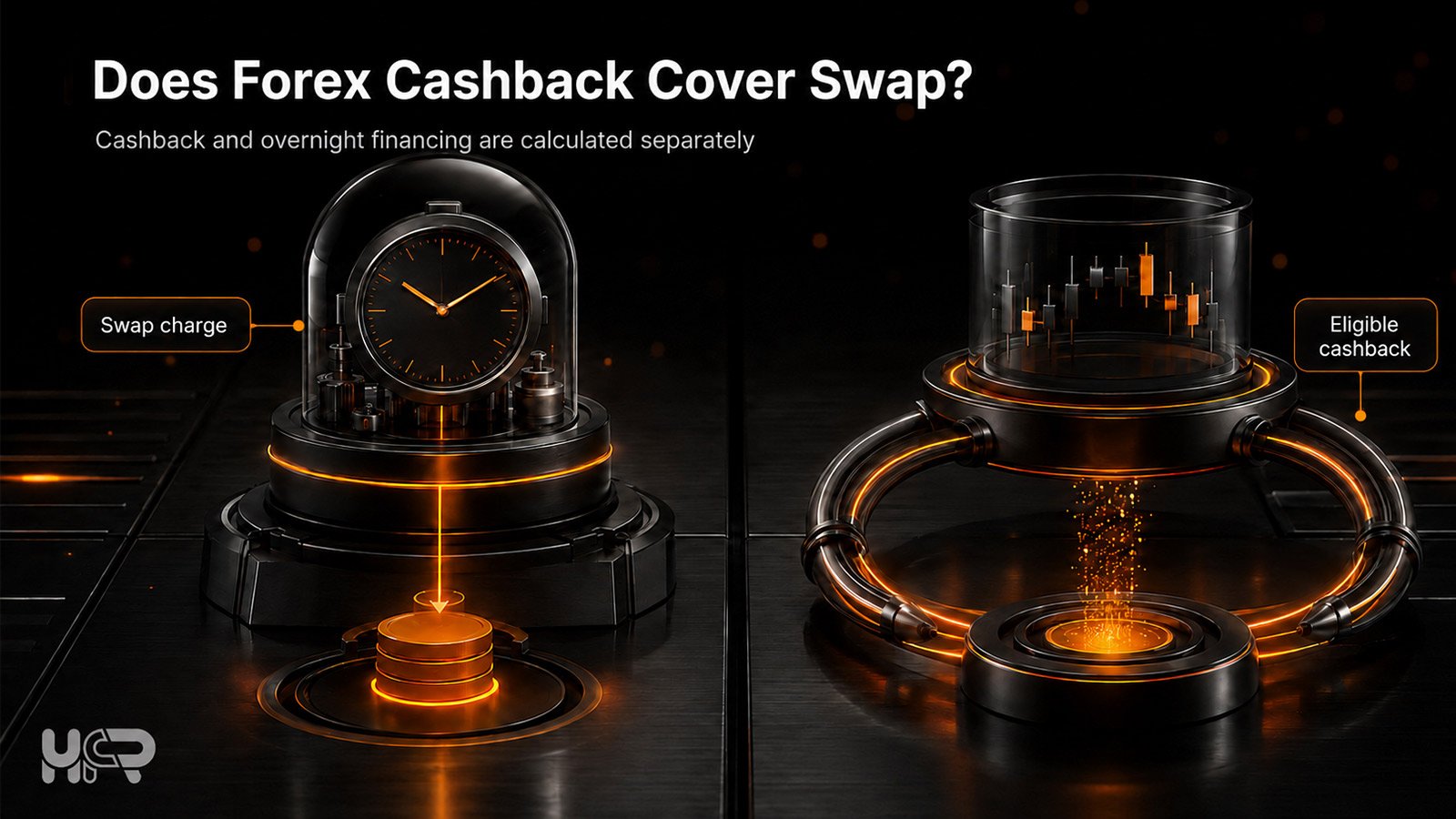
Forex cashback is generally calculated from eligible spread, commission, trading volume or broker-reported revenue, according to the conditions shown on the relevant HFR broker page. Swap charges should not be treated as rebate-eligible unless the published terms specifically include them.
Readers who are new to cashback can first review how forex rebates work and why eligibility and broker confirmation matter.
Spread and commission are transaction costs normally connected with opening or closing a position. Swap is a separate financing adjustment that can apply when an eligible position remains open through rollover.
Cashback may also be calculated and paid later than the broker’s trading charges. Depending on the arrangement, it may be credited to an HFR balance, trading account or another stated destination. This payment does not reverse or remove a negative swap already applied by the broker.
Cashback and swap are separate calculations. A trade can qualify for cashback and still receive an overnight financing charge.
A positive swap does not normally increase the cashback amount unless the broker’s rebate calculation explicitly includes overnight financing. Similarly, administration or holding fees charged on swap-free accounts should not be assumed to qualify for rebates.
Before estimating cashback, review how to read a forex rebate page and confirm the eligible account types, instruments, calculation basis and payout conditions.
How Swap Changes the Total Cost of a Trade
The advertised spread does not show the full cost of every position. When a trade remains open through rollover, swap charges or credits can change its total cost, particularly when the position is held for several nights.
| Cost component | Intraday trade closed before rollover | Position held through rollover |
|---|---|---|
| Spread | Applies | Applies |
| Commission | May apply | May apply |
| Swap | Normally does not apply for that rollover | A charge or credit may apply |
| Triple swap | Does not apply after the position is closed | May apply on the scheduled rollover day |
| Cashback | Depends on broker and HFR eligibility | Depends on broker and HFR eligibility |
| Market risk | Remains while the position is open | Continues while the position is held overnight |
A broker with a low spread may still produce a higher total cost for a longer-held position if its overnight financing charges are higher. The effect becomes more noticeable when the position remains open for several rollover periods or passes through a triple-swap day.
A higher cashback rate also does not automatically make an overnight position less expensive. The rebate may offset part of an eligible spread or commission, while the broker applies swap separately.
Compare spread, commission, swap and eligible cashback over the expected holding period rather than comparing only one daily cost. Market movement, slippage and currency-conversion charges may also affect the final result.
For a broader cost review, compare total forex trading costs including spreads, commissions, overnight financing, currency conversion and eligible cashback.
How to Compare Broker Swap Rates
A fair comparison uses the same instrument, trade direction, position size, account type and holding period across brokers. Comparing rates under different conditions can produce a misleading result.
Check:
- The exact symbol and long or short direction
- Position size, contract size and account type
- The swap unit and calculation method
- Account currency and any required conversion
- Broker server time and the number of nights held
- Triple-swap day and public-holiday adjustments
- Swap-free grace periods, holding limits and administration charges
- Spread, commission and other trading costs
- Eligible cashback and payout conditions
The swap unit is particularly important. One broker may publish points, while another uses a fixed amount per lot or an annualised percentage. Convert the figures to the same position size and currency where possible.
Do not compare a long position with a short position, or a standard account with a swap-free account, without including the different pricing and administration conditions.
Compare the complete expected cost over the intended holding period rather than looking only at one daily swap rate. Where cashback is based on trading volume, the HFR guide to forex cashback per lot explains how position size can affect the eligible rebate.
Final Words
Forex swap fees can change the total cost of positions held through rollover. The adjustment depends on the instrument, direction, position size, broker calculation method and number of financing days applied. Wednesday is a common triple-swap day for spot forex, but the applicable schedule must be checked for each instrument.
Swap-free accounts may use administration fees, grace periods or holding restrictions instead of standard swap. Forex cashback may offset part of an eligible spread or commission, but it normally does not reverse overnight financing charges.
Compare the broker’s current spread, commission, swap and eligible cashback over the expected holding period. These conditions can change, and cashback does not remove market, leverage, execution or loss risk.
FAQ
What is a forex swap fee?
A forex swap fee is an overnight financing adjustment applied when an eligible position remains open through the broker’s rollover time. It may appear as a debit or, in some cases, a credit. Swap is separate from the spread and trading commission.
Can a forex swap be positive?
Yes. A positive swap adds a financing credit to the account, while a negative swap creates a charge. However, a positive swap is not available for every instrument, direction or account, and the broker may change the rate.
How are forex swap fees calculated?
Brokers may calculate swap using points, pips, a fixed amount per lot or an annualised financing percentage. The final amount can depend on the instrument, long or short direction, position size, contract size, account currency and number of financing days. Check the broker’s current symbol specification or platform value for the applicable calculation.
Why is triple swap often applied on Wednesday?
Wednesday is a common triple-swap day for spot forex because of the usual settlement cycle and the need to account for weekend financing days. A position held through the relevant rollover may therefore receive three days of financing in one adjustment. Public holidays and broker-specific schedules can change this treatment.
Does every instrument have triple swap on Wednesday?
No. Metals, indices, energy products, shares, ETFs, futures-based CFDs and cryptocurrency CFDs may use different financing schedules. Some products may not receive daily swap in the same way as spot forex. Check the individual symbol specification rather than applying one rule to every market.
Can I avoid swap by closing before rollover?
A position fully closed before the applicable rollover cut-off would normally avoid that rollover adjustment, subject to the broker’s product rules. However, spreads may widen, and liquidity may change around rollover. Closing and reopening a position does not guarantee a lower total cost because spread, slippage, or re-entry price differences may apply.
What is a swap-free forex account, and can it have administration fees?
A swap-free account removes or changes the standard overnight swap treatment. Brokers may offer these accounts to eligible clients, sometimes under conditions described as Islamic account terms. Administration fees, grace periods, holding limits, instrument exclusions or alternative pricing may still apply, so swap-free does not always mean cost-free.
Does forex cashback cover swap charges?
Forex cashback is normally calculated from eligible spread, commission, trading volume or broker-reported revenue under the published rebate conditions. Swap is a separate overnight financing adjustment and should not be treated as rebate-eligible unless the terms specifically state otherwise. A trade can qualify for cashback and still receive a swap charge.
Sources and Methodology
This article is a desk-based educational review of common forex and CFD overnight-financing mechanisms. HFR checked official platform documentation, official broker explanations and current HFR educational pages on 3 August 2026. It does not claim live execution, account or withdrawal testing. Broker calculations, rollover times, product schedules and swap-free terms remain provider-specific and can change.
- MetaTrader 5 – Market Watch and symbol specifications
- Pepperstone – What are swaps and how to calculate them
- IG – Overnight funding and product treatment
- Pepperstone – Swap-free account conditions
- HighFxRebates – How to read a forex rebate page
- HighFxRebates – How forex cashback is calculated per lot
- HighFxRebates – How to reduce forex trading fees
- HighFxRebates – What are forex rebates?
Risk Warning and Disclaimer
Swap rates, rollover rules and overnight financing costs can change. Cashback may help offset part of eligible trading costs, but it does not remove swap charges, market risk, leverage risk, execution risk, spread risk, slippage risk, broker risk or the risk of loss.
This article is provided for educational and informational purposes only. It should not be treated as financial, investment, or trading advice, or as a recommendation to open an account with any broker or to hold a position overnight.
 6
6


