




Table of Contents
[ Show/Hide ]- • Forex Rebates Explained in Simple Terms
- • The Rebate Process: From Account Linking to Payout
- • Forex Rebate Calculation Models
- • How Rebates Relate to Spreads and Execution
- • Why Some Trades Do Not Qualify for Rebates
- • Forex Rebates vs Trading Bonuses
- • How to Compare Forex Rebate Programs
- • How to Use Forex Rebates Without Increasing Risk
- • How HighFxRebates Helps Traders Compare Rebates
- • Common Forex Rebate Mistakes to Avoid
- • Risk and Compliance Note
- • Conclusion
- • FAQ

Trading a forex or CFD position can involve the spread, commission, overnight financing, and other broker charges. When trading frequently, these costs can become a meaningful part of the total result.
Quick answer: Forex rebates, also called forex cashback, return part of the eligible trading costs after broker-confirmed trading activity. They can be calculated per lot, in pips per lot, as a percentage of spread or commission, or as a share of broker revenue. Rebates do not change the trade result and should not be treated as profit, income, or risk protection.
Data checked: 8 August 2026. According to the final BIS 2025 Triennial Survey data, average daily turnover in the global OTC foreign exchange market was approximately $9.5 trillion in April 2025, compared with $7.5 trillion in 2022.
This guide explains what forex rebates are, how they work, how rebate calculations differ, what conditions can affect eligibility, and how HighFxRebates helps users compare supported brokers. Cashback may help offset part of the eligible trading costs after confirmation, but it does not reduce market risk, leverage risk, execution risk, spread risk, slippage risk, swap cost, broker risk, or the risk of loss.
Forex Rebates Explained in Simple Terms
Forex rebates are cashback payments linked to eligible trading activity. When a trader opens or links an account through a rebate provider, the broker may share part of the spread, commission, or broker revenue with that provider. The rebate provider then returns an agreed portion to the eligible trader.
The rebate is calculated separately from the trade result. A winning trade and a losing trade can both generate a rebate if the account, product, trade, and broker rules qualify. At the same time, rebates are not automatic on every trade. Eligibility depends on the broker and the specific rebate conditions.
Users who want to compare current broker offers can start with the forex rebates list before opening or linking an account.

The Rebate Process: From Account Linking to Payout
The rebate process is usually simple, but the order of steps matters. If the account is opened or linked incorrectly, the broker may not track the activity under the correct partner code.
- Create or log in to a HighFxRebates account.
- Open a new broker account through the correct HighFxRebates link, or request an existing-account transfer if the broker allows it.
- Add the trading account number to the HFR dashboard for review.
- Wait for the broker to confirm whether the account is correctly linked and eligible.
- Continue trading under the broker’s normal trading conditions.
- Receive cashback according to the broker’s payout schedule after eligible activity is reported and confirmed.
Payment timing can differ by broker. Some rebate programs pay daily and directly to the trading account, while others pay weekly or monthly to the HighFxRebates account. The broker page should always be used as the latest reference for the payment schedule and destination.
For more detail on broker reporting, payout destinations and payment schedules, see how forex rebate payments work.
Forex Rebate Calculation Models
Forex rebates can be calculated in different ways. The calculation depends on the broker, account type, instrument, lot size, and rebate model. The most common models are fixed cashback per lot, pips per lot, percentage of spread, percentage of commission, and percentage of broker revenue.
| Rebate model | How it works | Simple example |
|---|---|---|
| Fixed amount per lot | A fixed amount is paid for each eligible round-turn lot. | $10per lot on 0.50 lot = estimated $5. |
| Pips per lot | The rebate is shown as a pip value per eligible round-turn lot. | 0.68 pip per lot depends on pip value and lot size. |
| Percentage of spread | Cashback is based on part of the spread paid. | 27% of the spread means the final amount depends on the spread charged. |
| Percentage of commission | Cashback is based on part of the trading commission paid. | 50% of the commission depends on the commission charged. |
| Broker revenue share | Cashback is based on a share of broker revenue from eligible activity. | 50% revenue share varies by broker calculation |
A round-turn lot refers to eligible trading volume that has been both opened and closed. Under a per-lot model, smaller trade sizes normally receive a proportional rebate where the broker’s terms allow it.
For more examples, users can read how forex cashback is calculated per lot before estimating monthly cashback.
How Rebates Relate to Spreads and Execution
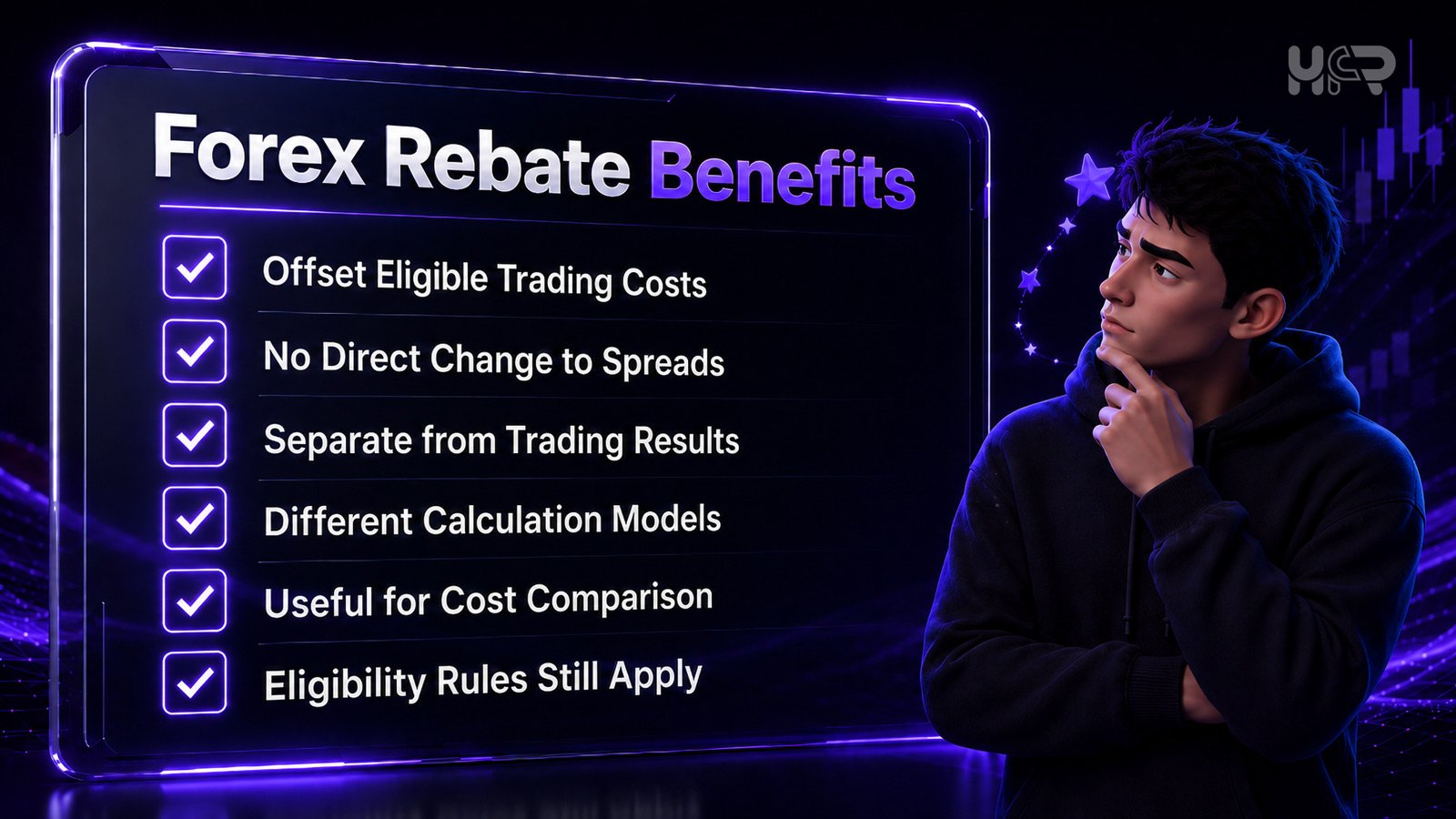
In normal rebate structures, forex rebates are calculated separately from the broker’s trading conditions. They should not directly change the spread, commission, leverage, swap rate, execution model, or trading platform conditions.
Positions held through rollover may also receive an overnight financing adjustment. The HFR guide to forex swap fees explains how swap charges, credits and triple-swap schedules work.
This is why cashback should be viewed as a post-trade cost offset, not as a different trading environment. The trader still needs to compare the broker’s actual spread, commission, swap cost, slippage risk, execution quality, and account rules.
If a broker or account type has special conditions, those conditions should be reviewed before registration. A high rebate does not automatically make an account cheaper overall. The spread, commission, swap, execution conditions, and rebate should be compared together.
Why Some Trades Do Not Qualify for Rebates
A common mistake is assuming that every trade on a supported broker will qualify. In practice, the broker must confirm the account and the trade activity before cashback can be calculated.
- The account must be opened or linked through the correct HFR process.
- Existing account transfers may require broker approval.
- The traded account type must be eligible for rebates.
- The instrument category must be included in the rebate table.
- Some brokers apply minimum trade-duration or price-movement rules.
- Bonuses, vouchers, or promotions can affect eligibility in some cases.
- The broker must report and confirm the activity before payout.
- Minimum payout rules or payment schedules can delay payment.
If cashback is missing, delayed, or lower than expected, the guide to common forex rebate mistakes explains the main points to check before contacting support.
Before opening or linking an account, the guide on how to read a forex rebate page explains how to check the eligible account type, instrument, rebate basis, payout destination, and broker-specific conditions.
Forex Rebates vs Trading Bonuses
Forex rebates and trading bonuses are not the same. A rebate is usually linked to eligible confirmed trading activity and can be calculated from spread, commission, lot size, or broker revenue. A bonus is usually a broker promotion with separate conditions, such as deposit rules, trading-volume requirements, withdrawal restrictions, or campaign limits.
This difference matters because a bonus can sometimes change how trading costs or eligible activity are treated. A bonus-funded trade, voucher, or promotion may not always work together with a rebate program.
Before using both at the same time, users should compare forex rebates vs trading bonuses and check the broker-specific conditions.
How to Compare Forex Rebate Programs
If you only compare the highest rebate number, you may miss the real trading cost. A broker with a smaller rebate may still be more cost-efficient if the spreads, commissions, swaps, and execution conditions are better for the trader’s account and instrument.
| What to compare | Why it matters |
|---|---|
| Rebate rate | Shows possible cashback, but only for eligible activity. |
| Account type | Standard, Raw, ECN, Cent, and Pro accounts may have different costs and rebate rates. |
| Instrument coverage | Forex, metals, indices, oil, shares, and crypto CFDs can have different rebate rules. |
| Payment schedule | Daily, weekly, monthly, direct, and to-HFR payments create different payout experiences. |
| Total trading cost | Spread, commission, swaps, slippage, and rebate should be reviewed together. |
| Regulation and entity | Client protection, leverage, and product access can vary by jurisdiction. |
| Eligibility rules | Incorrect linking, unsupported products, or excluded trades can prevent payout. |
For a broader cost view, traders can also read how to reduce forex trading fees by comparing spreads, commissions, swaps, and eligible cashback together.
Users comparing brokers side by side can also use the forex broker comparison page to review broker conditions, platforms, account types, and rebate options.
How to Use Forex Rebates Without Increasing Risk
Forex rebates should not be a reason to trade more, increase lot size, or use higher leverage. More trading can also mean more spread cost, more commission, more swap exposure, and more risk.
- Choose the broker based on the total trading structure, not only the rebate rate.
- Confirm that the account and instruments are eligible before trading.
- Use rebate calculators as estimates, not guaranteed payout promises.
- Check whether bonuses or promotions affect rebate eligibility.
- Review the payment schedule and payout destination before expecting cashback.
- Do not increase trade size only because cashback is available.
How HighFxRebates Helps Traders Compare Rebates
HighFxRebates helps users compare supported brokers, rebate structures, account conditions and payout methods. HFR operates under PipRebate Ltd., which has provided forex rebate services since 2008.
Users can review broker pages by account type, instrument, payment frequency and eligibility conditions. HFR also supports account-linking requests, existing-account transfers where the broker permits them, and missing-rebate checks. Final eligibility remains subject to broker confirmation and the applicable rebate terms.
Common Forex Rebate Mistakes to Avoid
Most forex rebate problems happen before the payout stage. The account may not be linked correctly, the traded product may not be eligible, or the user may expect payment before the broker has confirmed activity.
- Opening the broker account before using the correct HFR link or partner code.
- Assuming all account types and all instruments qualify.
- Ignoring trade-duration, price-movement, or lot-size rules.
- Using promotions without checking rebate compatibility.
- Comparing only the headline rebate instead of the total trading cost.
- Expecting a weekly-to-HFR payment to appear inside the broker account.
- Treating cashback as profit or risk protection.
Risk and Compliance Note
Forex and CFD trading involve risk. Rebates can reduce part of the eligible trading costs after broker confirmation, but they do not reduce market risk, leverage risk, execution risk, spread risk, slippage risk, swap cost, broker risk, or the risk of loss.
In practice, do not choose a broker, increase trading volume, or use higher leverage only because cashback is available. Broker conditions, account eligibility, rebate rates, and payout rules can change, so it is worth checking the latest broker page and terms before opening, linking, depositing, or trading.
Conclusion
Forex rebates are best treated as a partial offset of eligible trading costs rather than profit or protection from losses. Before choosing a rebate arrangement, compare the broker’s spread, commission, swaps, account conditions, payout schedule and eligibility rules.
HFR can help compare supported rebate programmes, but the broker and account should still be assessed on their full trading conditions.
FAQ
What are forex rebates?
Forex rebates are cashback payments that return part of the eligible trading costs after confirmed trading activity. They may be based on lots, pips, spreads, commissions, or broker revenue.
How do forex rebates work?
A trader opens or links a broker account through a rebate provider such as HighFxRebates. After the broker confirms qualifying activity, cashback is credited according to the broker’s rebate model and payout schedule.
Are forex rebates guaranteed on every trade?
No. Rebates are not guaranteed on every trade. Eligibility can depend on the account type, instrument, trade size, trade duration, region, broker confirmation, and payout rules.
Do forex rebates affect spreads or execution?
Normally, rebates are calculated separately from the broker’s normal trading conditions. They should not directly change spreads, commissions, leverage, swaps, execution, or platform rules.
How are forex rebates calculated?
They can be calculated as a fixed amount per lot, pips per lot, percentage of spread, percentage of commission, or percentage of broker revenue. The exact calculation depends on the broker and account conditions.
Can I get rebates on an existing broker account?
Sometimes. Some brokers allow existing account transfers under the HFR partner code, while others require a new account or sub-account. Users should confirm the process before trading.
When are forex rebates paid?
Payment timing depends on the broker. Some rebates are paid daily and directly to the trading account, while others are paid weekly or monthly to the HighFxRebates account.
Are forex rebates the same as trading bonuses?
No. Rebates are usually linked to eligible trading activity, while bonuses are promotional offers with separate rules. Bonus conditions can sometimes affect rebate eligibility.
Is the highest forex rebate always the cheapest option?
No. The lowest-cost option depends on spreads, commissions, swaps, execution, slippage, account type, and rebate eligibility. A lower rebate with lower total trading costs may be more efficient than a higher headline rebate.
Do forex rebates reduce trading risk?
No. Forex rebates may offset part of the eligible trading costs after confirmation, but they do not reduce market risk, leverage risk, execution risk, broker risk, or the risk of loss.
 10
10
Share Posts


Further Reading
- Why Forex Spreads Widen: News, Rollover, Liquidity and Volatility
- What is Proof of Reserves on a crypto exchange? What it shows and what it does not
- ActivTrades Review 2026: Accounts, Fees, Platforms, Regulation and Cashback
- Weekly market recap, 12–18 October 2026: Inflation, yields, gold and crypto