





Table of Contents
[ Show/Hide ]- • Forex Rebates vs Trading Bonuses: What’s the Difference?
- • What Are Forex Rebates?
- • What Are Trading Bonuses?
- • Forex Rebates vs Trading Bonuses: Direct Comparison
- • How Rebates Affect Trading Costs
- • How Trading Bonuses Usually Work
- • Which Is Easier to Compare?
- • When Rebates May Be More Useful
- • When Bonuses May Be Relevant
- • Common Mistakes to Avoid
- • How to Choose Between Rebates and Bonuses
- • Conclusion
- • FAQs

Forex Rebates vs Trading Bonuses: What’s the Difference?
Many traders compare forex rebates vs trading bonuses when looking for ways to reduce trading costs or receive extra value from a broker. At first, both may seem similar because they are connected to broker offers, trading accounts, and promotional value. However, they work in very different ways.
Forex rebates, also called cashback, are usually linked to eligible trading activity. They are calculated after trades are completed and can help offset part of the trading cost, such as spread or commission. Rebates do not change the spread, execution, leverage, or order pricing shown on the trading platform.
Trading bonuses are different. They are usually promotional offers from brokers, such as deposit bonuses, welcome bonuses, no-deposit bonuses, or seasonal campaigns. These offers may include extra trading credit or promotional value, but they often come with terms, eligibility rules, volume requirements, time limits, or withdrawal conditions.
This article compares forex rebates and trading bonuses based on cost transparency, trading conditions, and ease of comparison. The goal is to help traders understand which structure is easier to evaluate when comparing brokers and total trading costs.
What Are Forex Rebates?
Forex rebates, also called forex cashback, return part of the trading cost after eligible trades are completed. The rebate may be based on part of the spread, part of the commission, a fixed amount per lot, or another broker-approved rebate model.
In most cases, rebates are connected to trading volume. For example, a broker may offer cashback per lot traded, such as a fixed amount per standard lot or a pip-based rebate. This means a trader who trades 1.00 lot usually receives a different rebate amount than a trader who trades 0.10 lot.
Forex rebates are calculated separately after the trade is completed and confirmed as eligible. They do not change the trading conditions shown on the broker platform.
Rebates do not change:
- Spreads
- Commission charged by the broker
- Leverage
- Execution speed
- Order pricing
- Trade result
This is important because cashback should not be viewed as profit, free money, or a trading return. It is better understood as a cost-offset mechanism. The trader still pays the normal trading cost first, and the rebate is calculated afterwards based on eligible trading activity.
If you are new to rebates, start with our guide on how forex rebates work before comparing them with broker bonuses.
What Are Trading Bonuses?
Trading bonuses are promotional offers provided by brokers. They are usually designed to give traders extra trading credit, promotional value, or access to a campaign under specific conditions.
Common examples of trading bonuses may include:
- Deposit bonuses
- Welcome bonuses
- No-deposit bonuses
- Volume-based campaigns
- Seasonal promotions
- Broker-specific reward campaigns
A trading bonus may look attractive because it can increase the available trading credit in an account. However, the bonus does not automatically reduce the spread, commission, swap fee, or execution cost paid on each trade.
Most bonuses come with terms and conditions. These may include eligibility rules, minimum deposit requirements, trading volume targets, time limits, withdrawal restrictions, or account-type conditions.
Bonus availability can also vary by broker, region, regulatory entity, and campaign period. A promotion available in one country may not be available in another. The same broker may also offer different bonus rules under different entities.
For this reason, trading bonuses should be reviewed carefully before joining a campaign. A bonus can be useful for some traders, but its real value depends on the conditions attached to it. Traders should always read the official terms and understand whether the bonus is withdrawable, usable only as trading credit, or linked to trading volume requirements.
Forex Rebates vs Trading Bonuses: Direct Comparison
Forex rebates and trading bonuses can both be connected to broker offers, but they are not the same. Rebates are usually linked to trading volume and can offset part of the trading cost after eligible trades are completed. Bonuses are promotional offers that usually depend on campaign rules and conditions.
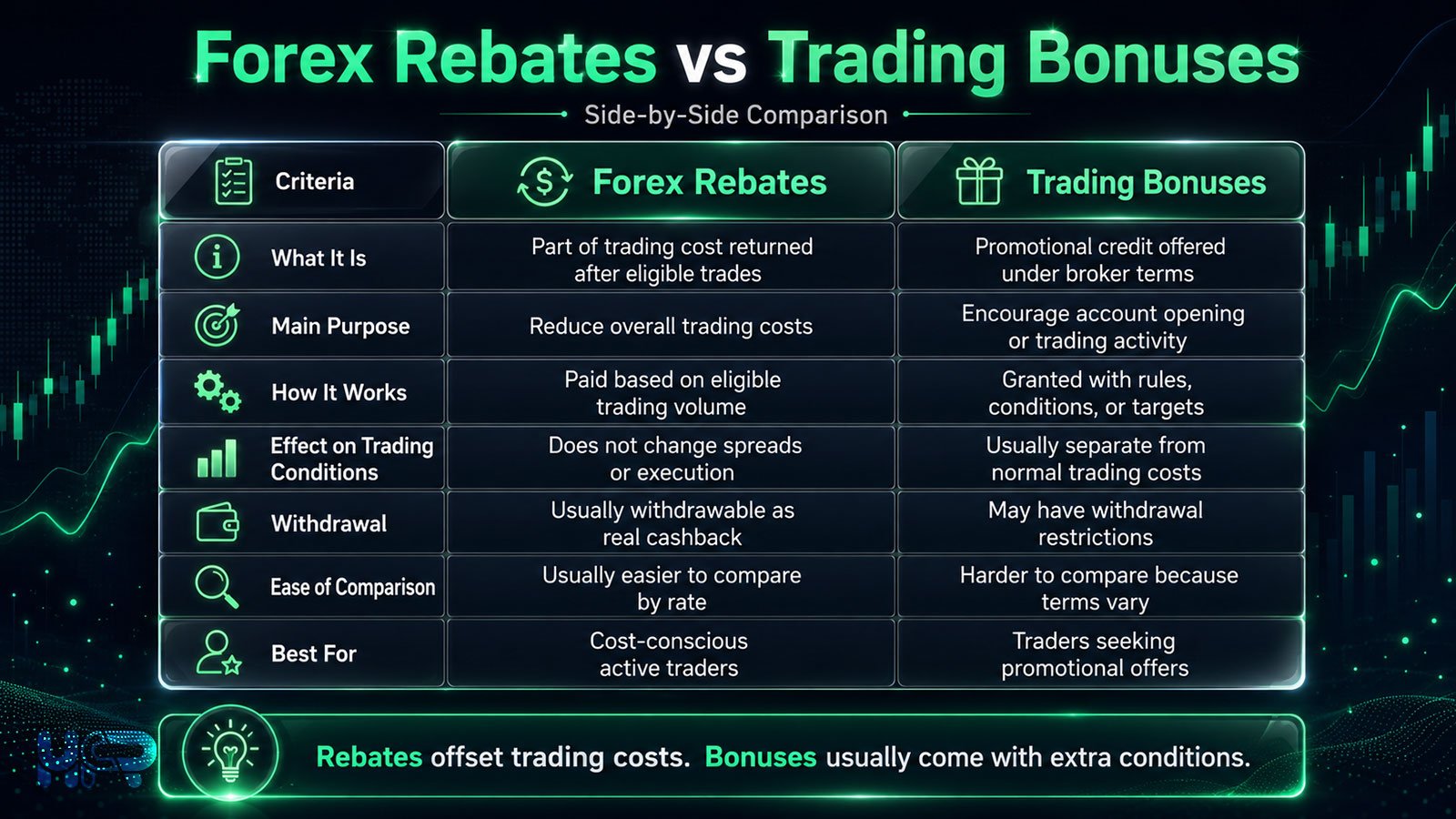
The table below compares the main differences.
| Factor | Forex Rebates | Trading Bonuses |
|---|---|---|
| Main purpose | Offset part of trading cost | Promotional offer or trading credit |
| When value applies | After eligible trades are completed and confirmed | Usually after deposit, registration, or campaign conditions |
| Calculation method | Based on volume, lot size, spread, commission, or broker-approved rebate rate | Based on bonus terms, deposit amount, eligibility rules, or campaign structure |
| Conditions | Usually depends on eligible account type, instrument, trading volume, and broker confirmation | Often includes minimum deposit, trading volume requirements, time limits, and withdrawal rules |
| Transparency | Often easier to calculate because it is linked to rebate rates and trading volume | Can be harder to compare because each campaign may have different terms |
| Effect on spreads | Does not change spreads | Does not usually change spreads |
| Effect on execution | No direct impact on execution | No direct impact on execution |
| Withdrawal restrictions | Depends on the rebate provider and broker payout rules | Often includes withdrawal restrictions or conditions |
| Best evaluated by | Net trading cost after cashback | Terms, conditions, and usable promotional value |
The key difference is how the value is measured. Forex rebates are usually easier to connect to trading costs because they are calculated from eligible trading activity. Trading bonuses may provide extra promotional value, but the real benefit depends heavily on the rules attached to the campaign.
For cost-focused traders, the most important point is to avoid looking only at the headline number. A large bonus may include strict conditions, while a smaller rebate may be easier to calculate against actual trading volume. Both should be reviewed together with spreads, commissions, swaps, funding costs, and account rules.
How Rebates Affect Trading Costs
Forex rebates can help reduce the net trading cost after eligible trades are completed and confirmed.
The trader still pays the normal spread or commission when the trade is placed, but part of that cost may be returned later as cashback.
This is why rebates should be understood as a cost-offset mechanism. They do not remove the original trading cost at the time of execution. Instead, they reduce the final cost after the rebate is calculated.
For example:
| Item | Amount |
|---|---|
| Trading cost | $10 |
| Cashback rebate | $2 |
| Net trading cost | $8 |

In this example, the trader pays $10 in trading costs and receives $2 cashback after the eligible trade is confirmed. The net trading cost becomes $8.
This does not mean the trade became profitable. It also does not mean the broker changed the spread or commission. The rebate simply offsets part of the cost after the trade.
The final rebate amount may depend on the broker, account type, instrument, trading volume, and confirmation rules. Some rebates are calculated per lot, while others may be based on spread, commission, or broker-approved rebate structures.
Traders who want a broader cost view can also learn how to reduce forex trading fees by comparing spreads, commissions, swaps, funding costs, and cashback together.
How Trading Bonuses Usually Work
Trading bonuses usually provide additional trading credit or promotional value under specific broker conditions. A bonus may be connected to a deposit, a welcome campaign, a no-deposit offer, or a volume-based promotion.
For example, if a broker offers a 20% deposit bonus, the trader may receive extra trading credit based on the deposit amount. However, this does not mean the bonus can always be withdrawn as cash.
In many cases, bonus funds are only used as trading credit. The trader may need to meet certain requirements before any part of the bonus, or profits linked to the bonus, can be withdrawn.
Common bonus conditions may include:
- Minimum deposit amount
- Eligible account type
- Trading volume requirements
- Time limits
- Withdrawal restrictions
- Regional availability
- Broker entity rules
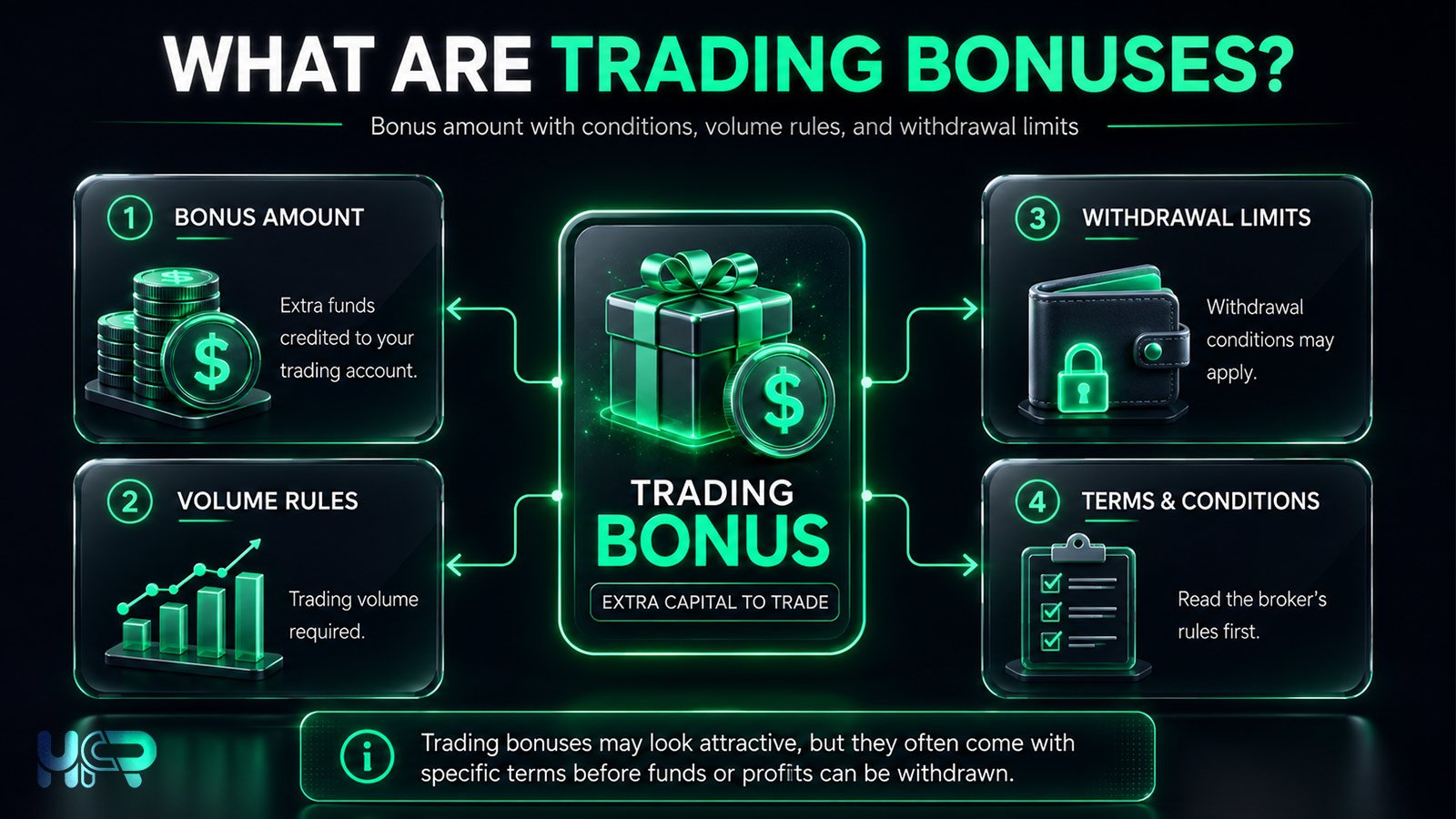
A bonus may increase available trading credit, but it does not automatically reduce the spread or commission paid on each trade. The trader may still pay normal trading costs, including spreads, commissions, swaps, and funding-related fees.
This is why traders should read the full bonus terms before joining a campaign. The headline bonus amount can look attractive, but the real value depends on how the bonus can be used, whether it can be withdrawn, and what conditions must be met.
Which Is Easier to Compare?
Forex rebates are often easier to compare because they are usually linked to eligible trading volume and rebate rates. For example, a rebate may be shown as a fixed amount per lot, a pip-based rate, or a percentage of spread or commission. This gives traders a clearer way to estimate how much cashback may be returned after eligible trades are completed.
Bonuses can be harder to compare because each campaign may have different terms. One broker may offer a deposit bonus, while another may offer a no-deposit bonus or a volume-based promotion. Even if the bonus amount looks higher, the conditions may be very different.
Bonus terms may include:
- Minimum deposit requirements
- Eligible account types
- Trading volume targets
- Time limits
- Withdrawal rules
- Regional restrictions
- Product or instrument limitations
This does not mean rebates are always better than bonuses. The better choice depends on the trader’s goals, account type, trading style, and the conditions attached to each offer.
For cost-focused traders, rebates are usually easier to evaluate because they can be compared with spreads, commissions, swaps, and trading volume. Bonuses may still be relevant, but traders should always read the official bonus terms before joining a promotion.
When Rebates May Be More Useful
Forex rebates may be more useful for traders who focus on trading costs and want a clearer way to measure cost-offset value. Since rebates are usually linked to eligible trading volume, they can be easier to compare with spreads, commissions, and account conditions.
Rebates may be especially useful for:
- Cost-focused traders
- Active traders
- Traders who compare brokers by total trading cost
- Traders who want a transparent cashback structure
- Traders who understand lot size and trading volume
For example, an active trader who places many trades may pay spreads or commissions repeatedly. If the account is eligible for rebates, part of those costs may be returned after the broker confirms the trading volume.
However, rebate value is not the same for every trader. The final cashback amount can depend on:
- Account type
- Instrument traded
- Lot size
- Trading volume
- Broker confirmation
- Rebate eligibility rules
This is why traders should not compare rebate rates by headline numbers only. A higher rebate rate may not always mean a lower total cost if the spread, commission, or account conditions are different.
For volume-based examples, traders can review forex cashback per lot to understand how lot size affects rebate amounts.
When Bonuses May Be Relevant
Trading bonuses may be relevant for traders who understand the terms and accept the conditions attached to the offer. A bonus can provide promotional value, but that value depends on how the bonus works and what the trader must do to use or withdraw it.
Bonuses may be relevant in cases such as:
- Deposit campaigns
- Welcome offers
- No-deposit promotions
- Temporary broker campaigns
- Volume-based promotions
- Broker-specific reward offers
For example, a deposit bonus may give extra trading credit after a trader funds an account. This may be useful for some traders, but only if they understand the rules connected to the bonus.
The real value of a bonus usually depends on:
- Eligibility rules
- Minimum deposit requirements
- Eligible account types
- Trading volume conditions
- Time limits
- Withdrawal restrictions
- Regional availability
A bonus should not be judged only by the headline amount. A larger bonus may have stricter conditions, while a smaller bonus may be easier to understand or use.
Bonuses can still be useful in some situations, but traders should read the official terms before joining any promotion. The key question is not only how large the bonus is, but whether the conditions match the trader’s account, trading style, and withdrawal expectations.
Traders who want to review current broker campaigns can also check available forex bonuses before joining a promotion.
Common Mistakes to Avoid
Traders can misunderstand both rebates and bonuses if they only look at the headline offer. A clear comparison should include account rules, trading costs, payout conditions, and restrictions.
One common mistake is assuming that a trading bonus is withdrawable cash. In many cases, a bonus may only be used as trading credit, or it may require specific trading volume before any withdrawal is allowed.
Another mistake is assuming that forex rebates change spreads or execution. Rebates do not reduce the spread shown on the trading platform, and they do not change execution speed, leverage, or order pricing. Cashback is calculated separately after eligible trades are completed and confirmed.
Traders should also avoid ignoring bonus trading volume requirements. A bonus may look attractive, but the required trading volume may be high compared with the trader’s normal activity.
Other common mistakes include:
- Comparing bonus size without reading the full conditions
- Comparing rebate rates without checking account type
- Ignoring the instrument category when reviewing rebates
- Choosing a broker only because of a bonus
- Forgetting spreads, commissions, swaps, and funding costs
- Assuming all broker promotions work the same way
The biggest mistake is ignoring the total trading cost. A large bonus does not always mean lower trading costs, and a high rebate rate does not always mean the account is cheaper overall.
Traders should compare the full structure: spreads, commissions, swaps, funding costs, account type, trading volume, rebate eligibility, and bonus restrictions. This gives a more realistic view than looking at rebates or bonuses alone.
How to Choose Between Rebates and Bonuses
Choosing between forex rebates and trading bonuses should not be based only on the biggest number shown in an offer. Traders should compare both options by looking at total trading cost, trading style, account type, payout rules, and restrictions.
For rebates, the main question is how much cost can be offset after eligible trades are completed. Traders should compare rebate rates together with:
- Spreads
- Commissions
- Swap fees
- Funding costs
- Account type
- Instrument category
- Payout schedule
- Broker confirmation rules
For bonuses, the main question is whether the promotional value is actually usable under the broker’s conditions. A bonus may look large, but the real value depends on the terms attached to it.
Before joining a bonus campaign, traders should check:
- Minimum deposit requirements
- Eligible account types
- Trading volume conditions
- Time limits
- Withdrawal restrictions
- Regional availability
- Whether rebates are still allowed on that account
Cost-focused traders should also think about their trading style. An active trader may find rebates easier to measure because the cashback is linked to eligible trading volume. A beginner may find a bonus attractive, but should first understand whether the bonus is withdrawable, restricted, or only usable as trading credit.
The safest comparison is to look at the full cost structure rather than one single offer. This includes spreads, commissions, swaps, funding fees, rebate eligibility, and bonus conditions.
You can also review our forex broker cashback comparison to see how rebate structures differ between brokers.
Conclusion
Forex rebates and trading bonuses are different tools. Both may be connected to broker offers, but they work in different ways and should not be compared only by headline numbers.
Forex rebates are usually clearer as a cost-offset mechanism because they are tied to eligible trading volume, rebate rates, account type, and broker confirmation. They do not change spreads, commissions, execution, leverage, or order pricing. Instead, they may reduce the net trading cost after eligible trades are completed.
Trading bonuses can still be relevant, especially for traders who understand the terms and accept the conditions. However, bonus value depends heavily on eligibility rules, trading volume requirements, time limits, withdrawal restrictions, and regional availability.
When comparing forex rebates vs trading bonuses, traders should focus on real trading costs, eligibility rules, and payout conditions rather than headline numbers alone. The more suitable option depends on the trader’s account type, trading style, cost structure, and ability to meet the required conditions.
FAQs
Are forex rebates the same as trading bonuses?
No. Forex rebates return part of the trading cost after eligible trades are completed and confirmed. Trading bonuses are broker promotions that usually come with separate terms, conditions, and eligibility rules.
Do forex rebates reduce spreads?
No. Forex rebates do not reduce the spread shown on the trading platform. They are calculated separately after eligible trades are completed and confirmed by the broker.
Are trading bonuses withdrawable?
Not always. Some bonuses are trading credit only, while others may have withdrawal conditions. Traders should always read the official bonus terms before joining a campaign.
Which is easier to compare, rebates or bonuses?
Rebates are usually easier to compare because they are linked to eligible trading volume and rebate rates. Bonuses can be harder to compare because conditions may differ widely between campaigns.
Can I use rebates and bonuses together?
It depends on the broker, account type, and promotion rules. Some brokers may allow both, while others may restrict rebates on promotional accounts. Traders should check the exact conditions before registering.
Do bonuses reduce trading costs?
A bonus does not automatically reduce spreads, commissions, or swaps. It may provide promotional value, but its real impact depends on the terms, trading volume requirements, and withdrawal rules.
 7
7
Share Posts


Further Reading
- Why Forex Spreads Widen: News, Rollover, Liquidity and Volatility
- What is Proof of Reserves on a crypto exchange? What it shows and what it does not
- ActivTrades Review 2026: Accounts, Fees, Platforms, Regulation and Cashback
- Weekly market recap, 12–18 October 2026: Inflation, yields, gold and crypto