




Table of Contents
[ Show/Hide ]- • What Is a Crypto Exchange and How Does It Work?
- • What a Crypto Exchange Actually Does
- • How Crypto Exchanges Work
- • How Buying and Selling Works on a Crypto Exchange
- • Order Books, Order Matching, and Liquidity
- • Market Orders vs Limit Orders
- • Maker and Taker Fees Explained
- • Centralized vs Decentralized vs Hybrid Exchanges
- • Crypto Exchange vs Crypto Wallet
- • Spot Trading on a Crypto Exchange
- • Crypto Derivatives, Perpetuals, and Futures
- • Funding Rates and Liquidation Risk
- • Wallets, Deposits, and Withdrawals
- • KYC, Security, and Account Protection
- • Exchange Rewards, Bonuses, and Cashback
- • What to Check Before Choosing a Crypto Exchange
- • How Crypto Exchange Cashback Works
- • Conclusion
- • FAQ
What Is a Crypto Exchange and How Does It Work?
Most people think choosing a crypto exchange is simple. Pick one with the coins you want and start trading. But the exchange you choose affects more than just which assets you can buy. It affects fees, liquidity, wallet risks, account limits, security, and whether you can earn cashback on eligible trades.
Understanding how a crypto exchange actually works before you deposit is one of the most practical steps a beginner can take. The differences between order types, account wallets, spot markets, and derivatives can all affect how much trading costs you in the end.
This guide explains what a crypto exchange is, how buying, selling, and fees work, what risks come with advanced products, and what to check before choosing where to trade; including how crypto exchange cashback may help offset part of eligible trading costs.
What a Crypto Exchange Actually Does
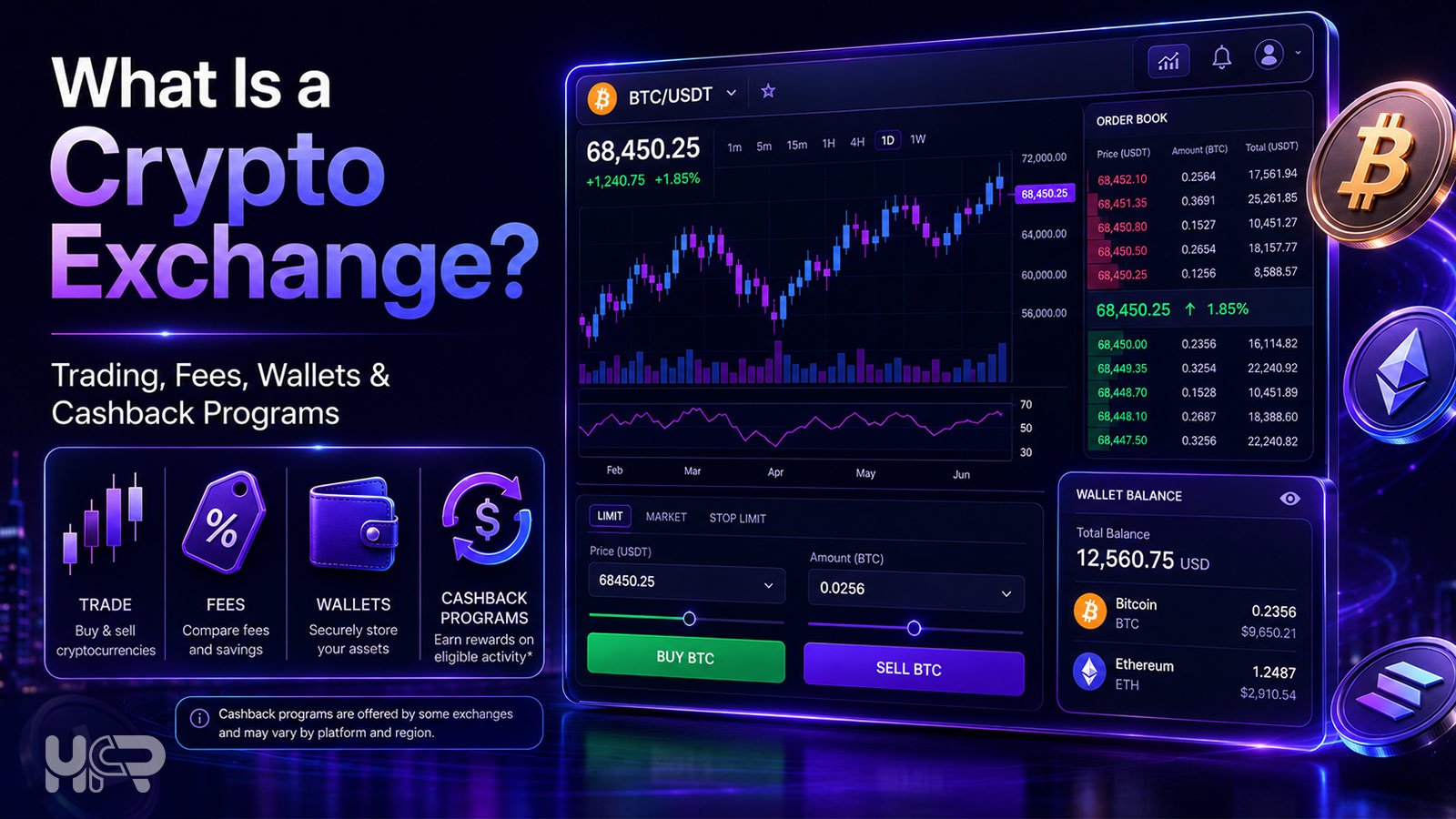
A crypto exchange connects buyers and sellers of digital assets. In simple terms, it gives users access to crypto markets, trading pairs, order books, wallets, and account tools.
On a crypto exchange, users can usually trade one cryptocurrency against another, such as BTC/USDT or ETH/USDT. Some exchanges may also support fiat currencies, allowing users to buy or sell crypto using currencies such as USD, EUR, or other local currencies where available.
Most crypto exchanges provide trading pairs, price charts, order books, account balances, deposit and withdrawal tools, and fee schedules. More advanced exchanges may also offer derivatives, margin trading, copy trading, trading bots, Earn products, or rewards.
Product availability can vary depending on the exchange, user region, verification level, and local restrictions. This means every user may not see the same products, payment methods, or trading options inside their account.
How Crypto Exchanges Work
Crypto exchanges work by connecting users who want to buy and sell digital assets. The process can look different from one platform to another, but the basic flow is usually similar.
A user first creates an exchange account and sets up login details. Depending on the exchange, region, and product access, the user may need to complete identity verification, also called KYC. This step may be required for fiat payments, withdrawals, higher limits, or access to certain trading products.
After the account is ready, the user can deposit crypto or fiat currency where available. Crypto deposits are sent to an exchange wallet address, while fiat deposits may use bank transfer, card payment, or third-party payment providers depending on the exchange and country.
Once funds are available, the exchange provides access to trading pairs, order books, price charts, account balances, deposit and withdrawal tools, and fee information. These tools allow users to buy, sell, convert, hold, or withdraw supported assets according to the exchange’s rules.
In simple terms, a crypto exchange provides the account system, market access, order matching, wallets, and fee structure that make crypto trading possible.
How Buying and Selling Works on a Crypto Exchange
When a user buys or sells crypto on an exchange, they usually select a trading pair, choose an order type, enter the amount, and submit the order. If the order matches available liquidity, the trade is executed and the balance updates inside the exchange account.
For example, if a user wants to buy Bitcoin with USDT, they may choose the BTC/USDT trading pair. If they want to buy immediately, they may use a market order. If they want to buy only at a specific price, they may use a limit order.
The basic flow is simple. The user chooses the coin or trading pair, selects buy or sell, enters the trade size, chooses the order type, and confirms the order. After execution, the purchased asset or remaining balance appears inside the user’s exchange account.
The final execution price can depend on the order type and available liquidity. A market order may execute quickly, but the final price can change if the order book moves or liquidity is limited. A limit order gives more price control, but it may not fill immediately if the market does not reach the selected price.
Trading fees may apply when the order is executed. These fees can vary depending on the exchange, trading pair, order type, VIP level, and whether the order is treated as a maker or taker order.
Order Books, Order Matching, and Liquidity
An order book is where buy and sell orders are listed on a crypto exchange. It shows the prices and amounts that other users are willing to buy or sell at a given time.
When a user places an order, the exchange tries to match it with available orders in the order book. Orders are usually matched based on price, timing, and available liquidity. If there is enough matching volume at the selected price, the trade can be executed. If not, the order may only be partially filled or may stay open until matching liquidity appears.
Liquidity means how easily an asset can be bought or sold without causing a large price movement. A highly liquid trading pair usually has more active buyers and sellers, tighter bid/ask differences, and better order depth.
Low liquidity can make trading more difficult. If there are not enough orders near the expected price, a market order may fill at several different prices. This can create slippage, where the final execution price is different from the price the user expected.
Liquidity is especially important for larger orders, smaller altcoins, and fast-moving market conditions.
Market Orders vs Limit Orders
Crypto exchanges usually give users different order types. The most common are market orders and limit orders. Each one works differently, so users should understand how they affect execution, price, and fees.
A market order is designed for fast execution. When a user places a market order, the exchange fills it at the best available price in the order book. This can be useful when the user wants to buy or sell quickly, but the final execution price may be different from the price shown before clicking the order button, especially in fast or low-liquidity markets.
A limit order gives the user more control over price. With a limit order, the user chooses the price they want to buy or sell at. The order will only execute at that price or a better price. However, it may not fill immediately if the market does not reach the selected price.
Market orders are usually treated as taker orders because they remove liquidity from the order book. Limit orders can be either maker or taker orders, depending on how they execute. If a limit order waits in the order book, it may act as a maker order. If it executes immediately against existing liquidity, it may act as a taker order.
| Order Type | How It Works | What to Watch |
|---|---|---|
| Market Order | Spread included | Fast execution, but possible slippage |
| Limit Order | Executes quickly at the best available price | More price control, but may not fill immediately |
| Stop Order | Triggers when a price condition is met | Useful for risk control, but execution is not guaranteed in all market conditions |
Market orders can be affected by slippage. Slippage happens when the final execution price is different from the expected price. This can happen during volatility, low liquidity, or when the order size is large compared with the available order book depth.
For beginners, market orders are easier to understand, but limit orders usually give more price control. The better choice depends on whether the user values faster execution or more control over the trade price.
Maker and Taker Fees Explained
Maker and taker fees are common on crypto exchanges. They are based on how an order interacts with the exchange order book.
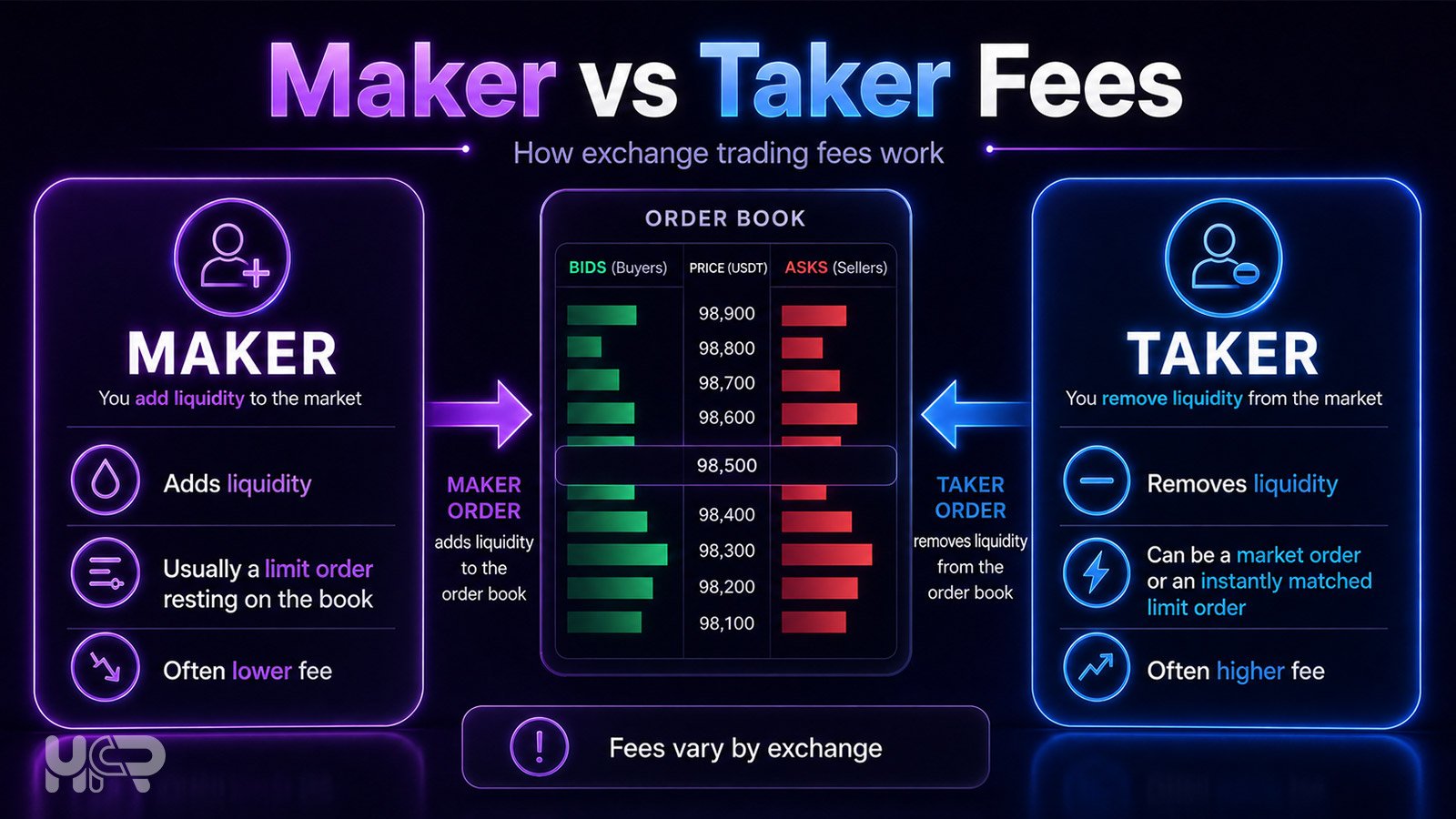
A maker order adds liquidity to the order book. This usually happens when a user places a limit order that does not execute immediately. The order waits in the book until another trader matches with it.
A taker order removes liquidity from the order book. This usually happens when an order executes immediately against an existing order, such as a market order or a limit order that fills right away.
Because maker and taker orders affect liquidity differently, exchanges may charge different fees for each. Fees can also vary depending on the exchange, product type, VIP tier, trading volume, and campaign eligibility.
| Order Type | What It Means | Fee Consideration |
|---|---|---|
| Maker | Adds liquidity to the order book | May have lower fee on some exchanges |
| Taker | Executes against existing liquidity | Often charged a different fee |
| Market Order | Usually acts as taker | Fast execution but may pay taker fee |
| Limit Order | Can be maker or taker | Depends on whether it fills immediately |
For beginners: market orders are usually faster but act as taker orders. Limit orders give more price control and may act as maker orders if they rest in the book before filling.
Centralized vs Decentralized vs Hybrid Exchanges
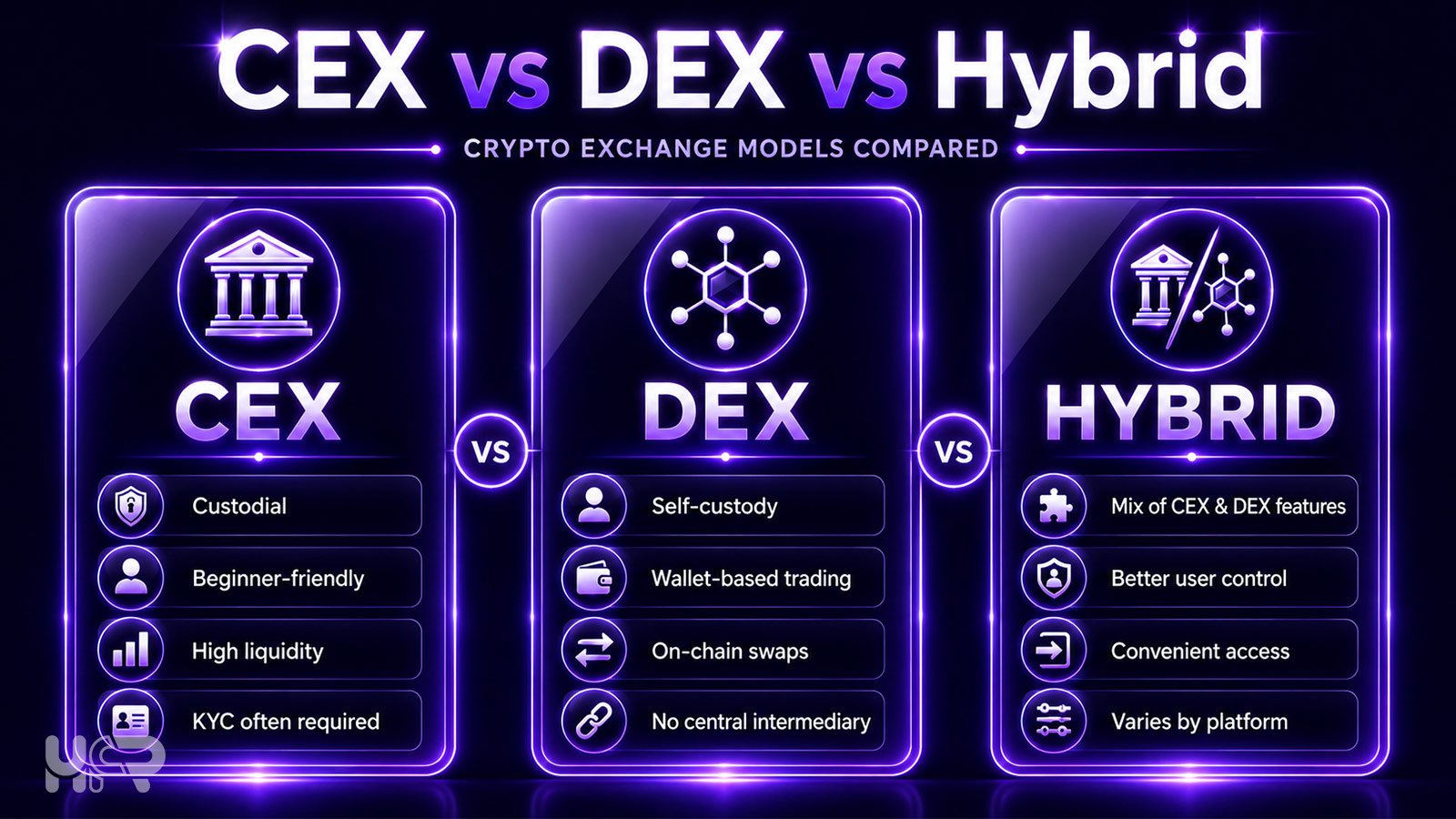
Crypto exchanges can use different operating models. The three common types are centralized exchanges, decentralized exchanges, and hybrid exchanges. Each one handles account access, custody, trading, and user responsibility in a different way.
A centralized exchange, or CEX, uses an account-based system. Users create an account, log in through the platform, and may need to complete KYC. The exchange usually manages internal balances, order books, deposits, withdrawals, and customer support.
A decentralized exchange, or DEX, works through crypto wallets and smart contracts instead of a traditional exchange account. Users keep more direct control of their assets, but they also take more responsibility for wallet security, network fees, transaction approval, and irreversible mistakes.
A hybrid exchange tries to combine parts of both models. It may offer a centralized-style interface with some blockchain-based custody, settlement, or liquidity features. Since hybrid models can vary widely, users should check how trading, custody, and withdrawals actually work before using one.
| Exchange Type | Main Feature | What to Check |
|---|---|---|
| CEX | Account-based trading with internal balances | KYC, custody, fees, withdrawals, support, security tools |
| DEX | Wallet-based trading through smart contracts | Wallet security, network fees, liquidity, transaction risk |
| Hybrid | Mix of centralized and decentralized features | Custody model, settlement process, withdrawal rules, transparency |
No exchange type is always better for every user. A centralized exchange may be easier for beginners and active traders, while a decentralized exchange may suit users who are comfortable with self-custody. The better choice depends on trading needs, security habits, available products, funding methods, and experience level.
Crypto Exchange vs Crypto Wallet
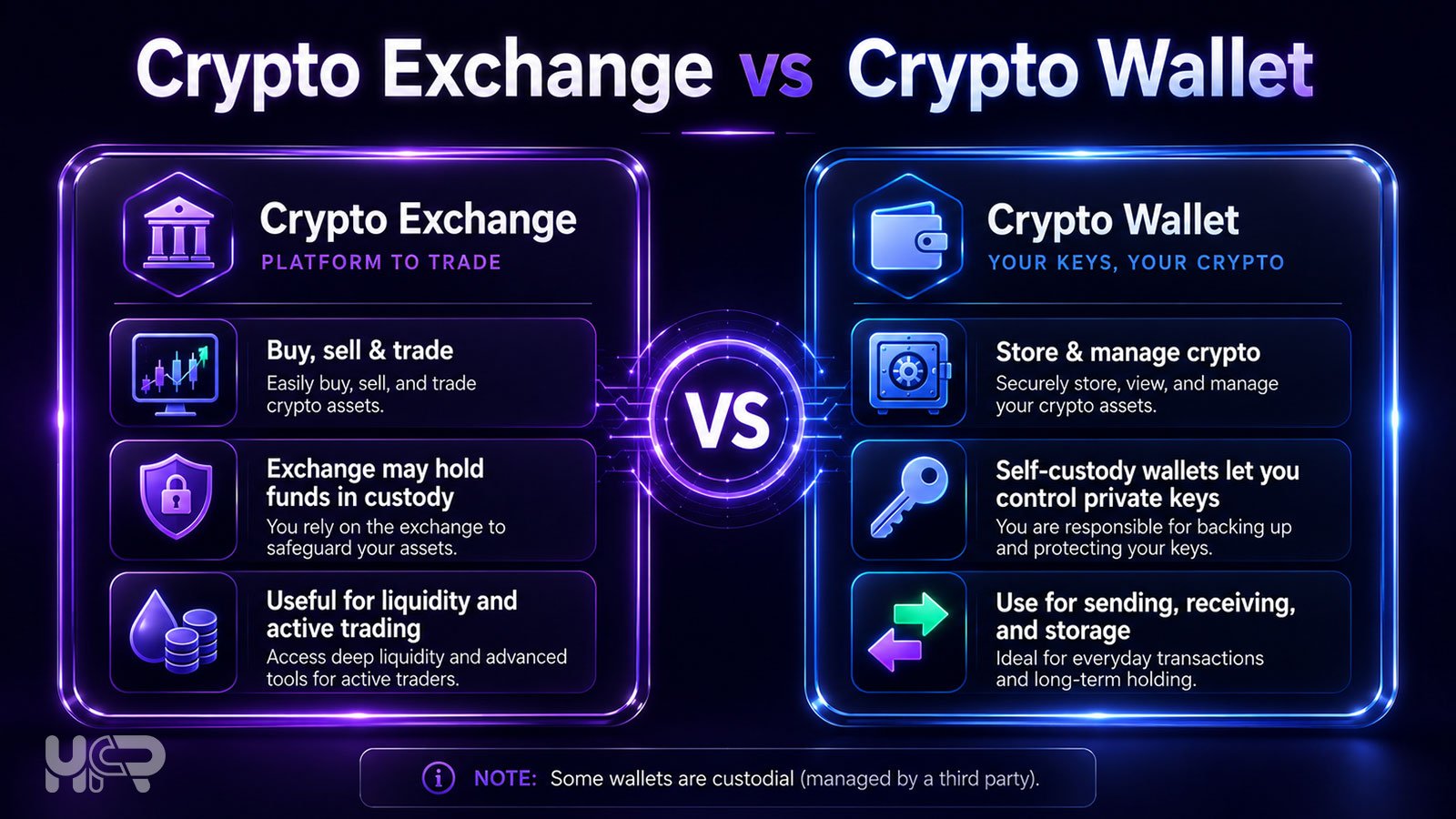
A crypto exchange and a crypto wallet are related, but they are not the same tool. A crypto exchange is mainly used for buying, selling, converting, and trading digital assets. A crypto wallet is mainly used for storing and controlling crypto assets.
When users keep funds on a centralized exchange, the balance is usually held inside the exchange account. The exchange manages the internal wallet system, account access, and withdrawal process. This can be convenient for active trading, but it also means the user depends on the platform’s custody and security systems.
A self-custody wallet works differently. With a self-custody wallet, the user controls the private keys or recovery phrase. This gives the user more direct control over the crypto assets, but it also creates more responsibility. If the private key or recovery phrase is lost, shared, or stolen, the funds may not be recoverable.
This difference matters because active trading and long-term storage often have different needs. Some users keep a smaller trading balance on an exchange for easier market access, while moving longer-term holdings to a self-custody wallet. Others may prefer the convenience of keeping funds on an exchange, but that increases dependence on the platform.
In simple terms, an exchange is a marketplace for trading, while a wallet is a tool for storing and controlling crypto. Users should choose the setup based on how often they trade, how much control they want, and how comfortable they are with wallet security.
Spot Trading on a Crypto Exchange
Spot trading is usually the simplest form of crypto trading. A user buys or sells a crypto asset at the current market price or at a selected limit price.
In spot trading, the user is trading the actual crypto balance on the exchange. For example, if a user buys Bitcoin with USDT, the BTC balance appears inside the exchange account after the trade is executed. If the user sells Bitcoin for USDT, the USDT balance increases after execution.
Common spot trading pairs may include BTC/USDT, ETH/USDT, and SOL/USDT, depending on the exchange and available markets. Each pair has its own price, order book, liquidity, and trading fee structure.
Spot trading has market risk because crypto prices can move up or down after the trade. However, normal spot trading does not usually involve liquidation risk unless the user is using margin or borrowed funds. This makes spot trading easier to understand than leveraged derivatives for many beginners.
The sections below cover more advanced exchange products. If you are new to crypto, you can read the spot trading section first and return to derivatives, funding rates, and liquidation once you are comfortable with the basics.
Crypto Derivatives, Perpetuals, and Futures
Crypto derivatives are trading products that let users speculate on the price movement of a crypto asset without directly owning the asset itself. Instead of buying Bitcoin or Ethereum in the spot market, a user trades a contract based on the asset’s price.
Perpetual contracts are one of the most common crypto derivatives. They do not have a fixed expiry date, so traders may be able to keep a position open as long as margin requirements are maintained. Because perpetual contracts do not expire, they often use funding rates to keep the contract price close to the spot market price.
Futures contracts are another type of crypto derivative. Unlike perpetual contracts, they may have an expiry date or settlement rule. The exact structure can vary by exchange and contract type, so users should check contract details before trading.
Leverage may be available on derivatives. Leverage allows a trader to control a larger position with a smaller amount of margin, but it also increases risk. If the market moves against the position and the account does not have enough margin, liquidation can occur.
Derivatives are more complex than spot trading and can create faster losses when leverage is used. Beginners should understand margin, liquidation, funding rates, order types, and contract rules before using these products.
Funding rates may apply to perpetual contracts. Depending on market conditions and position direction, a trader may either pay or receive funding. This means trading fees are not the only cost to consider when using derivatives.
Cashback, where available, does not remove derivatives risk. It may offset part of eligible trading fees after confirmation, but it does not reduce liquidation risk, market risk, funding-rate risk, or leverage risk.
Funding Rates and Liquidation Risk
Trading fees are not the only cost in derivatives trading. Perpetual contracts may include funding payments, and leveraged positions can be liquidated if the market moves against the trader.
Funding rates are usually used in perpetual contracts because these contracts do not have a fixed expiry date. The funding mechanism helps keep the perpetual contract price closer to the underlying spot market price.
Funding can be either paid or received. This depends on the funding rate, market conditions, and whether the user holds a long or short position. In some periods, long traders may pay short traders. In other periods, short traders may pay long traders.
Liquidation is another major risk in derivatives trading. It can happen when the user’s margin is no longer enough to keep the leveraged position open. If the market moves strongly against the position, the exchange may close the position automatically to prevent further losses.
This is why beginners should be careful with leverage. A higher leverage setting can make the position more sensitive to price movement. Even a small market move can create a large change in margin balance.
Cashback does not reduce liquidation risk. It may offset part of eligible trading fees after confirmation, but it does not protect users from market losses, funding payments, leverage risk, or forced liquidation.
Before using derivatives, users should understand how margin, funding rates, liquidation price, and risk controls work on the exchange they are using.
Wallets, Deposits, and Withdrawals
Crypto exchanges usually provide internal wallets for supported assets. These wallets allow users to deposit crypto, hold balances inside the exchange account, trade supported pairs, and withdraw funds when needed.
Crypto deposits require careful network selection. For example, the same asset, such as USDT, may be available on several networks. Users should always check the correct coin, blockchain network, wallet address, and memo or tag if required before sending funds.
Withdrawals work in a similar way. The user selects the asset, chooses the network, enters the destination address, and confirms the withdrawal. Network fees or withdrawal fees may apply, and these fees can vary by asset, blockchain network, and network congestion.
Some assets require a memo, tag, or payment ID. If this information is missing or incorrect, the deposit or withdrawal may be delayed or may not be credited automatically.
Fiat deposits and withdrawals, where available, can depend on the user’s country, verification level, payment provider, currency, and exchange rules. Users should check processing times, fees, and limits before using fiat payment methods.
The main risk is sending funds to the wrong address or network. Crypto transfers are often irreversible, so users should review all details carefully before confirming a deposit or withdrawal.
KYC, Security, and Account Protection
KYC, or identity verification, is common on many crypto exchanges. Depending on the platform, region, and account activity, KYC may be required for deposits, withdrawals, fiat payments, higher limits, derivatives access, or participation in certain exchange products.
Security is also an important part of using a crypto exchange. Most exchanges provide account protection tools, but users still need to manage their own login details, devices, and withdrawal settings carefully.
Common security tools may include two-factor authentication, anti-phishing codes, withdrawal whitelists, device management, login alerts, and proof of reserves where available. Two-factor authentication adds another layer of login protection, while withdrawal whitelists can help limit withdrawals to approved wallet addresses. Anti-phishing codes can help users identify official exchange emails and reduce the risk of fake messages.
Device management and login alerts can also help users monitor account access. If a user sees an unknown device, location, or login attempt, they should review account activity and change security settings immediately.
Security tools can reduce account-level risks, but they do not remove market risk, custody risk, platform risk, or liquidation risk. Users should protect passwords, enable 2FA, secure their email account, avoid sharing recovery codes, and review withdrawal settings before holding funds on any exchange.
For beginners, account security should be checked before the first deposit. A strong password, active 2FA, trusted devices, and careful withdrawal settings can help reduce avoidable account-access risks.
Exchange Rewards, Bonuses, and Cashback
Crypto exchanges may offer different types of rewards and promotional campaigns. These can include welcome rewards, deposit campaigns, trading competitions, task-based rewards, referral offers, VIP benefits, or temporary product campaigns.
These rewards should not be confused with cashback. Exchange rewards are usually promotional offers created by the exchange. They may come with conditions such as eligibility rules, time limits, minimum deposit requirements, trading volume targets, supported products, reward caps, and regional restrictions.
Cashback works differently. Crypto exchange cashback is usually linked to eligible trading fees or commissions. Instead of being a temporary promotion, cashback is calculated after eligible trading activity is completed and confirmed. The exact rate, payout timing, and eligibility rules can vary depending on the exchange and cashback provider.
Through HighFxRebates, crypto exchange cashback may help offset part of eligible trading costs after confirmation. It should not be viewed as profit, income, free money, or a trading result. It also does not change the fee charged inside the exchange, market risk, funding-rate risk, liquidation risk, or account rules.
| Item | How It Usually Works |
|---|---|
| Exchange rewards | Promotional offers with terms, time limits, and eligibility rules |
| Bonuses or campaigns | May require deposits, trading volume, or specific tasks |
| VIP benefits | May depend on trading volume, balance, or exchange criteria |
| Cashback | Usually linked to eligible trading fees or commissions after confirmation |
Although exchange rewards are not the same as forex promotions, users can review forex rebates vs trading bonuses to understand why cashback and promotional rewards should be evaluated separately.
What to Check Before Choosing a Crypto Exchange
Before choosing a crypto exchange, users should compare more than the available coins or headline trading fees. A good exchange choice depends on region, product access, fees, liquidity, funding methods, wallet control, security tools, and cashback eligibility.
| Factor | What to Check |
|---|---|
| Region | Is the exchange available in your country? |
| Exchange type | Is it a CEX, DEX, or hybrid exchange? |
| Products | Does it support spot, derivatives, futures, options, bots, or earn products? |
| Fees | What are the maker/taker fees, funding rates, and withdrawal fees? |
| Liquidity | Is there enough trading activity in the pairs you want to use? |
| Security | Does it offer 2FA, withdrawal whitelist, account alerts, or proof of reserves where available? |
| Funding | Which crypto networks, fiat gateways, and withdrawal rules are supported? |
| Wallet control | Are funds held as a custodial exchange balance or in a self-custody wallet? |
| Cashback | What are the eligibility rules, cashback rate, payout timing, and confirmation requirements? |
This checklist can help beginners avoid choosing an exchange based only on one feature. For example, an exchange may have many listed assets, but limited fiat access in some regions. Another exchange may offer lower trading fees, but weaker liquidity on smaller trading pairs.
Cashback should also be checked carefully. Crypto exchange cashback may help offset part of eligible trading fees after confirmation, but it does not reduce market risk, platform risk, funding-rate risk, or liquidation risk.
How Crypto Exchange Cashback Works
Crypto exchange cashback may return part of eligible trading fees or commissions after a user trades on a supported exchange. The exact cashback rate, eligible products, payout timing, and confirmation rules can vary depending on the exchange and the cashback provider.
Cashback is usually calculated after trades are completed and confirmed. This means the fee is first charged inside the exchange according to the exchange’s normal fee schedule. After eligible trading activity is reported and confirmed, cashback may be calculated separately based on the applicable rules.
Crypto exchange cashback does not change the fee shown or charged inside the exchange platform. It also does not change order execution, market prices, funding rates, liquidation rules, wallet rules, or account conditions.
Cashback should be viewed as a cost-offset mechanism. It may help offset part of eligible trading costs after confirmation, but it does not reduce market risk, funding-rate risk, custody risk, platform risk, or liquidation risk.
Eligibility can depend on several factors, including the exchange, user account status, product type, account linking process, trading activity, and confirmation from the exchange or cashback provider. Users should check the cashback terms before assuming that every trade, product, or account will qualify.
Users who want a more detailed explanation can read our guide on what is crypto exchange cashback and how it is calculated.
For a practical example, you can view Bybit cashback conditions or BloFin cashback conditions to compare how eligible exchange cashback rates and payout rules differ between platforms.
Conclusion
A crypto exchange is a platform that allows users to buy, sell, convert, and trade digital assets. Some exchanges focus on simple spot trading, while others offer advanced products such as derivatives, perpetual contracts, copy trading, trading bots, rewards, and earn products.
Before choosing a crypto exchange, users should compare more than the number of listed coins. Exchange type, trading products, maker and taker fees, liquidity, funding rates, wallet rules, deposit and withdrawal methods, security tools, regional availability, and cashback eligibility can all affect the final trading experience.
For beginners, it is usually better to understand the basics first: how orders are matched, how market and limit orders work, how wallets and withdrawals function, and what risks come with derivatives or leverage. These details can help users avoid common mistakes before trading or choosing an exchange.
Crypto exchange cashback may help offset part of eligible trading fees after trades are completed and confirmed. However, it should always be viewed as a cost-offset mechanism, not profit, income, or a risk reduction tool. Cashback does not change exchange fees inside the platform, market risk, funding-rate risk, custody risk, or liquidation risk.
FAQ
What is a crypto exchange?
A crypto exchange is a platform where users can buy, sell, convert, or trade cryptocurrencies and other digital assets. Some exchanges focus on simple spot trading, while others also offer advanced products such as derivatives, bots, rewards, or cashback programs.
Is a crypto exchange the same as a forex broker?
No. A crypto exchange usually provides access to digital asset markets, order books, exchange wallets, and crypto trading products. A forex broker usually provides access to forex and CFD products through broker account types, trading platforms, and broker pricing models.
What is the difference between a crypto exchange and a crypto wallet?
A crypto exchange is mainly used for buying, selling, converting, and trading crypto. A crypto wallet is mainly used for storing and controlling crypto assets. Some wallets are self-custody wallets, where the user controls the private keys or recovery phrase.
What is the difference between spot and derivatives trading?
Spot trading involves buying or selling crypto assets directly. Derivatives trading allows users to speculate on price movements using contracts such as perpetuals or futures. Derivatives often involve leverage, margin requirements, funding rates, and liquidation risk.
What are maker and taker fees?
Maker fees apply to orders that add liquidity to the order book. Taker fees apply to orders that execute against existing liquidity. The exact fee can depend on the exchange, product type, order type, VIP tier, trading volume, and campaign eligibility.
What is liquidity on a crypto exchange?
Liquidity refers to how easily an asset can be bought or sold without causing a large price movement. Higher liquidity can help trades execute more smoothly, while lower liquidity may increase slippage and make it harder to enter or exit at the expected price.
Are crypto exchanges safe?
Crypto exchanges may provide security tools such as two-factor authentication, withdrawal whitelists, anti-phishing codes, device management, proof of reserves, and account alerts where available. However, these tools do not remove market risk, custody risk, platform risk, or liquidation risk. Users should use strong security settings and understand the risks before trading.
What is crypto exchange cashback?
Crypto exchange cashback usually returns part of eligible trading fees or commissions after trades are completed and confirmed. It does not change the fee charged inside the exchange and should be viewed as a cost-offset mechanism, not profit, income, or a risk reduction tool.
Do I need to complete KYC to use a crypto exchange?
This depends on the exchange, your region, and what you want to do. Some exchanges allow basic spot trading without KYC, but identity verification is often required for fiat deposits or withdrawals, higher account limits, derivatives access, or participation in certain rewards programs. Users should check the specific KYC requirements of the exchange they plan to use before signing up.
When is crypto exchange cashback paid?
Cashback payout timing can vary depending on the exchange and the cashback provider. It is usually calculated after eligible trades are completed and confirmed. Payment may be weekly, monthly, or based on another schedule depending on the applicable conditions. Users should check the cashback terms for the specific exchange before assuming a payment date.
Disclaimer
Trading involves risk. Crypto exchange cashback may be based on eligible commissions paid and does not reduce market risk, leverage risk, liquidation risk, funding-rate risk, execution risk, custody risk, or platform risk. Derivatives, perpetual contracts, futures, and leveraged products are complex and may not be suitable for all users. Cashback eligibility and payment conditions may depend on the exchange, account status, product type, region, verification level, and confirmation rules. Users should review the relevant terms before opening, linking, or using an exchange account.
 6
6


