




Table of Contents
[ Show/Hide ]- • Forex broker comparison 2026: the short answer
- • How we compared forex broker trading costs
- • Spreads vs commissions: what costs are actually being compared?
- • Forex broker comparison 2026: matched cost table
- • Worked examples: cost before and after cashback
- • How HFR cashback affects the effective trading cost
- • Costs a spread-and-commission table cannot capture
- • Who qualifies for the displayed broker and HFR terms?
- • Regulation and protections are separate from costs
- • A practical checklist for comparing broker accounts
- • Use HFR’s tools to review current conditions
- • Conclusion
- • FAQ
- • Risk and commercial disclosure
- • Sources and methodology
Forex broker comparison 2026: the short answer
A fair forex broker comparison in 2026 should measure the same trade on the same basis: spread cost, full round-turn commission and any confirmed eligible cashback. A lower advertised commission or a higher rebate does not automatically produce the lowest net trading cost.
For example, a Raw account may show a tighter spread but add commission on both opening and closing the trade, while a Standard account may include more of the cost in the spread. Cashback can then reduce part of an eligible cost, subject to account and tracking conditions.
Any calculated net cost is an estimate based on stated inputs. The actual charge at execution can differ as spreads and other trading conditions change. HFR’s forex broker comparison tool can be used to review current broker information side by side.
How we compared forex broker trading costs
This comparison uses desk research, not live-account testing. It covers Pepperstone Standard and Razor alongside Tickmill Classic and Raw. Other HFR-supported brokers can be added when official sources provide comparable spread, commission, entity and rebate information.
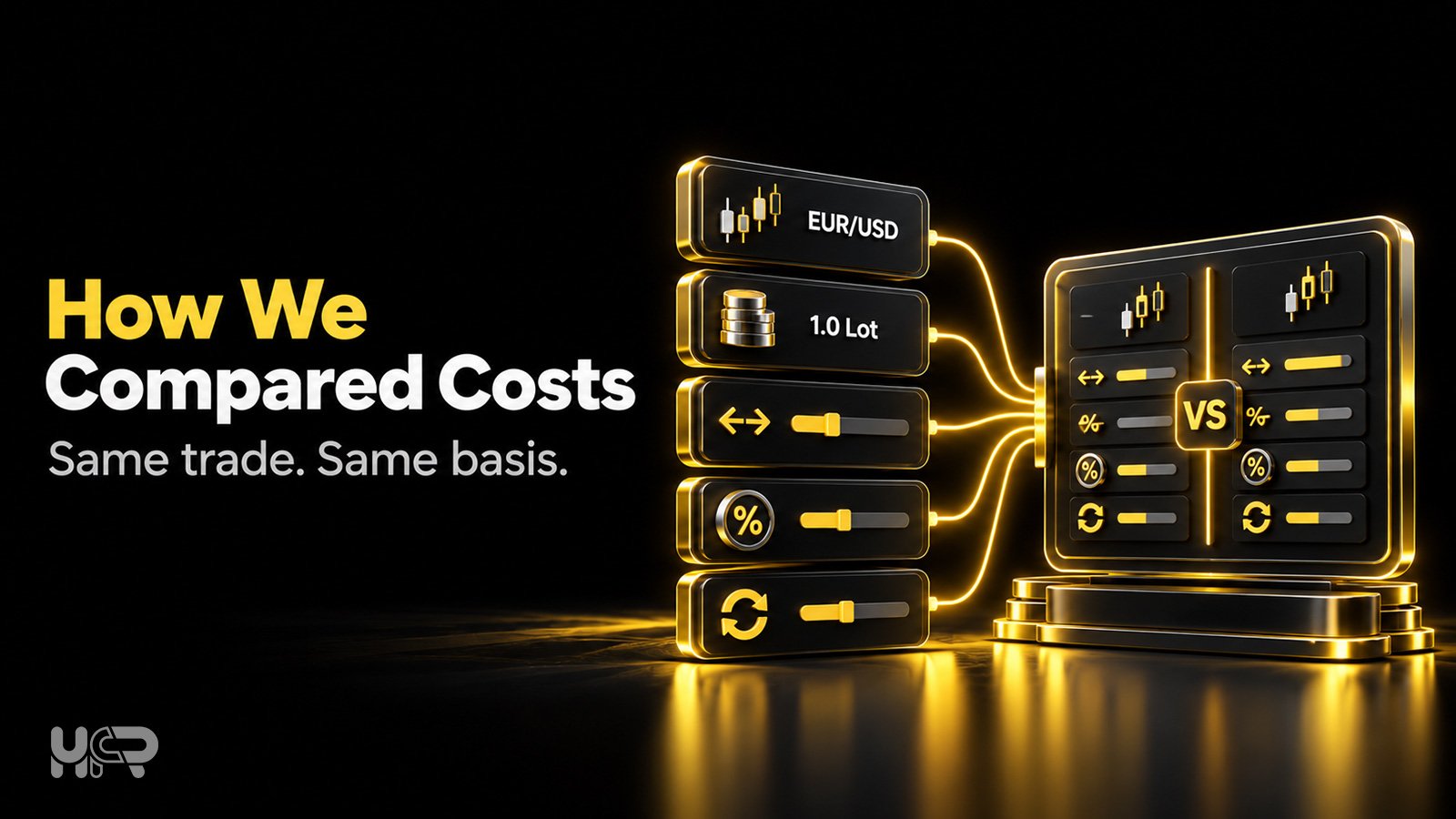
The reference scenario is one completed 1.00-standard-lot EUR/USD trade in a USD account, with no overnight holding. For each row, we record the broker, legal entity or eligible region, account, platform, spread statistic, source date and HFR rebate basis.
Spreads are normalised in pips and commissions in USD per full round turn. Minimum or “from” spreads are labelled as such and are never compared numerically with historical average spreads. Spread cost is a simplified round-trip proxy; the actual Bid-Ask spread can differ between entry and exit.
The comparison uses official broker fee schedules for trading costs and current HFR partner pages for rebate conditions. Promotions and temporary discounts are excluded unless specifically dated and comparable. Platform-specific commissions are applied only to the relevant platform.
If official sources conflict, cover different measurement periods or omit a required value, the affected row is marked as not directly comparable rather than filled with an unsupported estimate.
This desk review cannot measure slippage, live execution quality, or the exact prices available when an order is filled. HFR has commercial partnerships with supported brokers, but their spread and commission figures here come from the brokers’ published schedules rather than HFR estimates.
Spreads vs commissions: what costs are actually being compared?
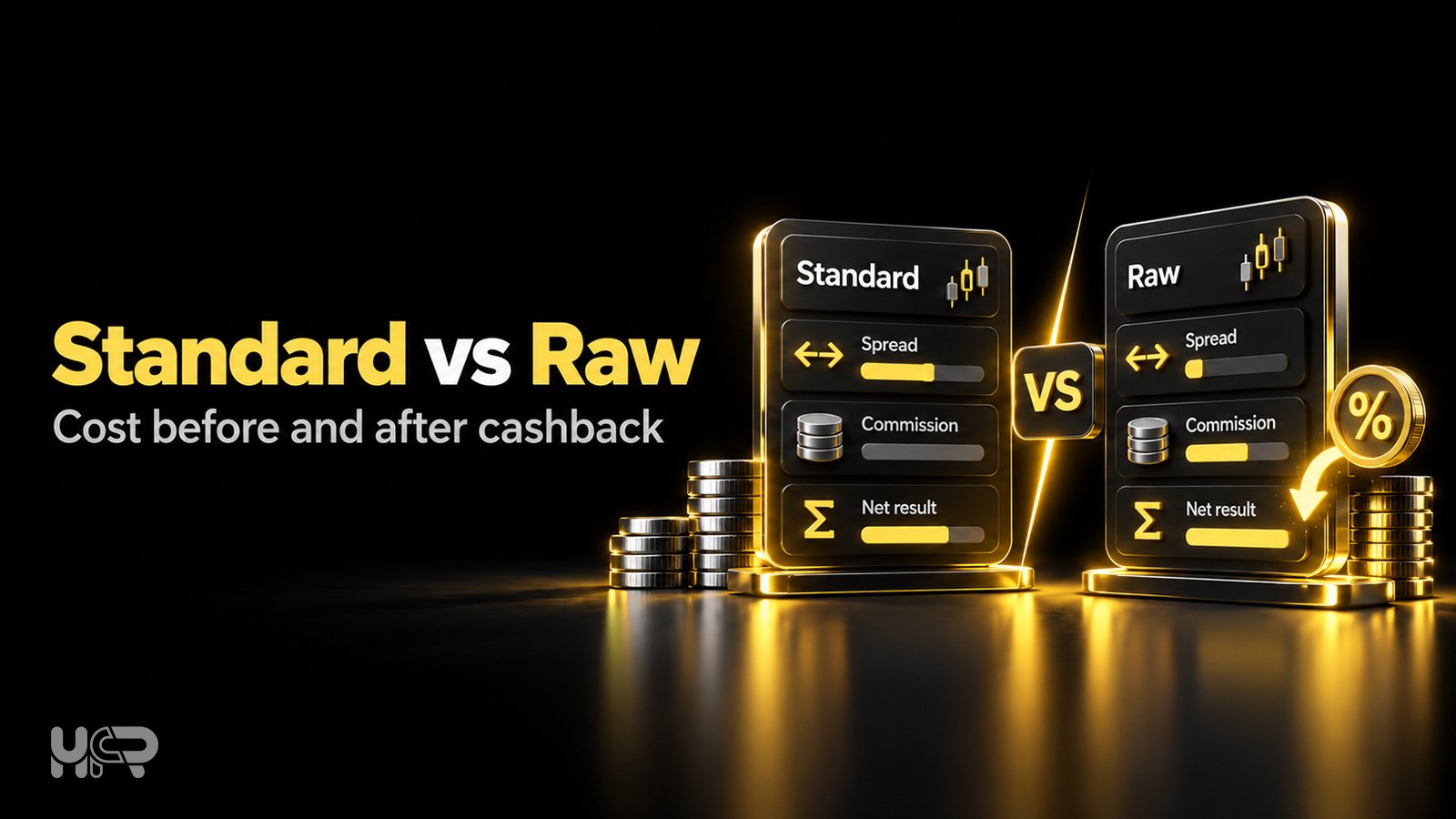
Forex accounts commonly use one of two pricing structures. A Standard-style account may include most of the trading cost in a wider variable spread, while a Raw-style account may show a tighter spread and charge a separate commission.
Those labels do not prove how orders are executed, and they are not standardised across brokers. The current fee schedule for the exact legal entity, platform and instrument remains the reference.
Spread statistics also need careful reading. A minimum or “from” spread shows the lowest published level, not the average spread a trader should expect across a session. Average or typical spreads are more useful for comparison when the measurement period and methodology are comparable.
Commission quotes must also use the same basis. $3.50 per lot per side becomes $7 round turn for one completed 1.00-lot trade when both entry and exit are charged.
For a fuller explanation of these conventions, see HFR’s guide to forex commission per side, per lot and round turn.
The fair comparison is therefore spread cost plus the complete round-turn commission, not either figure viewed alone.
Forex broker comparison 2026: matched cost table
The table models one completed 1.00-standard-lot EUR/USD trade on MT5 in a USD account, with $10 per pip and no overnight holding. Broker information and HFR rebate listings were rechecked on 27 October 2026. Figures are illustrative cost estimates, not actual transaction fills. Pepperstone’s averages cover August 2026; Tickmill publishes minimum spreads for the accounts shown.
| Broker/account | EUR/USD spread | Commission / RT | Gross basic cost | HFR rebate basis | Estimated net basic cost |
|---|---|---|---|---|---|
| Pepperstone Standard | 1.1 pips avg. | $0 | $11.00 | 0.36 pips / RT | $7.40 |
| Pepperstone Razor | 0.1 pips avg. | $7.00 | $8.00 | $1.70 / RT | $6.30 |
| Tickmill Classic, FSA Seychelles | From 1.6 pips | $0 | N/A — minimum only | $8.50 / RT | N/A — not comparable |
| Tickmill Raw, FSA Seychelles | From 0.0 pips | $6.00 | N/A — minimum only | $2 / RT + 5% Raw commission discount (eligible MT5) | N/A — not comparable |
RT = round turn; N/A = not directly comparable with an average-spread estimate.
Source notes: Pepperstone’s average spreads cover 1–31 August 2026, including rollover. HFR excludes EEA/UK Retail and Professional clients and Australian Retail clients from its Pepperstone rebate arrangement. Tickmill’s “from” spreads are minimums, not average-spread equivalents. HFR rebates are limited to eligible Tickmill Ltd (FSA Seychelles) accounts. Tickmill’s public account pages may redirect to a different legal entity, so Seychelles-specific pricing must be confirmed before account opening. The 5% Raw commission discount is listed for eligible MT5 accounts; it is a separate reduction, not additional cashback to subtract twice.
For the illustrated Pepperstone Standard trade, 0.36 pips is equivalent to $3.60 cashback, giving $11.00 − $3.60 = $7.40. For Razor, $8.00 − $1.70 = $6.30. Both net figures assume a fully eligible, confirmed rebate that is credited after trading. They cannot be used to rank Pepperstone against Tickmill’s minimum-spread quotes or predict future fills.
Worked examples: cost before and after cashback
The examples below use the same hypothetical trade: 1.00 standard lot of EUR/USD, with an illustrative pip value of $10 per pip. They show how spread, commission and eligible cashback can change the estimated basic transaction cost.
Standard account example
Assume a spread-based account has a 1.2-pip spread and no separate commission.
- Spread cost: 1.2 pips × $10 = $12.00
- Round-turn commission: $0.00
- Estimated basic cost: $12.00 + $0.00 = $12.00
The $12 figure is hypothetical. A real variable spread can be different when the trade is executed.
Raw account example
Now assume a Raw-style account has a 0.2-pip spread and charges $3 per lot per side.
- Spread cost: 0.2 pips × $10 = $2.00
- Round-turn commission: $3 entry + $3 exit = $6.00
- Gross basic cost: $2.00 + $6.00 = $8.00
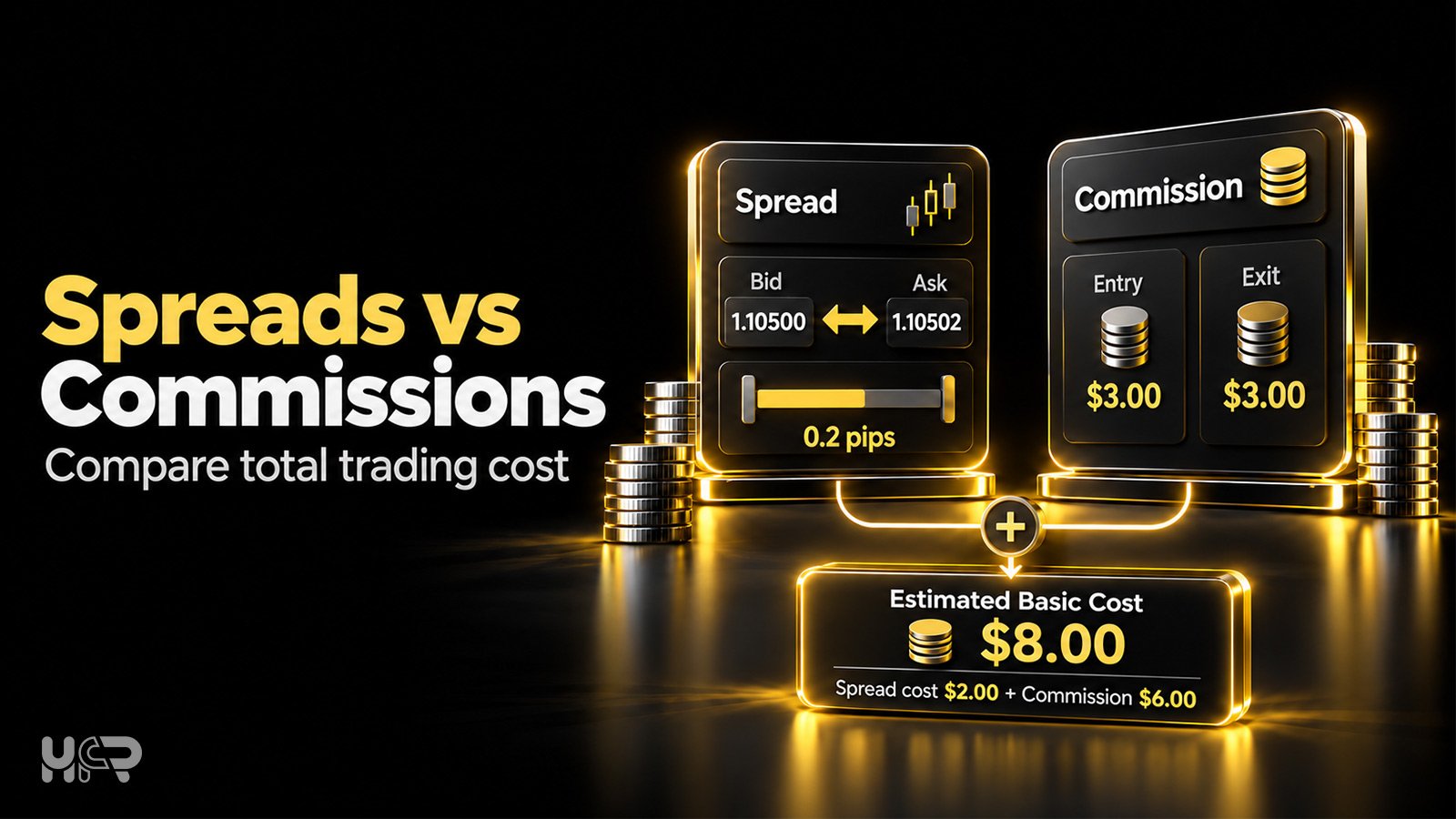
If the trade later qualifies for a separate $1.50 cashback payment:
$8.00 − $1.50 = $6.50 estimated net basic cost
Cashback or direct commission reduction
The treatment changes when the benefit is a direct commission reduction rather than cashback paid separately.
Suppose the same $6 round-turn commission is reduced by $1.50 before the broker charges it:
$6.00 − $1.50 = $4.50 reduced commission
The resulting basic cost is:
$2.00 spread + $4.50 commission = $6.50
The $1.50 must not then be deducted again as cashback. Doing so would count the same benefit twice.
How HFR cashback affects the effective trading cost
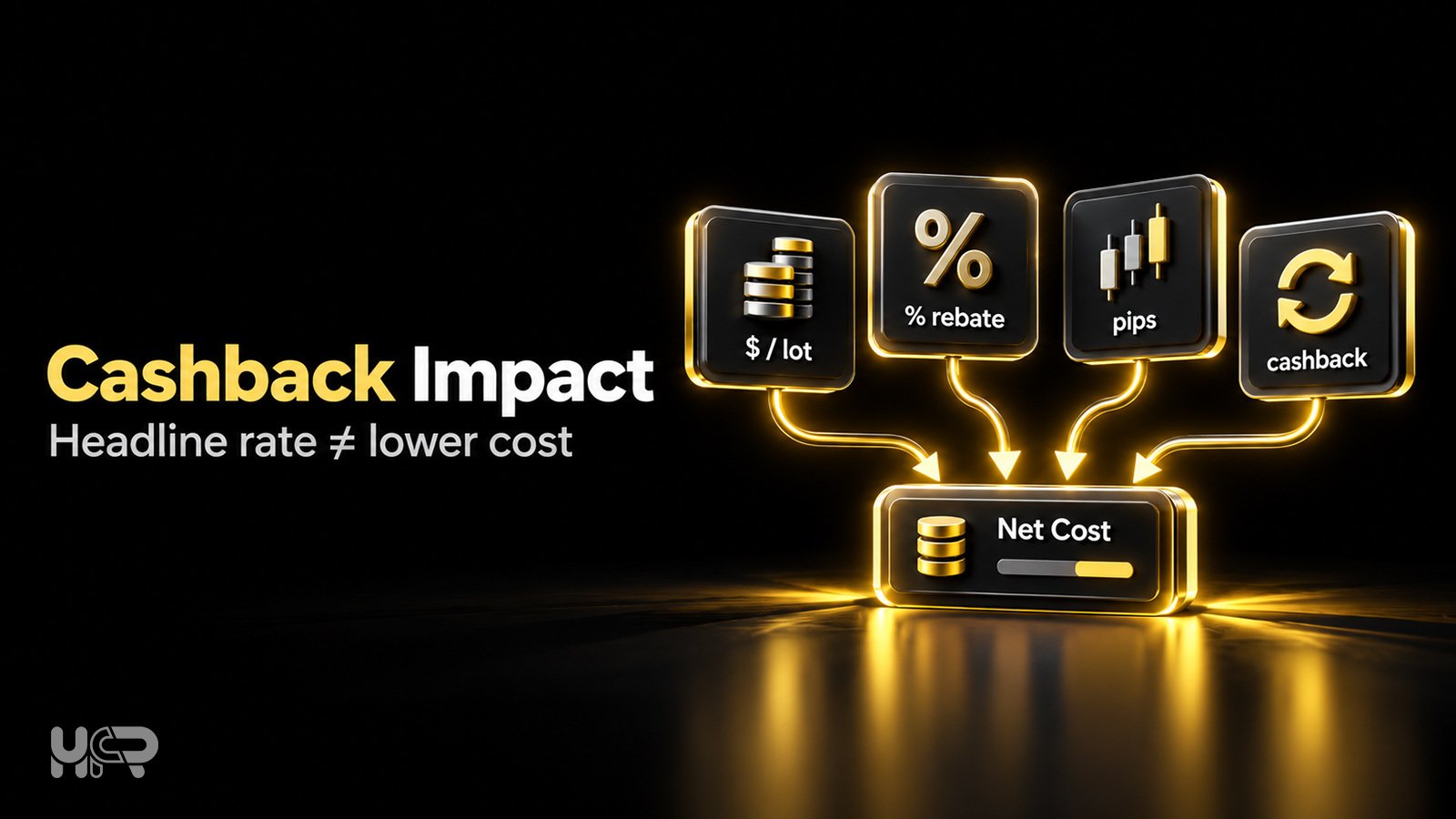
HFR broker rebates do not all use the same calculation method. Depending on the broker and account, cashback may be quoted as a fixed USD amount per lot, pips per lot, a percentage of the executed spread, a percentage of commission, or a percentage of broker revenue.
These figures cannot be compared directly by headline size. For example, “$4 per lot” and “40% of commission” use different calculation bases, so each must first be converted into a cash amount for the same trade before comparing estimated net cost.
Eligibility also matters. The displayed HFR rate may depend on the exact account type, broker legal entity, country, trading platform, instrument, and successful account tracking. An “up to” rate should not be treated as applying to every trade.
Broker commissions and HFR rebates are distinct. A separately credited cashback payment can offset the net cost only after the activity is accepted and payment is made. A broker-applied commission discount changes the commission charged at execution; do not deduct that same benefit again when calculating the net cost.
For current broker-specific rates and conditions, check HFR’s live forex rebate list and the individual broker listings.
Costs a spread-and-commission table cannot capture
A basic spread-and-commission comparison does not show every cost a trader may face.
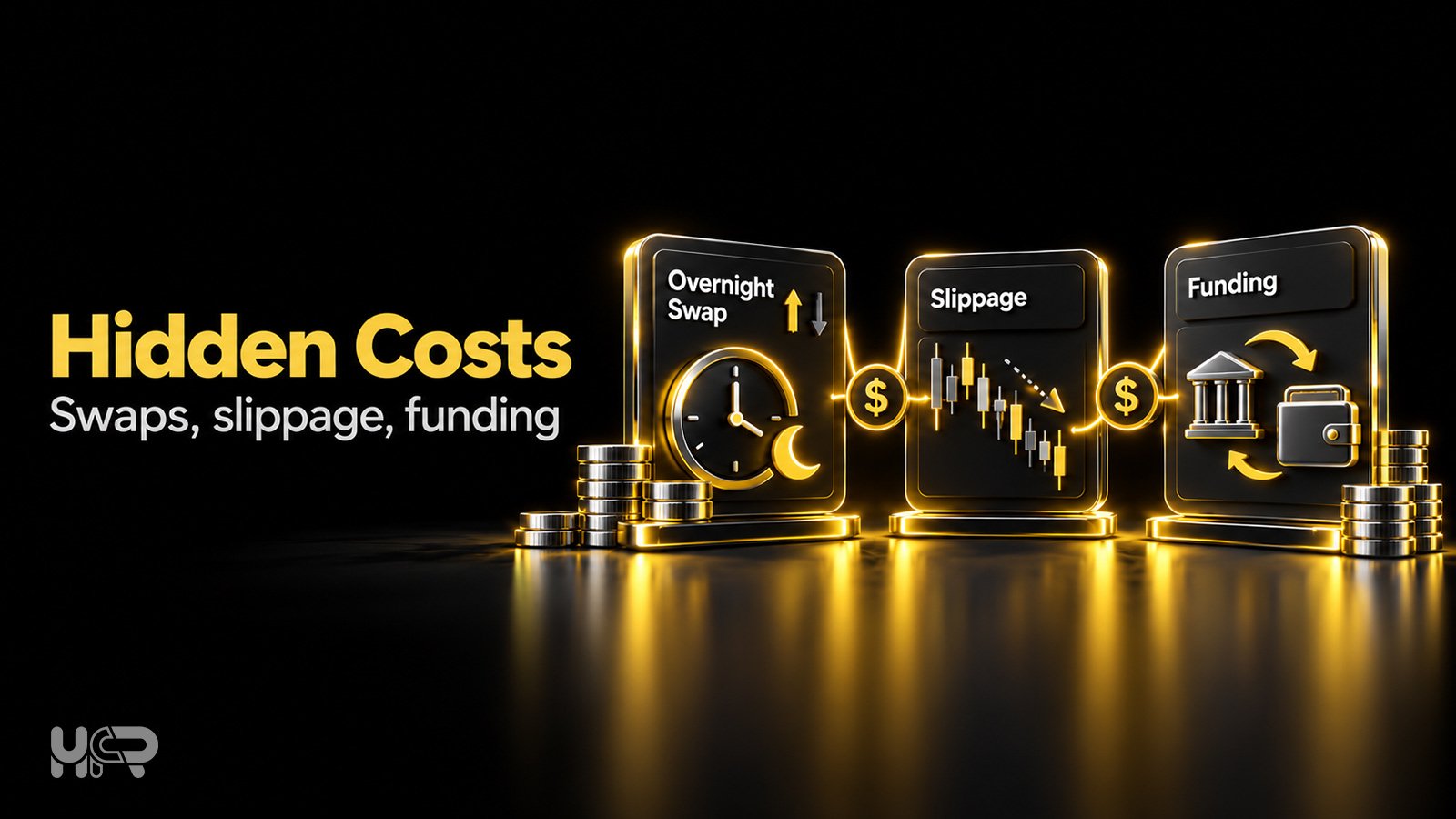
Overnight swaps or financing can apply when a position remains open beyond the broker’s rollover time. The amount may be positive or negative and can vary by instrument, direction, interest-rate conditions and broker terms.
Slippage is separate from the quoted spread: an order may fill at a different price from the one expected. Variable spreads can also widen around major news, daily rollover and market openings. Both effects can change realised cost compared with this model.
Funding costs should be treated separately as well. Deposits, withdrawals and currency conversion may involve broker charges, bank fees or payment-provider costs. A third-party processing fee is not automatically a broker fee.
For this reason, swaps, slippage and funding charges should only be added to an estimated cost when the comparison defines the relevant holding period, execution conditions or payment route. HFR’s guide to forex broker deposit and withdrawal fees explains these funding costs in more detail.
Who qualifies for the displayed broker and HFR terms?
Broker trading conditions and HFR cashback eligibility are separate checks. A broker may accept a client while a particular account, legal entity, country, platform or instrument is not eligible for the displayed HFR rate.

Before relying on a rebate figure, confirm the account type, contracting entity, region, trading platform, instrument or lot category, and any bonus or volume conditions attached to the offer. HFR tracking must also be approved before cashback should be expected.
New clients may need to register through a specific HFR tracking link. Existing clients follow different rules: some brokers permit an account to be reassigned to the HFR introducing-broker structure, while others require a new account or do not allow transfer at all.
An IB code or registration link should therefore be used only after checking the broker-specific instructions. Reassignment is broker-controlled and should not be treated as automatic or retroactive.
HFR’s guide to how to read a forex rebate page explains the eligibility and tracking fields to check before registration.
Regulation and protections are separate from costs
Trading cost is only one part of a broker comparison. Before focusing on spreads, commissions or cashback, check the exact legal entity that will hold the account, the regulator responsible for that entity and the protections that actually apply under its rules.
The same broker brand may operate through several companies with different leverage limits, client-money arrangements, compensation schemes and complaint procedures. Regulatory status should therefore be verified against the specific company named in the client agreement, not inferred from a group logo or licence displayed elsewhere.
Regulation provides a supervisory framework, but it is not a guarantee of safety or trading outcomes. Cashback is separate again: it may reduce part of an eligible trading cost, but it does not change margin requirements, execution conditions, leverage exposure or counterparty risk.
A practical checklist for comparing broker accounts
Before comparing two broker accounts, check that the inputs are genuinely matched:
- Use the same spread type and measurement window, not a minimum spread for one broker and an average for another.
- Include the full round-turn commission, covering both opening and closing charges.
- Check whether swap or overnight financing matters for the intended holding period.
- Separate broker charges from deposit, withdrawal, and FX-conversion costs.
- Confirm the exact HFR rebate basis and eligibility for the account and instrument.
- Make sure the account is correctly linked or reassigned before expecting cashback.
- Verify the legal entity, platform, and product availability for the client’s region.
- Check available support and the broker’s current account documentation before relying on any fee figure.
A useful comparison is built from matched, current inputs rather than headline spreads or cashback rates alone.
Use HFR’s tools to review current conditions
This article is a dated comparison snapshot, not a live trading quote. Broker spreads, commissions, account availability, and HFR rebate conditions can change.
Use HFR’s forex broker comparison tool to review currently displayed broker and account information side by side. You can also check the forex rebates list and individual broker pages for current rebate terms.
Before opening or linking an account, verify the exact legal entity, account type, platform, instrument fees, and HFR eligibility that apply to you.
Conclusion
A useful forex broker comparison in 2026 compares the same trade on the same basis: spread cost, full round-turn commission and any applicable rebate. The lowest headline spread, commission or cashback rate does not by itself determine the lowest net cost.
Before choosing or linking an account, verify the current broker entity, account type, platform, spread basis, commission schedule and HFR eligibility. Treat calculated net costs as estimates rather than guaranteed execution prices, and avoid judging brokers only by the largest advertised cashback figure.
FAQ
What is the cheapest forex broker in 2026?
There is no universal cheapest broker. The result depends on the exact legal entity, account, platform, instrument, trade size, and spread measurement. Compare matched spread costs, full round-turn commission, and any confirmed eligible rebate.
Are zero-commission forex accounts cheaper?
Not necessarily. A zero-commission account may use a wider spread. The relevant comparison is the total cost of the spread plus any commission and other applicable charges.
How do I compare a spread in pips with a dollar commission?
Convert the spread into money using the pip value for the same position size, then add the complete round-turn commission. For one EUR/USD standard lot in a USD account, a $10-per-pip assumption may be used illustratively.
Is a Raw or Standard account cheaper after cashback?
It varies. Raw accounts may combine tighter spreads with separate commission, while Standard accounts may include more cost in the spread. Compare both using the same trade and only confirmed eligible cashback.
Does a higher cashback rate always produce lower trading costs?
No. The rebate unit, starting spread, broker commission and eligibility rules all affect the result. Different rebate units must be converted to the same cash basis first.
Are advertised 0.0-pip spreads available on every trade?
No. “From 0.0 pips” normally describes a minimum, not a guaranteed or average spread. Variable spreads can widen with market conditions.
Can I get forex cashback on an existing account?
Sometimes. Some brokers permit an existing account to be reassigned to HFR after approval. Others require a new account. Linking is not automatic or retroactive.
Do forex rebates reduce trading risk or overnight swap fees?
No. Rebates may offset part of an eligible trading cost, but they do not reduce market, leverage, execution or liquidation risk and do not automatically cover overnight financing.
Risk and commercial disclosure
HighFxRebates may receive remuneration from broker partners for eligible referred activity. Cashback is subject to account, instrument, legal-entity, regional and tracking conditions and is not guaranteed for every trade.
Forex and CFD trading, particularly with leverage, involves a high risk of loss. Rebates may offset part of an eligible trading cost, but they do not reduce market, leverage, execution, liquidation or counterparty risk. This article is for informational purposes only and is not investment or trading advice.
Sources and methodology
Sources were rechecked on 27 October 2026 using official broker pricing pages and the live HFR Pepperstone and Tickmill listings. Pepperstone’s average spreads refer to 1–31 August 2026; the Tickmill sources show minimum spreads and may direct visitors to jurisdiction-specific pages. The figures illustrate the basic cost for a one-lot EUR/USD trade, not account-specific executable quotes, independently tested results, or a broker ranking.
 6
Share Posts


Further Reading
- Why Crypto Exchanges Require KYC: Verification Levels, Limits and Regional Rules
- Toobit Now Listed on HighFxRebates: 36% Spot and Futures Cashback
- Weekly Market Recap, 26 October–1 November 2026: Rates, Binance and Metals
- Daily technical outlook: Bitcoin and Ether recover as Solana and metals lag — 2 November 2026