
Forex Trading Sessions Explained: London, New York, Tokyo and Sydney
Compare the four main forex sessions, their overlaps and daylight-saving changes, with examples in local time and UTC.
The forex market runs across four broad regional sessions: Sydney, Tokyo, London and New York. As business activity moves between these centres, major currency pairs can remain tradable around the clock on most weekdays.
Session labels help explain who may be active and when liquidity can change. They do not set the opening hours for every forex broker. Holidays, platform maintenance and daylight-saving changes also affect the times shown on a trading screen.

What are forex trading sessions?
Forex trading sessions describe periods associated with financial centres in Australia, Japan, the United Kingdom and the United States. Banks, companies, institutional investors and other participants in these regions contribute to currency-market activity during their local business days.
Spot foreign exchange is largely traded over the counter (OTC), through multiple banks, dealers and trading venues. There is no single global spot-FX exchange that opens and closes at the same time for everyone. Currency futures and options also trade on regulated exchanges, but this article focuses on OTC forex.
Why does forex trade 24 hours on weekdays?
Sydney begins the Asia-Pacific day, Tokyo follows, London opens as parts of Asia remain active, and New York overlaps with London. This sequence supports a nearly continuous trading week from Sunday evening to Friday evening in New York time.
That does not mean every account or currency pair trades without interruption. Brokers can suspend prices for maintenance, holidays or instrument-specific breaks.
For example, OANDA Corporation lists most forex pairs from Sunday 17:05 to Friday 16:59 New York time, with a six-minute daily break. That schedule applies to its specified products and entity, not to the entire OTC market.
The four major forex sessions at a glance
Session tables often mix local time with US Eastern Time, which can create errors when daylight-saving dates differ. The reference below uses approximate local business windows, then converts them into UTC for two specific Wednesdays. It is an educational convention, not official exchange opening hours or a broker dealing schedule.
Session | Local reference | 18 Nov 2026 (UTC) | 15 Jul 2026 (UTC) |
|---|---|---|---|
Sydney | 09:00–18:00 | previous day 22:00–07:00 | previous day 23:00–08:00 |
Tokyo | 09:00–18:00 | 00:00–09:00 | 00:00–09:00 |
London | 08:00–17:00 | 08:00–17:00 | 07:00–16:00 |
New York | 08:00–17:00 | 13:00–22:00 | 12:00–21:00 |
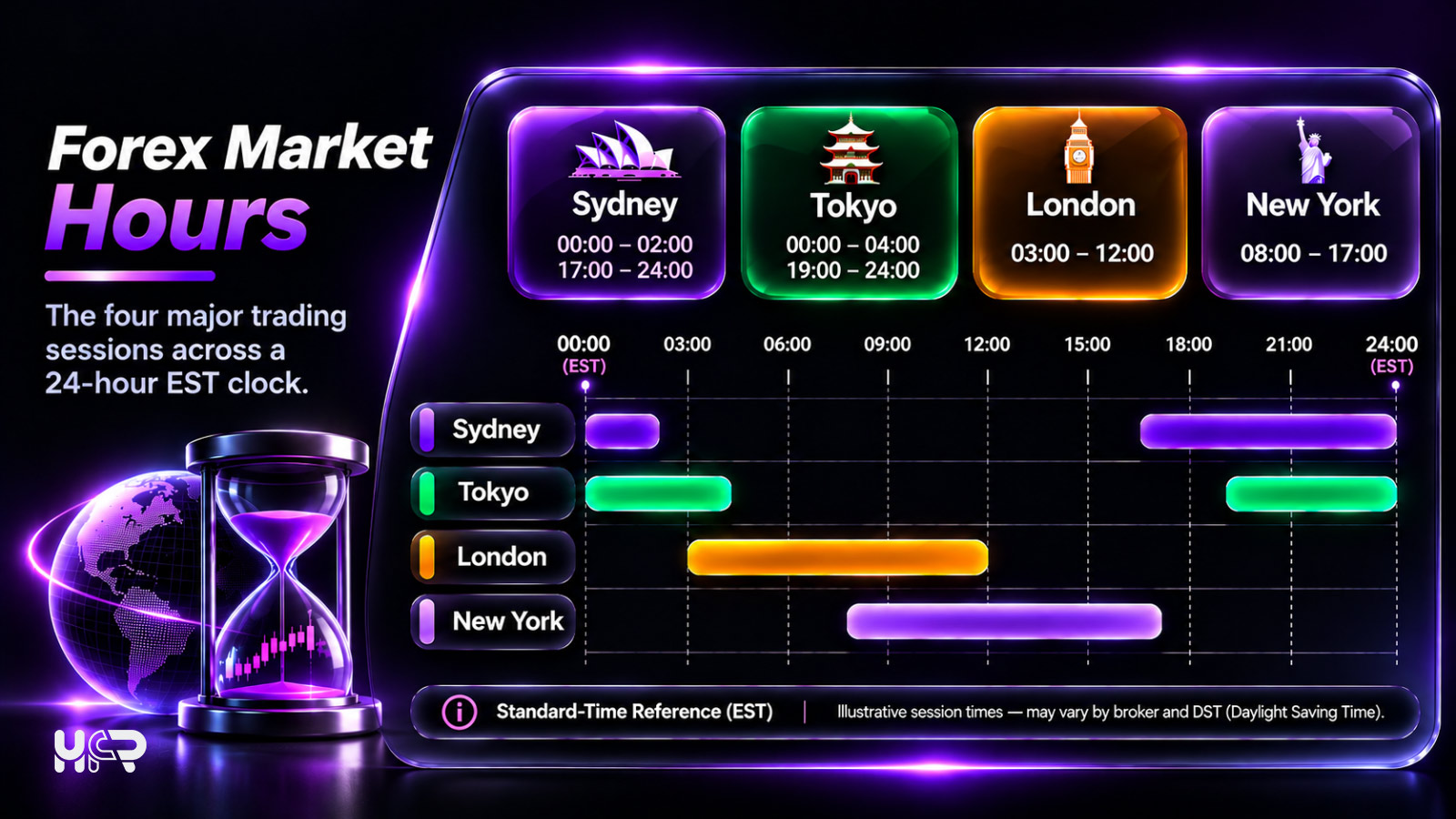
The November and July columns are snapshots, not fixed year-round UTC rules. Sydney begins on the previous UTC calendar day in both examples. Seasonal clock changes and the weeks when countries switch on different dates can change the overlaps.
What is the Sydney forex session?
Sydney is often used as the starting reference for the new forex week. Australian and New Zealand economic releases and local business activity can affect participation before Tokyo becomes fully active.
AUD and NZD pairs may attract particular attention during these hours, although no pair is guaranteed to be more volatile simply because its home market is open.
What is the Tokyo forex session?
Tokyo is the main local reference for Japanese business hours and a wider period of Asian currency activity. USD/JPY and yen crosses can be active when Japanese market participants are working.
Japan does not observe daylight saving time. A Tokyo session at 09:00 Japan Standard Time therefore stays at 00:00 UTC, even when its displayed time changes in London or New York.
What is the London forex session?
London is a major centre for global currency trading. The 2025 Bank for International Settlements (BIS) Triennial Survey attributed about 38% of worldwide FX turnover to UK sales desks in April 2025. This is a share of reported trading location, not a claim that 38% of transactions took place during a fixed nine-hour window.
London overlaps with the end of Asian business hours and with New York later in the day. European economic releases, central-bank statements and cross-border flows can affect trading during this period.
EUR/USD and GBP/USD commonly receive attention, but actual volatility, spreads and executable liquidity depend on the pair, the day and the news calendar.
What is the New York forex session?
New York covers the North American business day and overlaps with London. US employment, inflation, and Federal Reserve releases can influence dollar pairs, while Canadian data can affect CAD crosses.
The US dollar appeared on one side of 89.2% of FX trades measured by the BIS in April 2025. The figure describes global currency turnover, not the portion that occurs within the New York session.
When London closes, New York activity continues. Some major pairs may see fewer competing quotes later in the day, but unexpected events can still produce large price moves.
How do forex session overlaps work?
An overlap is a period when two regional business windows are active together. The times below are derived from the local-time convention in the preceding table and are shown in UTC for the same two example dates. They are not universal execution hours.
Overlap | 18 Nov 2026 (UTC) | 15 Jul 2026 (UTC) |
|---|---|---|
Sydney–Tokyo | 00:00–07:00 | 00:00–08:00 |
Tokyo–London | 08:00–09:00 | 07:00–09:00 |
London–New York | 13:00–17:00 | 12:00–16:00 |
Why is the London-New York overlap closely watched?
The London–New York overlap brings together two large currency-trading centres. The period can include major US economic releases and is often liquid in frequently traded pairs.
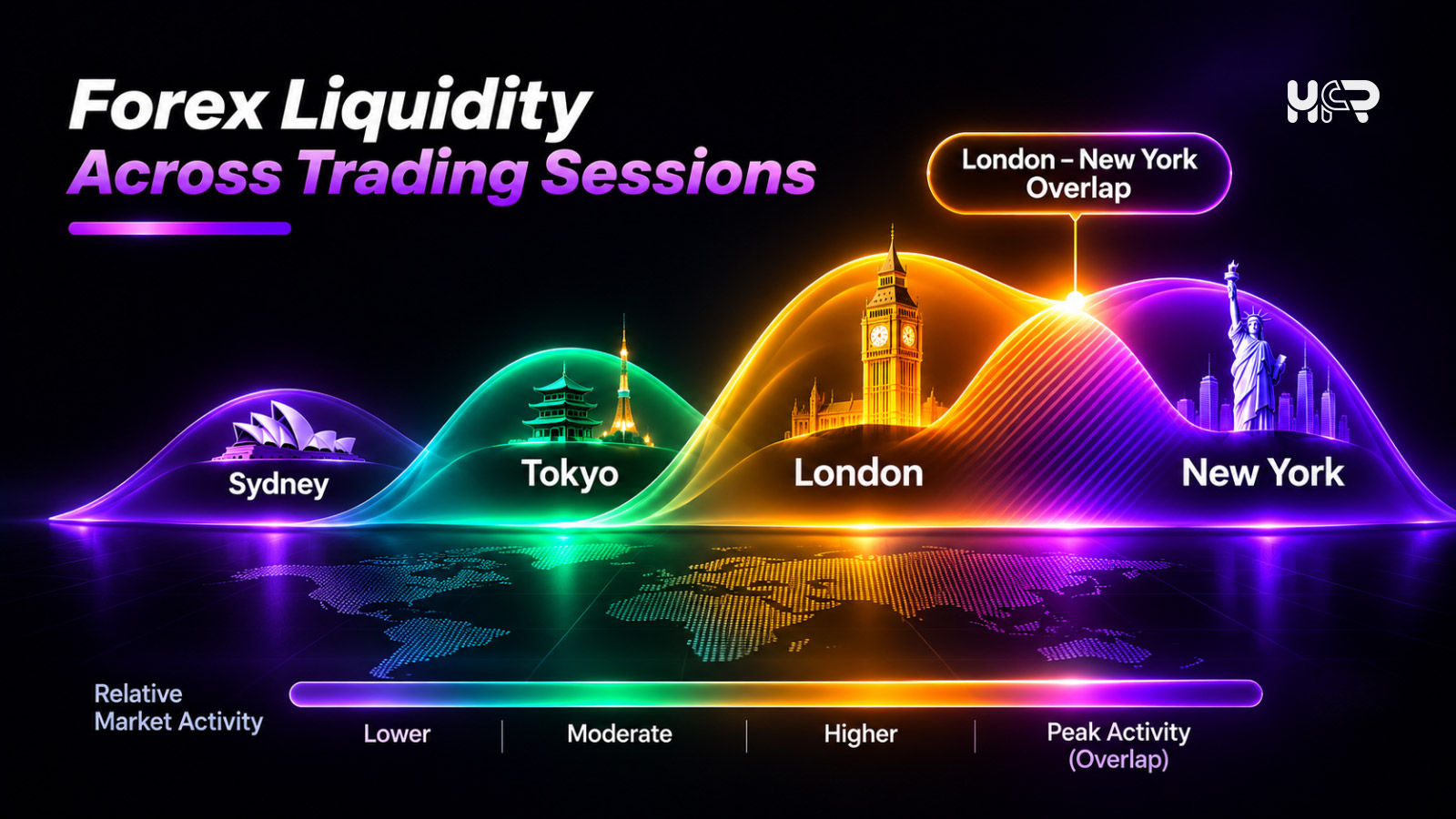
Higher participation may support tighter spreads, but that relationship is not guaranteed. Around important data releases, price movement can accelerate and available spreads may widen. HFR explains the distinction in its guide to forex spread widening.
How can liquidity, volatility and spreads change by session?
Liquidity concerns the availability of buyers, sellers and executable prices. Volatility describes how much and how quickly prices move. A session can be liquid yet volatile, or relatively quiet with occasional sharp moves.
When more market participants quote major pairs, spreads may narrow. During data releases or thin-liquidity transitions, spreads can widen and orders may fill away from an expected price. Read HFR’s forex slippage guide for the separate execution issue.
Why do forex session times change with daylight saving time?
Daylight saving time (DST) changes the UTC offset of some cities. New York and London move their clocks in spring and autumn on different dates; Sydney changes on a different seasonal schedule, while Tokyo remains on Japan Standard Time.
For example, London is 08:00–17:00 UTC under the illustrative winter window but 07:00–16:00 UTC during British Summer Time. New York is 13:00–22:00 UTC on Eastern Standard Time and 12:00–21:00 UTC on Eastern Daylight Time. The resulting overlap can temporarily differ during March and October transition weeks.
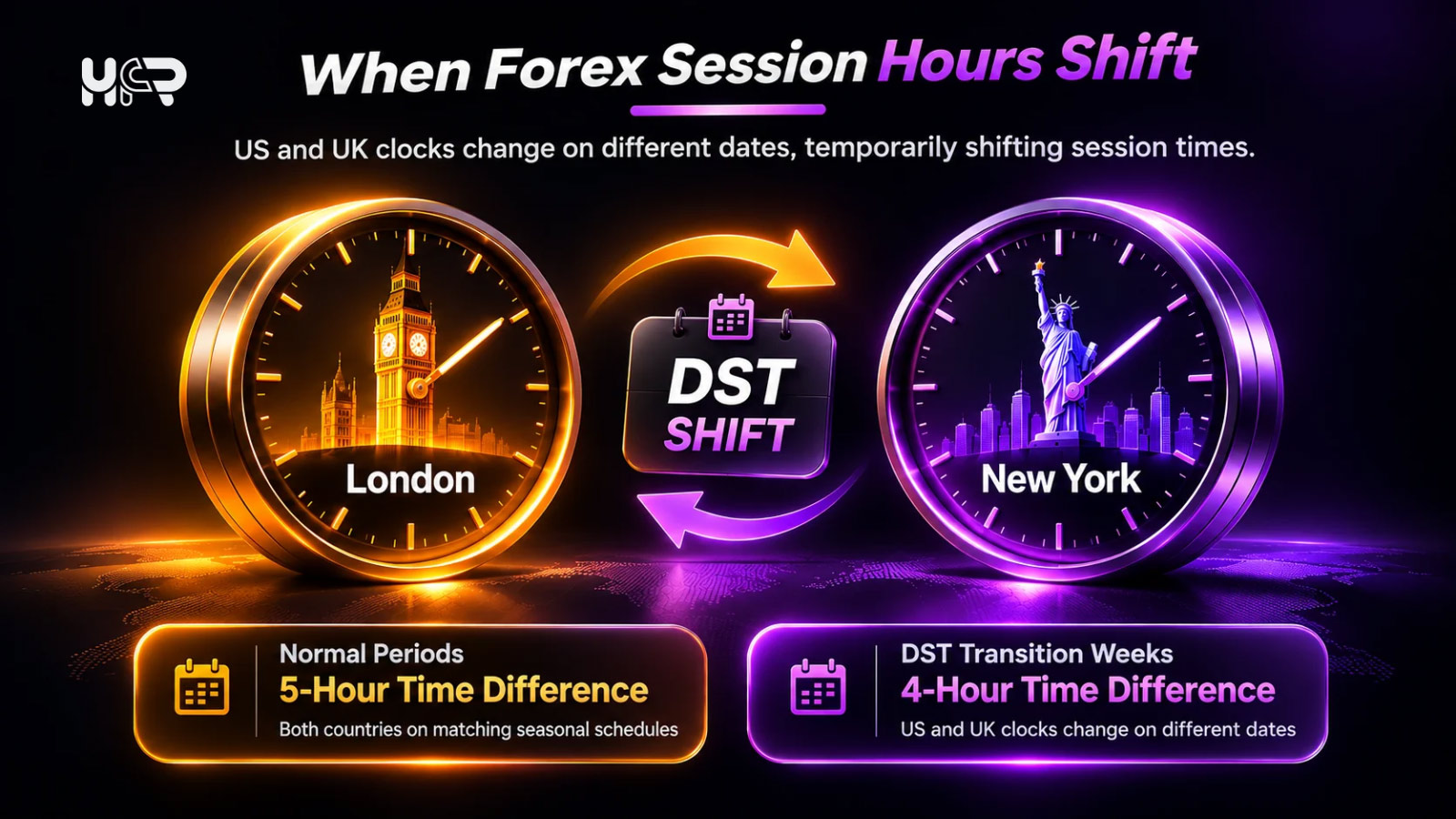
When planning around a session open or an economic release, check the current local clock, time zone and broker trading hours. A screenshot with only “EST” or an unlabelled “London open” can be wrong for part of the year.
Why can broker trading hours differ from forex session labels?
A regional session is an educational reference. A broker’s trading hours specify when a particular instrument is actually available on its platform.
Brokers can apply maintenance breaks, different weekly opening and closing times, public-holiday schedules and product-specific restrictions. These details can also vary by legal entity and platform.
Which currency pairs are most relevant to each session?
Currency pairs may attract more local interest when one of their home economies is active. Scheduled releases and business flows can matter more than the session label itself.
Session | Pairs often associated with the session | Why they may be relevant |
|---|---|---|
Sydney | AUD/USD, NZD/USD, AUD/JPY | Australian and New Zealand markets and data are active. |
Tokyo | USD/JPY, EUR/JPY, AUD/JPY | Japanese markets and yen-related flows are active. |
London | EUR/USD, GBP/USD, EUR/GBP, GBP/JPY | UK and European markets are active; London is a major FX centre. |
New York | EUR/USD, USD/JPY, GBP/USD, USD/CAD | US and Canadian markets are active; many major US data releases occur in this window. |
Pairs are not limited to one region. EUR/USD is commonly active during both London and New York, while USD/JPY can respond to Japanese events in Tokyo and US releases in New York.
A practical example: how one forex day moves through the sessions
Consider a normal Wednesday in November. Under the example clock convention, Sydney has already started by 22:00 UTC on Tuesday; Tokyo begins at 00:00 UTC, London at 08:00, and New York at 13:00. Each interval overlaps at least one adjacent regional business window.
The economic calendar can change the pattern. Japanese data may affect yen pairs during Asian hours, while UK releases and US inflation or employment reports can matter during London and the transatlantic overlap. Session times explain when participants are active; they do not predict a price move.
For examples of how releases are discussed in context after they occur, see HFR’s market analysis archive.
Common mistakes when reading forex session times
Treating one session table as permanently correct. DST changes can shift the relationship between sessions and UTC.
Confusing session labels with broker execution hours. A broker may have maintenance breaks, holiday changes or instrument-specific restrictions.
Forgetting to name the time zone. “London opens at 8” is incomplete unless the time zone is clear.
Assuming an active session guarantees volatility. Activity can be high while price movement remains limited.
Assuming a quieter session cannot move sharply. Unexpected news or thin liquidity can still produce large moves.
Ignoring transition weeks. The US, UK, and Australia can change clocks on different dates.
A simple checklist for using forex session information
Which regional session or overlap is active?
What time zone is the session table using?
Is daylight saving time currently in effect in the relevant financial centres?
Is this a DST transition week when session relationships may temporarily shift?
Does my broker list a different open, close, or maintenance break?
Are there holidays affecting one of the regional financial centres?
Are major economic releases or central-bank events scheduled during this session?
Final takeaway
Forex trading sessions group weekday OTC currency activity around Sydney, Tokyo, London and New York. Overlaps can help explain changes in participation and available liquidity.
Use session clocks as reference windows, not fixed execution schedules. For exact market access, check your broker’s instrument hours and the current daylight-saving offset. Session timing alone does not establish price direction or a particular spread.
Risk warning and disclaimer
Forex and CFD trading involve the risk of loss, especially when leverage is used. Liquidity, spreads, volatility and execution conditions can change across sessions and around economic releases, holidays and market openings. Session times do not guarantee particular spreads, price movements or execution outcomes.
This article is for educational and informational purposes only. It is not financial, investment or trading advice and does not recommend any broker, currency pair or trading strategy.
Sources and methodology
Session windows are approximate educational references based on local business hours. The UTC examples were calculated for 18 November and 15 July 2026 using the named financial centres’ time zones; actual broker hours can differ. BIS statistics refer to reported FX turnover in April 2025, not to transactions completed within a particular session. Sources checked 18 November 2026.
FAQ
The four commonly used session labels are Sydney, Tokyo, London and New York. They represent broad regional activity windows rather than four centralised forex exchanges.
Spot forex is generally available around the clock on weekdays as activity passes across global centres. Brokers can still apply daily breaks, holiday changes or product-specific hours.
Under the local-time reference used here, London is approximately 08:00–17:00 London time. That converts to 08:00–17:00 UTC in winter and 07:00–16:00 UTC during British Summer Time. A broker or market-data provider may use different educational boundaries.
A common local reference for New York is approximately 08:00–17:00. That is 13:00–22:00 UTC on Eastern Standard Time or 12:00–21:00 UTC on Eastern Daylight Time. Confirm the time zone shown by your own platform.
It is the part of the day when the London and New York reference windows overlap. In the two examples above it runs from 13:00–17:00 UTC on 18 November and 12:00–16:00 UTC on 15 July 2026. DST transition weeks can shift the duration.
Yes. Sydney, London and New York change clocks seasonally, not always on the same dates. Tokyo does not use daylight saving time, so fixed US-time or UK-time charts may misstate Tokyo hours during some months.
London and the London-New York overlap are commonly associated with high activity in major pairs, but liquidity and volatility still vary by pair, day and event calendar.
JPY pairs often receive attention during Tokyo hours, while AUD and NZD pairs may be more active around Sydney and the broader Asia-Pacific session. These are regional tendencies, not reliable forecasts of price movement.
Session tables describe regional windows; broker hours describe actual platform availability and can include maintenance, holidays or product-specific exceptions.