






Table of Contents
[ Show/Hide ]- • Why do forex spreads widen?
- • What is a normal variable forex spread?
- • How does liquidity affect forex spreads?
- • Why do news and volatility widen forex spreads?
- • Why can spreads widen around rollover?
- • Why do spreads widen near market open and close?
- • A worked example: how a spread can widen without a large chart move
- • How does a wider spread affect a forex trade?
- • Is spread widening the same as slippage?
- • Why can the same forex pair have different spreads at different brokers?
- • How can you check whether a wide spread is normal?
- • Common mistakes when reading forex spreads
- • FAQ
- • Final takeaway
- • Risk warning and disclaimer
- • Sources and methodology
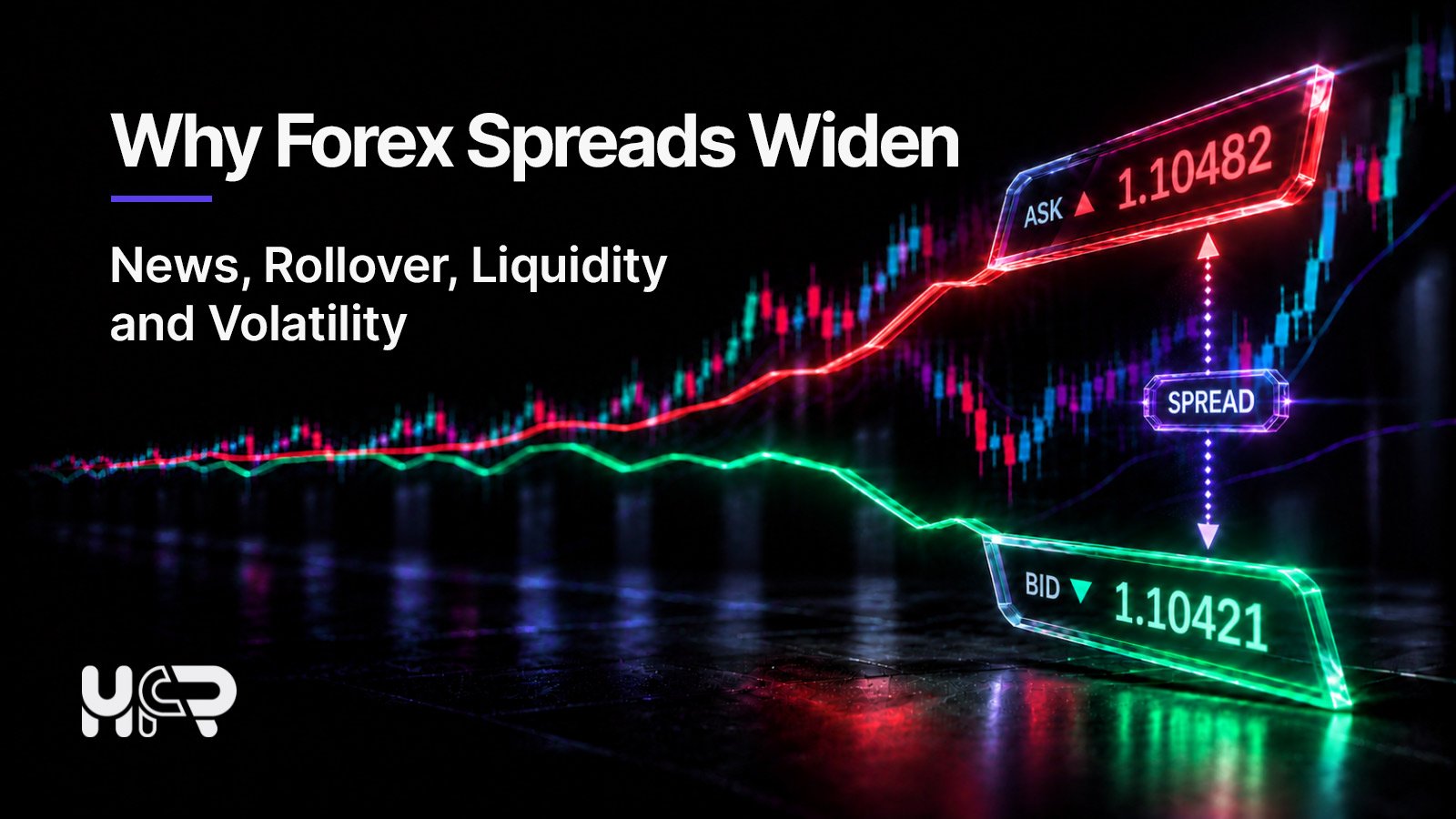
Forex spreads widen when the distance between the Bid and Ask increases. This usually happens when available liquidity falls, market prices become more volatile, or pricing conditions change around news releases, market openings and closings, or other periods of uncertainty.
A wider spread increases the price disadvantage between buying and selling and can raise the transaction cost of completing a trade. It can also change which Bid or Ask level is relevant to a pending order, Stop Loss, or Take Profit. Many forex accounts use variable spreads, so a wider quote is not automatically abnormal.
An advertised minimum spread is not a permanent quote. Actual spreads depend on the broker, account type, instrument, legal entity, and live market conditions. This guide explains why spreads widen and how to investigate an unusually large quote.
Why do forex spreads widen?

A forex spread widens when the Ask moves further above the Bid. Common drivers are lower liquidity, faster price movement, major news, uncertainty, and market transitions such as opening or closing periods. These conditions can make a narrow two-way quote harder to maintain.
OANDA describes its spreads as dynamic and links larger spreads to volatility, changes in global liquidity, news, market openings and closings, and uncertainty. IG likewise states that forex spreads are variable and may increase during illiquid periods or major economic releases.
What is a normal variable forex spread?
Why the minimum spread is not the spread you always get
A broker may advertise a minimum spread such as 0.6 pips or "from 0.0 pips" on a Raw account. That is the tightest quoted level available under the stated pricing model, not a promise that the spread will remain there.
IG’s published forex CFD tables distinguish minimum from average spreads, although some reported average figures relate to historical measurement periods rather than today’s pricing. Always check the date and account conditions attached to a spread statistic. For a detailed comparison of pricing models, see HFR’s Raw Spread vs Standard Account guide.
Why average and live spreads can differ
An average spread combines observations across a period; the live spread is the current Bid-Ask distance. A pair can trade near its average for much of the day and still widen sharply for a short period. Compare like with like: minimum with minimum, average with average, or live quotes observed under similar conditions.
How does liquidity affect forex spreads?
Why high liquidity usually supports tighter spreads
Liquidity refers to the availability of buyers, sellers, and executable prices. When many participants are quoting and trading, competing prices can sit closer together, usually supporting a narrower spread.
What happens when fewer prices are available
When liquidity thins, fewer competitive quotes may be available near the market price. The highest available Bid may move lower, the lowest Ask higher, or both can change, widening the spread. This can occur at certain times of day, on holidays, during market transitions or when liquidity providers reduce exposure.
Why do news and volatility widen forex spreads?
What happens around an economic release
Major scheduled releases such as inflation data, employment reports and central-bank decisions can cause prices to change rapidly as new information reaches the market. Some liquidity providers may quote more cautiously or reduce the size available near the current price while the market is repricing.
The result can be a wider spread before, during or immediately after the release. This does not mean every news event produces the same widening, and the size and duration can differ by currency pair, broker, account and market conditions.
Why volatility can widen spreads
News is a possible catalyst; volatility is the market condition describing how quickly and how far prices are changing. Volatility can come from scheduled data, geopolitical events, sudden order flow, or other shocks, so spread widening is not only a "news" effect.
When prices move quickly, a narrow quote can become stale almost immediately. Liquidity may be pulled or repriced, allowing Bid and Ask to move further apart.
Volatility can also coincide with gaps and slippage, but these are separate concepts: a wider spread is a larger Bid-Ask distance, a gap is a jump between available prices, and slippage is a difference between the expected and actual fill.
Why can spreads widen around rollover?
What forex rollover actually means
Forex rollover refers to the overnight financing or swap adjustment associated with holding an eligible position beyond the broker’s designated daily cutoff. FOREX.com describes its forex rollover processing around 5:00 p.m. New York time. The financing method, applicable date, and exact cutoff depend on the broker and instrument.
Why rollover cost and spread widening are not the same thing
The rollover charge itself is not the Bid-Ask spread. However, the daily New York-close transition can coincide with thinner liquidity and wider quotes. FOREX.com notes that spreads may widen and liquidity may thin briefly around daily rollover. Exact timing and behaviour remain broker- and instrument-specific, so saying "rollover causes the spread" is too simplistic.
Rollover policy varies by provider, so check the broker's processing time, financing method and instrument-specific terms.
Why do spreads widen near market open and close?
Why the Friday close can be different
Liquidity can fall as the weekly market approaches its close. OANDA Corporation notes that spreads typically widen at 4:00 p.m. Friday New York time in its environment to reflect decreased global liquidity. That timing is provider-specific, not a universal rule.
What can happen when the market reopens
When the market reopens after a weekend or other closure, the first available prices can differ from the previous close. Liquidity may still be rebuilding, spreads can be wider and prices can gap.
A worked example: how a spread can widen without a large chart move
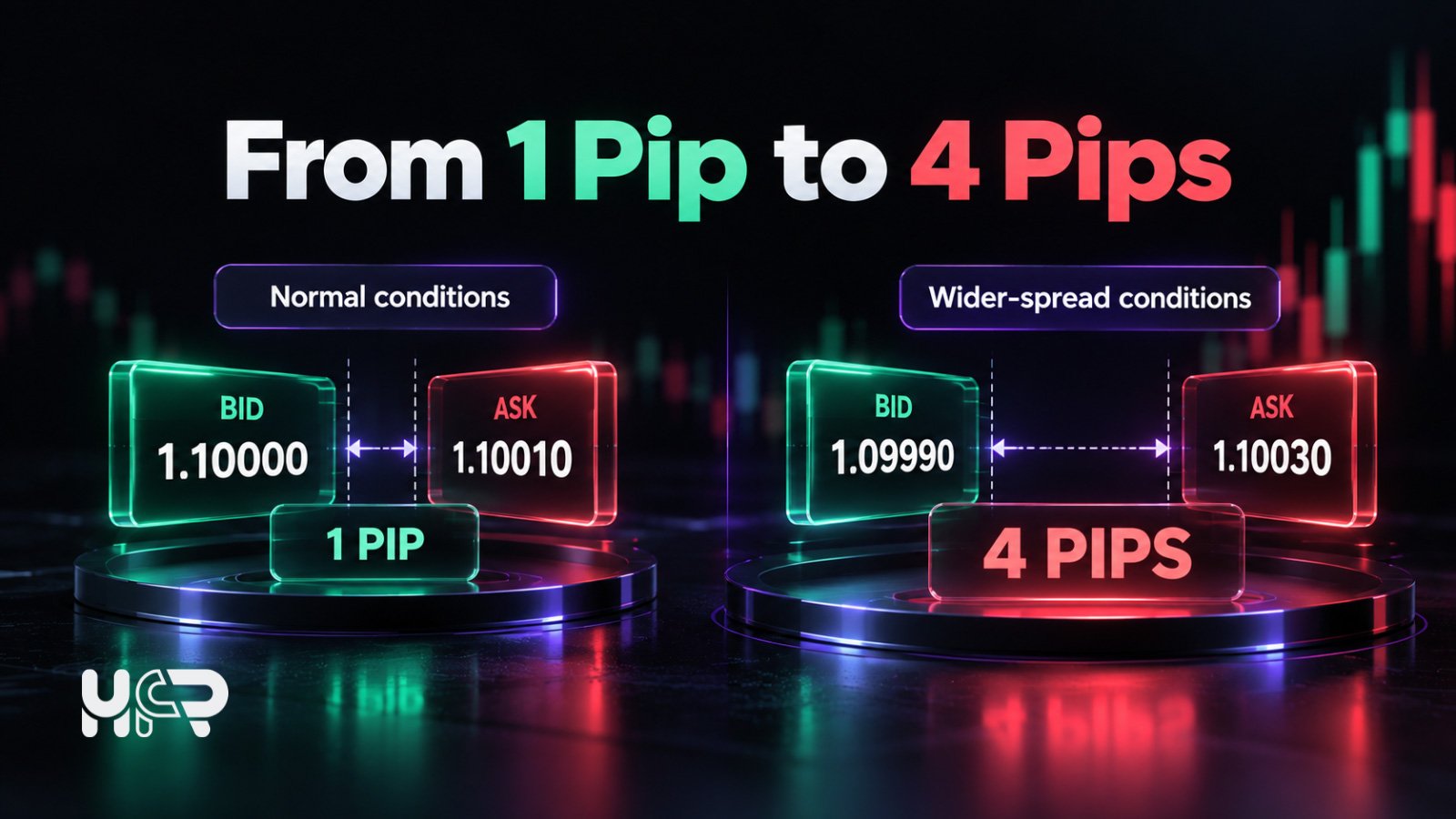
Assume EUR/USD is initially quoted with a 1-pip spread and then liquidity becomes thinner. The example is illustrative, not broker pricing:
| Condition | Bid | Ask | Important condition |
|---|---|---|---|
| Normal conditions | 1.10000 | 1.10010 | 1 pip |
| Wider-spread conditions | 1.09990 | 1.10030 | 4 pip |
The Bid is 1 pip lower and the Ask 2 pips higher, yet the spread has widened from 1 pip to 4 pips. A trader looking only at one chart price might miss the larger change in the available buying and selling prices. For an illustrative 100,000-unit EUR/USD trade, the additional 3 pips would correspond to about $30 of quoted spread cost at $10 per pip, before any separate commissions or execution differences.
For the underlying quote mechanics, see HFR's Bid vs Ask Price in Forex guide.
How does a wider spread affect a forex trade?
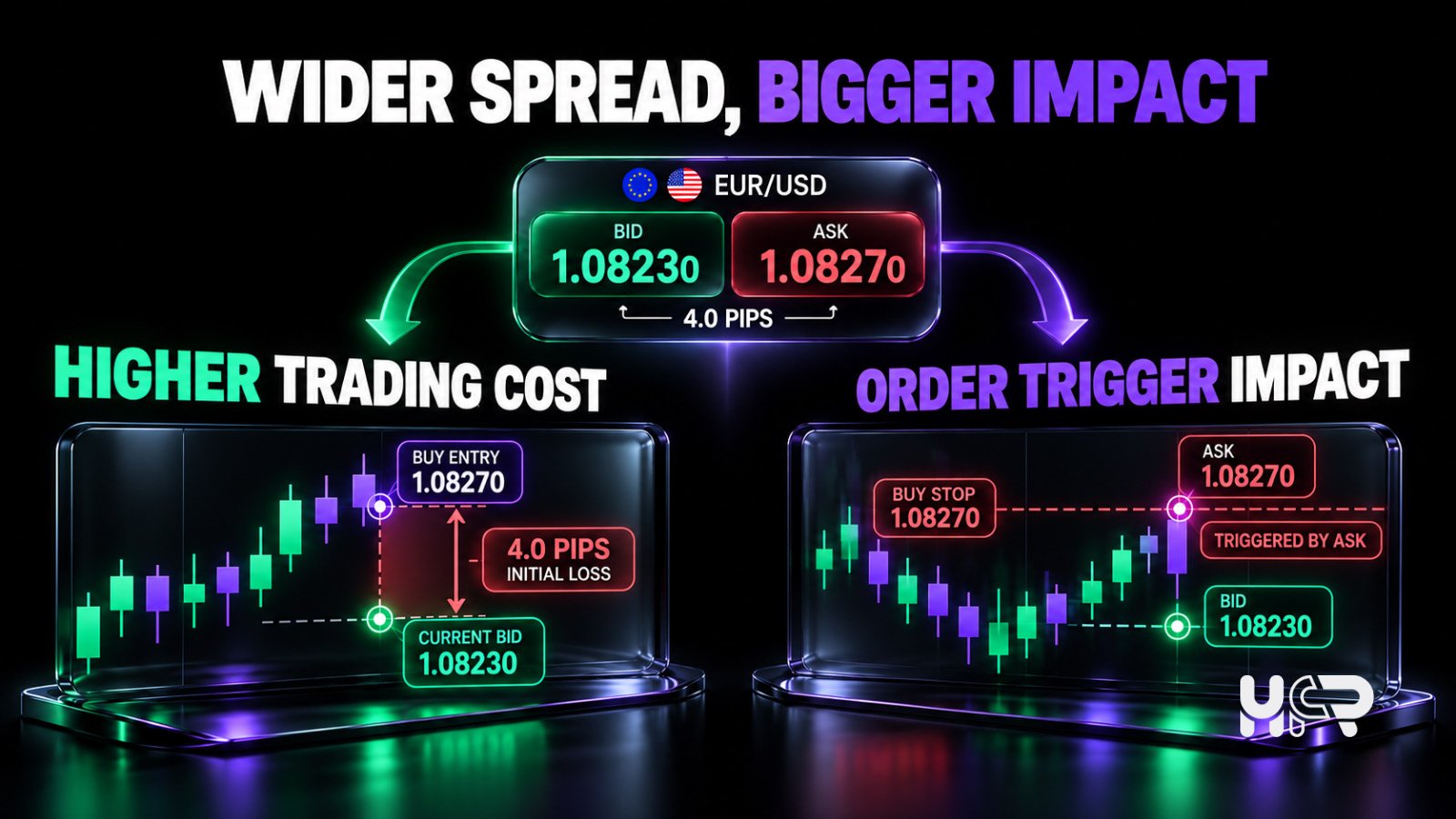
A wider spread changes the available buying and selling prices. Depending on the position, chart setting and platform, this may affect the immediate floating result, the price available for an entry or exit, and whether the relevant Bid or Ask reaches an order-trigger level.
- A new position may begin with a larger negative floating result if the spread is wider at entry.
- A market order can face a less favourable quoted side even before any separate slippage is considered.
- A Stop Loss, Take Profit or pending order can be affected if its trigger condition uses the side of the quote that moved further because of spread widening.
- Equity, free margin, and margin level can change as open positions are revalued using the broker's applicable prices.
- A wider spread does not guarantee slippage, but both can occur during the same volatile or low-liquidity period.
For the effect of changes in open-position value on equity and available margin, see HFR’s Free Margin in Forex guide.
Order-trigger and execution rules are broker- and platform-specific. In common MetaTrader forex conventions, a long position’s Stop Loss is checked against the Bid and a short position’s Stop Loss against the Ask. Check the relevant price history and the broker’s actual trigger rules rather than relying on a single chart line.
Is spread widening the same as slippage?
No. Spread widening means the Bid-Ask distance has increased. Slippage means the actual fill differs from the expected or requested execution price.
| Term | What it describes |
|---|---|
| Spread widening | The current Bid-Ask distance increases. |
| Slippage | The actual execution price differs from the expected or requested price. |
They can occur together during fast or illiquid markets, but one does not prove the other.
For the execution side of this distinction, see HFR's Forex Slippage Explained guide.
Why can the same forex pair have different spreads at different brokers?
Pricing model and liquidity sources
Spot forex is an OTC, decentralised and fragmented market rather than one centralised exchange. Brokers can use different pricing sources, liquidity relationships and quote construction, so retail Bid and Ask quotes do not have to match tick for tick.
Account type and broker markup
A Standard account may include more of the broker's charge inside the spread, while Raw or core pricing may use a tighter spread plus commission. Compare the current spread, commission and terms together rather than relying on the account label.
Legal entity and trading conditions
Pricing, account availability and execution terms can also vary by legal entity, jurisdiction, platform and instrument. A spread on one regional account is not automatically representative of every client of the same brand.
How can you check whether a wide spread is normal?
When a spread looks unusually large, check the context before assuming a pricing error:
- Check whether a major scheduled release or unexpected news event occurred.
- Check the market time and which forex sessions were active.
- Check whether the quote appeared near the broker's daily rollover or New York-close transition.
- Check whether the market was near the Friday close or reopening after a weekend or holiday.
- Compare the live spread with the broker's published minimum, average, or historical data where available.
- Confirm the exact account type, platform, instrument and legal entity.
- If reviewing an order trigger, check the applicable Bid or Ask rather than relying on one chart line.
- Compare general conditions with another reliable pricing source, while recognising retail quotes need not be identical.
- Review the broker's spread, execution, and order policies if the quote still appears inconsistent.
Common mistakes when reading forex spreads
Assuming the minimum spread is permanent. A minimum or "from" spread is a best-case quoted level, not a guarantee for every trade.
Confusing spread widening with slippage. A wider Bid-Ask gap and a different execution price are separate concepts.
Treating rollover cost and spread as the same charge. Swap is an overnight financing adjustment; the spread is the live Bid-Ask difference.
Looking only at one chart price. A Bid-only or Mid chart can hide Ask movement relevant to spread or order triggers.
Comparing account models as if they were identical. Raw, Standard, and commission-based accounts can package costs differently.
Assuming two brokers must quote the same spread. OTC pricing and quote construction can differ, especially in volatile or illiquid conditions.
FAQ
Why do forex spreads suddenly widen?
Spreads can widen when liquidity falls, volatility rises, new information changes prices quickly, or the market passes through opening, closing, or other uncertain conditions.
Why do forex spreads widen during news?
Major news can make prices move rapidly and reduce tight quoting near the current price, allowing Bid and Ask to move further apart.
Why do spreads widen at rollover?
The overnight financing charge is not the spread. However, rollover often coincides with the New York-close transition, when thinner liquidity can produce wider Bid-Ask spreads.
What time do forex spreads usually widen?
There is no universal time. Spreads may widen during news, illiquid session transitions, rollover periods, the Friday close, or market reopening.
Why are forex spreads wider at night?
For some pairs, overnight hours can mean lower participation and less liquidity. The effect depends on the pair, session, broker, and market conditions.
Why do spreads widen before the weekend?
Liquidity can fall before the weekly close. OANDA, for example, reports wider spreads near its Friday closing period because of decreased global liquidity.
Can a wide spread trigger a stop loss?
Yes, depending on the broker’s order-trigger rules. If the relevant Bid or Ask reaches the stop level as the spread changes, the order may be triggered even when the price shown on a different chart setting does not appear to reach that level. A triggered stop does not guarantee a particular fill price.
Is spread widening the same as slippage?
No. Spread widening is a larger Bid-Ask distance; slippage is a fill at a different price from the expected or requested execution price.
Why do two brokers show different spreads for the same pair?
Brokers can use different pricing sources, liquidity arrangements, markups, account models, and legal entities, so their Bid and Ask quotes can differ.
Final takeaway
Forex spreads are not fixed market constants. They can widen when liquidity falls, volatility rises, news changes pricing uncertainty, or the market passes through lower-liquidity opening, closing, or rollover periods.
A wider spread can increase transaction costs and change the Bid or Ask relevant to an order trigger. It remains distinct from slippage, gap risk and overnight financing.
When comparing brokers or reviewing an unusual spread, focus on the current pricing model, account type, legal entity, execution terms and live market context rather than one advertised spread figure.
Risk warning and disclaimer
Forex and CFD trading involve risk of loss, particularly when leverage is used. Variable spreads can increase transaction costs and affect Bid- or Ask-based order triggers. Fast markets, gaps, and slippage can also produce fills away from expected levels. Stop-loss orders do not guarantee a particular fill price.
This article is for educational and informational purposes only. It is not financial, investment, or trading advice, or a recommendation to use any broker, account type, order type, or derivative.
Sources and methodology
This educational explanation draws on OANDA, IG, FOREX.com and BIS source material checked on 23 October 2026. OANDA documents changing liquidity, volatility and spread behaviour; FOREX.com explains rollover timing and its possible overlap with thinner liquidity; IG distinguishes minimum and average forex spreads (with historical dates attached to some averages); and BIS research describes the structure of the fragmented FX execution market. Broker execution, spread, and financing rules vary by legal entity, account, platform, and instrument. No historical spread example is presented as a current quote.
Sources checked:
 5
Share Posts


Further Reading
- What is Proof of Reserves on a crypto exchange? What it shows and what it does not
- ActivTrades Review 2026: Accounts, Fees, Platforms, Regulation and Cashback
- Weekly market recap, 12–18 October 2026: Inflation, yields, gold and crypto
- Bitcoin, Ethereum, Solana, Gold and Silver: Daily technical outlook for 19 October 2026