






Table of Contents
[ Show/Hide ]- • What do balance and equity mean in a forex account?
- • What is used margin?
- • What is free margin in forex?
- • What is margin level and how is it calculated?
- • How do floating profits and losses affect margin figures?
- • A worked example: from balance to margin level
- • How do balance, equity, margin and free margin fit together?
- • Why can margin figures differ between brokers and platforms?
- • What happens when margin level falls?
- • Common mistakes beginners make with margin figures
- • A simple checklist for reading forex margin figures
- • FAQ
- • Final takeaway
- • Risk warning and disclaimer
- • Sources and methodology
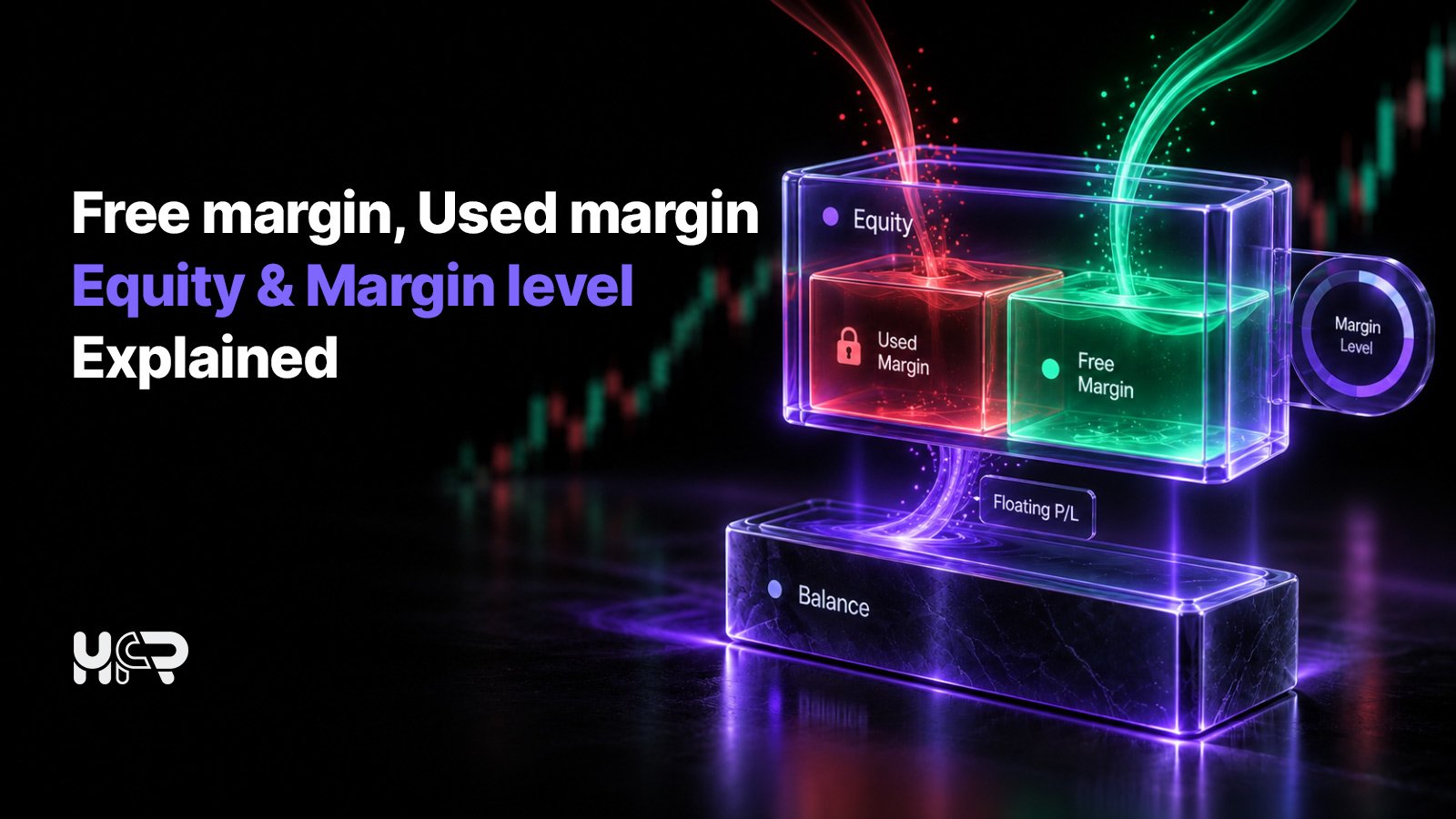
Free margin in forex is the part of account equity that remains after current margin requirements are deducted. In MetaTrader 5, the basic relationship is straightforward: Free Margin = Equity - Margin.
That formula is only useful once the other account figures are clear. Balance records account value without the result of current open positions; equity reflects open-position results and relevant account adjustments; and margin is the amount required to support positions and, depending on platform rules, some pending orders. Floating P/L can therefore change equity, free margin, and margin level before balance changes.
What do balance and equity mean in a forex account?
Balance and equity are related, but they answer different questions. Balance is the account value after completed account transactions and closed trading results, while equity reflects the account's current value after the effect of open positions and other relevant adjustments.
What is account balance?
MetaTrader 5 describes balance as the account balance excluding the results of currently open positions. In practical terms, an unrealised gain or loss on an open trade does not by itself change balance. Balance changes when realised trading results or account transactions are posted, such as closed-trade results, deposits or withdrawals. The treatment and timing of commissions, credits and other adjustments can depend on the account setup.
What is equity?
Equity is the current value of the trading account after open-position results and relevant account adjustments are included. A simple beginner relationship is:
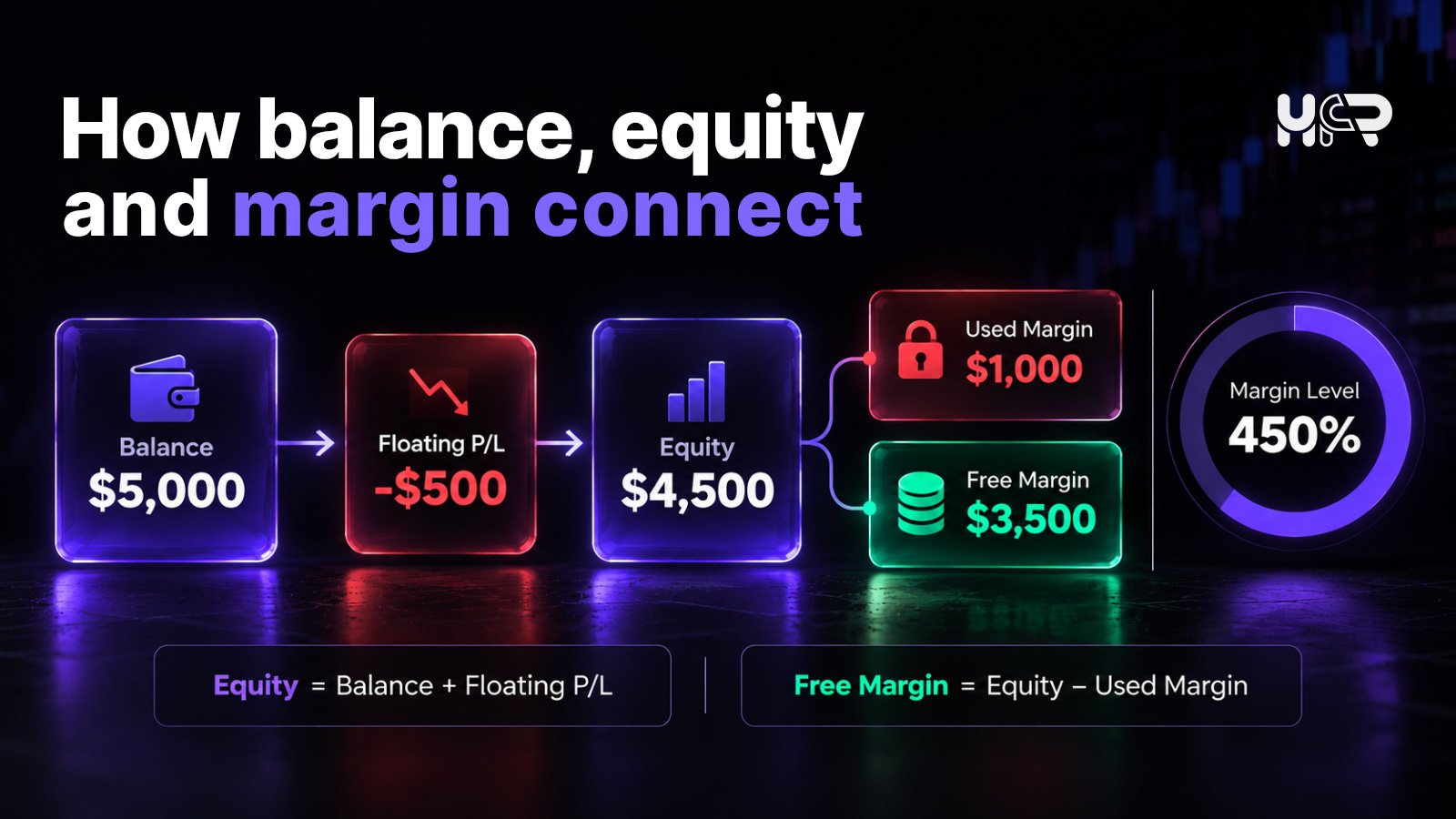
Equity = Balance + Floating P/L
That simplified formula is useful for examples, but MetaTrader 5 documents a fuller equity calculation that can also include credit, commission, and blocked amounts. The exact account display therefore depends on the trading conditions and account setup.
How floating P/L creates the difference
Suppose an account has a balance of $5,000 and open positions currently show a floating loss of $300. Ignoring other adjustments for simplicity, equity would be approximately $4,700. If those positions recover to a $200 floating profit, equity would be approximately $5,200, while the balance would still remain $5,000 until the positions are closed or another balance operation occurs.
What is used margin?
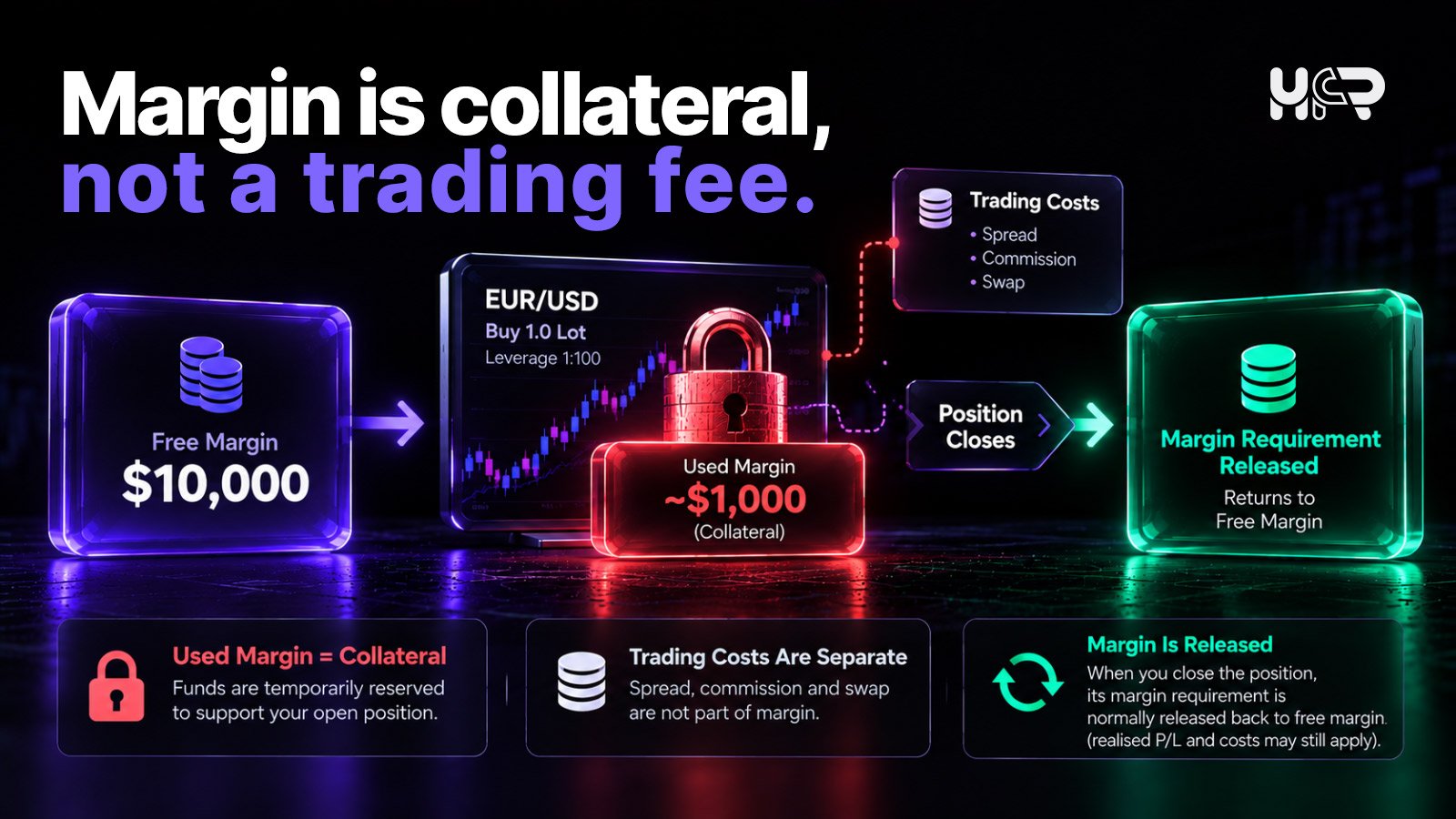
Used margin is the amount currently required as collateral to support leveraged positions. It is not a trading fee, and it is not the same as a realised or unrealised loss.
The amount of margin required depends on factors such as position size, the instrument, leverage or margin rate, account currency, conversion rates and broker-specific rules. Because those inputs can differ, there is no single used-margin amount that applies to every trade or account. For the position-size side of the calculation, HFR's What Is a Lot in Forex? guide explains how lot size relates to exposure and margin.
Why MT5 may show "Margin" instead of "Used Margin"
MetaTrader 5 uses the field name "Margin" for the money required to cover open positions and, under some conditions, pending orders. Other platforms and broker portals may label a similar concept "Used Margin" or "Margin Used".
The terminology is important because two platforms can describe a similar account concept with different labels. Users should compare definitions, not only field names.
Why used margin is not a fee or trading loss
Margin is a collateral requirement. It supports leveraged exposure while the position is open, but it is not automatically deducted as a cost in the same way as a commission or financing charge. When a position is closed, the margin requirement associated with that position is normally released, while the realised trading result and any applicable costs affect the account separately.
What is free margin in forex?
Free margin is the portion of equity remaining after current margin requirements are deducted. It shows how much account equity is not currently required as margin and can affect whether additional positions are allowed. If open-position losses reduce equity while margin is broadly unchanged, free margin also falls.
How free margin is calculated
MetaTrader 5 uses the formula:
Free Margin = Equity - Margin
For example, if equity is $4,500 and margin is $1,000, free margin is $3,500.
The formula is simple, but the inputs can be broker-specific. MetaTrader notes that the treatment of floating profit and loss in equity can depend on trading conditions set by the broker. Other platforms may also use different valuation or currency-conversion methods.
Is free margin the same as available margin?
The concepts are often closely related, but the label and display rule are platform-specific. MetaTrader commonly uses "Free Margin". For example, OANDA’s US materials use "Margin Available" and define it as the greater of zero and NAV minus Margin Used. The concepts are similar in purpose, but terminology, valuation inputs, and display rules can differ, so the labels should not be assumed to be identical across every broker implementation.
What is margin level and how is it calculated?
Margin level compares account equity with the amount of margin being used. It is expressed as a percentage and is mainly relevant while the account has positions that require margin. If margin is zero, the percentage may be undefined or displayed differently by the platform.
The margin level formula
MetaTrader 5 uses:
Margin Level = (Equity / Margin) × 100
If equity is $4,500 and margin is $1,000, the margin level is 450%.
Why margin thresholds differ between brokers
A margin level percentage does not have one universal action threshold across all brokers. Margin call, restrictions on new trades, and forced close-out rules can depend on the broker, jurisdiction, account type, and trading platform. A percentage should therefore be read together with the broker's published margin rules rather than treated as a universal warning level.
How do floating profits and losses affect margin figures?
Floating P/L is the unrealised result of open positions. When open trades move, equity usually changes before balance does. If used margin is broadly unchanged, a floating loss reduces both free margin and margin level; a floating profit generally has the opposite effect.
Used margin itself may also change if instrument-to-account-currency conversion rates, margin tiers or broker rules change. The live account display should therefore be read using the broker’s documented calculation method.
A worked example: from balance to margin level
Consider a simplified USD-denominated account. Assume the margin requirement stays at $1,000 throughout the example and ignore commissions, financing, credits, and other adjustments.
| Account metric | Initial state | After a $500 floating loss |
|---|---|---|
| Balance | $5,000 | $5,000 |
| Floating P/L | $0 | -$500 |
| Equity | $5,000 | $4,500 |
| Used Margin | $1,000 | $1,000 |
| Free Margin | $4,000 | $3,500 |
| Margin Level | 500% | 450% |
The $500 floating loss leaves balance unchanged at $5,000, but equity falls to $4,500. With margin held at $1,000 for this simplified example, free margin falls to $3,500 and margin level to 450%. The example shows the relationship between the figures; live margin can also change with broker rules or conversion rates.
How do balance, equity, margin and free margin fit together?
The account figures are easier to read when each one is treated as a separate part of the same system:
| Metric | What it represents |
|---|---|
| Balance | Account value excluding the result of currently open positions. |
| Equity | Current account value after open-position results and relevant account adjustments. |
| Used Margin / Margin | Collateral requirement currently supporting margin-based positions or orders, depending on platform rules. |
| Free Margin | Equity remaining after current margin is deducted. |
| Margin Level | Equity relative to margin, expressed as a percentage. |
These values should be read together. A high balance does not necessarily mean high free margin if large positions are using margin or open losses have reduced equity.
Why can margin figures differ between brokers and platforms?
The basic concepts are widely used, but labels and calculations are not fully standardised. MetaTrader commonly shows Balance, Equity, Margin, Free Margin and Margin Level, while broker portals may use terms such as NAV, Margin Used or Margin Available.
Account type and broker rules can also affect margin rates, currency conversion, hedged-position treatment, tiers, pending-order requirements and update timing. If MT5 and a broker portal differ, compare the broker's documented definitions and system-of-record values rather than assuming the labels are identical.
What happens when margin level falls?
A falling margin level means equity is becoming smaller relative to the margin being used. This can happen because open losses reduce equity, additional positions increase used margin, or both. Free margin usually falls at the same time, leaving less room above current requirements.
If conditions deteriorate far enough, broker-specific margin call or stop-out rules may become relevant. The trigger levels and actions are not universal, so use HFR's Margin Call vs Stop Out guide together with the broker’s own thresholds.
Common mistakes beginners make with margin figures
- Confusing balance with equity. Balance can stay unchanged while equity moves with open-position profit or loss, so balance alone can hide the current effect of open trades.
- Treating used margin as a fee. Used margin is a collateral requirement for leveraged exposure. It is not the same as a commission, spread, financing charge, or trading loss.
- Assuming free margin is the same as account balance. Free margin depends on equity and current margin requirements. A $5,000 balance does not mean $5,000 is available to support new exposure.
- Ignoring floating profit and loss. Floating P/L can change equity, free margin, and margin level before a trade is closed.
- Assuming every broker uses the same margin thresholds. The percentage that triggers a warning, restriction or forced close-out can vary by broker, jurisdiction, account type and platform.
- Reading one margin figure without checking the others. Balance, equity, margin, free margin and margin level describe different parts of the account, so one number alone gives an incomplete picture.
A simple checklist for reading forex margin figures
- What is the current account balance?
- What is the current equity?
- Do open positions have a floating profit or loss?
- How much margin is currently being used?
- How much free margin or margin available remains?
- What is the current margin level?
- Which broker, account type, and platform rules apply?
- What are the broker's Margin Call and Stop Out thresholds?
Read the figures together rather than treating any one number as a complete measure of account risk.
FAQ
What is free margin in forex?
Free margin is the amount of equity remaining after current margin is deducted. In MetaTrader 5, Free Margin = Equity - Margin.
What is the difference between balance and equity?
Balance excludes the result of currently open positions. Equity reflects the current account value after open-position results and other relevant account adjustments are included.
Is used margin the same as a trading loss?
No. Used margin is collateral required to support leveraged exposure. A trading loss is a negative trading result, either floating while a position is open or realised after it is closed.
Is free margin the same as available margin?
They are often closely related concepts, but the terminology and display method can depend on the broker and platform. MetaTrader commonly uses Free Margin, while some broker interfaces use Margin Available.
Why does free margin change when price moves?
Price movement changes floating P/L and therefore equity. Because free margin is based on equity minus margin, it can move even while balance stays unchanged.
Can free margin become negative?
Mathematically, Equity - Margin can be below zero if equity falls below the margin amount. Some broker interfaces instead floor an available-margin field at zero, and close-out rules may act before or around that point. The broker’s own platform documentation controls how the value is displayed and used.
Does closing a position release used margin?
Closing a margin-based position normally removes or reduces the margin requirement associated with that position. The realised P/L and any applicable trading costs are then reflected separately in the account values.
Does 100% margin level mean the same thing at every broker?
No. Margin-call, trade-restriction, and close-out thresholds are broker- and account-specific. The same percentage should not be assumed to trigger the same action everywhere.
Why can MT5 margin figures differ from my broker account page?
They can use different terminology, conversion methods, pricing inputs or update timing. Use the broker's own account documentation and system-of-record values as the final reference.
Final takeaway
Free margin, used margin, equity, and margin level are connected but not interchangeable. Balance excludes the result of current open positions, equity reflects them, used margin supports leveraged exposure, free margin is the equity remaining after margin, and margin level compares equity with margin as a percentage.
The practical relationship to remember is that floating P/L can change equity before balance changes. When equity falls, free margin and margin level can fall with it. Exact calculations, labels, and action thresholds remain broker- and platform-specific.
Next, use the HFR Margin Call vs Stop Out guide to understand what can happen when margin conditions deteriorate and why the relevant thresholds must be checked with the broker.
Risk warning and disclaimer
Forex and CFD trading involve risk of loss, particularly when leverage is used. Margin figures can change quickly as market prices move, and broker rules may restrict new trading or close positions when account requirements are not met.
This article is for educational and informational purposes only. It should not be treated as financial, investment, or trading advice, or as a recommendation to use any broker, account type, position size, or trading strategy.
Sources and methodology
This article is a desk-based beginner guide to forex account margin terminology. Core definitions and formulas were rechecked on 1 October 2026 against current MetaTrader 5 trading-account and retail-forex margin documentation. OANDA materials are used as an example of how broker/platform terminology and calculations can differ by account implementation. Broker-specific thresholds, conversion methods, and account rules can vary, so the broker’s own documentation remains the final reference for a live account.
Sources checked:
 6
6
Share Posts


Further Reading
- Why Forex Spreads Widen: News, Rollover, Liquidity and Volatility
- What is Proof of Reserves on a crypto exchange? What it shows and what it does not
- ActivTrades Review 2026: Accounts, Fees, Platforms, Regulation and Cashback
- Weekly market recap, 12–18 October 2026: Inflation, yields, gold and crypto