






Table of Contents
[ Show/Hide ]- • Margin call vs stop out: the short answer
- • Balance, equity, used margin and free margin
- • What is margin level?
- • What is a margin call?
- • What is a stop out?
- • Margin call vs stop out compared
- • What happens as margin level falls?
- • Worked example: 200% to 100% to 50% margin level
- • Do all brokers use the same margin-call and stop-out levels?
- • Which position is closed first during a stop-out?
- • Can a stop out happen below the stated percentage?
- • Margin call, stop out and negative balance protection are different
- • How leverage affects margin level
- • Ways to reduce the risk of reaching stop out
- • Do forex rebates change margin-call or stop-out risk?
- • Practical takeaway
- • FAQ
- • Sources and methodology
- • Risk warning and disclaimer
When open forex or CFD positions move against an account, floating losses reduce equity and can weaken the margin buffer supporting those trades. Understanding margin call vs stop out helps explain what may happen as margin level falls.
A margin call is generally a broker-defined margin condition that can trigger a warning, restriction or requirement to restore margin. A stop out is more serious: once the applicable stop-out condition is reached, the broker or platform can begin closing one or more positions automatically.
The exact percentages and liquidation rules are not universal. They can vary by broker, legal entity, account type, instrument and platform. This guide follows the process from normal margin conditions through falling equity, margin pressure and forced liquidation, using a clearly labelled example to show how the figures interact.
Margin call vs stop out: the short answer
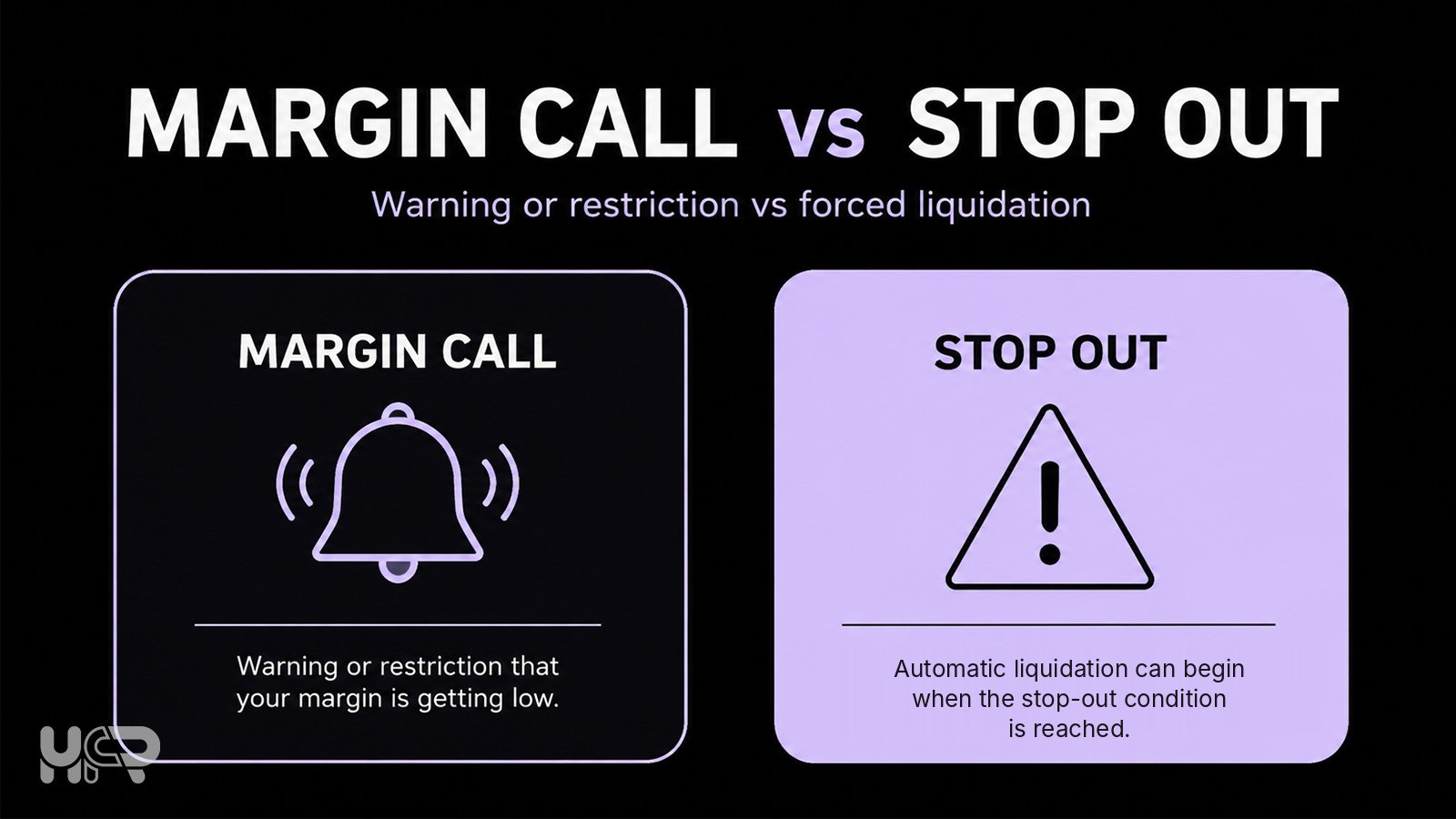
A margin call and a stop out are related but different. Where a broker defines a separate margin-call threshold, it is generally the earlier margin condition: the broker or platform may warn the client, restrict new positions or require more margin. A stop out is the liquidation condition at which one or more positions can be closed automatically.
The percentages vary. A broker may use 100% as a margin-call level and 50% as a stop-out level, but those numbers are only examples unless confirmed for the exact broker entity and account. A stop out does not require the trader to click close; liquidation can begin under the applicable platform and account rules.
Balance, equity, used margin and free margin
Before comparing margin call and stop out, it helps to separate the account figures that change while leveraged positions are open.
| Term | Plain-English meaning |
|---|---|
| Balance | The account value from settled activity, including deposits, withdrawals and closed profit or loss. It excludes the unrealised profit or loss of positions that remain open. |
| Equity | The account’s current value after open-position profit or loss and applicable account adjustments are taken into account. |
| Used margin | The amount currently reserved to support open leveraged positions. The requirement depends on the instrument, leverage and broker settings. |
| Free margin | The equity remaining above used margin under the platform rules. A common teaching formula is Equity − Used Margin. |
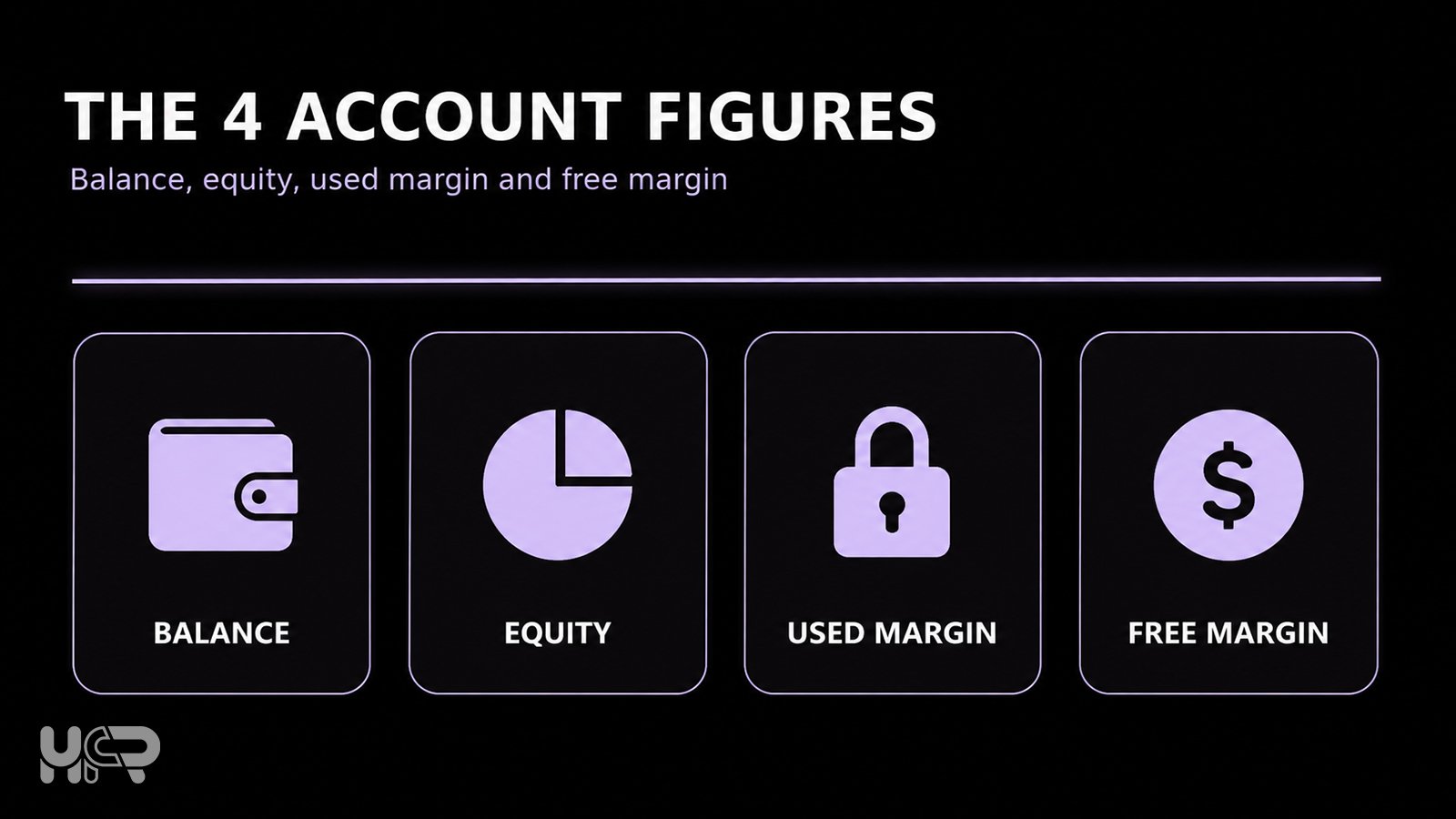
Once positions are open, equity becomes more important than balance for understanding margin pressure. Balance can remain unchanged while open trades move into profit or loss, but equity changes as those positions are revalued.
For example, if an account has a $2,000 balance and a $500 floating loss, simplified equity is $1,500. If $1,000 is being used as margin, free margin is $500. If the floating loss grows while used margin stays broadly unchanged, equity, free margin and margin level fall.
Real platform calculations can differ where credits, commissions, hedged-position rules or instrument-specific margin settings apply, so the broker’s own specification remains the final reference.
What is margin level?
Margin level compares current equity with the margin being used to support open positions. MetaTrader expresses account margin level as a percentage using the relationship below:
Margin Level (%) = Equity ÷ Used Margin × 100
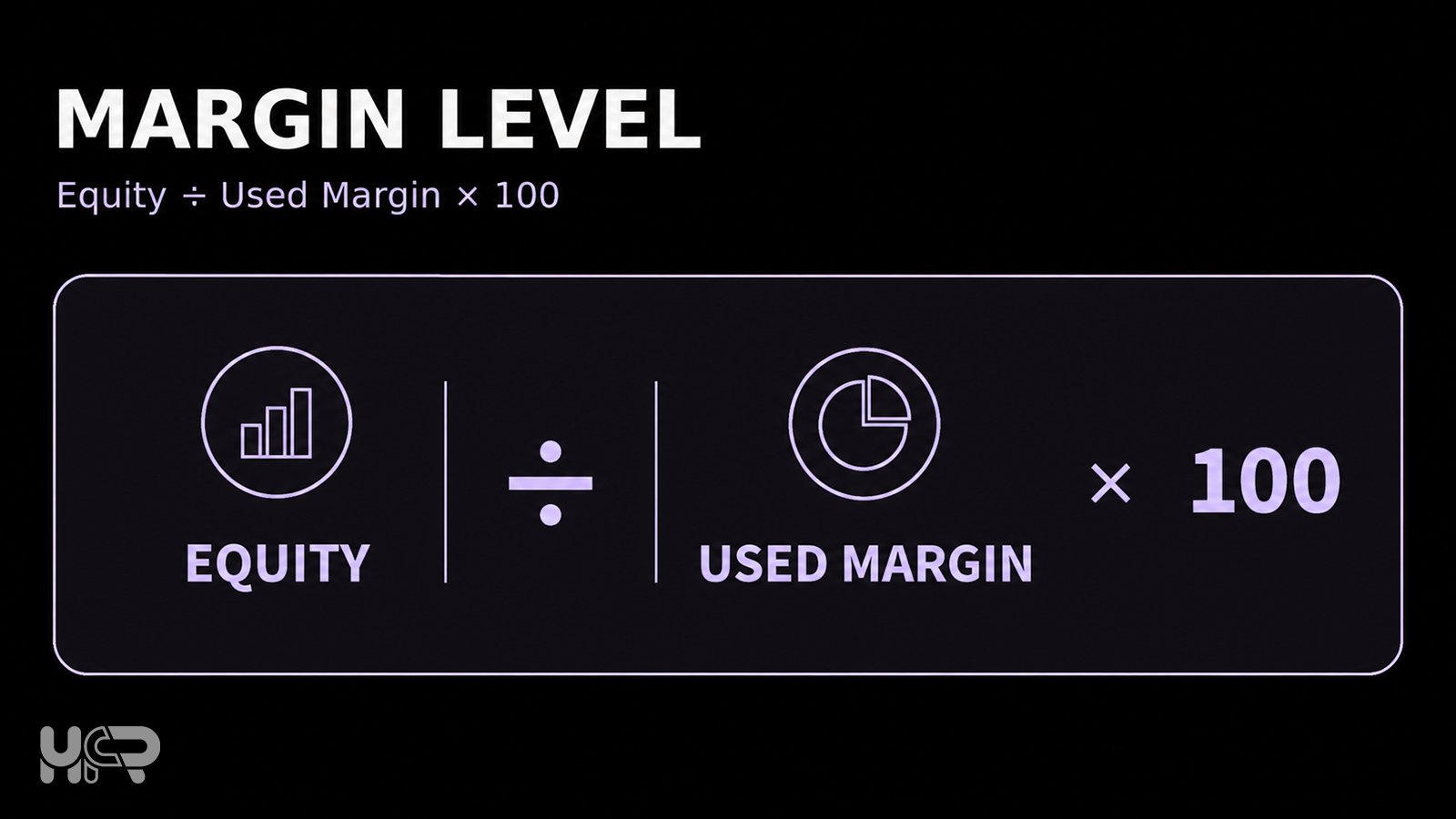
If equity is $2,000 and used margin is $1,000, the margin level is 200%. If equity later falls to $1,000 while used margin remains $1,000, margin level falls to 100%.
A higher margin level generally means more equity is available relative to used margin. If used margin is zero, the percentage is not meaningful and platforms may display the field differently. Brokers can define margin-call and stop-out conditions as percentages or, in some systems, other account values, so the account specification matters.
What is a margin call?
Where a broker defines one, a margin call is a broker-defined margin condition reached when equity becomes too low relative to the margin supporting open positions. Depending on the broker and platform, it may result in a warning, a requirement to restore margin, restrictions on new positions, or another account-level action.
Despite the name, a margin call does not necessarily mean that the broker will telephone the trader. Modern trading platforms may show an on-screen warning or account status change instead. Traders should not assume that they will receive a telephone call, email or guaranteed period to add funds before a stop out; the notification process depends on the broker’s terms, platform, and applicable regulatory requirements.
Reaching the margin-call condition does not always mean positions are closed immediately. If equity continues to fall, the account may move towards a separate stop-out condition where forced liquidation can begin.
What is a stop out?
A stop out is the point at which the broker or trading platform begins closing one or more open positions automatically because the account has reached its critical margin condition. The trader does not need to click close or provide separate approval at that moment if the account terms permit automatic liquidation.
Closing a position release some of the margin reserved for that exposure. The platform then recalculates equity, used margin and margin level. If the account still does not satisfy the required condition, further positions or parts of positions may be closed according to the broker and platform rules.
The stated stop-out percentage is a trigger rather than a guaranteed execution point. During gaps, fast markets or limited liquidity, prices can continue moving before a closing order is filled, so the account may be below the trigger percentage by the time liquidation is executed.
Margin call vs stop out compared
| Factor | Margin call | Stop out |
|---|---|---|
| Main function | Warning, restriction or margin-restoration condition | Forced-liquidation condition |
| Automatic closure | Not necessarily | Yes, one or more positions can be closed |
| Threshold | Broker/entity/account specific | Broker/entity/account specific; regulation can also impose minimum protections in some jurisdictions |
| Trader action | May still have options depending on broker rules | Broker/platform can act automatically once triggered |
| Execution price | Not an execution event by itself | Closures occur at available market prices and can be affected by gaps or slippage |
The exact percentages, warning method, and liquidation sequence can differ by broker, legal entity, account type, and platform. A 100% margin call and 50% stop out are examples, not universal rules.
What happens as margin level falls?
A simplified sequence is:
Floating losses increase
↓ Equity falls
↓ Free margin shrinks
↓ Margin level falls
↓ Margin-call condition may be reached
↓ Warning or restrictions may apply
↓ Stop-out condition may be reached
↓ Positions can be closed automatically
↓ Margin is released, and the account is recalculated
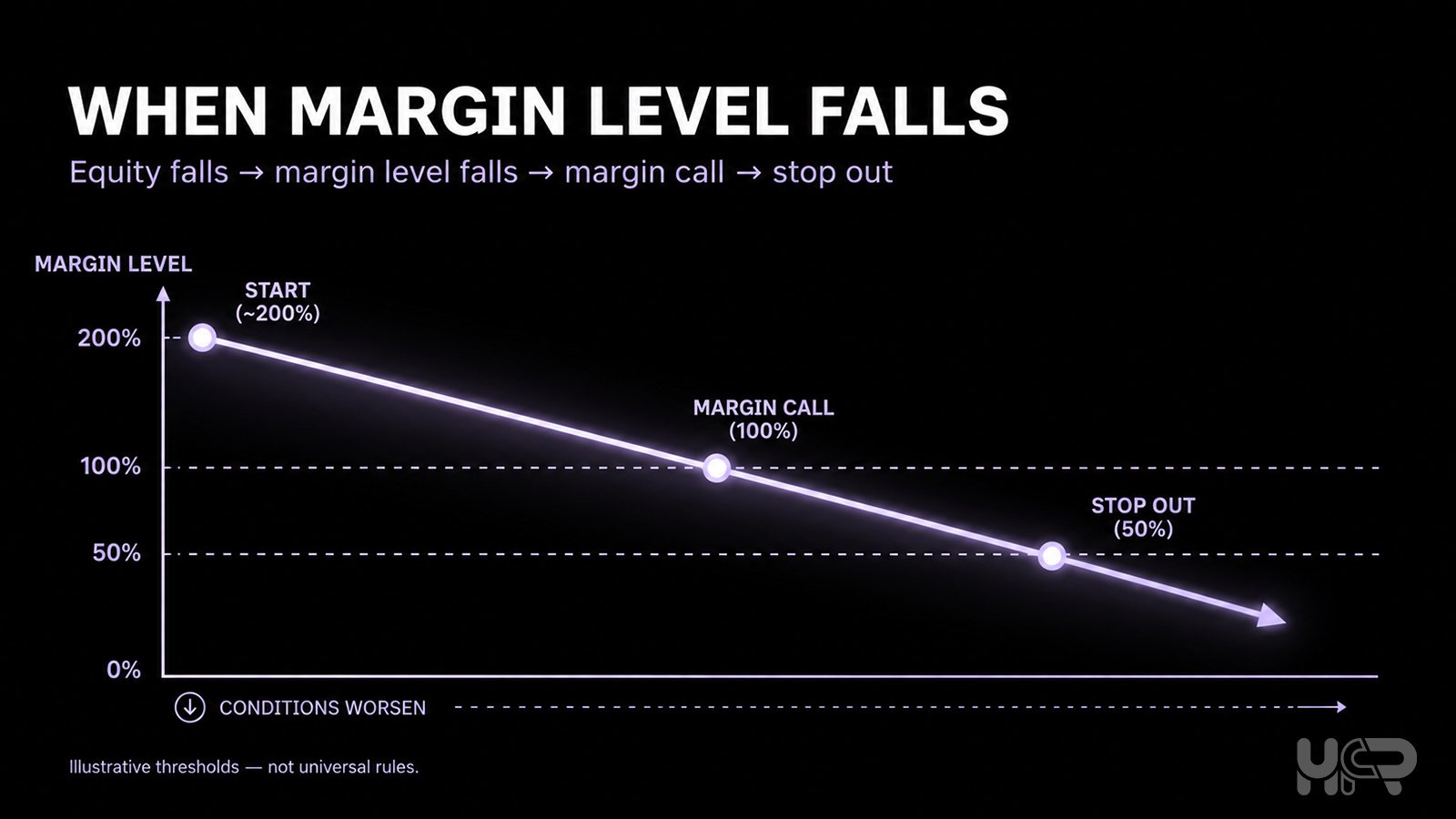
At first, the account may have enough free margin to absorb normal changes in open-position value. As losses increase, equity and free margin decline. If the broker’s margin-call condition is reached, the platform may warn the client or restrict activity without closing positions immediately.
If the stop-out condition is then triggered, liquidation can begin. After each closure, used margin and margin level are recalculated. Further liquidation can follow if the account remains below the required condition.
Worked example: 200% to 100% to 50% margin level
This simplified example uses a hypothetical broker with a 100% margin-call threshold and a 50% stop-out threshold. It assumes a $2,000 balance and used margin of $1,000 until liquidation begins, so free margin is equity minus $1,000. This isolates the relationship between floating loss, equity and margin level. Real margin requirements can change with position values, instruments and broker rules.
| Stage | Floating P/L | Equity | Margin level | Illustrative result |
|---|---|---|---|---|
| Starting point | $0 | $2,000 | 200% | Account has a margin buffer |
| Margin-call example | −$1,000 | $1,000 | 100% | Warning or restrictions may apply |
| Stop-out example | −$1,500 | $500 | 50% | Forced closure can begin |
At the starting point, $2,000 ÷ $1,000 × 100 = 200%. If floating losses reduce equity to $1,000, margin level falls to 100%. Under the hypothetical rules, that is the margin-call condition.
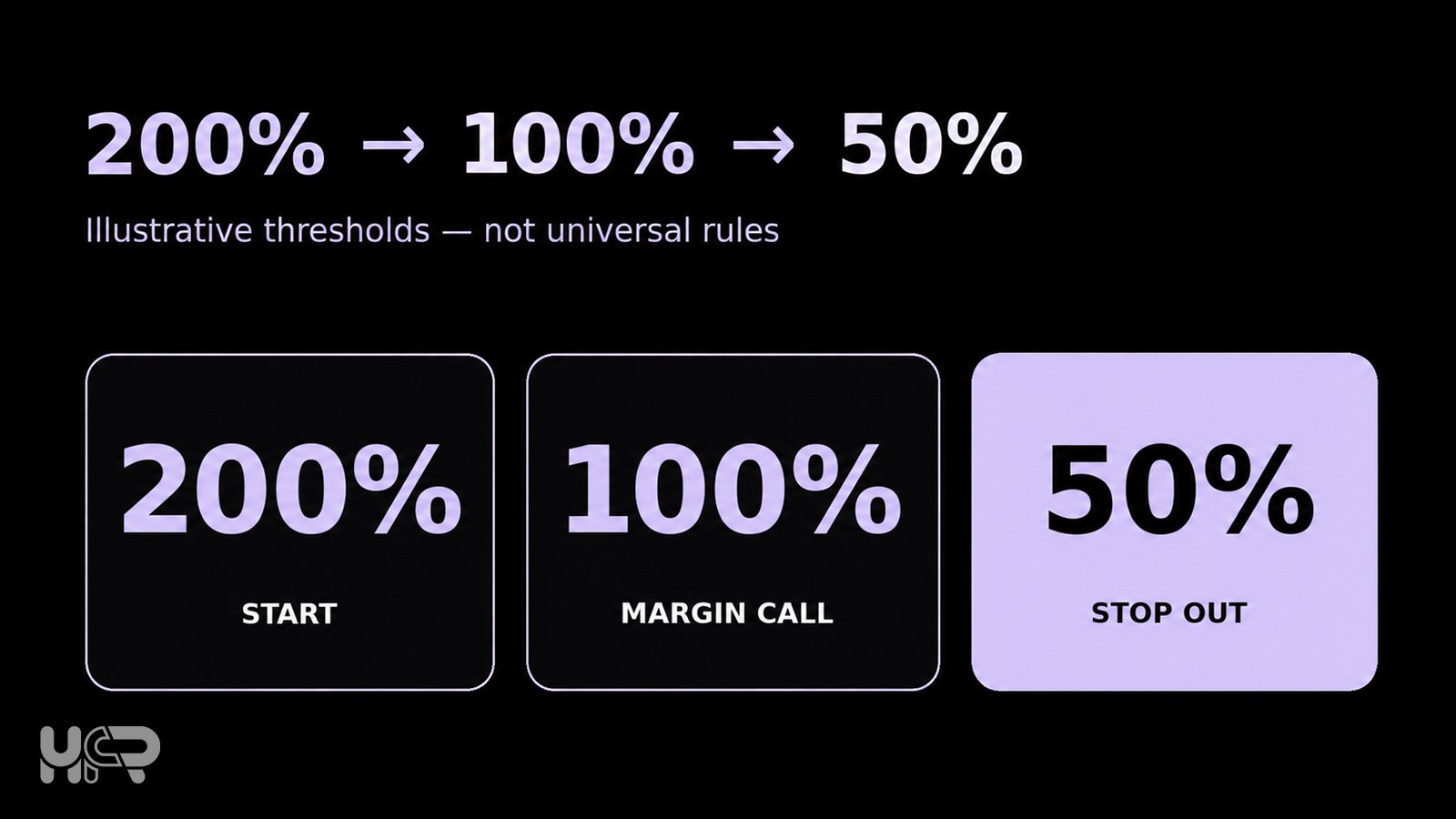
If equity then falls to $500 while used margin is still $1,000, margin level becomes 50%. Under this example, the stop-out condition is reached, and automatic liquidation can begin. The 100% and 50% thresholds are illustrative, and the actual execution can occur after the account has moved beyond the trigger because of market movement or slippage.
Do all brokers use the same margin-call and stop-out levels?
No. Margin-call and stop-out levels can vary by broker, legal entity, account type, platform, and client classification. A broker can also adjust margin requirements under its terms when market conditions or product settings change.
As an entity-specific example, IC Markets (EU) Ltd currently states a 100% margin-call level and a 50% stop-out level. Its leverage policy says liquidation begins at 50% of total initial margin, starting with the position with the largest loss and continuing as market conditions permit until margin level rises above 50% or all positions are closed. These figures apply to that entity’s stated rules and should not be generalised to other IC Markets entities or other brokers.
For EU retail CFDs, the permanent national product-intervention measures adopted by national competent authorities mirror the account-level margin close-out framework originally introduced through ESMA’s temporary measures. Under that framework, a provider must close one or more open CFDs when the total margin in the CFD account falls below 50% of the amount of initial margin required for the open CFD positions. This is a regulatory protection within the relevant retail CFD scope, not a worldwide 50% stop-out rule and not a rule to apply automatically to professional clients or accounts outside that framework.
Which position is closed first during a stop-out?
There is no universal liquidation sequence. The result depends on the broker and platform configuration. MetaTrader exposes broker-set margin-call and stop-out values and its documentation describes forced closure of the most unprofitable position at stop out. A broker’s own policy can provide more specific rules for the account it operates.
Other platforms can work differently. cTrader Smart Stop Out prioritises positions using the largest amount of margin and can close only part of a position if that is enough to restore margin level above the broker-defined threshold. After each closure, the platform recalculates the account and can repeat the process if necessary.
The broker’s current margin policy and platform rules are therefore the correct reference for the exact liquidation sequence.
Can a stop out happen below the stated percentage?
Yes. The stated percentage normally triggers the liquidation process; it does not guarantee the account will be closed exactly at that displayed percentage. Fast markets, gaps, low liquidity and slippage can move prices before the closing order is filled.
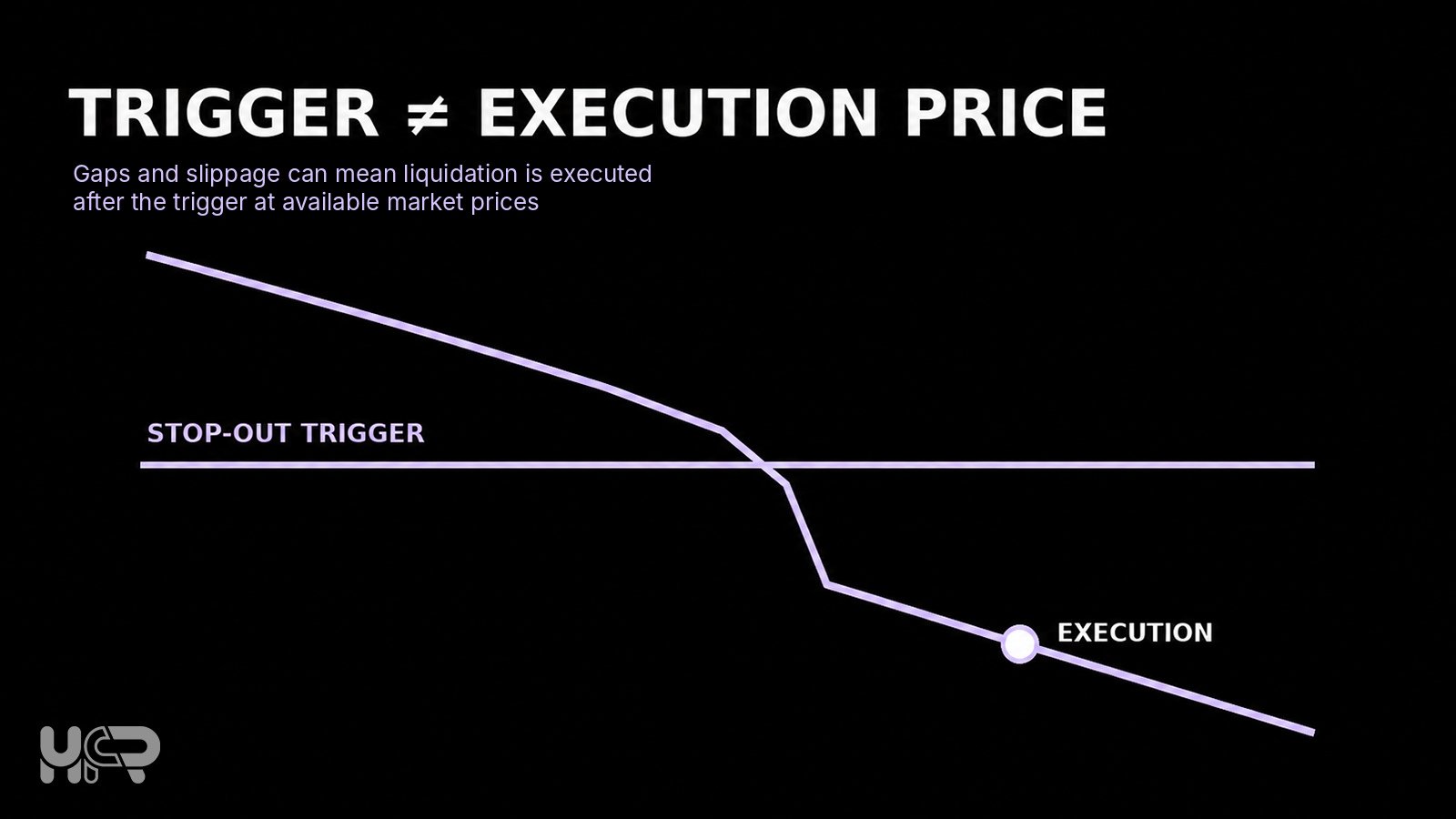
IC Markets (EU) Ltd, for example, states that trades begin to close at its 50% stop-out level and separately notes that orders are not guaranteed against slippage. The practical distinction is important: the threshold starts the process, while the final result depends on available execution prices.
Margin call, stop out and negative balance protection are different
A margin call concerns deteriorating margin conditions; a stop out concerns automatic liquidation. Negative balance protection addresses a different risk. Where it applies, it limits a client’s aggregate liability under the relevant broker or regulatory framework if losses would otherwise take the protected CFD account below zero.
Negative balance protection does not prevent a margin call, stop out or trading loss. A trader can still have positions closed automatically even when the protection applies. In the EU retail CFD framework, negative balance protection is one of the product-intervention protections that sits alongside leverage limits and margin close-out requirements. Its availability outside that scope depends on the broker, entity, client classification and jurisdiction.
How leverage affects margin level
Leverage affects how much margin is required to support a given position. Higher available leverage can reduce used margin for the same exposure, which can initially produce a higher margin-level percentage because the denominator in the formula is smaller.
Higher leverage does not itself create a trading loss. Profit and loss are driven by position exposure and market price movement. The risk is that higher available leverage can make it easier to open larger positions relative to account equity. If that extra capacity is used, a smaller adverse market move can create a larger floating loss relative to the account, reducing equity and margin level more quickly.
Margin requirements can also vary by instrument and may be changed by a broker under its terms during volatile conditions. Leverage should therefore be considered together with actual position size, account equity and the applicable margin rules.
Ways to reduce the risk of reaching stop out
- Leave a meaningful free-margin buffer instead of committing most of the account’s equity to used margin.
- Check the exact margin-call and stop-out rules for the broker entity, account type and platform before opening leveraged positions.
- Monitor equity, free margin and margin level rather than balance alone, because floating losses can reduce equity while balance remains unchanged.
- Understand that stop-loss orders can reduce exposure if triggered and filled, but gaps and slippage can cause execution away from the requested price.
- Be aware that brokers can change margin requirements for particular instruments or market conditions under their terms, which can increase used margin even without a new trade.
- Treat adding funds as additional capital at risk, not as a guaranteed solution. Equity can fall again if open positions continue losing value.
No method can guarantee that a leveraged account will avoid stop out. These are general risk-control considerations rather than a trading strategy or personalised recommendation.
Do forex rebates change margin-call or stop-out risk?
No. Forex rebates or direct trading-cost reductions can lower part of an eligible trading cost, but they do not change the broker’s margin-call or stop-out thresholds unless the broker explicitly states otherwise. They also do not change the open market exposure or remove leverage, liquidation, slippage or adverse-price-movement risk.
If cashback is credited directly into the trading account, the credited amount may become part of the account balance or equity under the broker’s rules and can therefore affect the displayed margin figures after it is credited. That should not be confused with margin protection: the broker’s thresholds, open exposure and liquidation rules remain unchanged, and a rebate cannot guarantee that stop out will be avoided. A direct spread or commission reduction lowers trading cost but likewise does not alter liquidation rules unless the account terms explicitly say so.
For the rebate mechanism itself, see HFR’s guide to how forex rebates work.
Practical takeaway
As open positions move against an account, floating losses can reduce equity, shrink free margin and lower margin level. If the broker’s margin-call condition is reached, warnings or account restrictions may apply. If the account deteriorates further and reaches the stop-out condition, the broker or platform can begin closing positions automatically and recalculating the remaining margin level.
The key point is that percentages, notification methods and liquidation rules are not universal. They vary by broker, legal entity, account type and platform, and actual execution can be affected by gaps or slippage. The specific account terms should therefore be checked before using leverage.
FAQ
What is the difference between a margin call and a stop out?
A margin call is generally a warning, restriction, or margin-restoration condition reached when margin level falls too far. A stop out is the automatic liquidation condition at which one or more positions can be closed. The exact percentages and actions vary by broker, entity, account, and platform.
What margin level triggers a margin call?
There is no universal percentage. Some brokers use 100%, while others use different thresholds or account-specific rules. Check the exact broker and account conditions rather than relying on a general example.
What margin level triggers a stop out?
There is no universal stop-out percentage. A 50% threshold appears in some broker rules and in the EU retail CFD margin close-out framework, but other thresholds exist. The applicable figure must be confirmed for the specific account.
Can a broker close my trades without permission?
Yes, if the account terms permit automatic liquidation when the stop-out condition is reached. The trader does not need to click close at that moment. The liquidation process depends on the broker and platform rules.
Which trade is closed first during a stop out?
It depends on the broker and platform. MetaTrader documentation describes closing the most unprofitable position, while cTrader Smart Stop Out prioritises the position using the largest amount of margin and can partially close it. Broker-specific rules remain decisive.
Can a stop out execute below the stated level?
Yes. The percentage is usually a trigger, not a guaranteed execution level. Fast markets, gaps, slippage, or limited liquidity can move prices before liquidation orders are filled.
Does negative balance protection prevent stop out?
No. Negative balance protection and stop out are different mechanisms. Stop out controls forced liquidation when margin becomes insufficient; negative balance protection, where applicable, limits liability after losses. It does not prevent margin calls, liquidation or trading losses.
Sources and methodology
Margin terminology and formula treatment were checked against MetaQuotes account-margin documentation. The broker example was checked against IC Markets (EU) Ltd’s current June 2026 Leverage and Margin Policy and help centre. Platform-specific liquidation behaviour was checked against cTrader’s Smart Stop Out documentation. EU retail CFD wording was checked against ESMA’s February 2026 statement on permanent national product-intervention measures and ESMA’s margin close-out guidance. Data checked: 25 August 2026.
- MetaQuotes — Account margin settings
- MetaQuotes — Account properties
- IC Markets (EU) Ltd — Help Centre
- IC Markets (EU) Ltd — Leverage Policy
- cTrader — Trading conditions and Smart Stop Out
- ESMA — 2026 CFD product-intervention reminder
- ESMA — Margin close-out FAQ
Risk warning and disclaimer
Trading forex and CFDs with leverage involves a high risk of loss. Margin calls and stop outs are account-risk controls, not guarantees that losses will be limited to a particular amount or that positions will close at the stated threshold. Market gaps, slippage and fast price moves can affect execution. Broker rules, legal protections and margin requirements vary by entity, account, platform and instrument.
Cashback may help offset part of eligible trading costs after confirmation, but it does not reduce market risk, leverage risk, liquidation risk, execution risk, slippage risk, broker risk or the risk of loss.
This article is for educational and informational purposes only. It should not be treated as financial advice, investment advice, trading advice or a recommendation to use leverage, open a position, add funds to a margin account or use any broker.
 6
6
Share Posts


Further Reading
- Why Did My Stop Loss Trigger When Price Never Reached It?
- Why the Same Forex Broker Can Have Different Legal Entities
- U.S. Jobs Slow, the Dollar Firms & Bitcoin Advances While Rate Expectations Shift — September 28-October 4, 2026
- Bitcoin, Ethereum, Solana, Gold and Silver Technical Outlook: Key Daily Zones After a Mixed Macro Week — October 5, 2026