






Table of Contents
[ Show/Hide ]- • Broker brand vs legal entity: what is the difference?
- • Why can the same forex broker use several legal entities?
- • What can change when the legal entity changes?
- • Example: one broker brand, several legal entities
- • How is your broker entity assigned?
- • How to identify the entity that applies to your account
- • Why the legal entity can matter for HFR cashback
- • Common mistakes when comparing broker entities
- • Final takeaway
- • FAQ
- • Sources and methodology
- • Risk warning and disclaimer
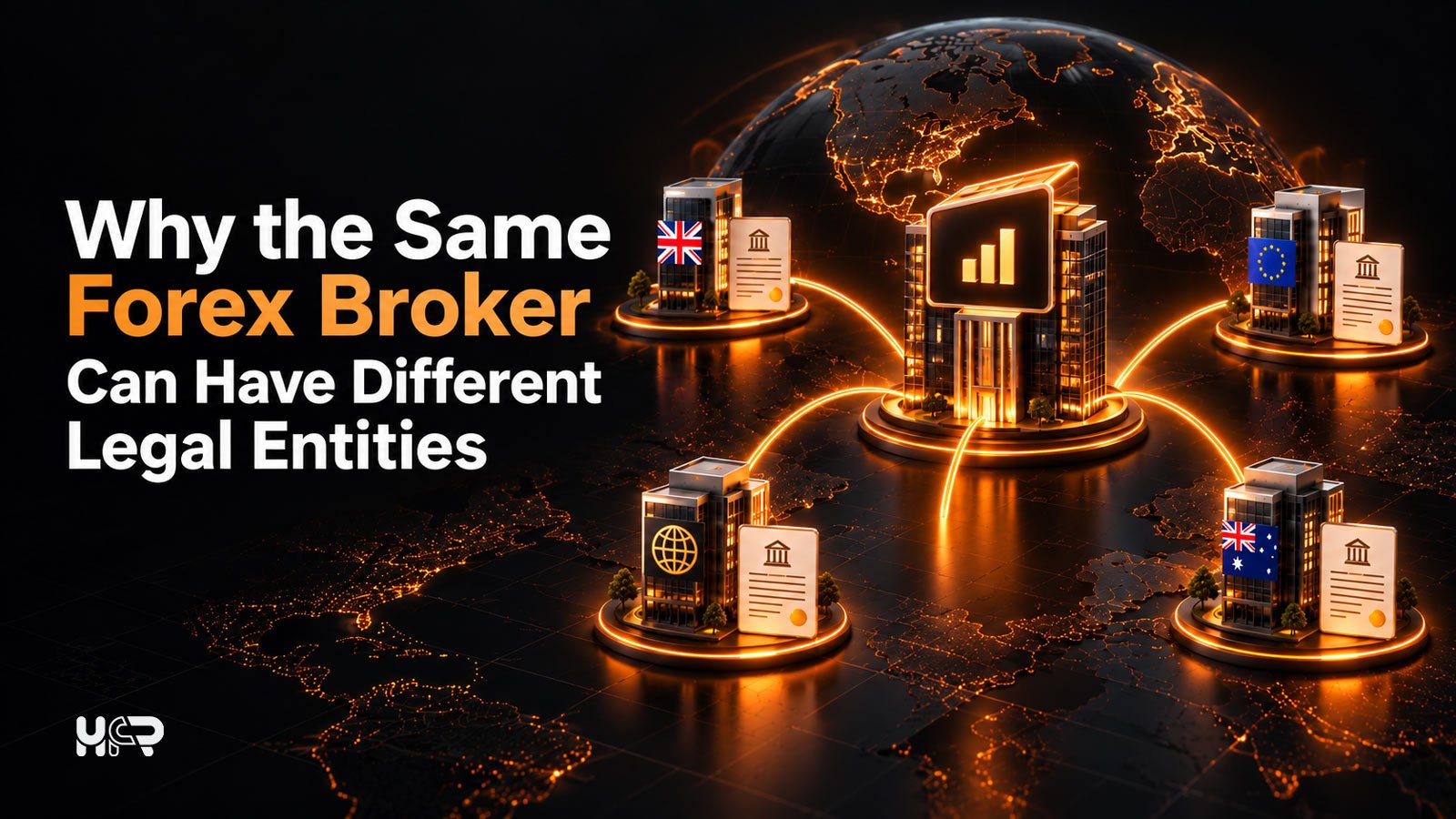
A single forex broker brand can operate through several legal entities. Each entity may be incorporated in a different jurisdiction, regulated by a different authority, or serve a different group of clients.
Which entity applies to an account can depend on the client’s country of residence, the onboarding route, client classification, and local regulatory requirements. As a result, two clients using the same broker brand may have different leverage limits, available products, regulatory protections or account conditions.
The brand name alone does not identify the legal relationship. Start with the final Client Agreement, Terms of Business or equivalent account agreement, which should identify the company acting as the contractual counterparty. That specific entity, rather than the wider broker group, determines the regulatory and contractual framework that applies to the account.
Broker brand vs legal entity: what is the difference?
A broker brand is the public-facing name clients recognise on the website, trading platform and marketing materials. The legal entity is the specific company that contracts with the client and provides the brokerage service under a particular legal and regulatory framework.
One broker brand may therefore be used by several separate companies. A group might have one entity serving UK clients, another for the EU, and other companies for additional regions. Each entity can have its own regulator, legal documents, permissions and account conditions.
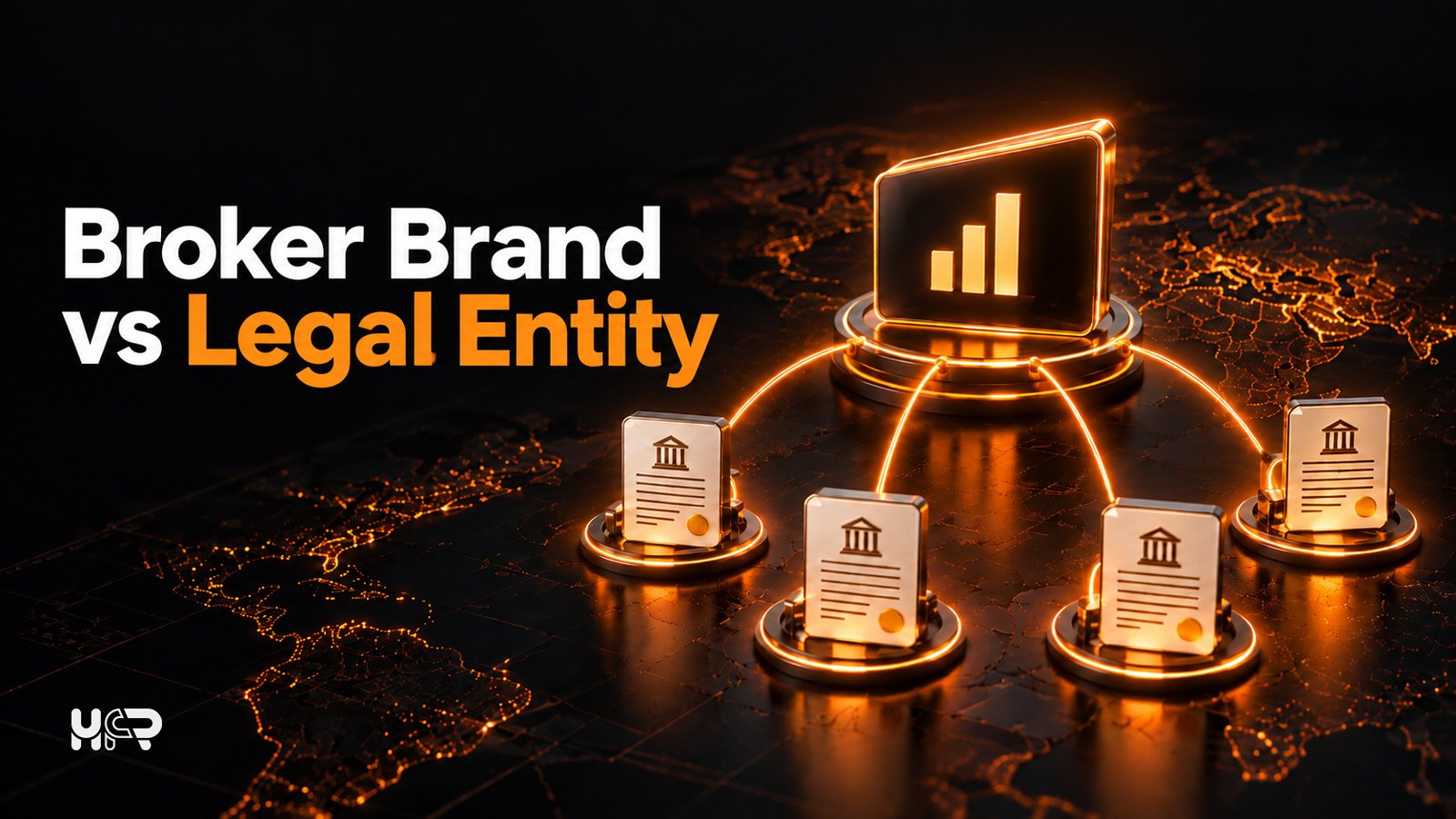
This is why a broker homepage or footer may display several regulators or group companies. Those licences do not necessarily apply to every client using the brand. The relevant question is which legal company is named as the counterparty in the account agreement.
If you need a broader introduction to the role of a broker before comparing legal entities, see HFR’s What Is a Broker? How to Choose the Right Forex Broker.
Why can the same forex broker use several legal entities?
A forex broker may operate through several legal entities because financial-services rules differ between countries and regions. A company authorised in one jurisdiction may not automatically be permitted to provide the same services to clients elsewhere, so a broker group may use separate companies and licences for different markets.
Local regulation can also affect what each entity is allowed to offer. Rules may differ on leverage limits, permitted products, client-money arrangements, marketing, reporting and the types of clients a firm can accept. Retail and professional clients can also be subject to different requirements within the same regulatory framework.

Geographic restrictions are another factor. Some entities are authorised to serve clients only in specified countries, while others operate across a broader international region. The entity available to a client can therefore depend on residence and the broker’s onboarding rules for that jurisdiction.
Large broker groups may also be organised through several companies within the same corporate group. Those companies can share the same trading brand while remaining separate legal entities. These are general structural reasons rather than universal rules; the exact arrangement depends on the broker group and the laws that apply to each entity.
What can change when the legal entity changes?
The entity assigned to a trading account can affect several parts of the broker-client relationship. The exact differences depend on the broker and jurisdiction, so not every item below will change in every case.
| Area | What may vary by legal entity |
|---|---|
| Regulation and governing law | Different entities may be authorised by different regulators and operate under different legal frameworks, client agreements and dispute rules. |
| Leverage and margin rules | Maximum leverage and product-specific limits can differ according to local regulation and client classification. |
| Products and services | Certain CFDs, account types, promotions, platforms or other services may be available under one entity but restricted under another. |
| Client protections | Client-money rules, negative balance protection and compensation arrangements can depend on the applicable framework and client eligibility. |
| Complaints and redress | The complaints process, external dispute body or compensation route can depend on the company that holds the account. |
| HFR rebate eligibility | Entity, country, account type, instrument and registration route can affect whether a particular HFR cashback arrangement is available. |

Client classification can make a difference as well. Retail and professional clients may have different leverage limits, disclosures or regulatory protections even when they use the same broker entity.
The legal documents provided during onboarding may therefore differ between entities. These can include the Client Agreement, risk disclosures, order-execution policies and client-money information. Practical features such as funding methods, platforms or regional promotions may also differ, although these variations are broker-specific.
Conditions shown for one company within a broker group should not automatically be applied to another. The entity named in the account agreement is the starting point for understanding the regulatory and contractual framework of that account.
Example: one broker brand, several legal entities
Pepperstone is a useful example of how one broker brand can operate through separate legal companies. Pepperstone’s legal-document pages state that the documents applying to a client vary according to the Pepperstone entity and the regulation governing that entity, and that the applicable entity is made clear during the application process.
Among the entities Pepperstone currently identifies are:
- Pepperstone Group Limited in Australia, licensed and regulated by the Australian Securities and Investments Commission under AFSL 414530.
- Pepperstone Limited in the UK, authorised and regulated by the Financial Conduct Authority under FRN 684312.
- Pepperstone EU Limited in Cyprus, authorised and regulated by the Cyprus Securities and Exchange Commission under licence 388/20.
These are examples rather than a complete list of every Pepperstone group entity. Pepperstone also operates through other legal companies in additional jurisdictions.
The three companies above use the same Pepperstone brand but are separate legal entities operating under different regulatory frameworks. A licence held by Pepperstone Limited in the UK, for example, should not be treated as the licence governing an account contracted with Pepperstone Group Limited in Australia or Pepperstone EU Limited in Cyprus.
The example does not mean one Pepperstone entity is inherently better or safer than another. It shows why the exact company named in the account agreement should be identified before comparing regulation, protections or account conditions.
How is your broker entity assigned?
The legal entity assigned to a trading account is usually determined during the broker’s onboarding process. Clients cannot necessarily choose freely between every company within a global broker group.
Country of residence is often one of the main factors. Brokers may use different entities for the UK, EU, Australia, or other markets because each company operates under its own permissions and geographic restrictions. The website or onboarding route can also direct applicants toward the entity authorised to serve that market, subject to the broker’s rules and applicable law.
Client classification may affect the relationship as well. Retail, professional or other client categories can be subject to different regulatory requirements. Product and platform availability may then differ according to the entity and classification that apply.
The final onboarding documents are the practical reference. The Client Agreement or equivalent account agreement should identify the exact company that will hold the contractual relationship. That company, rather than the wider broker brand, is the entity whose terms and regulatory framework apply.
How to identify the entity that applies to your account
Start with the Client Agreement or equivalent terms provided when the account is opened. Look for the exact legal company entering into the contract with you. That company name is more useful than the broker brand shown on the website.

You can also check the onboarding confirmation, account-opening email, and legal disclosures for the same company name. These documents may include the registered address, regulator, and licence or reference number. They can help confirm that you are looking at the correct company.
Do not assume that every regulator or licence shown in a broker’s website footer applies to your account. A group may display information for several companies operating under the same brand.
Once you have identified the exact entity, verify that company on the relevant regulator’s official register. HFR’s How to Check If a Forex Broker Is Regulated guide explains the verification process step by step, including how to compare the legal company, licence details, status, and approved website information.
Why the legal entity can matter for HFR cashback
The broker entity that holds an account and the HFR cashback arrangement are separate parts of the relationship.
The broker’s legal entity determines the underlying brokerage contract, including the regulatory framework, account conditions and protections that apply. HFR rebate terms determine whether eligible trading activity can be tracked for cashback and how that cashback is calculated and paid. If you are new to the mechanism, see HFR’s What Are Forex Rebates? guide for the basic rebate process and eligibility principles.

HFR eligibility may vary by legal entity, country, account type, instrument or registration route. A cashback arrangement available for clients under one broker entity may not necessarily be available under another. Clients should therefore check both the entity assigned during registration and the eligibility conditions shown on the relevant HFR broker page.
The method used to open or link an account can also matter. Some HFR arrangements require registration through a tracked link, while existing-account transfers may be subject to separate broker rules and approval.
Cashback does not change the broker’s regulatory status, leverage, client protections, spreads or execution. It returns part of eligible trading costs or partner commission after qualifying activity is confirmed, but it does not reduce market or leverage risk.
For a broader broker-selection checklist that keeps entity, trading costs and rebate eligibility separate, see HFR’s How to Choose a Forex Broker for Cashback Trading.
Common mistakes when comparing broker entities
The same brand may appear across several websites, legal documents and regulatory references, which can make entity comparisons confusing. Common mistakes include:
- Assuming every group licence covers every client. A licence held by one company within a broker group does not automatically apply to accounts opened with another legal entity.
- Assuming leverage, products and protections are the same worldwide. These can vary by jurisdiction, entity and client classification.
- Assuming clients can freely choose any entity. In practice, the available entity is usually determined by residence, onboarding rules and applicable law.
- Relying only on the website footer. A footer may list several group companies and regulators. The account agreement is more useful for identifying the company that actually holds the account.
- Assuming HFR cashback is identical across all entities. Rebate eligibility can vary by entity, country, account type, instrument and registration route.
A practical way to avoid these mistakes is to separate the checks. First identify the legal entity and understand the conditions attached to that company. Then check HFR separately to confirm whether the same entity, account and registration route are eligible for cashback.
Final takeaway
When a forex broker operates through several legal entities, the practical starting point is to identify the exact company named in the final Client Agreement or equivalent account agreement. That company determines the contractual relationship and the regulatory framework, protections and account conditions that apply.
Once the entity is clear, review the terms attached to that specific company rather than relying on the broker brand or a general list of group licences. If you then want to confirm the entity’s authorisation, licence details and regulator status, use HFR’s regulation-verification guide rather than repeating the same checks here.
The same principle applies to HFR cashback: confirm the broker entity first, then check whether that entity, account, instrument and registration route are eligible for the relevant rebate arrangement.
FAQ
Why does the same forex broker have different company names?
A broker brand can be used by several separate legal companies. Each company may serve different countries or client groups and may operate under a different regulatory framework. The company named in the Client Agreement or equivalent account agreement is the legal entity that holds the contractual relationship.
Can the same broker be regulated by more than one regulator?
Yes. Different companies within the same broker group can be authorised by different regulators. This does not mean every licence applies to every client. The relevant regulator is the one connected to the legal entity holding the account.
Which broker entity applies to my trading account?
Check the exact company name in the Client Agreement, onboarding confirmation or other account-opening documents. These documents should identify the legal entity responsible for the account and usually include the relevant regulatory details.
Can I choose which legal entity opens my account?
Not necessarily. The available entity is usually determined by factors such as country of residence, onboarding route, client classification, and applicable local rules. Clients should not assume they can freely select any entity within a global broker group.
Do different broker entities have different leverage or products?
They can. Maximum leverage, available CFDs, account types, platforms and other services may differ by entity, jurisdiction and client classification. The exact differences depend on the broker and applicable rules.
Does a licence held by one group company protect clients of every entity?
No. Regulation and related protections normally apply to the specific authorised legal entity and eligible clients of that entity. A licence held by one company within the group should not be assumed to cover accounts contracted with another company.
Can HFR cashback eligibility change depending on the broker entity?
Yes. HFR cashback eligibility can vary by broker entity, country, account type, instrument and registration route. The broker entity determines the underlying trading relationship, while HFR terms determine whether eligible activity can be tracked and paid as cashback.
Sources and methodology
This article is a desk-based educational guide. General explanations are based on the distinction between a broker brand and the legal company that contracts with a client. The Pepperstone example was rechecked on 6 October 2026 against Pepperstone’s current legal pages and official regulator records. Broker structures, licences and regional onboarding rules can change, so readers should confirm the entity shown in their final account agreement and recheck the relevant regulator register before relying on a current status.
- Pepperstone — Legal documents
- Pepperstone Australia — Legal documents / regulatory disclosure
- Pepperstone UK — Legal documents / FCA disclosure
- Pepperstone EU — EU website / CySEC disclosure
- FCA Financial Services Register — search FRN 684312
- ASIC — Pepperstone Group Limited, AFSL 414530
- CySEC — Pepperstone EU Limited, licence 388/20
Risk warning and disclaimer
Forex and CFD trading involves a high level of risk, particularly when leverage is used. Regulation can impose oversight and legal requirements, but it does not guarantee the safety of funds, execution quality, or trading outcomes. Cashback may return part of eligible trading costs or partner commission, but it does not reduce market risk or guarantee a profit.
This article is for general educational information only and is not financial, investment, legal or trading advice. Broker entities, protections, product availability and HFR rebate eligibility can vary by country, account, client classification and registration route.
 6
6
Share Posts


Further Reading
- Weekly Market Recap, 19–25 October 2026: Gold and Silver Fall as Crypto Flows Diverge
- Bitcoin, Ethereum, Solana, Gold and Silver: Daily Technical Outlook After the October Pullback
- Why Forex Spreads Widen: News, Rollover, Liquidity and Volatility
- What is Proof of Reserves on a crypto exchange? What it shows and what it does not