




Table of Contents
[ Show/Hide ]- • Raw Spread vs Standard Account: the short answer
- • How a Standard forex account charges for trading
- • How a Raw Spread account charges for trading
- • Raw Spread vs Standard Account: side-by-side comparison
- • How to calculate the total cost of each account
- • Example: when can a Standard account cost less?
- • Does trading volume decide which account is cheaper?
- • What other costs should you compare?
- • How forex rebates affect Standard and Raw account costs
- • How to compare Raw and Standard accounts before choosing
- • Which account costs less?
- • FAQ
- • Sources and methodology
- • Risk warning and disclaimer
Data checked: 18 August 2026
Choosing between a Raw Spread and Standard account is not simply a question of finding the lowest advertised spread. The useful starting point is the basic transaction cost of the same trade under each pricing structure.
Standard accounts generally place more of the trading charge inside the spread, while Raw accounts typically use tighter variable spreads plus a separate commission. Neither model is automatically cheaper.
To compare them fairly, use the same broker, legal entity, account currency, instrument, and trade size. Calculate the spread cost, add any applicable round-turn commission, then consider other relevant charges separately.
This guide explains that process step by step, including how per-side commissions work, when swaps matter, and how eligible forex rebates or direct broker-applied cost reductions can affect the net cost after the broker's normal pricing has been identified.
Raw Spread vs Standard Account: the short answer
A Standard forex account generally includes more of the broker's trading charge in the spread and may have no separate forex commission. A Raw Spread account generally offers tighter variable spreads and charges a separate commission. To compare them fairly, add the spread cost and any commission for the same broker, instrument, and trade size.
Neither pricing model is automatically cheaper. A Raw account can cost less when the spread saving is greater than the added commission, but a Standard account can be equal or lower in other cases.
The exact result depends on the broker, account, instrument, legal entity, and current spread. Account labels also vary, so the pricing terms matter more than whether a broker calls an account Raw, Standard, Razor, Zero, Pro, or something similar.
How a Standard forex account charges for trading
A Standard forex account usually places most of the broker's trading charge inside the bid-ask spread rather than showing a separate forex commission.
The bid is the price at which the trader can sell, while the ask is the price at which the trader can buy. The difference between the two prices is the spread. If EUR/USD is quoted with a 1.2-pip spread, that spread represents a trading cost even when the account has no separate forex commission.
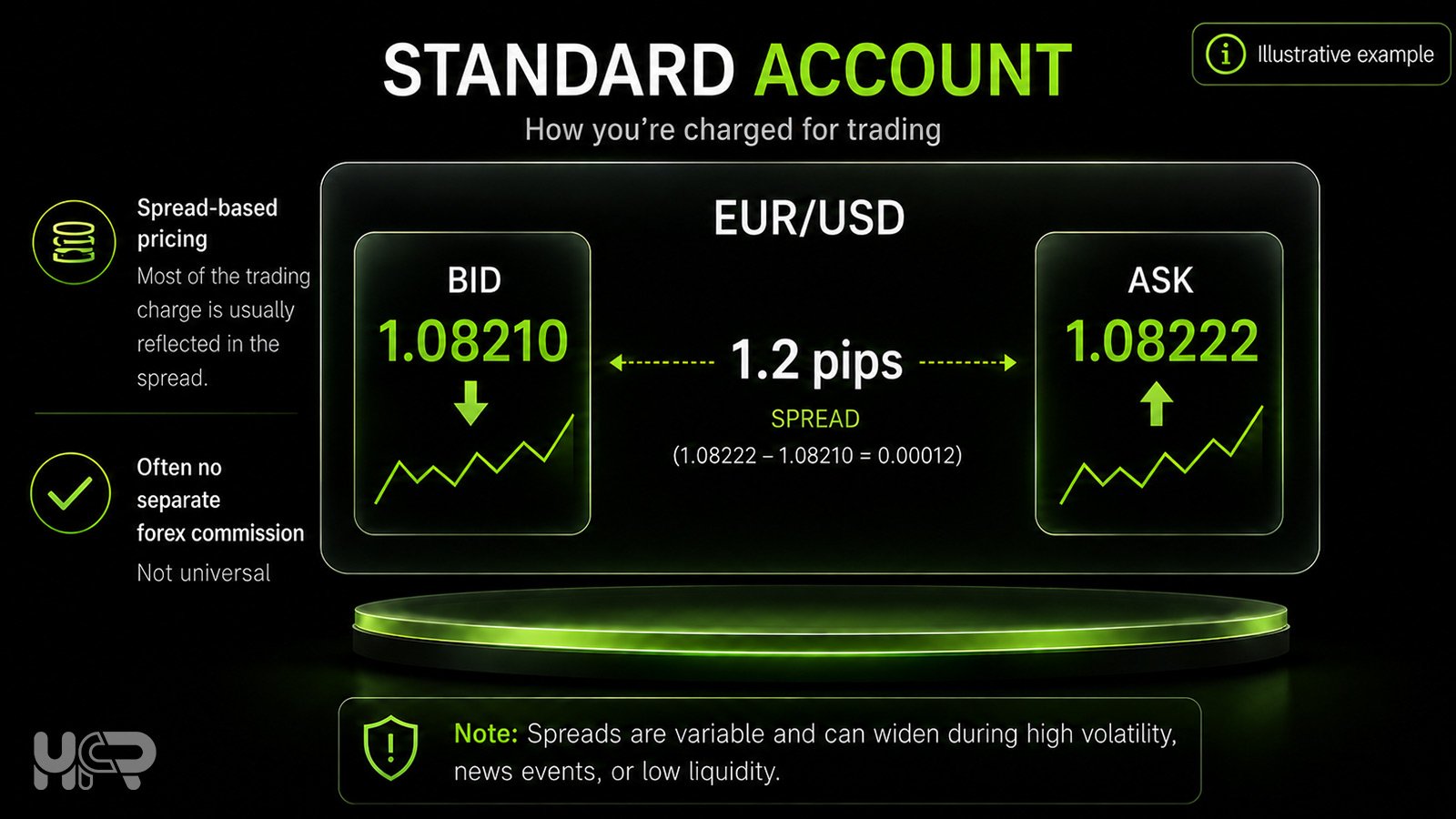
This is why “commission-free” should not be read as “cost-free”. The broker may earn part of its remuneration through the spread instead of charging a separate amount per lot. Spreads are often variable, so the actual cost can change with market conditions, liquidity and the instrument being traded.
Not every account labelled Standard follows exactly the same structure. A broker may charge separate commissions on certain instruments, platforms or account arrangements even if forex trading is mainly spread-based.
When comparing a Standard account with a Raw account, use the actual spread at execution or a comparable average or typical spread published for the same instrument where possible. Do not compare a Standard average spread with a Raw account's minimum “from” spread and treat the result as equivalent.
How a Raw Spread account charges for trading
A Raw Spread account generally uses a tighter variable spread and adds a separate trading commission. The spread is still part of the cost, so Raw pricing should be calculated as spread cost plus commission, not commission alone.
When a broker advertises spreads “from 0.0 pips”, this refers to the minimum quoted spread that may be available under certain market conditions. It does not mean the spread remains at 0.0 pips for every trade. Actual spreads can widen or narrow as liquidity and market conditions change.
Raw-account commissions are commonly expressed per lot per side or as a round-turn amount. A per-side commission is charged separately when the position is opened and when it is closed. The round-turn commission is the combined charge for both sides.
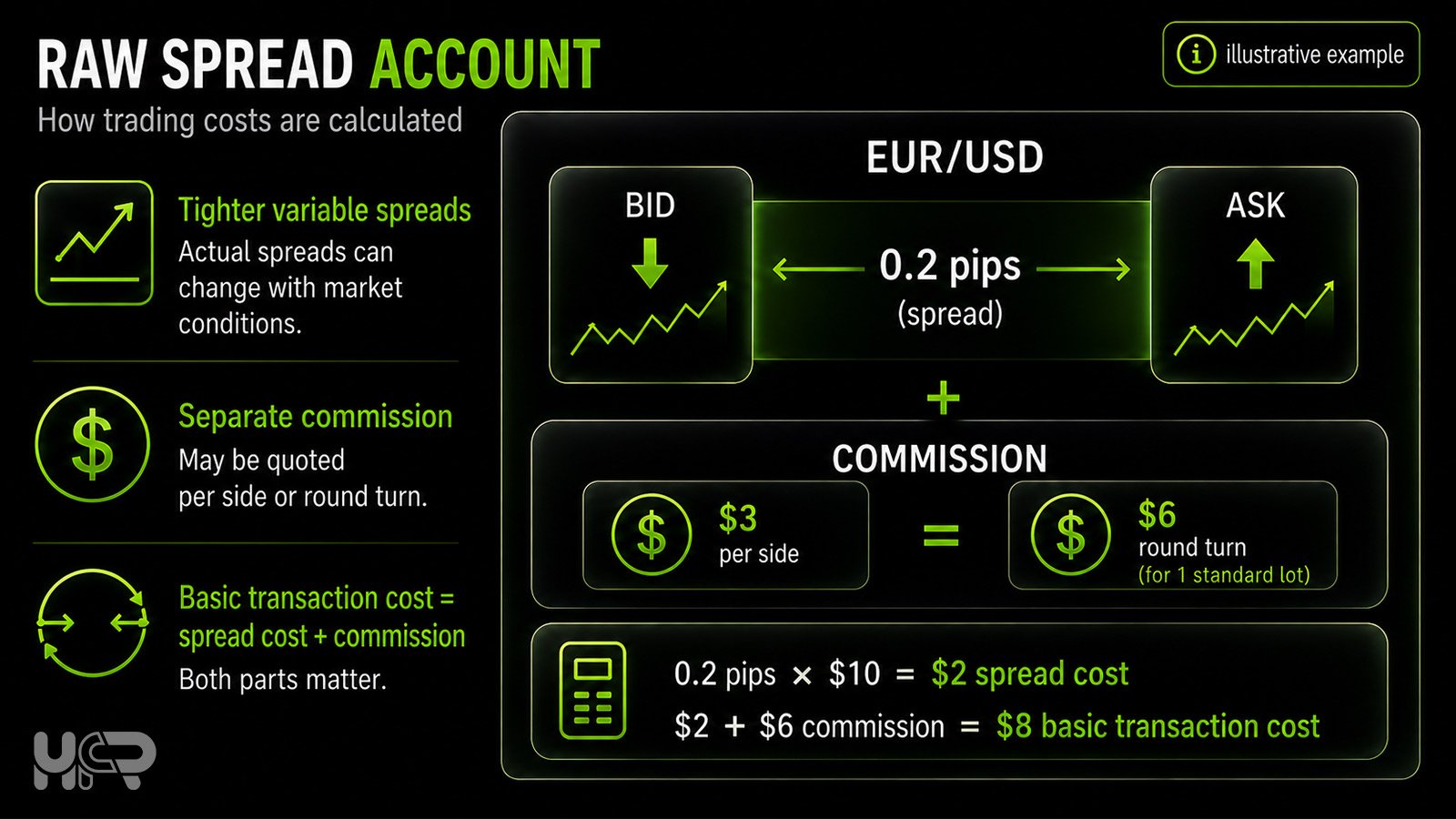
Tickmill's current Raw Account page provides a clear example of per-side commission pricing. It lists spreads from 0.0 pips and a commission of $3 per standard lot per side. For a one-lot EUR/USD trade, Tickmill states that this equals $3 to open and $3 to close, or $6 round turn, with an equivalent amount used where applicable for the account currency.
This example explains the commission structure; it does not establish that Tickmill Raw is cheaper than its Classic account. A real account comparison would also require comparable spread data for the same instrument, legal entity, and market conditions.
Commission terms can vary by broker, instrument, platform, account currency and legal entity, so the current account specification should be checked before calculating total cost.
Information checked: 18 August 2026.
Raw Spread vs Standard Account: side-by-side comparison
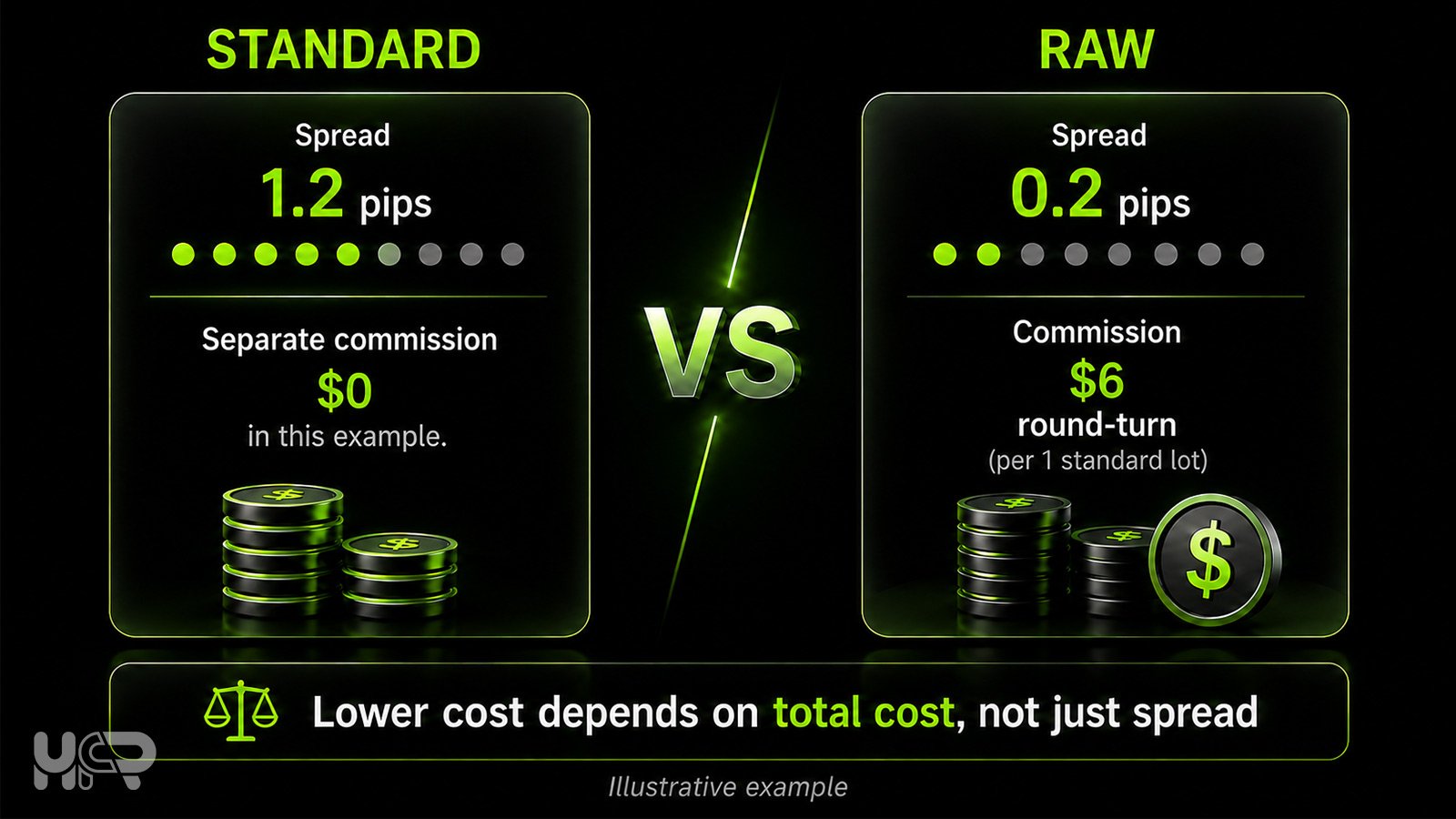
Raw and Standard accounts mainly differ in how the broker charges for trading, not necessarily in which one is cheaper. A Standard account usually places more of the trading charge inside the spread, while a Raw account generally combines a tighter variable spread with a separate commission.
| Comparison point | Standard account | Raw Spread account |
|---|---|---|
| Spread structure | Usually wider, with more of the trading charge included in the spread | Usually tighter; may be advertised from 0.0 pips |
| Separate forex commission | Often none, but this is not universal | Commonly charged per lot, either per side or round turn |
| Cost visibility | Much of the transaction cost is visible through the spread | Spread and commission must be combined |
| Swaps / overnight financing | Can apply | Can apply |
| Forex rebates | May be available where the account is eligible | May be available, sometimes at a different rate or calculation basis |
| Platforms and account restrictions | Depend on the broker and legal entity | Depend on the broker and legal entity |
| What to verify | Actual or typical spread, any commissions, swaps, and eligibility | Actual spread, commission basis, swaps and eligibility |
Neither account label defines the broker's execution model. A Raw account should not automatically be treated as ECN, and a Standard account should not automatically be treated as market-maker execution.
The fair comparison is the basic transaction cost for the same broker, instrument and trade size, using comparable spread measurements and any applicable commission.
How to calculate the total cost of each account
Start by calculating the spread-plus-commission cost on the same basis. For positions held beyond the broker's financing cut-off, swaps and other applicable charges should then be considered separately. Rebates or direct broker-applied reductions should also be handled according to the way the specific arrangement is applied.
Calculate the spread cost
Start with the spread in pips and convert it into money.
For an illustrative one-standard-lot EUR/USD trade in a USD-denominated account, assume the pip value is $10 per pip. This assumption is specific to this example and should not be applied automatically to every currency pair, trade size or account currency.
If the Standard account spread is 1.2 pips:
1.2 pips × $10 = $12 spread cost
If the Raw account spread at the time of the trade is 0.2 pips:
0.2 pips × $10 = $2 spread cost
The important figure is the spread used for the comparison, not simply the lowest advertised “from” spread.
Add the round-turn commission
Next, add any separate commission charged by the account.
Suppose the Raw account charges $3 per lot per side. A complete trade has two sides: opening and closing.
$3 opening commission + $3 closing commission = $6 round-turn commission
The Raw account's basic transaction cost would therefore be:
$2 spread cost + $6 commission = $8
If the Standard account in this hypothetical example has no separate forex commission, its basic transaction cost remains $12.
Compare the two totals
Using these hypothetical inputs:
| Account | Spread cost | Round-turn commission | Basic transaction cost |
|---|---|---|---|
| Standard | $12 | $0 | $12 |
| Raw | $2 | $6 | $8 |
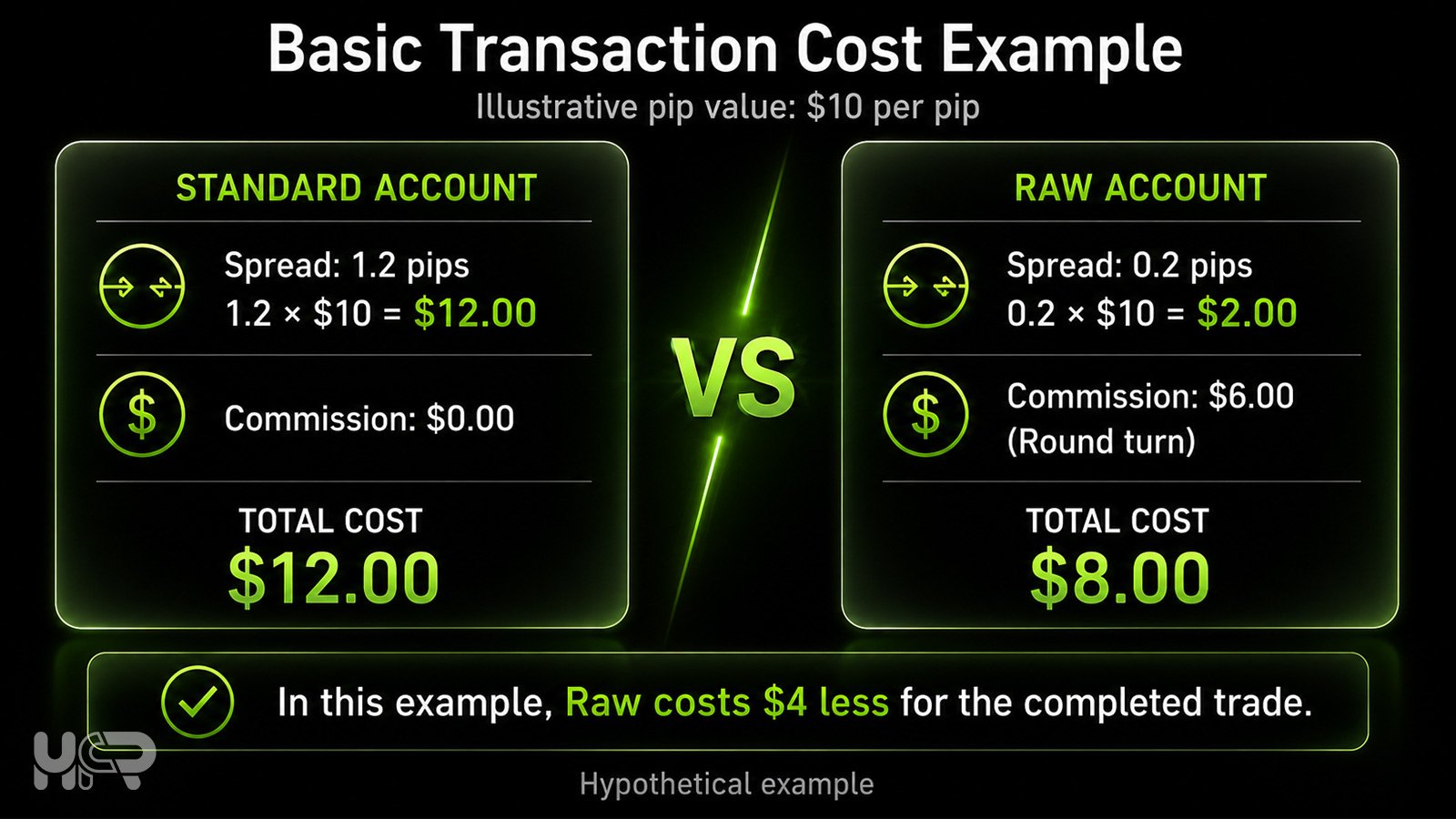
In this example, the Raw account costs $4 less for the completed one-lot trade. That result does not mean Raw pricing is always cheaper. If the Raw spread widens, its commission is higher, or the Standard spread is lower, the outcome can change.
Standard basic cost = spread cost + applicable commission
Raw basic cost = raw spread cost + round-turn commission
Example: when can a Standard account cost less?
A Standard account can cost less when its spread is narrow enough that the Raw account's spread saving does not offset the separate commission.
Using the same illustrative one-standard-lot EUR/USD trade in a USD-denominated account, assume:
- Standard spread: 0.8 pips; Standard commission: $0
- Raw spread: 0.3 pips; Raw round-turn commission: $6
At $10 per pip, the Standard account costs $8. The Raw account costs $3 in spread plus $6 commission, or $9. Under these hypothetical assumptions, the Standard account costs $1 less.
The example is illustrative, not broker pricing or an average spread. Actual costs depend on the broker, instrument, account, legal entity, and market conditions.
Does trading volume decide which account is cheaper?
Trading volume affects the total amount paid, but it does not automatically determine whether a Raw or Standard account is cheaper.
If both accounts charge proportionally per lot, the cost relationship usually scales with volume. Suppose a hypothetical Standard account costs $10 per lot and a Raw account costs $8 per lot after combining spread and commission. At one lot, the difference is $2. At five lots, the difference becomes $10. The absolute difference changes, but the Raw account was already cheaper on a per-lot basis.
There is therefore no universal trading-volume point at which Raw pricing suddenly becomes cheaper. The comparison still depends on the spread and commission applicable to the same broker, instrument, and conditions.
Volume can matter differently when a broker uses tiered commissions or volume-based discounts. If the commission per lot changes after a specified monthly volume, the effective transaction cost can change once that threshold is reached. Any such tier should be verified from the broker's current pricing terms rather than assumed.
Trading more simply to reach a lower commission tier is not a cost-comparison strategy. Higher trading volume increases gross trading activity and total transaction costs. Market exposure can also increase depending on position size, the number of simultaneous positions, and holding time.
What other costs should you compare?
Spread plus commission gives a useful measure of the basic transaction cost, but it does not capture every charge that may affect a Raw or Standard account. Other costs depend on the broker, instrument, account currency, and how long the position remains open.
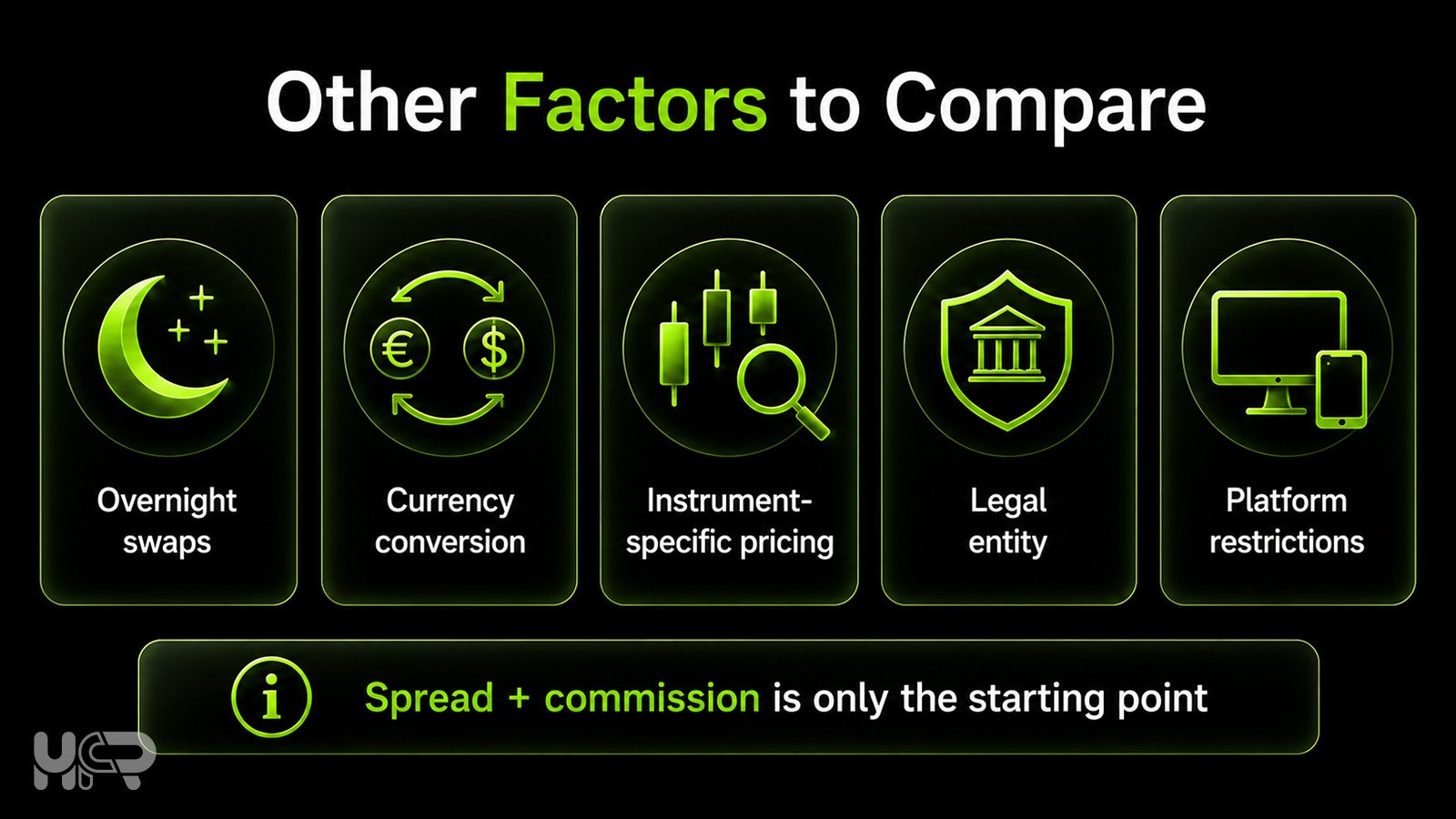
Overnight swaps and financing
If a position is held beyond the broker's daily financing cut-off, an overnight swap or financing charge may apply. Rates can differ by instrument, trade direction and account type, and they can change over time.
Swaps should be compared separately from the spread-plus-commission calculation. A same-day trade that is closed before the applicable financing period should not have an overnight charge added simply for comparison purposes.
Currency conversion and account currency
Trading or settling charges in a currency different from the account's base currency can involve conversion. The broker may apply its own conversion method or fee to commissions, financing charges, realised results or other account movements.
Account currency can also affect how a commission quoted in another currency is converted into the amount actually charged.
Instrument-specific commissions
Do not assume that one account's forex pricing applies to every product. Metals, indices, shares, cryptocurrencies and other CFDs may use different spreads, commissions or financing structures.
When comparing Raw and Standard accounts, check the exact pricing for the instruments you expect to use rather than relying only on the headline EUR/USD spread. For a broader explanation of spreads, commissions, swaps and other charges, see HFR's guide to forex trading costs.
How forex rebates affect Standard and Raw account costs
Forex rebates should be considered after the broker's normal pricing structure has been identified. In many arrangements, the trader first pays the broker's normal spread and commission and later receives cashback for eligible activity. Other arrangements can include a direct spread or commission reduction from the broker, so the calculation method must be checked before comparing net costs.
For a separately paid cashback rebate:
Net eligible cost = broker transaction cost − confirmed eligible rebate
If the arrangement instead includes a direct commission or spread reduction, use the reduced broker charge in the original transaction-cost calculation. Do not subtract the same reduction again as cashback.
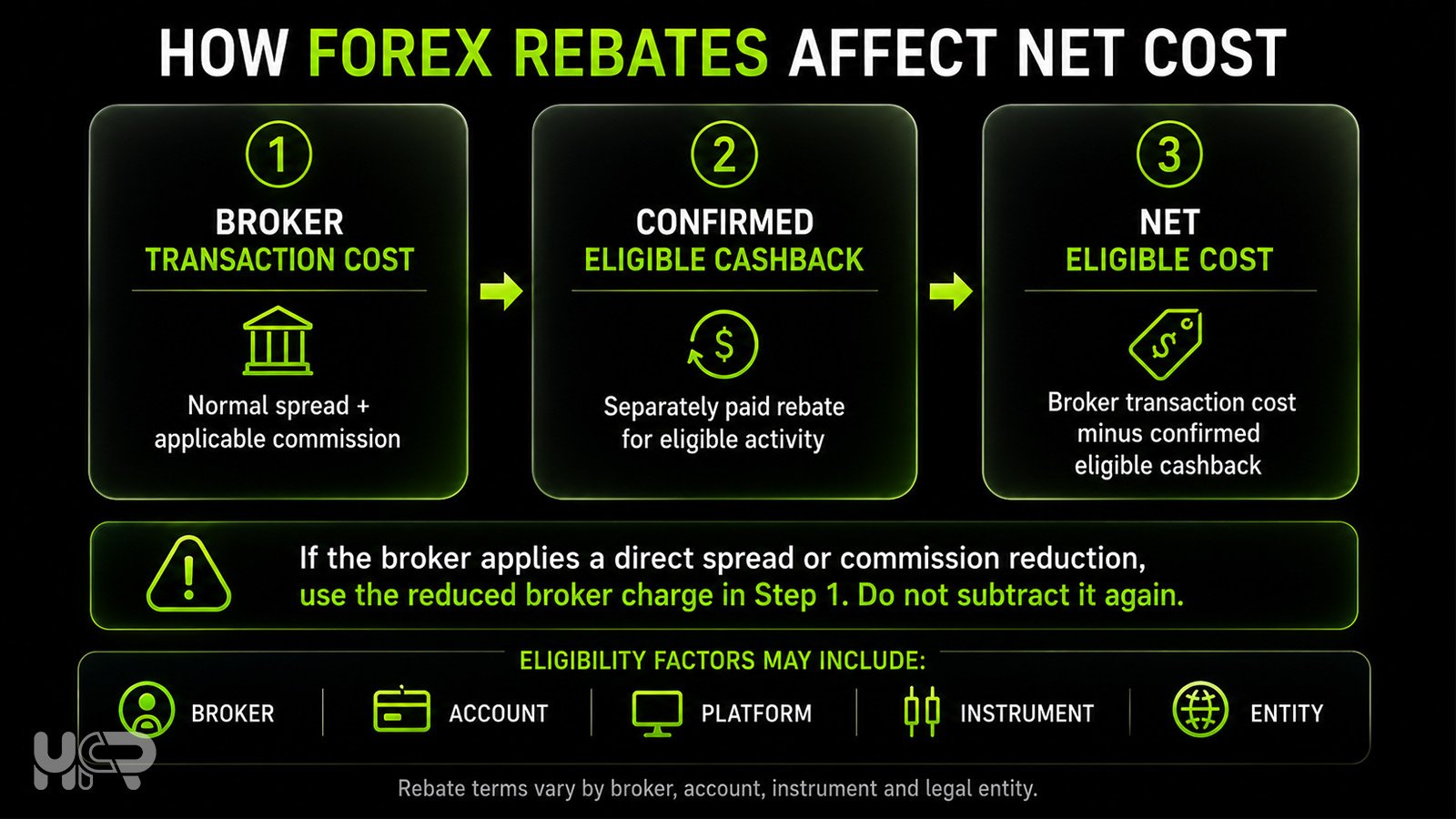
HFR rebate conditions can differ by broker, account type, instrument, platform, and legal entity. For example, HFR's current Tickmill rebate page lists the Raw arrangement as $2 per round-turn lot plus a 5% commission reduction and notes that the 5% direct commission discount applies to eligible Raw MT5 accounts under Tickmill FSA Seychelles. The cash rebate and commission reduction are separate components and should not be counted twice.
A separately paid cashback rebate does not normally alter the price at which the original trade was executed. However, some broker arrangements include a direct spread or commission reduction, which should be treated as part of the broker-cost calculation.
If a rebate is quoted per lot, see how forex cashback is calculated per lot before subtracting it from the broker's trading cost. A lower spread and a rebate are different cost mechanisms and should be compared separately.
If the broker and account are supported by HFR, check the current forex rebate rates and eligibility conditions before including cashback in the comparison. Eligibility can depend on the broker, legal entity, account, platform, instrument, and registration or linking method.
How to compare Raw and Standard accounts before choosing
Before choosing between Raw and Standard pricing, compare the two accounts on the same basis rather than relying on account names or headline spreads.
- Match the broker and legal entity. Pricing, platforms, leverage, and account availability can differ between regions and entities.
- Compare the exact account types. Check the broker's current specifications rather than assuming that labels such as Raw, Zero, Pro or Standard have universal meanings.
- Use the same instrument. A cost comparison for EUR/USD may not apply to gold, indices or other CFDs.
- Use comparable spread data. Do not compare a Raw account's minimum “from” spread with a Standard account's average spread.
- Check the commission basis. Confirm whether commission is quoted per side, round turn, per lot or under another structure.
- Review overnight swaps where relevant. Financing can affect positions held beyond the broker's applicable cut-off.
- Check rebate eligibility separately. Confirm the account, instrument, platform, legal entity, and HFR attribution before deducting cashback or applying a direct reduction.
- Review platform and account restrictions. Minimum deposits, supported platforms, and other conditions may differ.
You can also use HFR's forex account type comparison to review published spreads, rebate rates, platforms and other account-level conditions before registering or linking an account.
Which account costs less?
Neither Raw nor Standard is inherently the lower-cost forex account. Compare the spread-plus-commission cost for the same broker, legal entity, instrument, trade size, and market conditions. For a Standard account, add the spread cost and any applicable commission; for a Raw account, add the raw spread cost and full round-turn commission.
Then consider swaps and other applicable charges, followed by any confirmed eligible rebate or direct broker-applied cost reduction. Minimum 'from 0.0 pips' and zero-commission labels are not enough on their own; use the broker's current pricing for the exact account and instrument.
FAQ
Is a Raw Spread account cheaper than a Standard account?
Not always. A Raw Spread account normally combines a tighter variable spread with a separate commission, while a Standard account may place more of the trading charge inside the spread. Compare the spread cost and full round-turn commission for the same broker, instrument, and trade size before deciding which account costs less.
What is the main difference between a Raw and Standard forex account?
The main difference is usually how trading costs are charged. Standard accounts often use a wider spread with no separate forex commission, while Raw accounts generally offer tighter spreads and charge commission separately. The exact structure can vary by broker, account, platform, instrument, and legal entity.
Does a 0.0-pip Raw spread mean the trade is free?
No. “Spreads from 0.0 pips” refers to a minimum quoted spread that may be available under certain market conditions. The actual spread can change, and Raw accounts may also charge commission. Swaps, currency conversion, or other charges can apply depending on the trade and the broker's current terms.
What does commission per side mean?
A per-side commission is charged separately when a position is opened and when it is closed. For example, a $3-per-lot-per-side commission would normally total $6 round turn for one standard lot after both sides of the trade are completed. Commission structures vary, so always check how the broker quotes the charge.
Do Standard forex accounts have commission?
Many Standard-style forex accounts use spread-based pricing without a separate forex commission, but this is not universal. A broker may apply commissions to certain instruments, platforms or account arrangements. Check the current pricing for the exact account and product rather than assuming “Standard” always means commission-free.
Are Raw accounts the same as ECN accounts?
Not necessarily. “Raw”, “ECN”, “Razor”, “Zero” and “Pro” are broker-specific labels and should not automatically be treated as identical account or execution models. A Raw account can describe a pricing structure without proving a particular execution method. Compare the broker's actual spread, commission, execution, and account specifications.
Do forex rebates work with both Raw and Standard accounts?
They can, depending on the broker and rebate arrangement. Raw and Standard accounts may have different rebate rates, calculation methods, or eligible instruments. For separately paid cashback, calculate the broker's trading cost first and then deduct the confirmed eligible rebate. If the arrangement includes a direct spread or commission reduction, use the reduced broker charge in the original calculation instead.
Should I compare minimum or average spreads?
Average or typical spreads can provide a more representative comparison when the broker publishes them, although they can still change with market conditions. Minimum “from” spreads show only the lowest advertised level and should not be treated as the spread available continuously. Use comparable spread measurements when assessing Raw and Standard pricing.
Sources and methodology
The calculation examples in this article are hypothetical unless a broker is named. Current broker and HFR conditions were checked on 18 August 2026. Because spreads, commissions, legal-entity availability and rebate terms can change, readers should verify current conditions before using a real account comparison.
Disclosure: HighFxRebates may receive remuneration from supported brokers under partner or introducing-broker arrangements. Rebate and direct cost-reduction eligibility remains subject to the relevant HFR and broker conditions.
HighFxRebates — Tickmill rebates
HighFxRebates — Forex rebate rates
HighFxRebates — Forex account type comparison
Risk warning and disclaimer
Cashback may help offset part of eligible trading fees after account approval, but it does not reduce market risk, leverage risk, liquidation risk, funding-rate risk, execution risk, slippage risk, broker risk, security risk, counterparty risk or the risk of loss.
This article is for educational and informational purposes only. It should not be treated as financial advice, investment advice, trading advice, or a recommendation to use any broker, account type, trading strategy, or derivative.
 5
5
Share Posts


Further Reading
- Weekly Market Recap, 19–25 October 2026: Gold and Silver Fall as Crypto Flows Diverge
- Bitcoin, Ethereum, Solana, Gold and Silver: Daily Technical Outlook After the October Pullback
- Why Forex Spreads Widen: News, Rollover, Liquidity and Volatility
- What is Proof of Reserves on a crypto exchange? What it shows and what it does not