






Table of Contents
[ Show/Hide ]- • Forex broker deposit and withdrawal fees: the short answer
- • What costs can appear when you fund or withdraw from a forex broker?
- • How payment methods change the cost and withdrawal process
- • Why the amount credited or received can be different
- • Why withdrawals often have more rules than deposits
- • Processing time is not the same as settlement time
- • Why fees and payment methods can differ by broker legal entity
- • How to compare broker deposit and withdrawal conditions
- • Do forex rebates cover deposit or withdrawal fees?
- • Withdrawal fee red flags and when to verify before paying
- • Final takeaway
- • FAQ
- • Sources and methodology
- • Risk warning and disclaimer

A broker can advertise no internal funding charge and a deposit or withdrawal can still cost money. Forex broker deposit and withdrawal fees should be separated from charges applied by banks, card issuers, payment providers and intermediary banks, as well as costs created by currency conversion.
For example, a broker may accept a bank deposit without charging its own fee while the sending bank or an intermediary bank deducts an amount before the funds reach the trading account. The same can happen when money is withdrawn.
Payment methods, fees, limits and withdrawal rules can also vary by the broker's legal entity, country, account currency and payment method. For that reason, 'free deposit' or 'free withdrawal' does not necessarily mean the transfer has no total cost.
Forex broker deposit and withdrawal fees: the short answer
Deposit and withdrawal costs can come from the broker, a bank, card issuer, payment provider or intermediary bank. Currency conversion can add a separate cost when the payment currency differs from the trading account currency. Where crypto funding is supported, blockchain or network charges may also apply.
Funding costs are separate from trading costs such as spreads, commissions and swaps, so they should be compared separately.
A 'free withdrawal' may mean only that the broker does not charge its own fee. A bank or payment provider can still apply a separate charge, depending on the entity, method and currency.
What costs can appear when you fund or withdraw from a forex broker?
The amount sent to or received from a forex broker can be affected by several separate charges. Identifying who applies each cost helps avoid treating every deduction as a broker fee.
| Cost type | Who may charge it | Where it appears | What to check |
|---|---|---|---|
| Broker deposit fee | Broker | Added to or deducted from the deposit | Broker funding page and entity-specific fee schedule |
| Broker withdrawal fee | Broker | Deducted when the broker processes the withdrawal | Method, currency, amount and withdrawal frequency |
| Bank fee | Sending or receiving bank | Before a deposit arrives or when a withdrawal is received | Domestic vs international transfer charges |
| Intermediary-bank deduction | Correspondent/intermediary bank | Deducted while an international transfer moves between banks | Whether correspondent-bank charges can apply |
| Card/e-wallet/provider fee | Card issuer, e-wallet or payment processor | Applied separately or deducted during the transfer | Provider terms, country and transaction type |
| Currency-conversion cost | Broker, bank or payment provider | Included in the exchange rate or charged during conversion | Account currency, payment currency and conversion rate or markup |
| Blockchain/network fee | Blockchain network or crypto payment route | Applied when crypto funding or withdrawal is supported | Supported network and live fee before confirming |
OANDA Corporation, for example, states that it does not charge for accepting wire-transfer deposits, but the sending bank may charge a service fee and intermediary banks may deduct fees before the funds arrive.
How payment methods change the cost and withdrawal process
The funding method affects both cost and the withdrawal procedure. Availability varies by broker entity, country and payment provider, so the same method may not be available to every client.
| Method | Typical cost points | Common operational issue | What to verify |
|---|---|---|---|
| Bank transfer/wire | Sending, receiving and intermediary-bank charges | International transfers may pass through correspondent banks | Broker fee, bank charges, supported currencies and transfer route |
| Debit/credit card | Card issuer or international-processing charges | Withdrawals may be returned to the original card and can be subject to refund limits | Card eligibility, withdrawal rules and issuer charges |
| E-wallet / local payment method | Provider fees or currency conversion | A method available for deposits may not also support withdrawals | Country, entity, provider and withdrawal availability |
| Crypto funding | Blockchain/network fee and possible conversion costs | Wrong network or address can delay or prevent receipt | Whether crypto is supported, accepted network and live network fee |
Bank transfers can involve costs outside the broker. OANDA US, for example, warns that banks and intermediary banks may charge for wire transfers. Domestic payment rails can also differ from international SWIFT transfers in both cost and processing time.
A card can be fee-free at broker level while the issuer applies its own charge. Pepperstone UK also uses a return-to-source rule: withdrawals are returned to the same bank account or debit/credit card in the same name, or a joint name, as the trading account.
Why the amount credited or received can be different
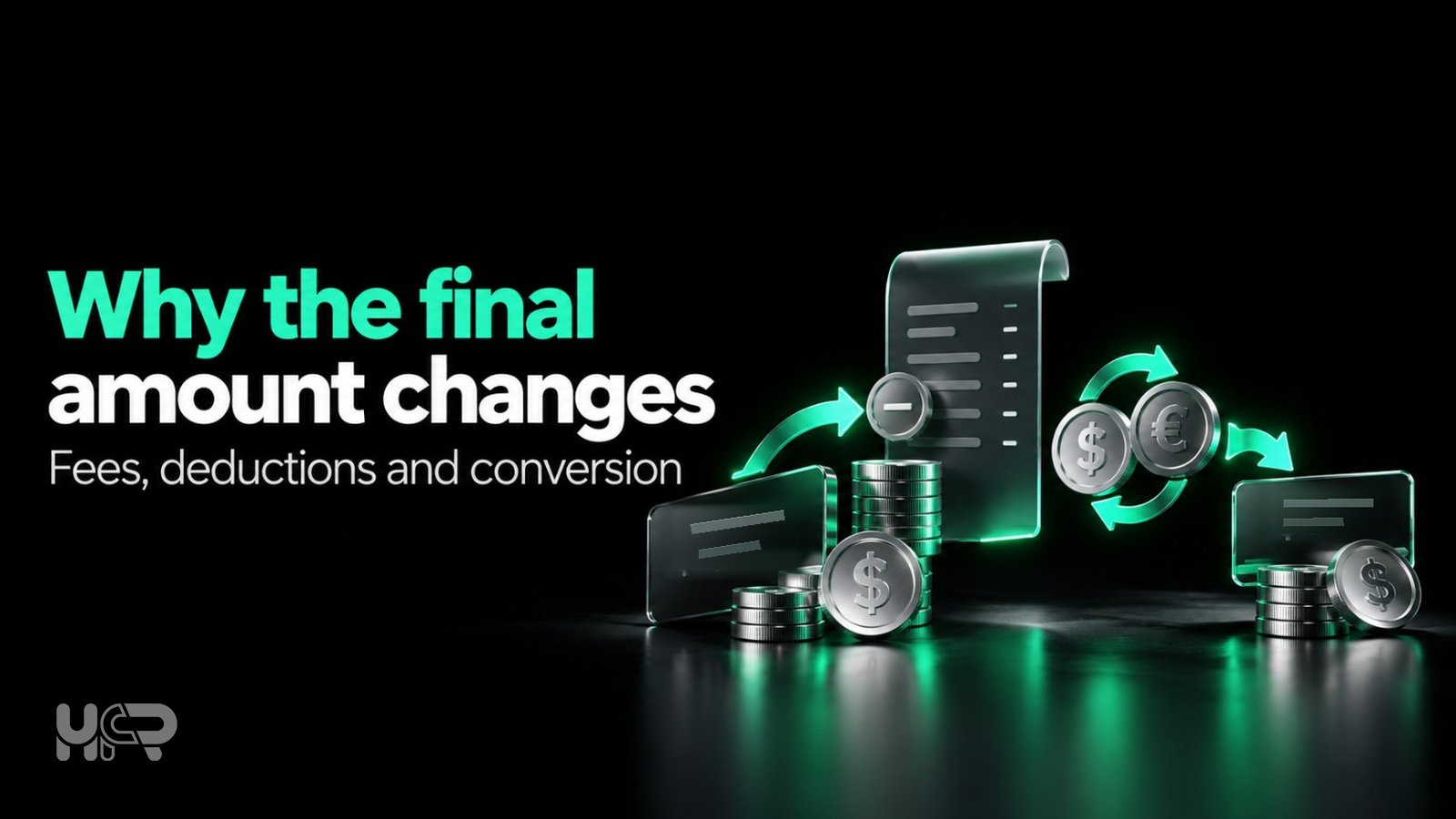
The amount credited to a trading account, or received after a withdrawal, can differ from the amount originally sent without the difference necessarily being a broker fee.
A simple way to view the process is:
Amount sent -> bank/provider deductions or conversion -> amount credited
Currency conversion can add cost when the payment currency differs from the account or payment-route currency. The final amount depends on the exchange rate used and any conversion spread or markup.
OANDA TMS in Europe states that conversion costs can apply when a deposit is made in a currency different from the relevant sub-account currency. It also notes that the customer's bank or card provider may charge its own fee.
Why withdrawals often have more rules than deposits
Some brokers require deposited funds to be returned to the original payment source and restrict withdrawals to an account or card held in the client's name.
Pepperstone UK, for example, states that funds can only be returned to the original source and to a bank account or debit/credit card in the same name, or a joint name, as the trading account.
Where several funding methods were used, a broker may apply a withdrawal hierarchy. OANDA US currently places debit-card withdrawals before wire transfers when original deposited amounts are being returned.
Card withdrawals can also have limits because they may be processed as refunds. Under OANDA US rules, debit-card withdrawals are capped at the amount originally deposited by card. Trading profits or amounts above that limit are withdrawn by wire transfer, subject to the account's withdrawal rules.
Brokers may request identity, bank-account ownership or source-of-funds information for KYC and anti-money-laundering checks. These controls do not guarantee fund safety.
Processing time is not the same as settlement time

Processing time covers the broker review and release stage. Arrival time then depends on the receiving bank, card issuer, or payment provider.
OANDA US, for example, states that debit-card withdrawals typically take one to three business days for processing and that the card provider may need additional time. Pepperstone UK similarly separates its internal processing period from final settlement and notes that banks or payment providers may take longer or apply their own charges.
Several factors can extend the total timeframe:
- weekends and bank holidays
- payment cut-off times
- intermediary or correspondent banks
- additional identity or payment verification
- card issuer or payment-provider processing
Treat published withdrawal times as estimates for the relevant entity and method; bank or provider settlement can take longer.
Why fees and payment methods can differ by broker legal entity
The same broker brand can use different funding methods, currencies, limits and withdrawal rules across legal entities.
OANDA illustrates the point: its U.S. service has its own debit-card and wire-transfer rules, while OANDA TMS in Europe publishes different payment methods, currencies, limits and conversion conditions.
HFR's Why the Same Forex Broker Can Have Different Legal Entities guide explains why these entity differences exist and why one set of conditions should not automatically be applied to another company in the same group.
How to compare broker deposit and withdrawal conditions

Compare the full funding process rather than relying on a 'no-fee' headline.
- Broker fees: Does the broker charge for deposits or withdrawals using your chosen method?
- Third-party charges: Could a bank, card issuer, intermediary bank, e-wallet or payment provider deduct its own fee?
- Supported methods: Are bank transfer, card or other local methods available for both deposits and withdrawals?
- Account currencies: Does your funding currency match the trading account currency?
- Conversion rules: Who performs any required currency conversion, and what rate or markup applies?
- Transaction limits: Check minimum and maximum deposit or withdrawal amounts.
- Return-to-source rules: Will deposited funds need to be returned to the original payment method?
- Verification: Check KYC, account-ownership and source-of-funds requirements.
- Timing: Separate the broker's processing time from the bank or payment provider's settlement time.
- Regional conditions: Confirm that the payment method and rules apply to your legal entity and country.
To place funding charges within the wider cost structure, see HFR's How to Reduce Forex Trading Fees.
Do forex rebates cover deposit or withdrawal fees?
Normally, no. Forex rebates are linked to eligible trading activity under the broker and HFR arrangement, using the calculation basis shown on the relevant HFR broker page.
Bank-wire charges, card fees, intermediary-bank deductions and currency-conversion costs are separate from rebate-eligible trading activity unless a specific HFR broker page states otherwise.
If you are new to the rebate mechanism, see What Are Forex Rebates? For HFR payout timing and withdrawal mechanics, see How Forex Rebate Payments Work.
Withdrawal fee red flags and when to verify before paying
A disclosed withdrawal or bank-wire fee is not automatically a warning sign if it is clearly stated in the broker's official terms.
More caution is needed when funds are withheld pending an unexpected payment. The CFTC warns that fraudulent OTC forex dealers may refuse withdrawals until customers pay undisclosed commissions, made-up taxes or additional money to reach a higher account status.
If a broker unexpectedly asks for more money to unlock a withdrawal, verify the request before paying. Check:
- the charge against the broker's official withdrawal terms
- the exact legal entity on the relevant regulator's official register
- the request through contact details taken from the broker's official website or regulatory record
Use contact details from the broker's official website or regulatory record, not only details supplied by the person requesting payment. Unexpected taxes, commissions or demands for another deposit should be independently verified before any further money is sent.
HFR's How to Check If a Forex Broker Is Regulated guide explains how to verify the exact legal company, licence and official website details.
Final takeaway
When comparing forex broker deposit and withdrawal fees, first identify who charges each cost. A broker may charge nothing while a bank or payment provider still applies a fee.
Where practical, matching the payment currency to the trading account currency can reduce avoidable conversion costs. Check return-to-source and same-name rules before depositing so you know how funds can later be withdrawn.
Keep broker processing time separate from bank or provider arrival time, and recheck the live payment page before a material deposit or withdrawal.
FAQ
Do forex brokers charge deposit fees?
Some do, while others charge no internal deposit fee. Banks or payment providers can still apply separate charges.
Do forex brokers charge withdrawal fees?
They can. A withdrawal charge can come from the broker, bank, payment provider or intermediary bank, depending on the entity and method.
Why did I receive less money than I deposited or withdrew?
The difference may result from bank or intermediary charges, payment-provider fees or currency conversion. It should not automatically be treated as a broker fee.
Why do some brokers return withdrawals to the original payment method?
Some brokers use return-to-source rules for payment control and anti-money-laundering or fraud-prevention purposes. The exact hierarchy and same-name requirements are broker- and entity-specific.
Can I withdraw trading profits back to the same card I used to deposit?
Not always. OANDA US, for example, limits debit-card withdrawals to the amount originally deposited by card. Remaining funds may need to be withdrawn by wire transfer.
Can currency conversion add a cost to deposits or withdrawals?
Yes. If the payment currency differs from the account or withdrawal currency, the broker, bank or provider may apply an exchange rate and conversion cost or markup.
Do HFR forex rebates cover broker deposit or withdrawal fees?
Normally, no. HFR forex rebates are linked to eligible confirmed trading activity, not bank, card, intermediary-bank or currency-conversion charges.
Is it normal for a broker to ask for extra tax or another deposit before releasing a withdrawal?
Unexpected demands for extra deposits, undisclosed commissions or supposed taxes to unlock funds are a warning sign. The CFTC has specifically warned about this behaviour; verify the request independently before paying.
Sources and methodology
This desk-based educational guide was rechecked on 12 October 2026. Broker-specific examples use current official OANDA and Pepperstone funding or withdrawal pages, while the withdrawal-fraud warning uses the U.S. CFTC customer advisory on OTC forex. Funding methods, charges, limits, processing times and return-to-source rules can change by legal entity and payment provider, so the live broker page and Client Agreement for the client's actual entity remain the final references before a transaction.
Pepperstone UK currently has inconsistent wording across two official pages about international bank-withdrawal fees: its withdrawal page describes withdrawals as fee-free, while its costs-and-fees page refers to a GBP 15 charge for an international bank-account withdrawal. Because those official pages conflict, this article does not use a fixed Pepperstone UK international-withdrawal fee. Clients should check the live withdrawal screen and the terms applying to their account before submitting the transfer.
Source links
- OANDA Corporation - Trading charges and intermediary-bank fees
- OANDA Corporation - Deposit methods
- OANDA Corporation - Withdrawal methods and hierarchy
- OANDA TMS - Deposit methods and conversion costs
- Pepperstone UK - Deposit methods and third-party payment rules
- Pepperstone UK - Withdrawal methods and return-to-source rules
- Pepperstone UK - Costs and fees
- CFTC - Eight Things You Should Know Before Trading Forex
Risk warning and disclaimer
Forex and CFD trading involve risk of loss, particularly when leverage is used. Deposit and withdrawal methods, fees, and processing times can change, and third-party banks or payment providers may apply charges outside the broker's control. Regulation and payment-verification procedures do not guarantee the safety of funds or trading outcomes.
Forex rebates may return part of eligible trading costs after broker confirmation, but they do not reduce market risk, leverage risk, execution risk, broker risk, or the risk of loss. This article is for general educational information only and is not financial, investment, legal, tax, or trading advice.
 5
5


