





Table of Contents
[ Show/Hide ]- • What does leverage mean in forex?
- • How do leverage and margin work together?
- • A worked example: the same forex position at different leverage ratios
- • What does leverage actually change?
- • Does higher leverage increase profit and loss?
- • Why high leverage can increase account risk
- • How leverage interacts with lot size
- • How leverage affects free margin
- • Why leverage limits differ between brokers and accounts
- • Why leverage can differ between forex, gold, indices, and other CFDs
- • Common mistakes beginners make with leverage
- • A simple checklist before using a leveraged forex account
- • Final takeaway
- • FAQ
- • Sources and methodology
- • Risk warning and disclaimer
Leverage in forex allows a trader to control a market position that is larger than the margin set aside to support it. A ratio such as 1:30 or 1:100 describes the relationship between market exposure and the margin required for that exposure.
Leverage does not add cash to the account or change pip value for an unchanged position size. Its most direct effect is the margin required for a position. Higher available leverage can make larger exposure easier to open with the same equity, which is why risk can rise when that extra capacity is used.
The exact calculation depends on the instrument, broker, legal entity and account conditions. The worked examples below use MetaTrader 5's standard Retail Forex formula.

What does leverage mean in forex?
Forex leverage is usually shown as a ratio. A ratio of 1:100 means that, under the applicable margin rules, each 1 unit of margin can support up to 100 units of qualifying market exposure. A ratio of 1:30 supports less exposure for the same margin, while 1:500 supports more.
That ratio describes a margin relationship, not a cash transfer. If an account has $5,000 and the broker offers 1:100 leverage, the balance is still $5,000. The leverage setting affects how much margin the platform may require when positions are opened.
How lower margin requirements can increase exposure
Because leverage reduces the margin required for a qualifying position, the same equity can support larger notional exposure. Price changes still apply to the full position size, not only to the margin reserved for it.
How to read leverage ratios such as 1:30, 1:100, and 1:500
| Leverage ratio | Approx. margin as % of exposure | Interpretation |
|---|---|---|
| 1:30 | 3.33% | About 1 unit of margin for 30 units of exposure |
| 1:100 | 1.00% | About 1 unit of margin for 100 units of exposure |
| 1:500 | 0.20% | About 1 unit of margin for 500 units of exposure |
The 1:500 figure is used here only as an illustrative example; availability depends on the broker, legal entity, client classification and jurisdiction. These are simplified equivalents. Actual margin can differ because of symbol-specific rules, fixed initial margin, conversion rates, tiered requirements or other broker settings.
How do leverage and margin work together?
Leverage and margin describe the same relationship from different directions: leverage is the exposure-to-margin ratio, while margin is the equity required or reserved to support the position.
What is the difference between leverage and margin?
Leverage is normally expressed as a ratio such as 1:100. Margin is expressed as an amount of money or as a percentage of exposure. A 1:100 ratio corresponds to a 1% margin requirement in the simplest case, while 1:30 corresponds to roughly 3.33%.
How leverage changes the margin required for a position
For a standard Forex symbol in MetaTrader 5, the platform documents the basic margin formula as:
Margin = Volume in lots x Contract size / Leverage
If the broker defines an initial margin in the symbol specification, or uses a different calculation mode, that formula may not be the one applied. The final margin can also require conversion into the account deposit currency.
A worked example: the same forex position at different leverage ratios
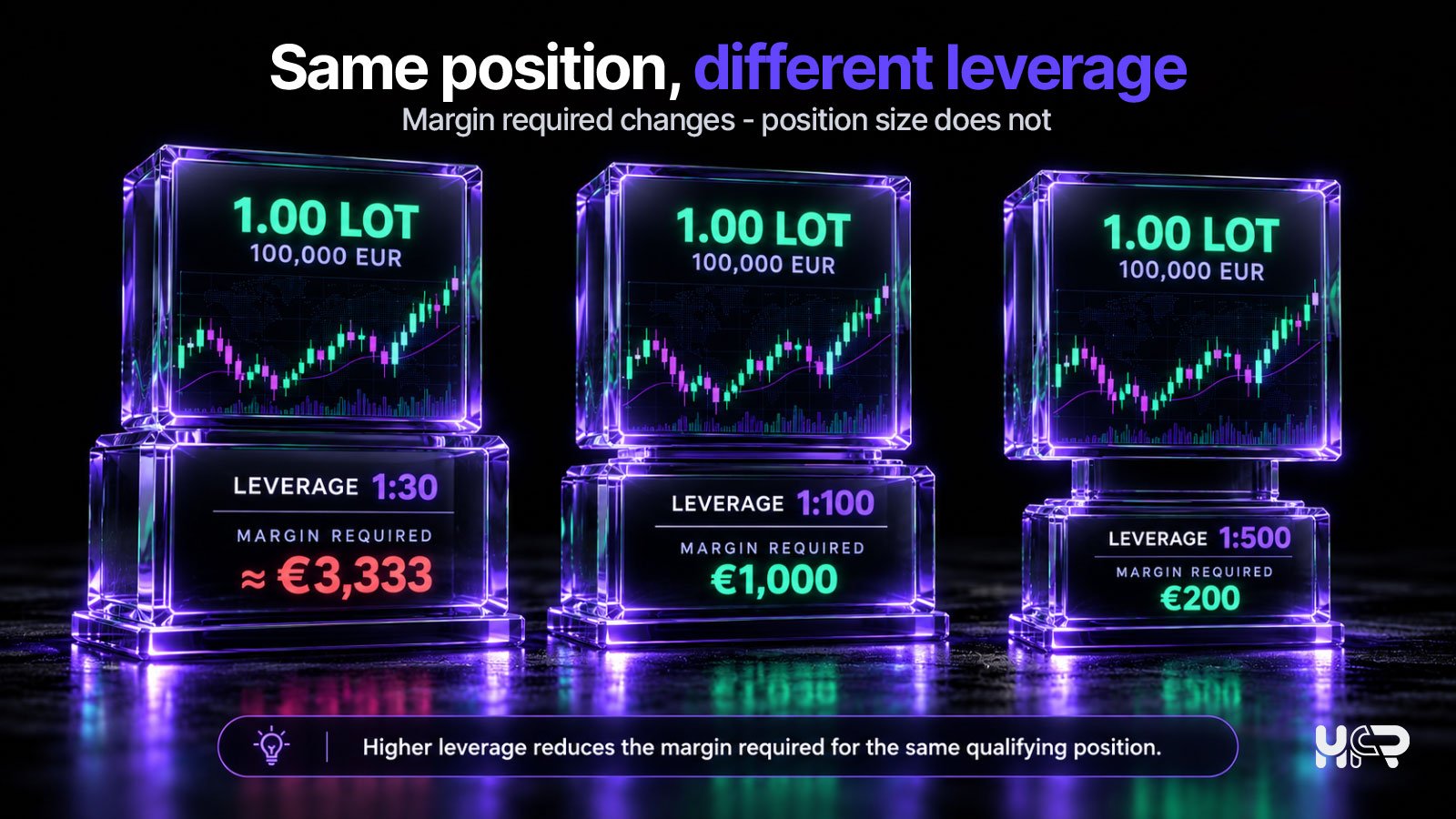
Assume a trader opens 1.00 lot of EUR/USD and the broker defines one standard contract as 100,000 EUR. Using the MetaTrader 5 Retail Forex formula, the basic margin requirement before any conversion into the account currency would be:
| Leverage | Position size | Basic margin requirement | 10-pip P/L for 1 lot EUR/USD* |
|---|---|---|---|
| 1:30 | 100,000 EUR | 3,333.33 EUR | About USD 100 |
| 1:100 | 100,000 EUR | 1,000 EUR | About USD 100 |
| 1:500 | 100,000 EUR | 200 EUR | About USD 100 |
*For EUR/USD, one pip is 0.0001. On a 100,000-unit EUR/USD position, a 10-pip move is about USD 100 before trading costs. If the account is denominated in another currency, the platform may then convert that amount into the account currency.
The position size and market exposure are identical in all three cases, so the same EUR/USD price move has the same gross monetary effect. Only the margin requirement changes.
This is the key distinction: lower required margin does not mean the position itself has become smaller or safer.
What does leverage actually change?
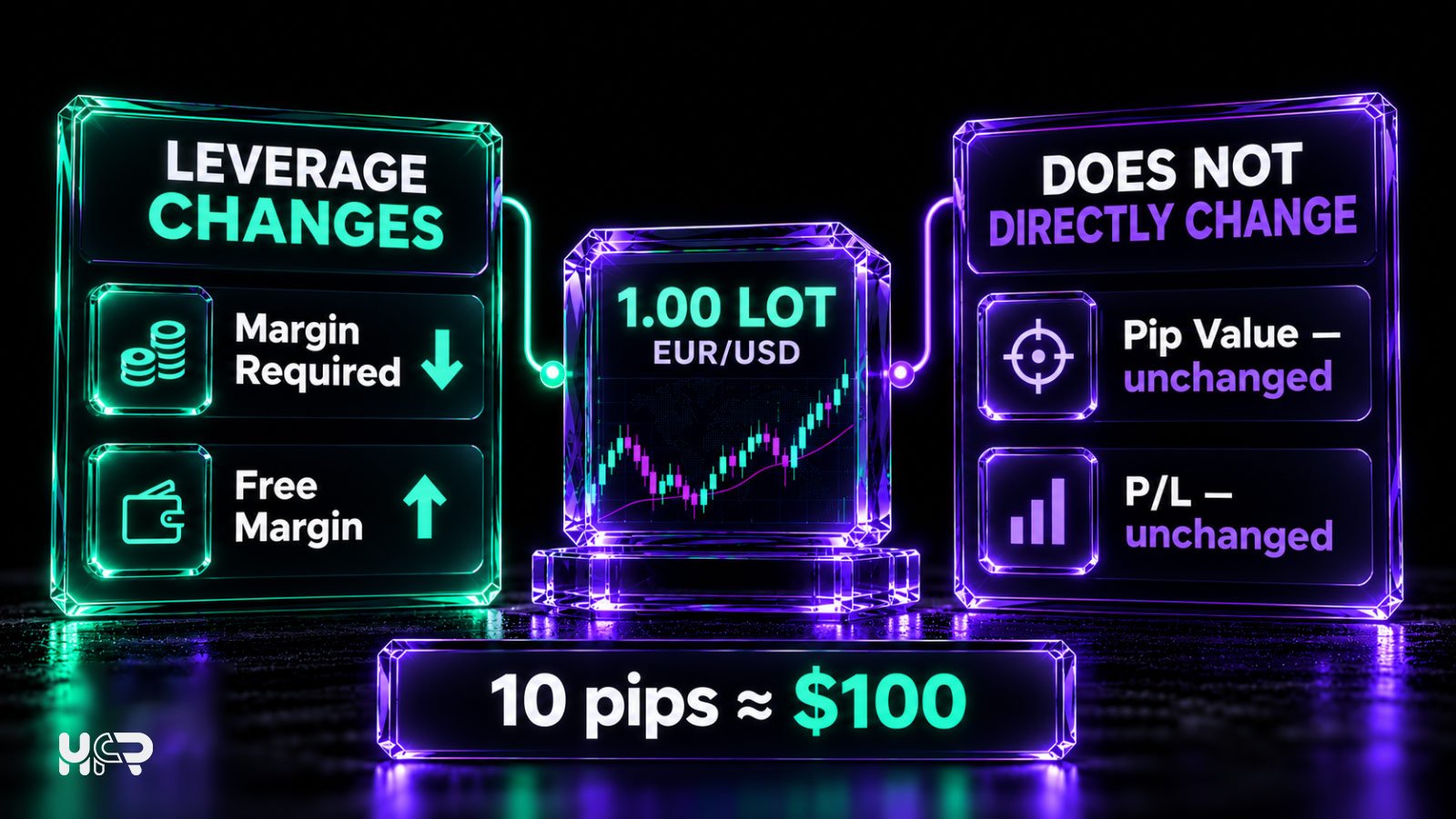
Leverage is easiest to understand by separating what the leverage setting can directly affect from what it does not change when the position size stays the same.
| Leverage can affect | Leverage does not directly change |
|---|---|
| Required margin for a qualifying position | The market price movement itself |
| How much exposure the available margin can support | Pip value for the same position size |
| How much free margin remains immediately after opening a position | The spread quoted for the same account and symbol |
| How easily an account can open a larger position | The profit or loss from the same price move on an unchanged position size |
Does higher leverage increase profit and loss?
Higher account leverage does not automatically make the same position gain or lose more from each pip. Position size determines how much market exposure is open, while leverage determines how much margin is needed to support that exposure.
If two traders both hold the same 0.10-lot EUR/USD position, the same price move has the same gross monetary effect on both positions even if one account offers 1:30 leverage and the other offers 1:500. The difference is that the second account may reserve less margin for that position.
Why position size matters more than the leverage number alone
Risk changes when leverage is used to increase position size. An account with access to 1:500 leverage can open substantially more exposure per unit of margin than an account limited to 1:30. If the trader uses that extra capacity, the account becomes more sensitive to the same market move because more units are exposed.
Maximum leverage is not the same as effective leverage
A broker may advertise a maximum account leverage such as 1:100, but an account does not automatically use that full ratio. Effective leverage is commonly assessed by comparing the account-currency value of total open market exposure with account equity. For example, an account with $5,000 equity and approximately $25,000 of exposure has effective leverage of about 5:1, even if its maximum permitted leverage is 1:100. Currency conversion and instrument specifications affect the exposure calculation.
Why high leverage can increase account risk
The main danger is the combination of low margin requirements and larger exposure. When higher leverage is used to open bigger positions, losses can consume account equity more quickly.
A small margin figure can be misleading. Margin is not the maximum possible loss; it is a requirement for supporting exposure. Losses can exceed the amount initially reserved as margin, subject to liquidation rules, execution and any applicable negative balance protection.
As floating losses reduce equity, free margin and margin level can deteriorate. For the account-metric side of this process, read HFR's guide to Free Margin, Used Margin, Equity and Margin Level Explained. If margin conditions continue to weaken, the broker's margin-call and stop-out rules become relevant.
How leverage interacts with lot size
Leverage and lot size are different variables. Lot size defines position size. Leverage affects how much margin is required to support that position under the account and symbol rules.
Two accounts can both offer 1:100 leverage while carrying very different risk. A 0.01-lot position and a 1.00-lot position do not have the same exposure or pip value, even though the leverage setting is identical. This is why leverage should never be assessed without also checking position size.
For the position-size side, see What Is a Lot in Forex? Standard, Mini and Micro Lots Explained.
How leverage affects free margin
For the same qualifying position, higher leverage generally reduces initial margin and can leave more free margin immediately after the trade is opened.
Extra free margin does not mean lower market risk. If the unused capacity is used to open additional or larger positions, total exposure and account sensitivity can rise.
Why leverage limits differ between brokers and accounts
Leverage is not universal. It can depend on the broker, legal entity, client classification, account type, instrument and regulation, so the same brand can offer different conditions through different entities.
How regulation can limit leverage
As one jurisdiction-specific example, current FCA rules for UK retail CFD and rolling spot forex clients require minimum opening margin of 3.33% for major FX pairs, equivalent to maximum leverage of about 30:1. Minor FX pairs and gold require at least 5% margin, equivalent to about 20:1. These are UK retail-client rules, not global leverage limits.
Why retail and professional accounts may have different limits
Retail leverage restrictions can be stricter than conditions available to professional clients. A different client classification can also mean losing retail protections, so the applicable regulator and broker terms matter when comparing leverage.
Why the broker's legal entity matters
A broker group may operate through several legal entities, each with different leverage caps, margin-close-out rules, protections and product conditions. The brand name alone does not determine the account rules.
Why leverage can differ between forex, gold, indices, and other CFDs
A headline account leverage setting does not mean every symbol uses the same margin method. MetaTrader 5 supports several calculation modes, and a broker can also define initial margin directly in the symbol specification.
Do not assume that 1:100 on the account produces the same margin percentage for EUR/USD, XAU/USD, an index CFD and a share CFD. Check the symbol specification and current broker margin schedule.
Common mistakes beginners make with leverage
Treating leverage as extra cash. Leverage changes the margin relationship; it does not increase the account balance.
Confusing leverage with lot size. Leverage affects required margin, while lot size defines how much of the market is being controlled.
Assuming higher leverage changes pip value. For the same currency pair and the same position size, pip value does not change merely because the account leverage setting changes.
Looking only at required margin. A low margin requirement can support a large exposure. Risk should be assessed from the full position size and account equity, not from margin alone.
Assuming one leverage number applies to every instrument. Gold, indices, shares and other CFDs can use different margin rules from major forex pairs.
Assuming the same broker brand always means the same leverage. Different legal entities, client classifications, and jurisdictions can produce different limits and protections.
A simple checklist before using a leveraged forex account
- What maximum leverage applies to this account?
- Which legal entity holds the account, and which regulator applies?
- Does the leverage or margin requirement change by instrument?
- What contract size does the broker define for the symbol?
- What lot size and notional exposure will the position create?
- How much margin will the position require under the current symbol settings?
- How much free margin and margin level will remain after the position is opened?
- What margin-call and stop-out rules apply to this account?
- Does negative balance protection apply, and under what conditions?
Evaluate the full exposure and account rules rather than the headline leverage ratio alone.
Final takeaway
Leverage changes how much margin is required for a given amount of market exposure. It does not by itself change market price movement or the pip value of an unchanged position size.
The practical risk comes from how leverage is used. Higher available leverage can make larger positions easier to open; if that capacity is used, the account becomes more sensitive to adverse price moves and margin pressure.
Before comparing leverage ratios, check the position size, contract specification, margin requirement, free margin, margin-call and stop-out rules, legal entity and client protections for the specific account. These checks are more useful than judging an account by its maximum leverage alone.
FAQ
What is leverage in forex?
Leverage is the relationship between market exposure and the margin required to support it. A ratio such as 1:100 means that, under the applicable margin rules, 1 unit of margin can support up to 100 units of qualifying exposure.
What does 1:100 leverage mean in forex?
In the simplest case, 1:100 leverage corresponds to a 1% margin requirement. A 100,000-unit qualifying forex position would require a basic margin of 1,000 units of the margin currency before conversion or broker-specific adjustments.
Is 1:500 leverage higher than 1:100?
Yes. 1:500 provides more exposure per unit of margin than 1:100. That means the same qualifying position can require less margin, but it also makes it easier to open larger exposure with the same equity.
What is the difference between leverage and margin?
Leverage is a ratio. Margin is the amount of equity required or reserved to support a leveraged position. Higher leverage generally means a lower margin requirement for the same qualifying position.
Does higher leverage increase pip value?
Not by itself. Pip value depends mainly on the currency pair, position size and account-currency conversion. If lot size stays the same, changing the leverage setting does not automatically change pip value.
Does higher leverage automatically mean higher risk?
Not for an unchanged position size. Risk rises when the extra capacity from higher available leverage is used to open larger or additional positions.
Can leverage change while a trade is open?
It can, depending on the broker's terms. A broker may change account leverage or symbol-specific margin requirements, and tiered or dynamic margin rules can also alter the margin required for an open position. Check the broker's current contract specifications and margin policy for the relevant instrument.
Why does leverage differ between brokers?
Brokers operate under different regulators, legal entities, client classifications and risk policies. They can also apply different margin rules to different symbols and account types.
Why can forex and gold have different leverage on the same account?
Because instruments can have different regulatory limits and margin methods. For example, UK FCA retail rules require at least 3.33% opening margin for major FX pairs and 5% for gold, while brokers can impose stricter requirements.
Sources and methodology
This article is a desk-based beginner guide to forex leverage, margin requirements and account risk. Core margin mechanics were checked on 15 October 2026 against current MetaTrader 5 documentation. The UK retail leverage example was checked against the FCA Handbook and FCA CFD rules current at the same date. Examples use a common 100,000-unit EUR/USD contract for explanation; broker contract size, margin method, leverage limits, conversion rules and instrument specifications can differ, so the relevant broker and legal-entity documentation remains the final reference for a specific account.
Sources checked:
- MetaTrader 5 - Margin Calculation: Retail Forex, Futures
- FCA Handbook - COBS 22.5 Restrictions on retail CFDs and rolling spot forex
- FCA - Contract for differences
- HighFxRebates - What Is a Lot in Forex? Standard, Mini & Micro Lots
- HighFxRebates - Margin Call vs Stop Out
Risk warning and disclaimer
Forex and CFD trading with leverage involves a high risk of loss. Leverage can make large market exposure possible with a relatively small margin requirement, and losses are based on the full position size. Market gaps, slippage, changing margin requirements and forced liquidation can increase losses. Negative balance protection, where available, does not prevent trading losses, margin calls or stop outs.
This article is for educational and informational purposes only. It should not be treated as financial advice, investment advice, trading advice or a recommendation to use a particular leverage level, open a position, change client classification or use any broker.
 6
6


