





Table of Contents
[ Show/Hide ]- • What does lot size mean in XAUUSD?
- • How does XAUUSD contract size work?
- • How much market exposure does an XAUUSD lot represent?
- • What does a pip mean in XAUUSD?
- • How do you calculate XAUUSD price-move value?
- • Does leverage change XAUUSD pip or price-move value?
- • How is XAUUSD margin calculated?
- • Worked example: XAUUSD margin at different leverage levels
- • Why can two XAUUSD calculators give different answers?
- • Which XAUUSD specifications should you check before calculating?
- • Common XAUUSD calculation mistakes
- • A simple XAUUSD calculation checklist
- • FAQ
- • Final takeaway
- • Risk warning and disclaimer
- • Sources and methodology
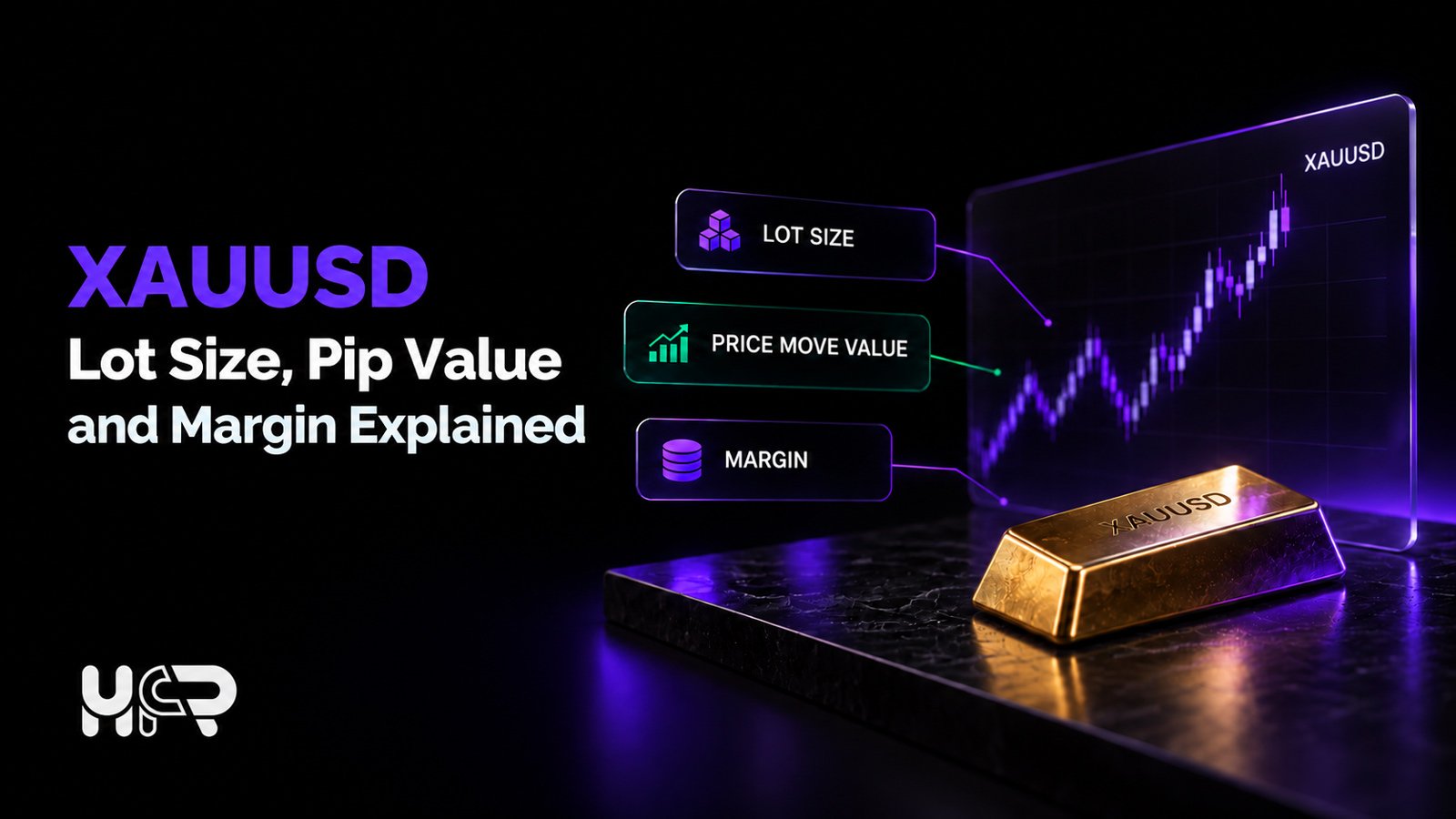
XAUUSD lot size describes how much gold exposure a position represents, but the exact quantity behind one lot depends on the broker and symbol specification. A common example is 100 troy ounces per lot, but that should never be treated as universal.
Contract size affects the value of a gold price move, while the symbol's margin method determines the collateral required. Pip, point, and tick terminology can also differ, so the safest starting point is the broker's XAUUSD specification, including contract size, tick size, tick value, and margin settings.
What does lot size mean in XAUUSD?
For XAUUSD, lot size expresses the size of a gold position. The exact quantity represented by 1.00 lot is only known after the contract size is checked.
Why one XAUUSD lot is not universal across every broker
A common retail gold-CFD convention is 100 troy ounces per 1.00 lot, but it is not a universal standard. As a provider-specific reference, IG's MetaTrader gold specification dated 8 September 2026 lists one XAUUSD contract as 100 troy ounces. The amount represented by a lot must still be checked for the exact account and symbol.
Where to find the contract size in MT5
In MetaTrader 5, open Market Watch, right-click XAUUSD and select Specification. Check Contract Size, minimum volume, volume step, Tick Size, Tick Value, the calculation method, and the relevant margin fields. Broker settings take priority over generic gold-lot examples.
How does XAUUSD contract size work?
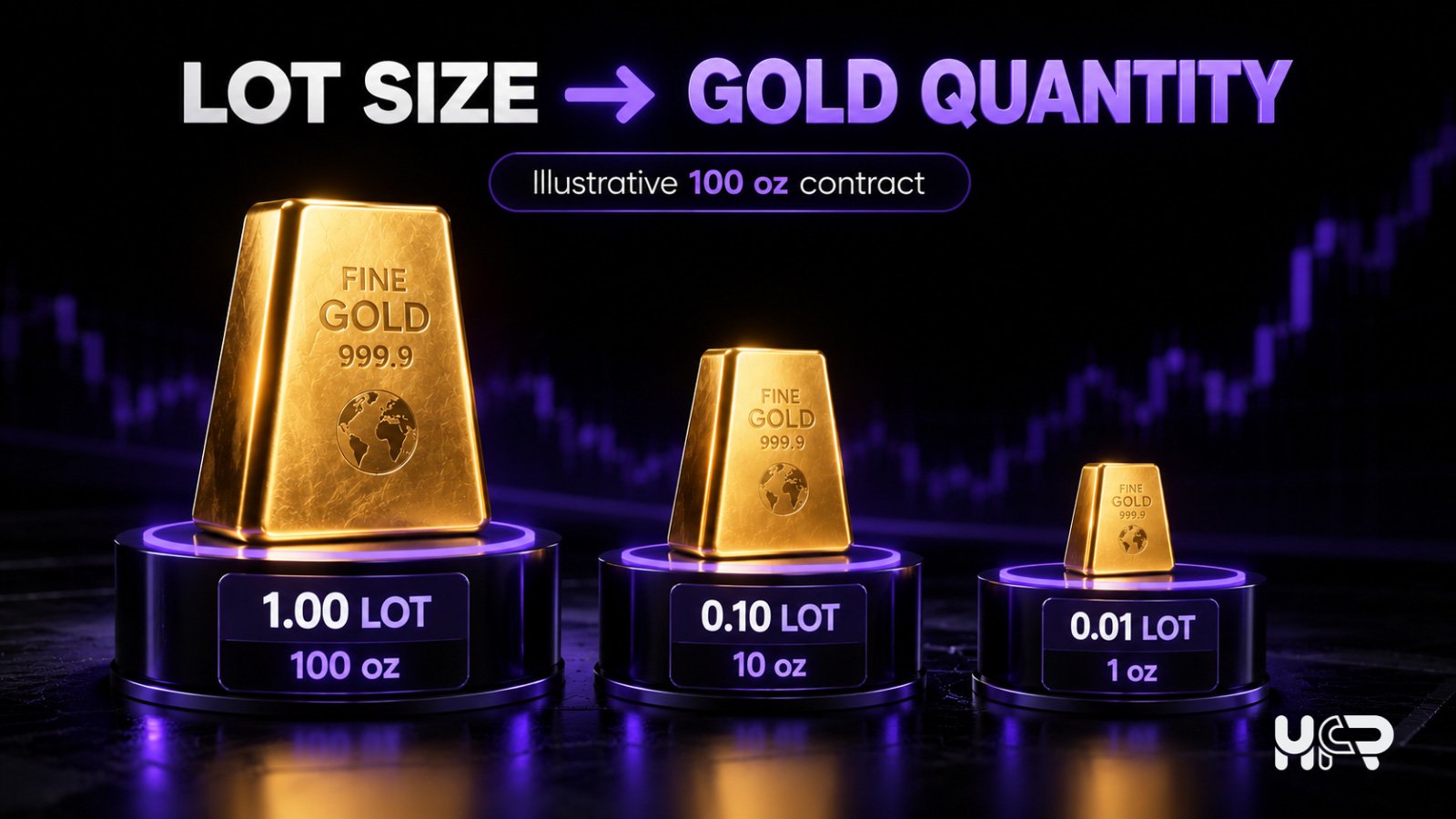
The basic quantity relationship is:
Gold quantity = Lot size × Contract size
Assume, only for illustration, that a broker defines 1.00 lot of XAUUSD as 100 troy ounces. The position quantity would then be:
| Lot size | Assumed contract size | Gold quantity represented |
|---|---|---|
| 1.00 lot | 100 oz per lot | 100 oz |
| 0.10 lot | 100 oz per lot | 10 oz |
| 0.01 lot | 100 oz per lot | 1 oz |
This table applies only to a 100-ounce contract. A different contract size changes every downstream calculation.
A standard currency-pair lot follows a different convention from a gold CFD lot. HFR’s guide to forex lot sizes explains the distinction across instruments.
How much market exposure does an XAUUSD lot represent?
Notional exposure is the market value represented by the position. In a simple USD-quoted example:
Notional exposure = Lot size × Contract size × Gold price
Using an illustrative gold price of USD 4,000 per ounce - not a live market quote - and a 100-ounce contract, the examples are:
| Position | Ounces represented | Illustrative notional exposure |
|---|---|---|
| 1.00 lot | 100 oz | USD 400,000 |
| 0.10 lot | 10 oz | USD 40,000 |
| 0.01 lot | 1 oz | USD 4,000 |
Notional exposure is not the same as required margin or the amount at risk. Margin can be a fraction of notional exposure, while losses can exceed the initial margin committed to a position. Actual requirements depend on the symbol and account terms.
What does a pip mean in XAUUSD?
Gold does not have one universal retail “pip” definition comparable to the common 0.0001 convention for many currency pairs. Brokers may use pip, point, and tick differently.
Why gold pip terminology can differ between brokers
A broker may use pip, point, or full point for different price increments. The actual price increment and its monetary value matter more than the label.
Pip, point, and tick are not always the same thing
MetaTrader 5 displays Digits, Tick Size, and Tick Value in the symbol specification. Digits is the number of displayed decimals; Tick Size is the minimum quoted price increment; Tick Value is the monetary value associated with the relevant price increment under the broker’s specification. Tick-value treatment and conversion can vary by symbol and account currency, so these fields should be checked together.
The usual currency-pair convention is covered in HFR’s forex pip and pip-value guide; it should not be applied to gold without checking the symbol.
How do you calculate XAUUSD price-move value?
For a simple XAUUSD CFD quoted in USD, an educational gross-value relationship is:
Gross price-move value = Price change × Ounces represented by the position
Using the illustrative 100-ounce contract above, the gross monetary effect of different gold price moves would be:
| Gold price move | 1.00 lot (100 oz) | 0.10 lot (10 oz) | 0.01 lot (1 oz) |
|---|---|---|---|
| USD 0.01 | USD 1.00 | USD 0.10 | USD 0.01 |
| USD 0.10 | USD 10 | USD 1 | USD 0.10 |
| USD 1.00 | USD 10 | USD 10 | USD 1 |
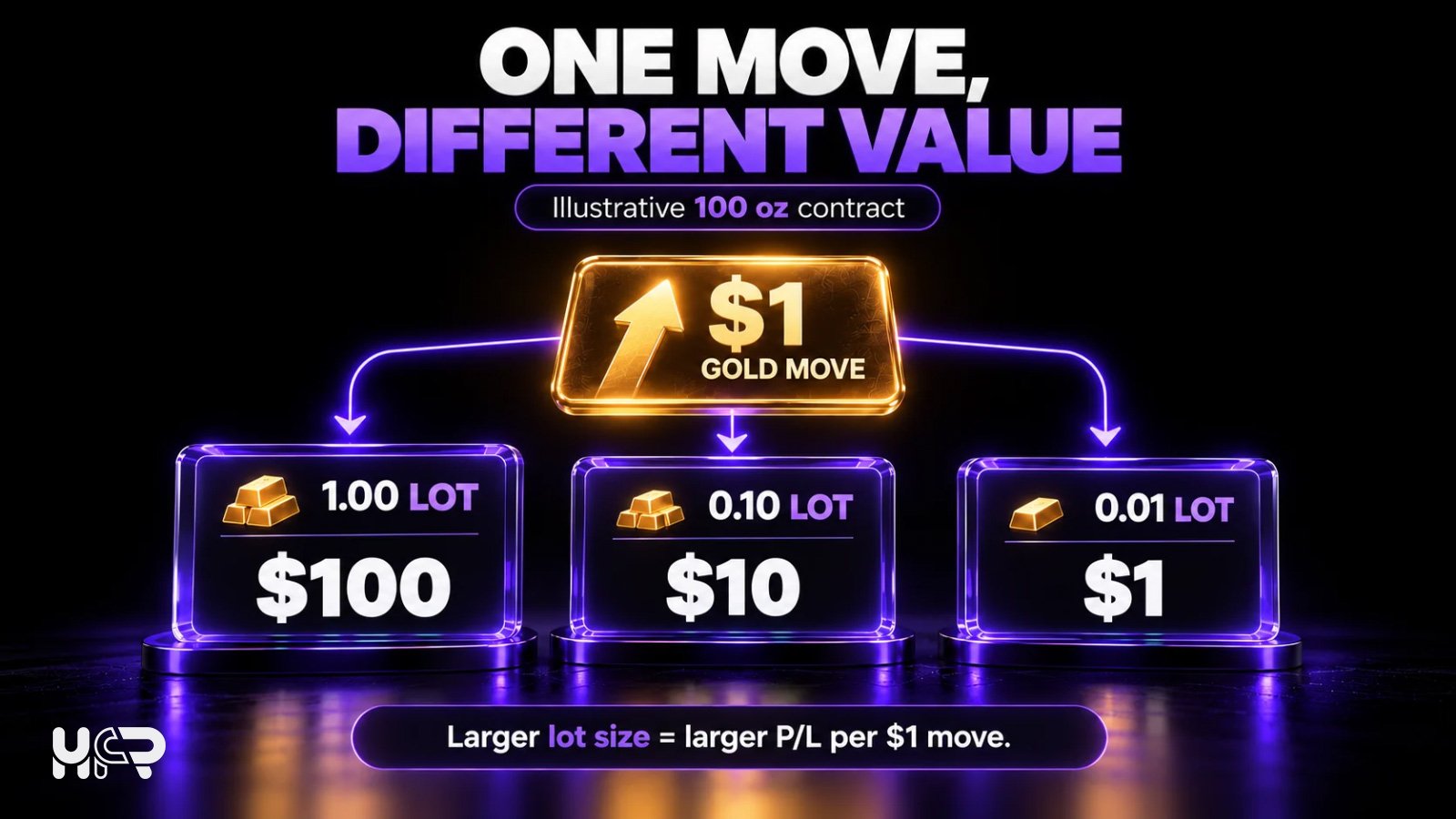
The table shows the absolute gross change in the position’s USD value under the stated assumptions. It does not predict a realised gain or loss, and it excludes spread, commission, financing, slippage and any account-currency conversion. The broker may label the same increments as pips, points or ticks.
Does leverage change XAUUSD pip or price-move value?
No. With lot size and contract size unchanged, leverage changes the required margin, not the gross monetary effect of a given price move. Higher leverage can nevertheless make it possible to open greater exposure with the same account equity.
If 0.10 lot represents 10 ounces, a USD 1 gold move corresponds to a USD 10 gross position-value change whether the illustrative leverage is 1:20, 1:50 or 1:100.
For the separate margin effect of leverage, see HFR’s leverage and margin explanation.
How is XAUUSD margin calculated?
There is no single margin formula for every XAUUSD product. MetaTrader 5 supports different symbol calculation types; fixed initial margin, contract-specific margin rates, tiers and currency conversion can change the result. The examples below apply only to their stated models.
Margin under a simple leverage-based contract model
For a MetaTrader 5 symbol using the Contracts Leverage calculation type, the documented basic formula is:
Margin = Volume in lots × Contract size × Open market price ÷ Leverage
Use this formula only for a symbol configured for the Contracts Leverage calculation type, where the basic price-based formula applies. If the broker sets a non-zero Initial Margin, MetaTrader 5 instead follows the fixed-margin treatment documented for that calculation type; additional margin ratios or currency conversion can also apply.
Margin when a broker uses a margin percentage
Some brokers express gold margin as a percentage of notional exposure. In that simplified case:
Margin = Notional exposure × Margin rate
IG's MetaTrader gold product details, dated 8 September 2026, list a 0.50% minimum margin requirement for its XAUUSD contract. That is an IG product example, not a general XAUUSD margin rule. Actual requirements may differ by account, client classification and applicable margin tiers.
Why the broker's calculation method matters
MetaTrader 5 can apply different calculation modes, fixed initial or maintenance margin, margin-rate multipliers, and currency conversion. Some brokers also impose dynamic or tiered requirements. A generic leverage calculator will not necessarily reproduce the broker’s live margin calculation.
Worked example: XAUUSD margin at different leverage levels
Assume a simplified Contracts Leverage example: 0.10 lot, 100 ounces per lot and gold at USD 4,000. The position represents 10 ounces, or USD 40,000 of notional exposure.
| Illustrative leverage | Notional exposure | Simplified margin |
|---|---|---|
| 1:100 | USD 40,000 | USD 400 |
| 1:50 | USD 40,000 | USD 800 |
| 1:20 | USD 40,000 | USD 2,000 |
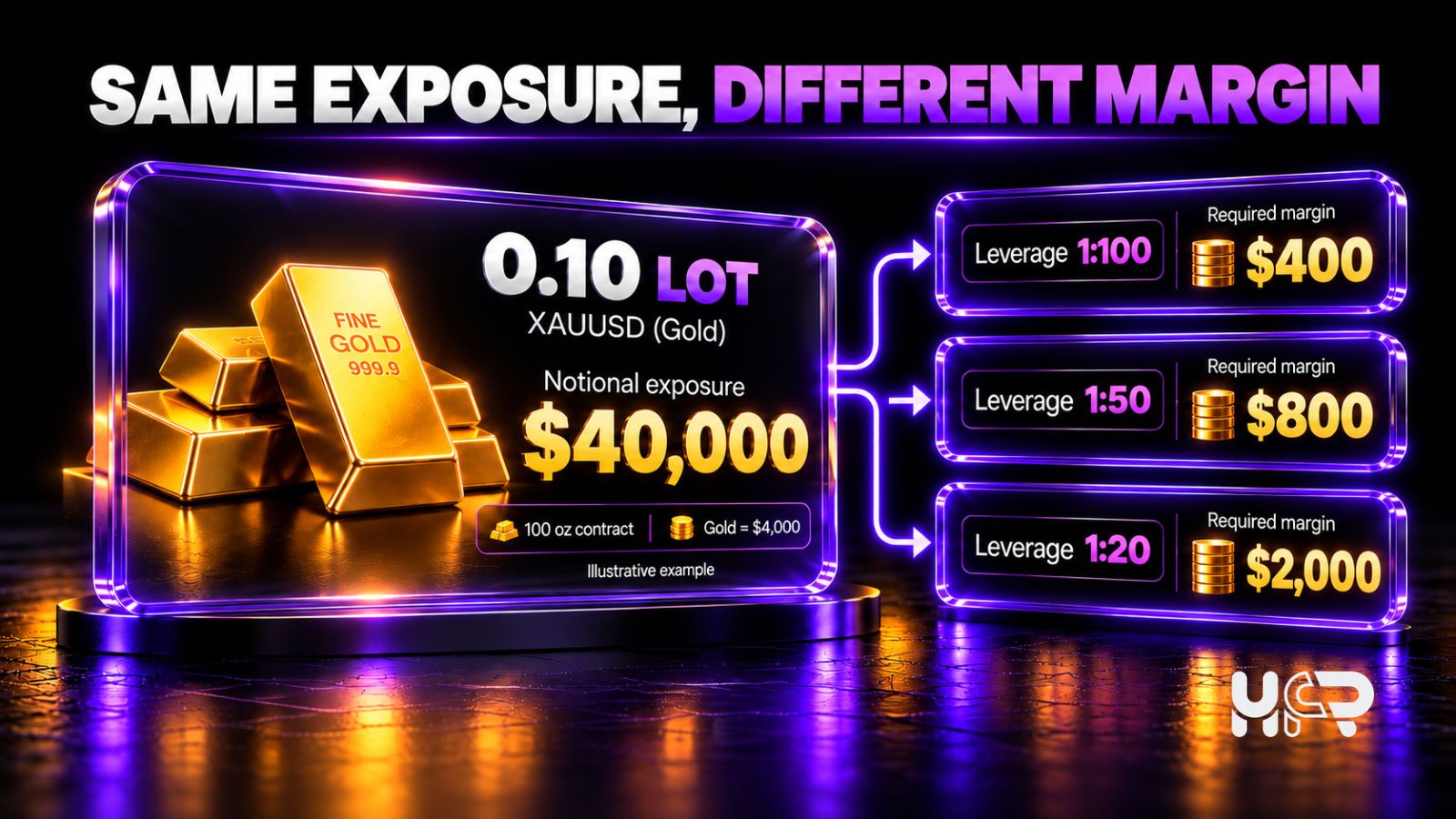
These figures use a hypothetical USD-denominated, leverage-based model without separate tiers, fixed-margin overrides or currency conversion. The ratios are calculation examples, not a statement that these leverage levels are available to all clients. Actual margin can depend on the broker, legal entity, client classification and market conditions.
To understand how margin affects an account after a position opens, read HFR’s guide to free margin, equity and margin level.
If margin level falls, the broker’s margin-call and stop-out rules can determine when positions are restricted or closed automatically. The thresholds are account-specific.
Why can two XAUUSD calculators give different answers?
Two XAUUSD calculators can give different results even for the same lot size. Check whether they use:
- Different contract size per lot.
- Different definitions of pip, point, or tick.
- Different tick size or tick value.
- Different leverage or margin percentage.
- Tiered, floating, or dynamic margin settings.
- Different account or margin currency conversion.
- Different symbol calculation methods or broker-specific overrides.
The calculator should use the same contract size, price convention, account currency and margin method as the symbol shown in the actual trading account.
Which XAUUSD specifications should you check before calculating?
Before converting a gold lot size into a monetary estimate, check these fields in the broker’s live symbol specification:
| Verification status | Why it matters |
|---|---|
| Contract size | Tells you how much gold one lot represents. |
| Minimum volume/step | Shows the allowed lot increments. |
| Digits | Shows displayed decimal places. |
| Tick size | Defines the minimum price-change step. |
| Tick value | Shows the monetary value of the broker-defined tick or price increment; currency conversion may apply. |
| Profit currency | Currency in which gross trading profit or loss is calculated. |
| Margin currency | Shows the margin currency. |
| Calculation method | Determines the platform margin formula used for the symbol. |
| Initial / maintenance margin | Can replace or modify the basic symbol-margin calculation, depending on the MT5 calculation type. |
Common XAUUSD calculation mistakes
- Assuming 1 XAUUSD lot always equals 100 ounces. It is common, not universal.
- Assuming one gold pip always equals 0.01. Broker terminology can differ.
- Using a forex pip formula without checking the gold contract. Currency-pair conventions do not automatically apply to gold.
- Thinking leverage changes the same price-move value. Leverage changes margin, not fixed-position exposure.
- Confusing notional exposure with required margin. They are not the same amount.
- Ignoring currency conversion when profit, margin, and deposit currencies differ.
- Using a calculator without matching its contract, tick, and margin assumptions to the symbol.
A simple XAUUSD calculation checklist
- What is the broker's XAUUSD contract size?
- What lot size am I using, and how many ounces does it represent?
- What are the symbol's tick size and tick value?
- How does the broker define pip, point, or full point for gold?
- What gold price movement am I measuring?
- What is the position's notional exposure?
- Which margin calculation method applies to this symbol?
- What leverage, margin percentage, fixed margin, or tier applies?
- Are the profit, margin, and account currencies the same?
- Does the broker specification or calculator use any additional assumptions?
Gold lot size and margin calculations are separate from rebate eligibility. HFR’s forex cashback per lot guide explains the rebate-volume calculation. Cashback may offset part of eligible trading costs, but it does not alter gold exposure or remove trading risk.
FAQ
How much is 1 lot of XAUUSD?
It depends on the broker's contract specification. One hundred troy ounces per lot is common, but it must be verified on the actual symbol.
How much is 0.01 lot of XAUUSD?
If 1.00 lot equals 100 ounces, 0.01 lot equals 1 ounce. A different contract size changes the answer.
How much is one pip worth in XAUUSD?
There is no universal XAUUSD pip size or pip value. Check the broker’s pip or point convention and the actual Tick Size, Tick Value and Contract Size. A value quoted in USD may also require conversion if the trading account uses another currency.
Is a 0.01 gold price move always one pip?
No. Some brokers call a USD 0.01 move a pip or point, while others use a different convention. The price movement and contract size are more reliable inputs than the label.
How much is a USD 1 move worth in XAUUSD?
With a 100-ounce contract, a USD 1 move equals USD 100 at 1.00 lot, USD 10 at 0.10 lot and USD 1 at 0.01 lot before costs.
How do you calculate XAUUSD pip or price-move value?
Find the contract size and lot size, calculate the ounces represented, then multiply by the price move. Map any broker-specific pip or point label to Tick Size and Tick Value.
How do you calculate margin for XAUUSD?
Use the symbol's documented calculation method. Margin may depend on leverage, a percentage, fixed initial margin, or broker-specific rates and tiers.
Does leverage change XAUUSD pip value?
No. For a fixed position and contract, leverage changes required margin, not the ounces represented or the same price-move value.
Why does my broker's XAUUSD calculator show a different result?
It may use a different contract size, tick convention, margin model, tier or conversion rate. Compare its inputs with the live XAUUSD contract specification; a generic calculator may not reflect broker overrides.
Final takeaway
An XAUUSD lot size is meaningful only alongside the broker’s contract size. The familiar 100-ounce example is useful, but one gold pip is not universally 0.01 and a one-lot position is not universally the same quantity at every provider.
Check Contract Size, Tick Size, Tick Value and the applicable margin method first. Then calculate the quantity represented by the lot size, the gross value of the chosen price movement, and the margin requirement as separate steps. Confirm the broker’s current specification before using these examples for an account.
Risk warning and disclaimer
Gold prices can move sharply, and leveraged XAUUSD CFDs can lead to rapid losses and margin close-outs. Contract sizes, spreads, financing, leverage limits, execution and margin rules vary by broker, legal entity, platform and market conditions. The illustrative calculations do not predict or cap actual losses. Cashback, where available, offsets part of eligible trading costs but does not reduce market or leverage risk.
This article is for educational and informational purposes only. It is not financial, investment or trading advice, or a recommendation to use a particular broker, trading platform or derivative.
Sources and methodology
The formulae and broker-specific examples in this educational guide were rechecked on 5 November 2026 against MetaTrader 5 documentation, IG’s September 2026 XAUUSD specification and OANDA’s explanation of pip conventions. The calculations use explicitly hypothetical contract sizes, prices and margin rules; broker symbol specifications remain decisive.
 5
Share Posts


Further Reading
- Why Crypto Exchanges Require KYC: Verification Levels, Limits and Regional Rules
- Toobit Now Listed on HighFxRebates: 36% Spot and Futures Cashback
- Weekly Market Recap, 26 October–1 November 2026: Rates, Binance and Metals
- Daily technical outlook: Bitcoin and Ether recover as Solana and metals lag — 2 November 2026