






Table of Contents
[ Show/Hide ]- • What does a pip measure in forex?
- • What is a pipette in forex?
- • How is pip value calculated?
- • How do pip calculations work in practical examples?
- • How does position size change pip value?
- • How are pips related to spread and trading costs?
- • Why pip conventions can differ across instruments
- • Common mistakes when working with forex pips
- • A simple checklist for calculating pip value
- • FAQ
- • Final words
- • Sources and methodology
- • Disclosure, risk warning and disclaimer
A pip is a standard unit used to measure price movement in forex. For most currency pairs, one pip is a change of 0.0001. For pairs involving the Japanese yen, one pip is usually 0.01.
For example, if EUR/USD moves from 1.1000 to 1.1001, the move is one pip. If USD/JPY moves from 150.20 to 150.21, that is also one pip even though the decimal position is different.
A pip measures how far a price moved; it does not tell you the monetary effect of that move by itself. Pip value depends on factors such as position size, the currency pair, the account currency, and, where conversion is required, the current exchange rate. Broker and platform terminology can also differ, so instrument specifications remain the final reference for a specific account.
What does a pip measure in forex?
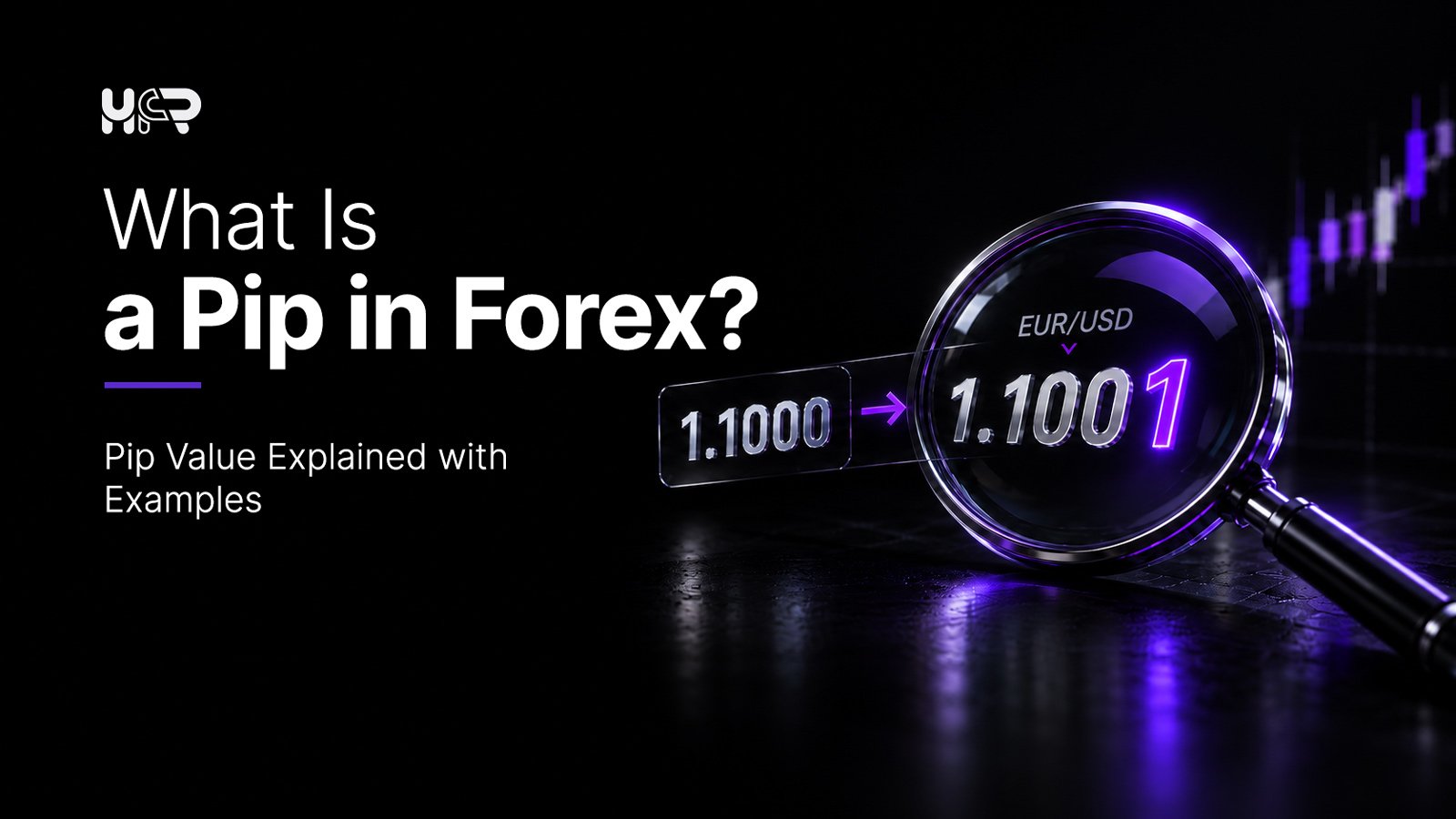
Forex quotes can move by very small amounts. Pips provide a standard way to describe those changes without repeatedly referring to long decimal numbers.
Consider EUR/USD:
- 1000 to 1.1001 = 1 pip
- 1000 to 1.1010 = 10 pips
- 1000 to 1.1050 = 50 pips
The pip count describes the size of the exchange-rate move. It does not show whether a position gained or lost money, because the financial effect also depends on the direction and size of the position.
How most currency pairs quote one pip
For many major currency pairs, including EUR/USD, GBP/USD and AUD/USD, one pip is the fourth decimal place, or 0.0001. OANDA and IG both use this convention in their current educational material.
For example, EUR/USD moving from 1.0840 to 1.0841 is a one-pip move. A change from 1.0840 to 1.0865 is 25 pips. The same 25-pip distance applies if price moves back from 1.0865 to 1.0840; only the direction changes.
Why JPY pairs use a different decimal place
Pairs involving the Japanese yen normally use the second decimal place for one pip. In this convention, one pip is 0.01 rather than 0.0001.
For example, USD/JPY moving from 150.20 to 150.21 is one pip. A move from 150.20 to 150.70 is 50 pips.
The concept is the same as for EUR/USD: a pip is still a standard unit of price movement. Only the decimal position used by market convention is different.
What is a pipette in forex?
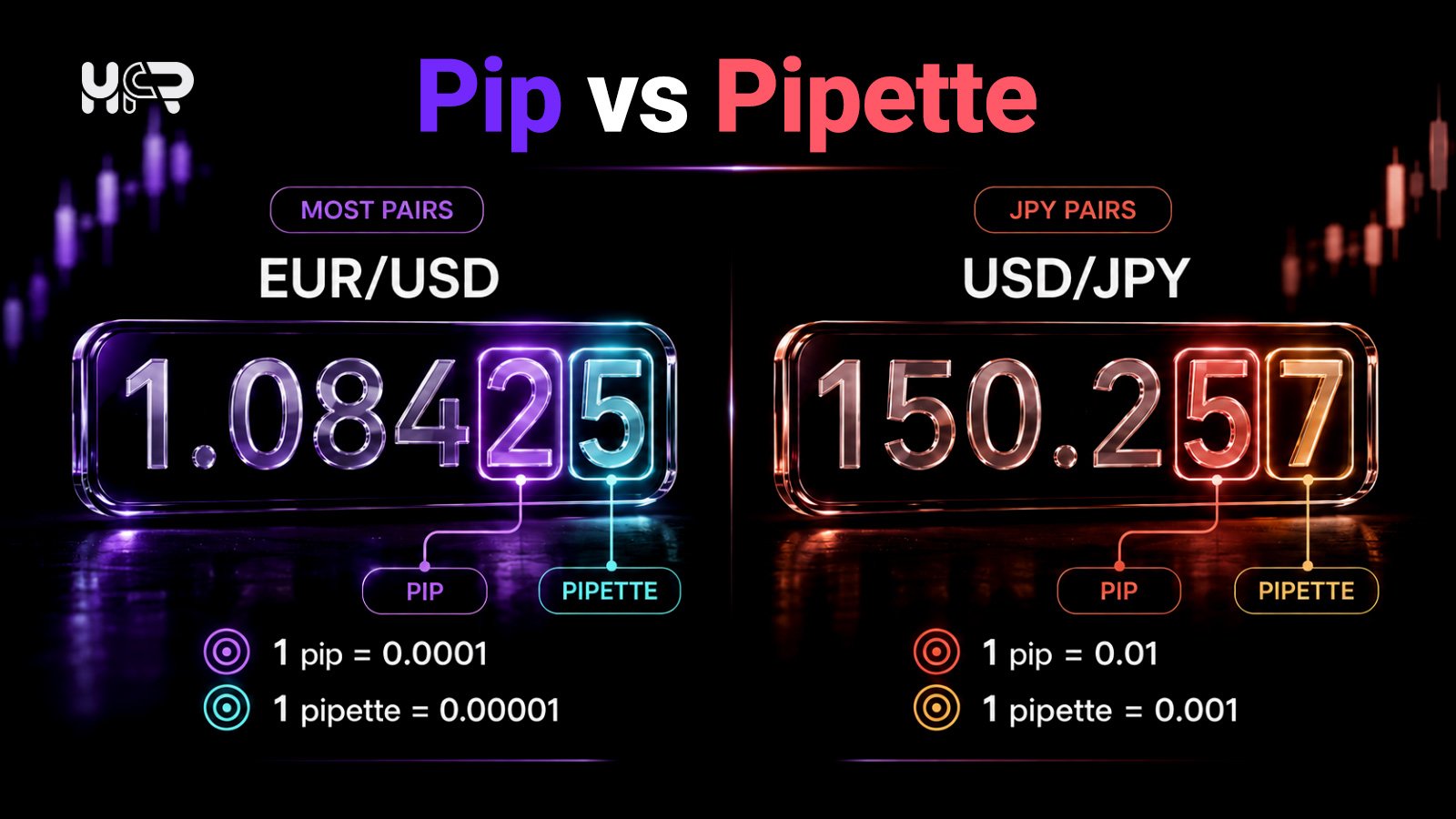
Many brokers display one extra decimal place beyond the traditional pip. This fractional unit is commonly called a pipette and usually represents one-tenth of a pip.
For example, EUR/USD may be quoted as 1.08425. The fourth decimal place is the full pip, while the fifth decimal place is a fractional pip. For USD/JPY at 150.257, the second decimal place is the pip and the third is the fractional pip.
| Price unit | Most forex pairs | JPY pairs |
|---|---|---|
| 1 pip | 0.0001 | 0.01 |
| 1 pipette | 0.00001 | 0.001 |
How a pip differs from a pipette
If EUR/USD moves from 1.08420 to 1.08425, the change is 0.00005. That equals 0.5 pip, or 5 pipettes.
Platform terminology is not universal. Some brokers use terms such as point for the smallest displayed price increment, while others use point and pip differently. Check the broker or platform specification before treating those words as interchangeable.
How is pip value calculated?
Pip value expresses the monetary effect of a one-pip move for a specific position. The calculation should first be understood in the quote currency of the pair:
Pip value in quote currency = position size in base-currency units × pip size
If the quote currency is also the account currency, the result is already expressed in the account currency. If it is different, the pip value must be converted using the relevant exchange rate.
This is why a pip does not have one universal cash value. The same one-pip move can have a different monetary effect when position size, pair or account currency changes.
-When the quote currency matches the account currency
For a USD-denominated account trading EUR/USD, the quote currency is USD. A 100,000 EUR position uses a pip size of 0.0001:
100,000 × 0.0001 = USD 10 per pip
| Position size | Approximate EUR/USD pip value |
|---|---|
| 100,000 units | USD 10 per pip |
| 10,000 units | USD 1 per pip |
| 1,000 units | USD 0.10 per pip |
These sizes are commonly associated with standard, mini and micro lots. The table is an educational EUR/USD example, not a universal pip-value table for every pair or instrument.
When the account currency is different
If the pip value is first expressed in a currency other than the account currency, convert that quote-currency amount into the account currency using the relevant exchange rate.
For a 100,000 USD position in USD/JPY, one pip is 0.01 JPY per unit:
100,000 × 0.01 = 1,000 JPY per pip
Because JPY is the quote currency, the result is initially expressed in yen. If the account currency is USD and USD/JPY is 150.00, the approximate conversion is:
1,000 JPY ÷ 150.00 = about USD 6.67 per pip
If the exchange rate changes, the converted pip value can also change. This is one reason a platform-calculated pip value may not remain fixed for every pair.
How do pip calculations work in practical examples?
EUR/USD pip example
Suppose EUR/USD moves from 1.0750 to 1.0785. The difference is 0.0035. Since one pip is 0.0001:
0.0035 ÷ 0.0001 = 35 pips
If the position size is 10,000 EUR in a USD-denominated account, the pip value is approximately USD 1 per pip. A 35-pip move therefore corresponds to about USD 35 of gross profit or loss before spread, commission, slippage or other applicable costs. Whether the result is positive or negative depends on the position direction and the price move.
USD/JPY pip example
Suppose USD/JPY moves from 149.80 to 150.10. The difference is 0.30. Since one pip is 0.01:
0.30 ÷ 0.01 = 30 pips
The pair moved 30 pips, but that number alone does not provide a universal dollar result. Position size and account-currency conversion are still needed to determine the monetary effect.
How does position size change pip value?
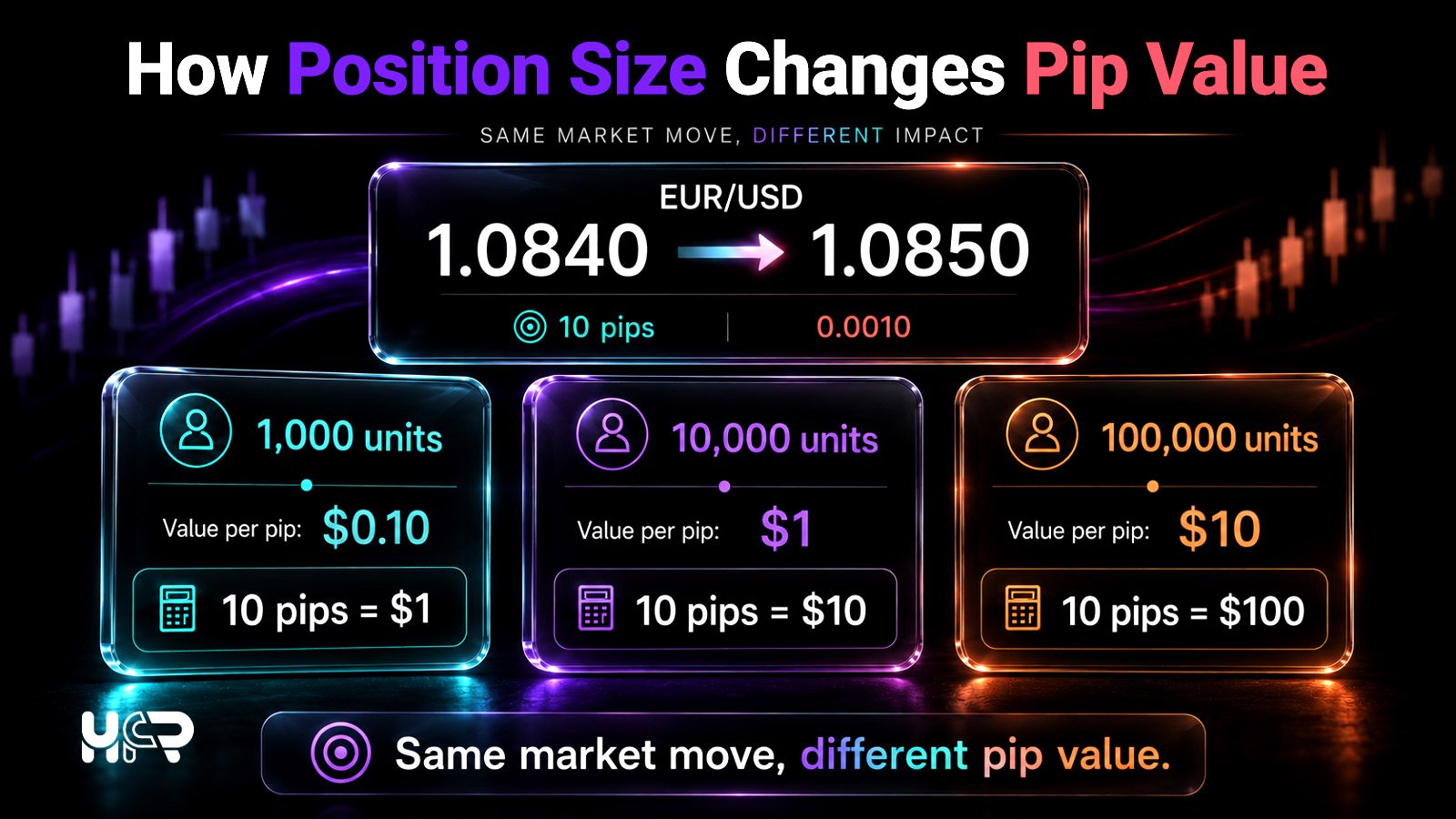
Pip movement and pip value are different. The market can move 10 pips regardless of whether the position is 1,000, 10,000, or 100,000 units, but the monetary effect changes with position size.
| Position size | Approx. EUR/USD value per pip | Approx. value of 10 pips |
|---|---|---|
| 1,000 units | USD 0.10 | USD 1 |
| 10,000 units | USD 1 | USD 10 |
| 100,000 units | USD 10 | USD 100 |
The price move is identical in all three examples; only the position exposure changes. Pip count alone is therefore not a complete measure of monetary risk. For a defined trade, risk depends on factors such as pip value, position size, stop distance, account currency, and execution. Leverage affects the margin required and can enable larger exposure, but it does not change pip value for an unchanged position size.
How are pips related to spread and trading costs?
A pip measures price movement, not trading cost. However, the bid-ask spread is often expressed in pips.
If EUR/USD is quoted at 1.1000 Bid and 1.1002 Ask, the difference is 0.0002, or 2 pips. The monetary effect of that spread depends on the pip value of the position.
Execution should also be kept separate from the pip count shown on a chart. MetaTrader 5 states that OTC charts are based on Bid prices, while executable prices use Bid and Ask depending on the transaction. Spread and slippage can therefore affect the actual entry or exit price even when chart movement is described in pips.
For more detail, HFR's Forex Slippage Explained guide explains why an order may fill at a different price from the one expected. For rebate calculations, see How Forex Cashback Is Calculated Per Lot.
Cashback may help offset part of eligible trading costs after confirmation, but it does not change pip value and does not reduce market, leverage, margin, spread, slippage, execution or loss risk.
Why pip conventions can differ across instruments
The 0.0001 and 0.01 conventions are useful for forex currency pairs, but they should not be transferred automatically to every CFD or market.
Gold, indices, commodities, cryptocurrencies and other instruments can use different contract sizes, decimal conventions, tick sizes, point values and minimum price increments. Even the words pip, point and tick may be used differently by different brokers.
For an instrument such as XAU/USD, the broker's contract specification should be checked before turning a price move into a monetary value. A currency-pair pip example is not enough to determine gold exposure.
Common mistakes when working with forex pips
- Confusing pips with money. A 20-pip move is not automatically worth USD 20. Pip count is price distance; pip value determines the monetary effect for a particular position.
- Using the wrong decimal place. Most forex pairs use 0.0001 for one pip, while JPY pairs generally use 0.01.
- Confusing pips and pipettes. On many five-decimal non-JPY quotes, the fifth decimal is a fractional pip; on many three-decimal JPY quotes, the third decimal is fractional.
- Assuming every position has the same pip value. The same one-pip move has a smaller monetary effect on a 1,000-unit position than on a 100,000-unit position.
- Ignoring account-currency conversion. A pip value calculated in the quote currency may still need to be converted into the account currency.
- Applying forex pip rules to every instrument. Gold, indices, and other CFDs can use different contract sizes, tick sizes, and price-increment conventions; check the broker specification.
A simple checklist for calculating pip value
Before turning a price move into a monetary amount, identify the inputs first:
- Which currency pair or instrument am I looking at?
- Does it use the standard forex pip convention or the JPY convention?
- What decimal place represents one full pip?
- Is the final displayed digit a full pip or a fractional pip?
- What is the position size in base-currency units?
- What is the quote currency?
- What is the account currency?
- Is an exchange-rate conversion required?
- Am I using the broker's current contract and pricing specification?
Separating these inputs makes pip calculations easier to check and reduces the chance of confusing price distance with monetary exposure.
FAQ
How much is one pip in forex?
For most currency pairs, one pip is 0.0001. For JPY pairs, it is usually 0.01. The cash value of that pip depends on position size, pair, and account currency.
Is 10 pips a large move?
Not necessarily. The significance of a 10-pip move depends on the currency pair, timeframe, volatility, and market conditions. Its monetary effect also depends on pip value.
Is a pip the same for every currency pair?
No. Most forex pairs use 0.0001 as one pip, while JPY pairs normally use 0.01. Pip value can also differ because position size and currency conversion differ.
What is the difference between a pip and a pipette?
A pipette is normally one-tenth of a pip. It is commonly the fifth decimal place in many non-JPY quotes and the third decimal place in many JPY quotes.
Why does my forex quote show five decimal places?
Many brokers use fractional-pip pricing. On a pair such as EUR/USD, the fourth decimal place is normally the full pip and the fifth decimal place represents one-tenth of a pip.
What is the difference between a pip and a point?
The terminology depends on the broker or platform. Some systems use point for the smallest displayed price increment, while others use the word differently. The instrument specification is the safest reference.
Can pip value change?
Yes. It changes when position size changes and can also vary when a value must be converted from the quote currency into the account currency.
Does pip count tell me how much I am risking?
No. Pip count describes price distance. Monetary risk for a defined trade also depends on pip value, position size, stop distance, account currency, and execution. Leverage changes the margin required and can enable larger exposure, but it does not change pip value for a fixed position size.
Final words
A pip is a standard way to measure forex price movement. For most currency pairs, one pip is 0.0001; for JPY pairs, it is generally 0.01.
The practical distinction is between pip movement and pip value. Pip movement tells you how far the exchange rate changed. Pip value translates that move into a monetary amount for a specific position, which may require currency conversion.
Before using a pip figure to evaluate exposure or cost, check the position size, account currency, and broker specifications. For execution-related costs, continue with HFR's Forex Slippage Explained and How Forex Cashback Is Calculated Per Lot guides.
Sources and methodology
This article is a desk-based beginner guide to forex pips and pip-value calculations. Core pip conventions, fractional-pip terminology, and the worked calculations were rechecked on 10 September 2026 against current OANDA and IG educational material. MetaTrader 5 documentation was used to verify the distinction between OTC Bid-based charts and executable Bid/Ask prices. Broker contract specifications can vary, so the relevant broker or platform documentation remains the final reference for a specific instrument or account.
Sources checked:
- OANDA - What is a pip in trading?
- IG - What is a pip in forex trading?
- MetaTrader 5 - Price Data
- HighFxRebates - Forex Slippage Explained
- HighFxRebates - Forex Cashback Per Lot Explained
Disclosure, risk warning and disclaimer
Disclosure: HighFxRebates may receive remuneration from supported brokers under partner or introducing-broker arrangements. Rebate eligibility, calculation and payment conditions remain subject to the applicable HFR and broker terms.
Risk warning: Forex and CFD trading involve risk of loss. Pip value describes price sensitivity for a stated position size. Leverage does not change pip value for a fixed position, but it reduces the margin required and can enable larger exposure, which can magnify losses relative to account equity.
Educational disclaimer: This article is for educational and informational purposes only. It should not be treated as financial advice, investment advice, trading advice, or a recommendation to use any broker, account type, trading strategy, or derivative.
 5
5
Share Posts


Further Reading
- Weekly Market Recap, 19–25 October 2026: Gold and Silver Fall as Crypto Flows Diverge
- Bitcoin, Ethereum, Solana, Gold and Silver: Daily Technical Outlook After the October Pullback
- Why Forex Spreads Widen: News, Rollover, Liquidity and Volatility
- What is Proof of Reserves on a crypto exchange? What it shows and what it does not