
Negative Balance Protection Explained: What It Covers and What It Does Not
Understand how negative balance protection can limit eligible retail-client liability, how it interacts with margin close-out, and why broker entity and client classification matter.
Negative balance protection (NBP) can limit an eligible retail client's liability when covered forex or CFD trading losses exceed the funds dedicated to the relevant trading account. It does not prevent losses: the client may still lose all money committed to that account.
In jurisdictions with mandatory retail-CFD safeguards, NBP operates alongside leverage limits and margin close-out rules. Exact coverage depends on the product, legal entity, jurisdiction, account structure, and client classification. A protection offered by one company in a broker group should not be assumed to apply to another.
What is negative balance protection?
Negative balance protection limits an eligible client’s aggregate liability for covered leveraged trading activity. In plain English, if losses would otherwise push the protected account beyond zero, the applicable protection can prevent the client from owing more than the funds covered by the rule or contract.
The key word is liability. NBP does not prevent adverse market movement, margin calls, forced liquidation, slippage, or loss of the money already committed to the protected account.
How does negative balance protection work?
Consider a simplified example. A retail CFD account contains $1,000. A sudden market gap moves through available prices so quickly that the final loss would otherwise be $1,200. Without an applicable liability limit, the account could theoretically leave a $200 amount due. If mandatory NBP applies to that account and activity, the client’s liability is limited to the protected funds rather than extending beyond them.
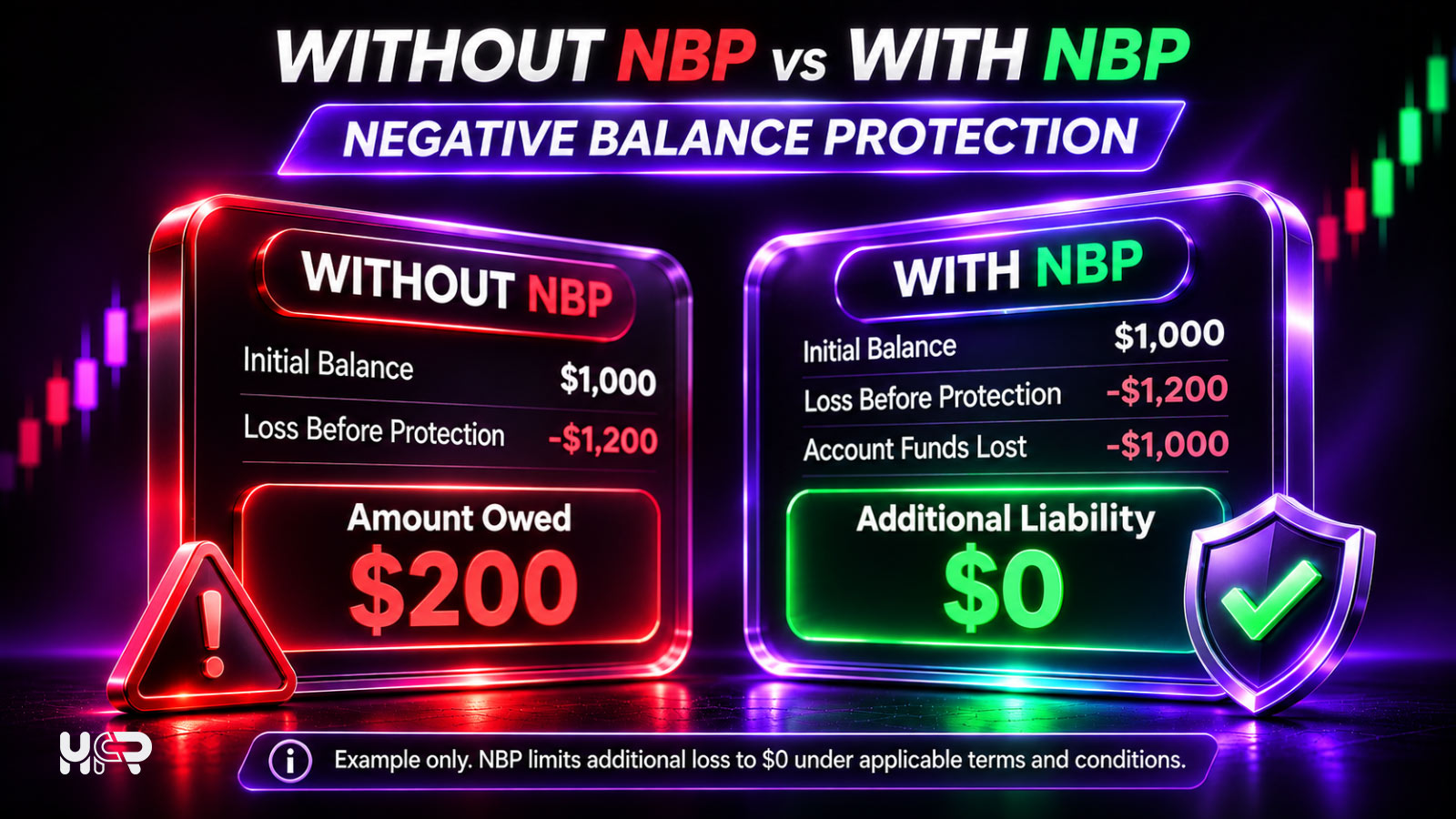
This is an illustration, not a universal broker process. The legal definition of protected funds, the products covered, account structure and operational treatment depend on the rules and terms that apply to the exact account.
Why can losses pass a margin threshold?
Margin close-out is a trigger for liquidation, not a guaranteed execution price. During gaps, fast markets or limited liquidity, the price available when a closing order is executed can be worse than the price at which the close-out condition was reached. This is why a liability backstop can still matter even when a margin close-out rule exists.
Negative balance protection is account-level under FCA and ESMA rules
In the UK retail-CFD framework, the FCA limits the retail client’s liability for all restricted speculative investments connected to the account to the funds in that account. ESMA’s CFD guidance uses the same account-level concept: aggregate liability for all CFDs connected to a CFD trading account is limited to the funds dedicated to that account.
That is different from saying each individual position is protected by its own margin amount. One position can lose more than the margin initially reserved for that position. NBP addresses the client’s total liability at the protected account level.
Concept | What it means |
|---|---|
Position margin | Collateral or margin required to support a particular exposure. It is not a maximum-loss amount. |
Account equity | The current account value after balance and open-position profit or loss are reflected. |
Account-level NBP | A limit on aggregate liability for covered activity, where the applicable rule or contract provides it. |
Negative balance protection vs margin close-out
Margin close-out and NBP address different stages of account risk. Margin close-out is intended to reduce exposure when the account’s margin resources fall too far. NBP deals with the remaining liability if losses still exceed protected funds.
Protection | Main purpose | What it does not guarantee |
|---|---|---|
Margin close-out | Starts forced liquidation when the applicable account threshold is reached. | It does not guarantee the exact price or account value at which liquidation will finish. |
Negative balance protection | Limits eligible client liability if covered losses would otherwise exceed protected account funds. | It does not stop the account losing its protected funds or prevent liquidation. |
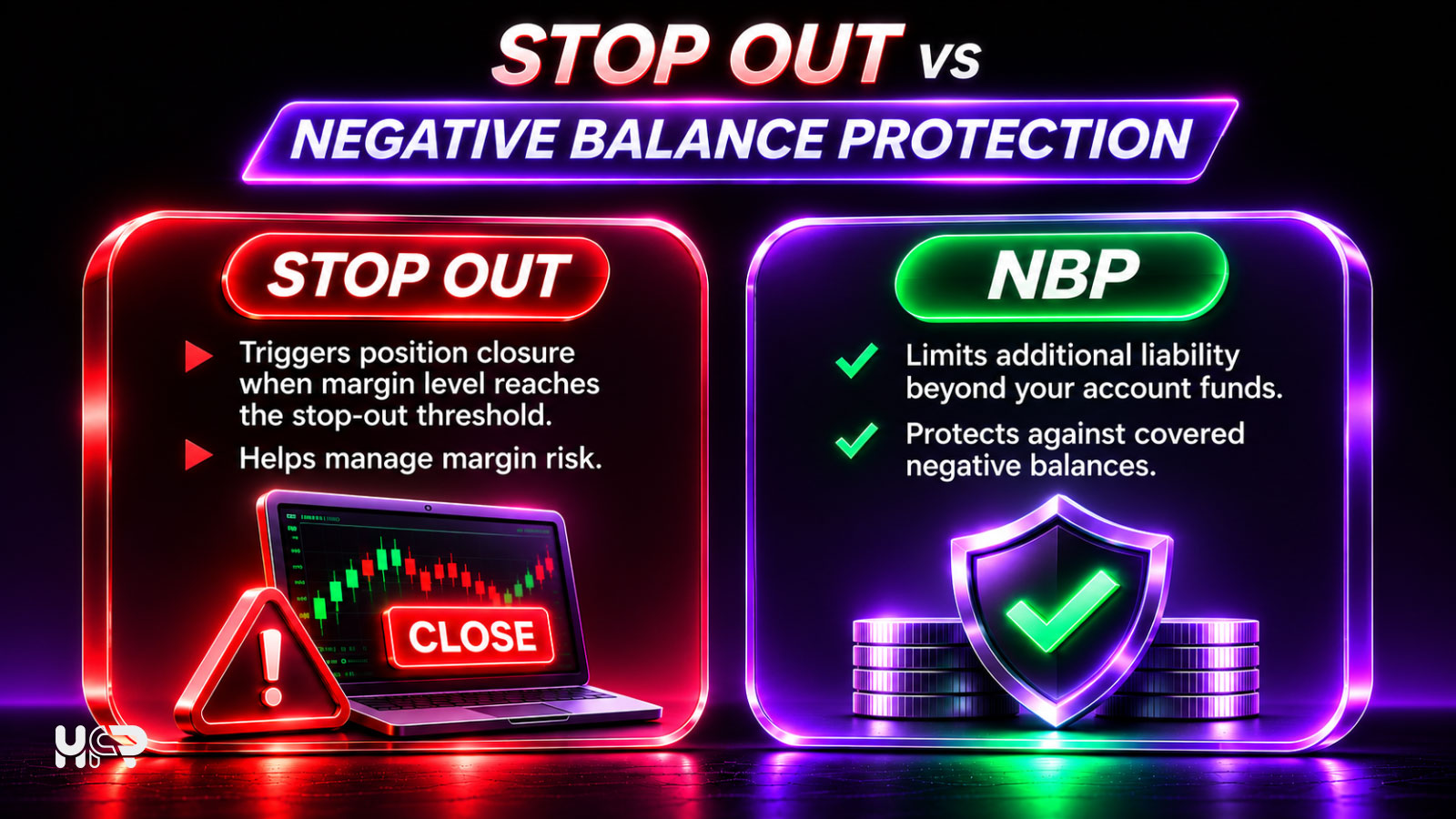
Under FCA retail-CFD rules, if a retail client's net equity falls below 50% of the margin required to maintain the account's open positions, the firm must close open position(s) as soon as market conditions allow. The 50% level is the FCA regulatory close-out trigger discussed here; a firm's contractual terms or discretionary risk controls may result in positions being closed earlier. It should not be treated as a worldwide stop-out percentage for every account.
Negative balance protection vs margin call and stop out
A margin call is generally a broker warning or requirement to restore margin, while stop out or regulatory margin close-out triggers forced liquidation. NBP is different: it limits eligible residual liability if liquidation would otherwise leave an amount owing.
For the account mechanics behind this sequence, see HFR’s Margin Call vs Stop Out and Free Margin, Used Margin, Equity and Margin Level Explained.
Does negative balance protection mean you cannot lose your full deposit?
No. Protection from debt is not protection from trading loss.
A covered account can still lose all funds dedicated to that trading activity. NBP is intended to prevent eligible liability from extending beyond the protected amount; it does not preserve the account balance, guarantee recovery, or make leveraged trading low risk.
Who is covered by negative balance protection?
Coverage is not universal. The safest approach is to identify the exact broker legal entity, regulator, product and client classification rather than relying on a brand name or a generic broker website.
UK retail CFD and rolling spot FX clients
The FCA’s retail restrictions cover CFDs and related restricted speculative investments, including leveraged rolling spot forex. For retail clients within that scope, the FCA limits liability to funds in the relevant account. Its guidance states that those funds include cash and unrealised net profits from open positions, while assets held for other purposes are disregarded.
EU retail CFD clients
EU retail CFD protections originated in ESMA's product-intervention measures and are reflected in national measures. Negative balance protection limits aggregate liability per covered trading account. On 24 February 2026, ESMA reminded firms that derivatives marketed as perpetual contracts can also fall under national CFD measures when they meet the CFD definition. The scope depends on the product, not its marketing label.
Australian retail CFD clients
ASIC's existing CFD product-intervention order includes negative balance protection for retail clients, alongside leverage limits and standardised margin close-out. As checked on 27 November 2026, the order is scheduled to expire on 23 May 2027. ASIC has proposed extending it, subject to Ministerial approval, until its statutory sunset on 1 April 2031, with targeted amendments. Consultation CS 64 closed on 16 November 2026. The proposed extension and amendments should not be described as already enacted.
Why the broker legal entity matters
A broker brand can operate through several legal entities in different jurisdictions. A UK entity, EU entity, Australian entity and offshore affiliate may be subject to different product rules and client protections even when they use the same brand, website design or trading platform.
The FCA has warned that clients can lose UK retail protections if they are directed to overseas firms or encouraged to change status. The legal entity that actually holds the account is therefore more important than the brand name alone when checking NBP. Protection can therefore change if the account moves to another entity or client status changes. For a broader account-opening checklist, see HFR's guide to what a forex broker does.
Why client classification matters
The FCA, EU and ASIC protections described above are principally retail-client safeguards. Moving to elective professional status can remove statutory retail protections. Some firms may provide contractual negative balance protection to other clients, but this must be checked in the terms of the actual account, not assumed from a retail marketing page.
The practical rule is simple: do not assume that NBP automatically follows an account after a change in client classification. Check the new legal and contractual terms before relying on it.
What negative balance protection does not cover
It does not prevent the loss of all funds in the protected trading account.
It does not prevent margin close-out, stop out, or forced liquidation.
It does not guarantee a stop-loss or close-out will execute at the requested price.
It does not automatically apply to every product, account type or client classification.
It does not automatically follow the same broker brand across different legal entities.
It is not the same as client-money segregation, compensation-scheme protection or broker-insolvency protection.
It does not make leverage safer or reduce the market exposure created by a position.
Client-money rules and compensation arrangements address different risks. For example, the FCA’s CASS framework is designed to safeguard client money if a firm fails, while FSCS investment protection may apply in specific circumstances when an authorised firm fails and there is an eligible shortfall. Those mechanisms should not be confused with NBP, which addresses trading-loss liability.
Can a forex account still go negative?
A leveraged account can move beyond the intended close-out point during a gap or fast market because the closing order still needs an executable price. NBP addresses what the client can ultimately be liable for where the protection applies; it is not a promise that market prices, liquidation timing, or platform accounting will never pass through a negative account value during processing.
Outside a mandatory NBP regime, whether a negative balance remains payable depends on the applicable law and broker agreement. A generic promise of protection on a group website is not proof that it covers every product, entity or client classification.
A practical market-gap example
Suppose a retail CFD account has $2,000 of equity before a weekend. The market reopens after a major event at a price far beyond the previous close. A stop or margin close-out instruction may be triggered, but the next executable price is materially worse. The resulting loss would otherwise exceed the account’s available funds.
Where mandatory NBP applies, the liability limit can prevent the client from owing more than the protected account funds. The example does not imply that all brokers, entities, or products use the same process, and it does not remove the loss of the $2,000 already at risk.
For execution mechanics, see HFR’s Forex Slippage Explained. For the role of leverage and margin, see What Is Leverage in Forex?.
How to check whether your account has negative balance protection

Identify the exact legal entity that holds the account.
Check which regulator supervises that entity and whether the product falls within the relevant CFD or rolling spot FX rules.
Confirm whether you are classified as a retail or professional client.
Read the broker’s current client agreement and negative-balance or margin policy.
Check whether protection is defined per account and which funds are included in that account.
Check whether the same protection applies to every product you trade.
Review what happens if margin close-out is passed during a gap or fast market.
Do not assume another entity under the same brand offers identical protection.
Common mistakes about negative balance protection
Thinking NBP prevents losses. It limits eligible liability; it does not preserve the trading balance.
Confusing NBP with a stop loss. A stop loss is an order; NBP is a liability protection.
Confusing NBP with margin close-out. Close-out controls liquidation; NBP addresses liability if losses still exceed protected funds.
Assuming every broker entity offers the same protection.
Assuming professional clients automatically keep retail protections.
Confusing NBP with client-money segregation or compensation schemes.
Ignoring product scope, account structure, and the current client agreement.
Final takeaway
Negative balance protection is designed to limit an eligible client’s liability, not to prevent trading losses. A protected retail CFD account can still lose all funds dedicated to that activity, and positions can still be closed through margin close-out or stop-out rules.
Before relying on NBP, check the exact broker legal entity, regulator, product, account structure and client classification. The protection attached to one retail account should never be assumed to apply automatically to another entity or professional-client account.
Risk warning and disclaimer
Forex and CFD trading involve substantial risk, especially with leverage. Negative balance protection, where applicable, does not prevent a loss of the funds dedicated to a protected account, nor does it stop slippage, gaps or forced liquidation. Coverage depends on the legal entity, jurisdiction, instrument, and client classification.
This article is for educational and informational purposes only. It is not financial, investment, legal or trading advice, or a recommendation to use any broker, account type or derivative.
Sources and methodology
This educational guide was fact-checked against FCA, ESMA and ASIC material available on 27 November 2026. Mandatory protections vary by jurisdiction, product and retail-client status. Broker agreements may offer additional contractual protection, but the applicable regulator and current account terms remain the final references for a particular client.
FCA Handbook - COBS 22.5: Retail CFD restrictions and negative balance protection
FCA - Contract for differences
FCA - CFD investors risk losing out on protections (30 October 2025)
ESMA - Q&A 1981: Aggregate liability and negative balance protection
ASIC - CFD product-intervention consultation CS 64 (12 October 2026)
ASIC - 26-239MR: ASIC moves to extend and strengthen CFD consumer protections
FCA - Client money and assets
FSCS - Investment protection
FAQ
It is a protection that can limit an eligible client’s liability if covered leveraged forex or CFD losses would otherwise exceed the funds in the protected account. The exact scope depends on the applicable regulation and account terms.
Yes, the displayed equity can briefly become negative during a gap or liquidation. Where NBP applies, the key protection is the eventual limit on eligible liability, not a guarantee that the platform will never display a negative figure.
Where mandatory NBP covers the account and trading activity, the client's liability is limited to the funds specified by that rule. Other accounts may rely on contractual protection or have no equivalent limit; check the legal terms before assuming a debt cannot arise.
No. A protected retail account can still lose all funds dedicated to the covered trading activity.
No. Stop out or margin close-out starts forced liquidation when margin conditions deteriorate. NBP limits liability if losses still exceed protected funds.
Under the FCA and ESMA retail-CFD frameworks discussed here, the protection is account-level rather than a separate maximum-loss limit for each individual position.
No. Coverage depends on jurisdiction, legal entity, client classification, product scope and sometimes contractual terms.
Retail regulatory protections do not automatically carry over to professional status. A professional account may have different rules or contractual protections, so the exact terms must be checked.
NBP is relevant precisely because gaps and slippage can make final losses worse than the margin close-out trigger. Where applicable, it limits liability; it does not stop the gap or guarantee the execution price.
Identify the exact legal entity and regulator, confirm your client classification, then read the current client agreement and margin or NBP policy for that specific account.