






Table of Contents
[ Show/Hide ]- • How does Proof of Reserves work?
- • What can a Proof of Reserves report show?
- • What does Proof of Reserves not prove?
- • Proof of Reserves vs a financial-statement audit
- • How to check a crypto exchange’s Proof of Reserves
- • How Kraken and Binance approach Proof of Reserves
- • Other checks before keeping crypto on an exchange
- • FAQ
- • Final takeaway
- • Risk warning and disclaimer
- • Sources and methodology
Proof of Reserves (PoR) is a method some crypto exchanges use to provide evidence of specified digital assets they control at a particular time. Depending on the method, the exchange may also compare those assets with covered customer balances and allow users to verify that their own balance was included. PoR alone does not establish overall solvency.
When customers leave crypto on a custodial exchange, the exchange or its appointed custodians control the relevant wallets while the exchange records customers’ account balances. A PoR process may examine selected on-chain holdings alongside the balances owed to users within its stated scope.
That scope matters. A report may exclude certain coins, accounts or obligations, and it normally describes a particular snapshot rather than the exchange’s finances on every subsequent day. Methods also vary: some exchanges publish wallet holdings, while others use independent reviews, Merkle trees or zero-knowledge proofs.
For the difference between custodial exchange balances and self-custody wallets, see HFR’s guide to how a crypto exchange works.
How does Proof of Reserves work?
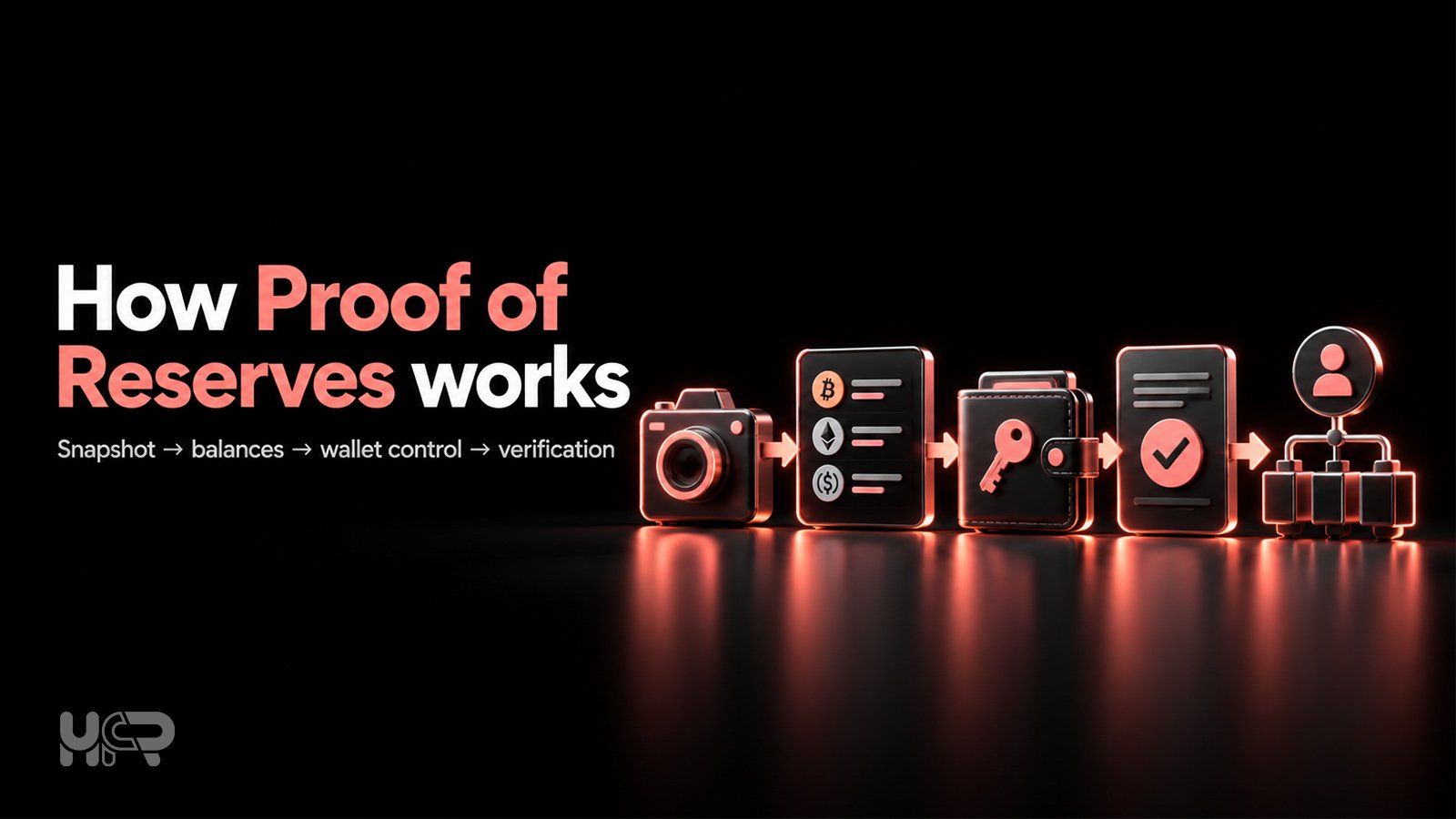
A typical PoR process involves the following steps, although not every exchange performs all of them:
- Define the assets, account types, obligations, and snapshot time covered by the report.
- Record customer balances for the covered accounts and assets.
- Demonstrate control of the on-chain addresses counted as reserves.
- Compare the assets with covered customer balances under the stated methodology.
- If supported, provide a way for individual users to verify inclusion of their own snapshot balance.
Checking assets and wallet control
On-chain balances can be observed publicly, but an exchange also needs a method to establish control of the addresses it counts. One approach is a cryptographic signature generated using the relevant wallet key. Kraken says its independent accountant collects signatures produced by Kraken and checks the balances at those addresses. Binance likewise describes verifying wallet-address ownership within its PoR process.
Showing control of a wallet is not the same as proving that every asset in it is legally unencumbered or available to customers.
Recording customer liabilities
The comparison is incomplete without examining what the exchange owes customers within the report’s scope. A snapshot captures specified account balances at an identified date and time. Exchanges may differ in how they treat margin positions, negative balances, collateral and balances assigned to separate products. These rules should be disclosed and checked rather than assumed.
Using Merkle trees and other cryptographic proofs
A Merkle tree combines hashed account records into a single cryptographic summary called a Merkle root. Where the exchange supplies the necessary information, a user can test whether their snapshot record forms part of that committed dataset without accessing other users’ records.
Binance also uses zk-SNARKs, a type of zero-knowledge proof, to support checks on the balance dataset. A successful user inclusion check supports the conclusion that the user’s record is represented in the published dataset; it does not independently establish that every account, debt or off-chain liability was included.
What can a Proof of Reserves report show?
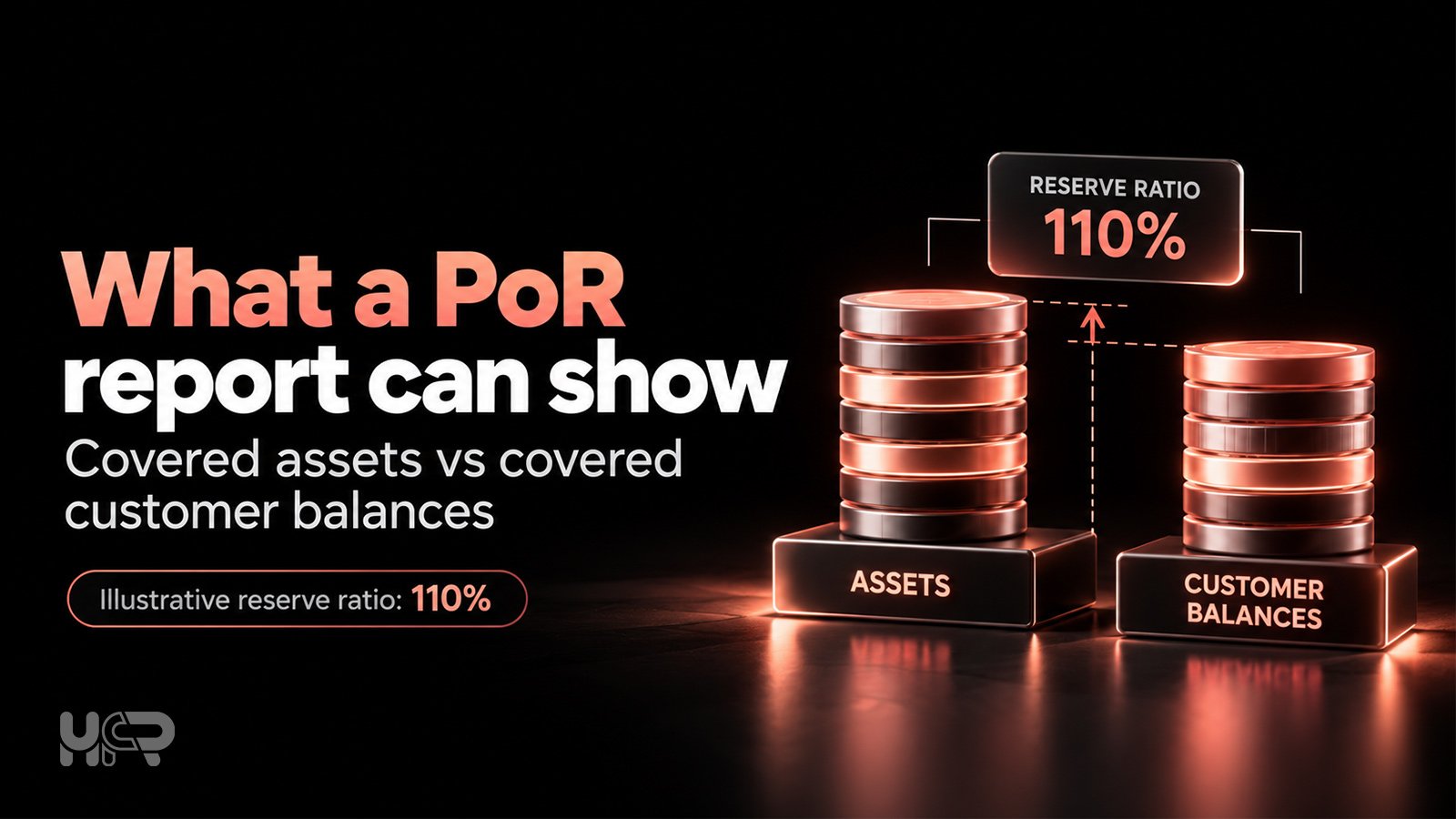
PoR can provide evidence of the particular assets and customer balances covered by a report as of its snapshot date. The evidence is only as useful as the verification method, the records examined, and the information published.
| Potential evidence | What to check |
|---|---|
| Reserve wallet balances | Assets, addresses and snapshot time |
| Customer balance totals | Accounts, products and liabilities included |
| Reserve ratio | Numerator and denominator for each asset |
| Customer inclusion proof | Whether users can check their snapshot records |
| Independent procedures | Who performed them and the report type |
A reserve ratio is calculated as covered reserve assets divided by the covered customer liabilities, multiplied by 100. The assets and liabilities must use consistent units and the same defined scope. Suppose a fictional exchange reports 1,100 BTC in covered assets against 1,000 BTC in covered customer balances. Its BTC reserve ratio would be 110%. This is only an illustrative calculation, not information about a real exchange, and it says nothing about liabilities or assets excluded from the calculation.
An asset-by-asset reserve ratio should not be mistaken for a bank capital ratio or an assessment of the exchange’s entire financial position.
What does Proof of Reserves not prove?
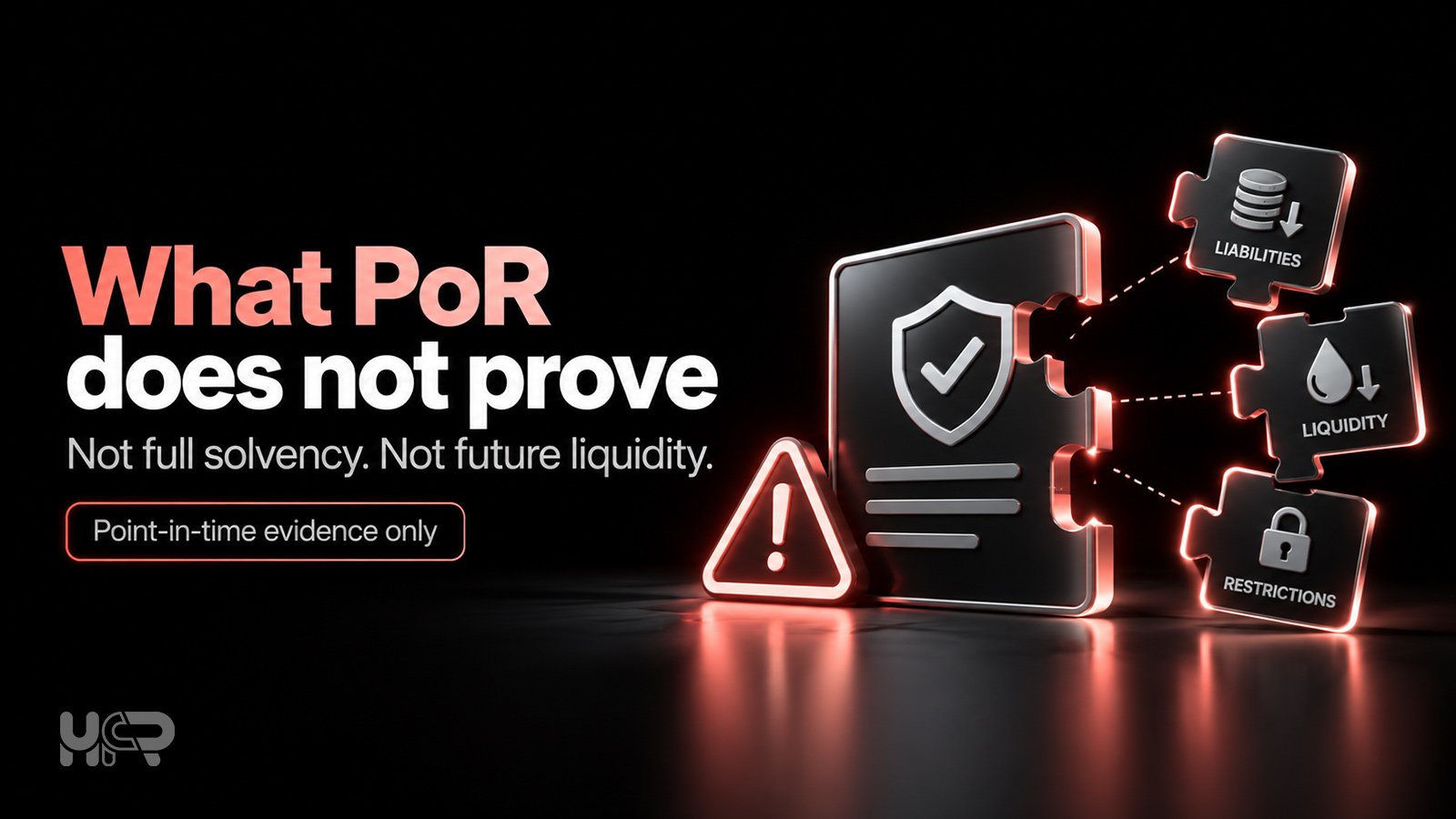
PoR is not a complete view of a company’s finances. Even a method that compares assets with specified customer balances can leave important questions unanswered.
| What a report may establish | What it may not establish |
|---|---|
| Control of specified reserve addresses | Unrestricted ownership or availability of the assets |
| Covered customer balance totals | Every debt, creditor claim or off-chain obligation |
| Inclusion of an individual user record | Completeness of the entire customer dataset |
| A ratio for in-scope assets and balances | Company-wide solvency or available liquidity |
| A dated balance snapshot | Whether reserves remain available afterwards |
A key limitation is liability completeness. A report may reconcile customer balances without covering corporate borrowing, third-party obligations, or other claims. Assets can also be pledged, lent, or subject to restrictions that are not visible from their blockchain address alone.
Timing presents another limitation. The US Public Company Accounting Oversight Board (PCAOB) has warned that point-in-time procedures may not reveal temporarily borrowed assets or what happens to the holdings after the verification date. On-chain data cannot independently show every contract or competing claim affecting those holdings.
PoR also does not demonstrate that an exchange can meet a sudden wave of withdrawals. It does not prove cyber-security, effective internal controls, legal protection, future liquidity or how customers would be treated in insolvency. Its conclusions depend on the published scope and procedures.
Proof of Reserves vs a financial-statement audit
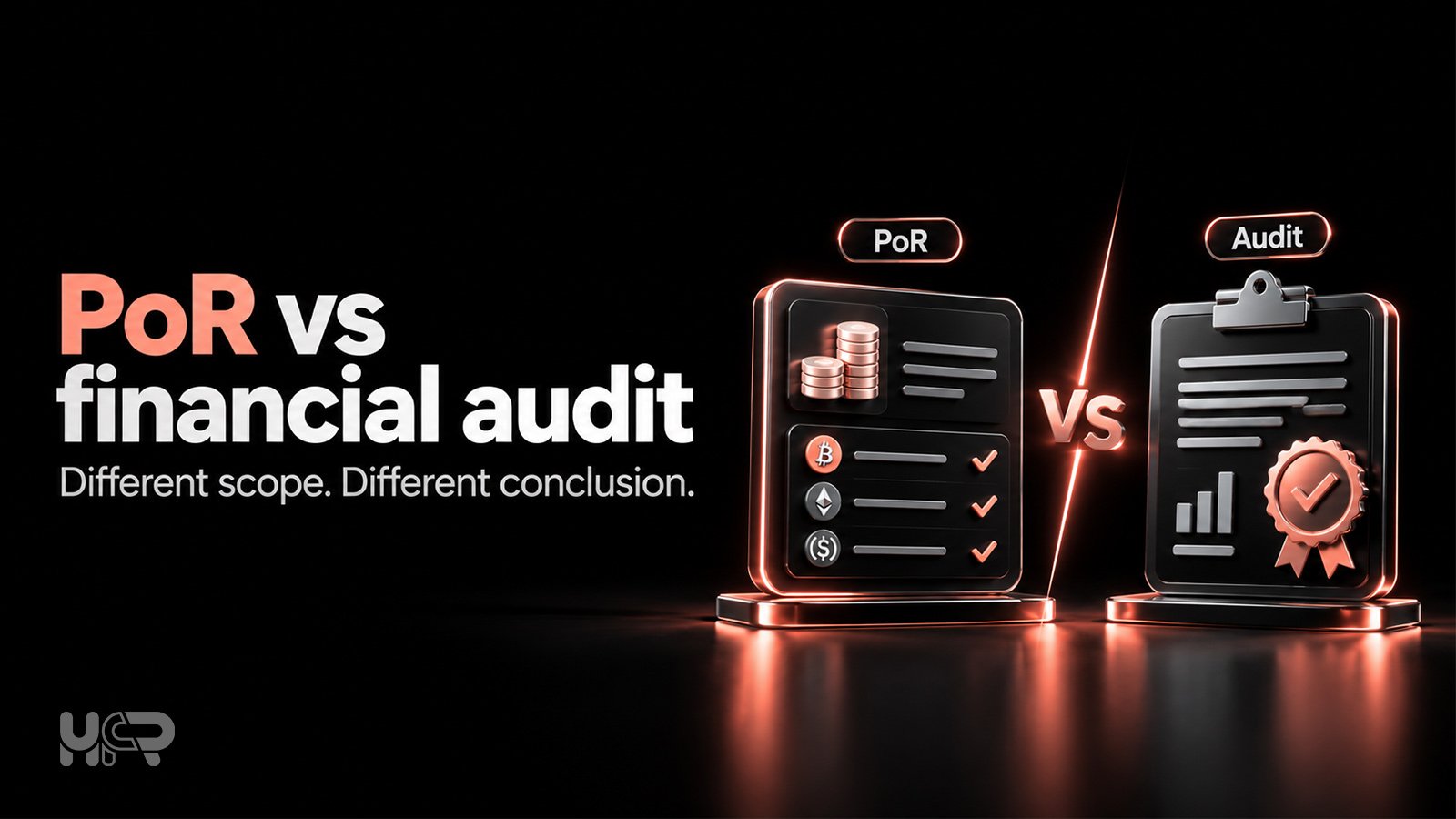
These engagements answer different questions. A PoR review can involve an independent accountant, but the participation of an accountant does not automatically make the report a financial-statement audit.
| Comparison | Proof of Reserves | Financial-statement audit |
|---|---|---|
| Main focus | Specified reserves and sometimes covered customer balances | Financial statements prepared under an accounting framework |
| Liabilities | May cover only selected customer obligations | Includes recognised liabilities required by that framework |
| Timing | Often a defined reserve snapshot | Financial reporting period and reporting date |
| Internal controls | Not necessarily assessed | Relevant controls considered as required; a separate controls opinion is not automatic |
| Reporting outcome | Depends on procedures and assurance level; may provide only factual findings | Audit opinion under the applicable standards |
The PCAOB Office of the Investor Advocate and a US Securities and Exchange Commission investor bulletin caution against treating PoR reports as substitutes for audited financial statements. In particular, an agreed-upon-procedures report may describe the results of selected checks without expressing an audit opinion or assurance on financial stability. Readers should inspect the precise engagement type and standards rather than rely on the phrase “audited reserves”.
How to check a crypto exchange’s Proof of Reserves
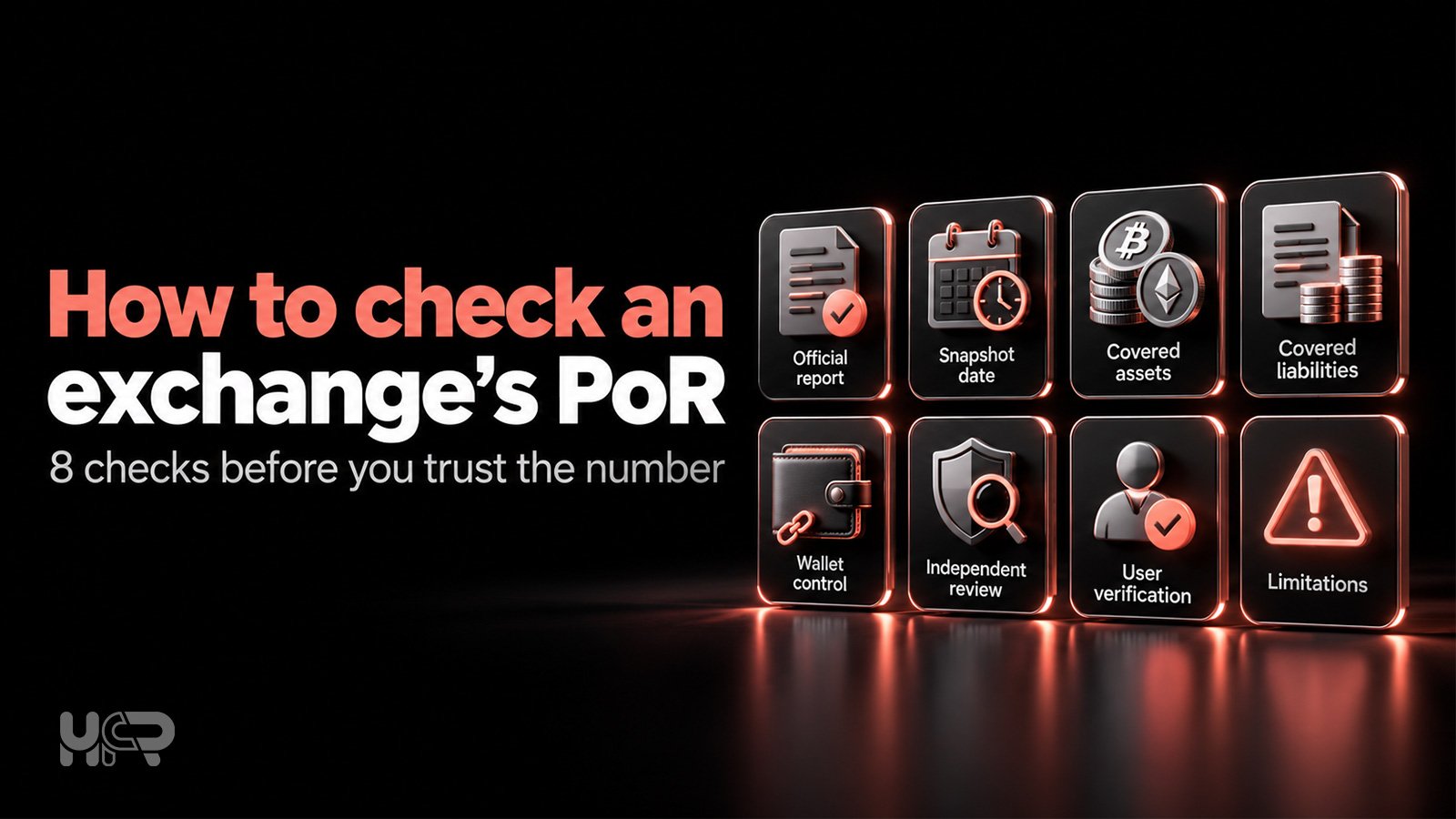
Start with the official report and work through these questions before relying on a reserve percentage:
- Find the official PoR page and any linked third-party report. Confirm the provider and the methodology used.
- Check the exact snapshot date and whether a more recent report is available.
- Identify the cryptocurrencies, account types, and products included or excluded.
- Check how customer balances and other covered liabilities are calculated, including whether balances are netted.
- Look for evidence of reserve-wallet control and how addresses were identified.
- Check whether an independent accountant performed procedures and what assurance, if any, was provided.
- If available, verify that your own snapshot balance was included using the exchange’s official tools.
- Read the limitations, then examine the exchange’s custody terms, withdrawal rules and wider financial disclosures.
User-level cryptographic verification can check inclusion in a committed dataset. It generally cannot let an individual customer verify every off-chain liability, financing arrangement or legal obligation of the exchange.
How Kraken and Binance approach Proof of Reserves
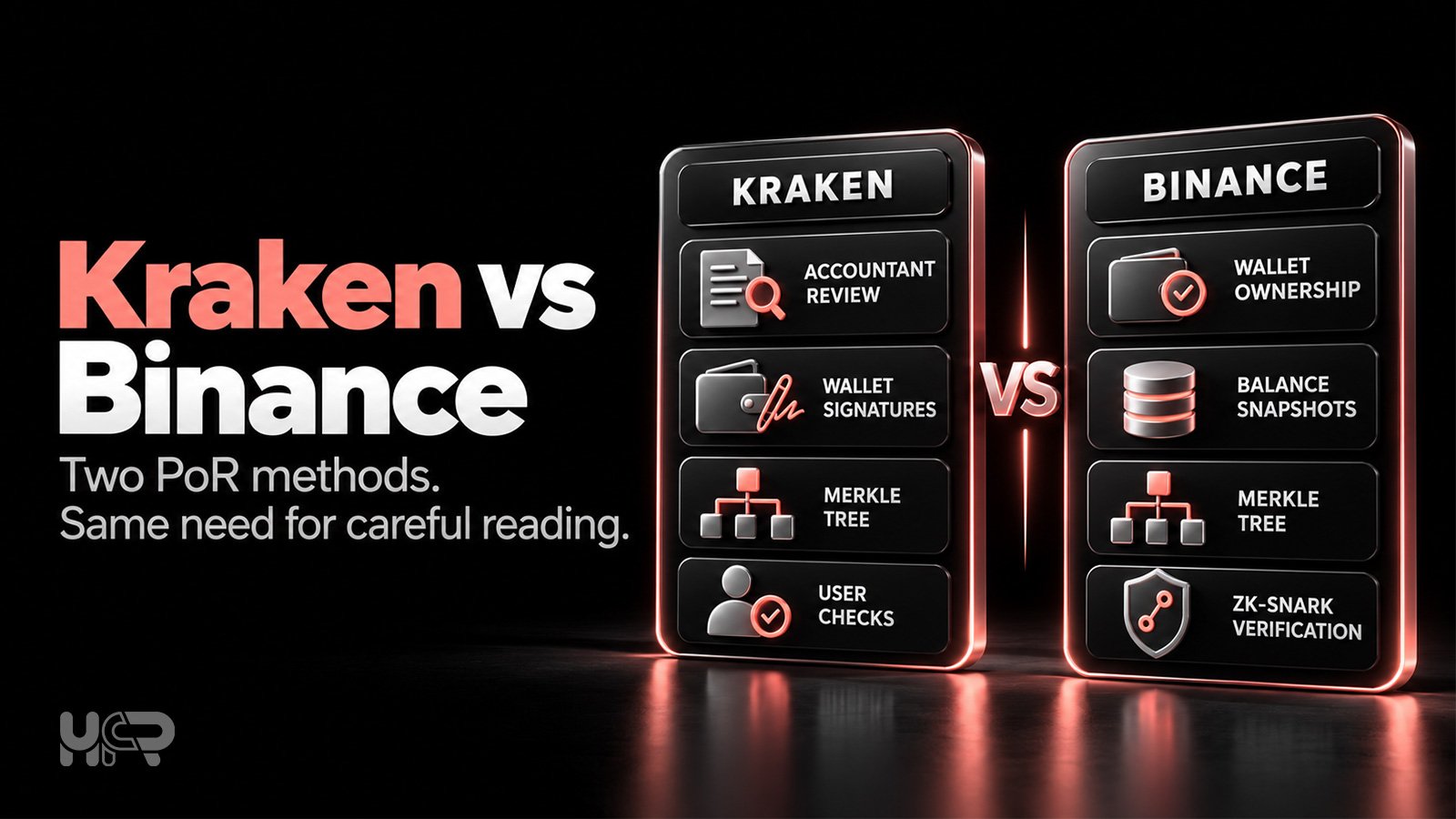
Kraken and Binance provide practical examples of how PoR methods differ. Their published explanations describe particular verification processes; they are not independent endorsements or rankings.
Kraken: a dated review and customer inclusion checks
Kraken’s official Proof of Reserves page showed a 30 June 2026 snapshot when checked on 19 October 2026. Kraken says an independent accountant reviews signed evidence of wallet control and compares the in-scope on-chain balances with customer balances represented in a Merkle tree. Kraken also provides tools for customers to verify inclusion of their in-scope balances.
The snapshot and its asset coverage should be read together. A ratio published for an included coin does not establish that every Kraken asset, obligation, or future withdrawal is covered.
Binance: Merkle trees and zk-SNARK verification
Binance describes wallet ownership verification, customer balance snapshots, Merkle trees and zk-SNARKs in its PoR methodology. Eligible users can retrieve a Record ID or Merkle Leaf and select a report date to check their inclusion in the relevant dataset.
These cryptographic checks support specific claims about the published balances and commitments. They do not establish the completeness of off-chain liabilities or the exchange’s overall financial condition.
Other checks before keeping crypto on an exchange
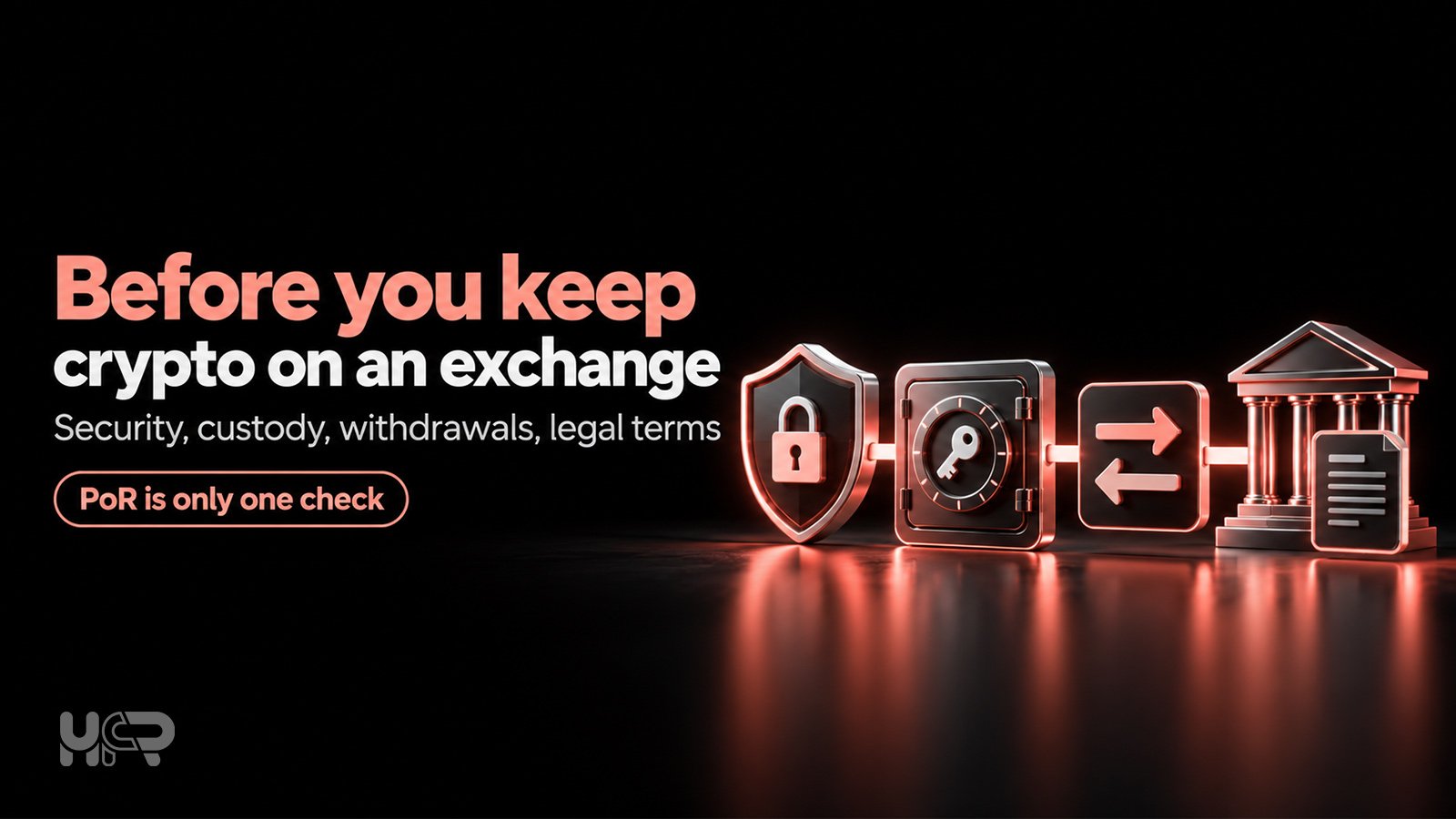
Reserve disclosures are one input to a broader assessment of a custodial platform. Consider:
- Account protection: two-factor authentication, anti-phishing measures, withdrawal controls and recovery arrangements.
- Custody agreements: who controls the assets, whether sub-custodians are involved and any rights to use customer assets.
- Withdrawal access: limits, delays, suspension provisions and any current official notices.
- Legal entity and jurisdiction: the contracting company, applicable law and customer rights if the operator fails.
- Financial information: published financial statements or other independent reports, where available.
- Custody concentration: the risk of relying on one platform to hold a large share of your assets.
Self-custody changes those risks rather than removing them: users control their keys but become responsible for secure backups, transaction details, and recovery. HFR’s KuCoin review illustrates how reserve disclosures, account controls, and historical incidents can be considered separately when researching an exchange.
FAQ
Does 100% Proof of Reserves mean an exchange is safe?
No. A 100% ratio may show that certain assets match the customer balances covered by that report at a specified time. It does not establish that all liabilities were examined, that assets are unencumbered, or that the exchange can meet every future withdrawal.
Can a user verify their own balance in a PoR report?
Some exchanges provide Merkle-tree or other cryptographic verification tools. These can help confirm that a user’s balance record was included in a particular snapshot dataset. The check does not prove that the dataset includes all other customers or every company obligation.
Is Proof of Reserves the same as proof of liabilities?
No. Evidence of reserve assets is one side of the comparison; evidence of the covered amounts owed to customers is the other. A PoR methodology that includes customer balances provides more information than a wallet-address list alone, but completeness still depends on its scope and verification procedures.
How often should exchanges publish Proof of Reserves?
There is no universal reporting interval for every exchange. Some publish snapshots regularly, while others use different schedules. Users should check the timestamp and methodology of the latest report rather than assume that an older snapshot describes the exchange’s present reserves.
Does an independent PoR report replace a financial audit?
No. Third-party PoR procedures may verify specified balances or provide agreed-upon factual findings. A financial-statement audit examines financial statements under an applicable accounting and auditing framework and results in an audit opinion. The two reports should not be described as equivalent.
Final takeaway
Proof of Reserves can help users check whether specified exchange assets were sufficient to cover the customer balances included at a particular snapshot time. The strength of that evidence depends on the methodology, independent procedures, liability coverage, and date.
It cannot, on its own, establish complete solvency, liquidity, cyber-security or future access to withdrawals. Before relying on a PoR claim, check the full report, its date and exclusions, and the exchange’s custody terms and wider financial disclosures.
Risk warning and disclaimer
Crypto assets and derivatives involve market, security, custody, counterparty and loss risks. Proof of Reserves does not guarantee the safety or recoverability of customer assets. This article is for educational and informational purposes only and is not financial, investment, trading, or legal advice, nor a recommendation to use any exchange, digital asset, or derivative.
Sources and methodology
This educational article was fact-checked on 19 October 2026 against the official Kraken and Binance PoR explanations, the PCAOB Office of the Investor Advocate’s advisory, and an SEC investor bulletin. Exchange-specific PoR methods, snapshot dates, and asset coverage may change. The fictional 110% BTC ratio is an illustrative calculation, not an exchange result.
 5


