



Table of Contents
[ Show/Hide ]- • GO Markets Review: Accounts, Spreads, Fees & Cashback Explained
- • Overview of GO Markets
- • Is GO Markets Regulated and Safe?
- • GO Markets Account Types
- • GO Markets Spreads, Fees, and Commissions
- • Trading Platforms Available at GO Markets
- • Instruments Available on GO Markets
- • Trading Features and Tools
- • Promotions and Bonuses
- • How Cashback Works with GO Markets
- • Deposits and Withdrawals
- • Pros and Limitations
- • Is GO Markets Right for You?
- • Conclusion
- • FAQ
GO Markets Review: Accounts, Spreads, Fees & Cashback Explained
This GO Markets review looks at the broker’s account structure, spreads, commissions, trading platforms, regulation, and cashback options. GO Markets is a forex and CFD broker that provides access to multiple asset classes through different account types and platform choices.
For traders comparing brokers, the real trading cost is not based only on the advertised spread. Account type, commission, swap fees, funding costs, platform access, region, and rebate eligibility can all affect the final cost of trading.
This review explains GO Markets trading conditions, account types, fees, available instruments, platforms, and rebates through HighFxRebates. Eligible traders can receive rebates of up to $12 per lot, paid weekly to their HighFxRebates account, depending on account type, traded instrument, eligible volume, and broker confirmation.
Overview of GO Markets
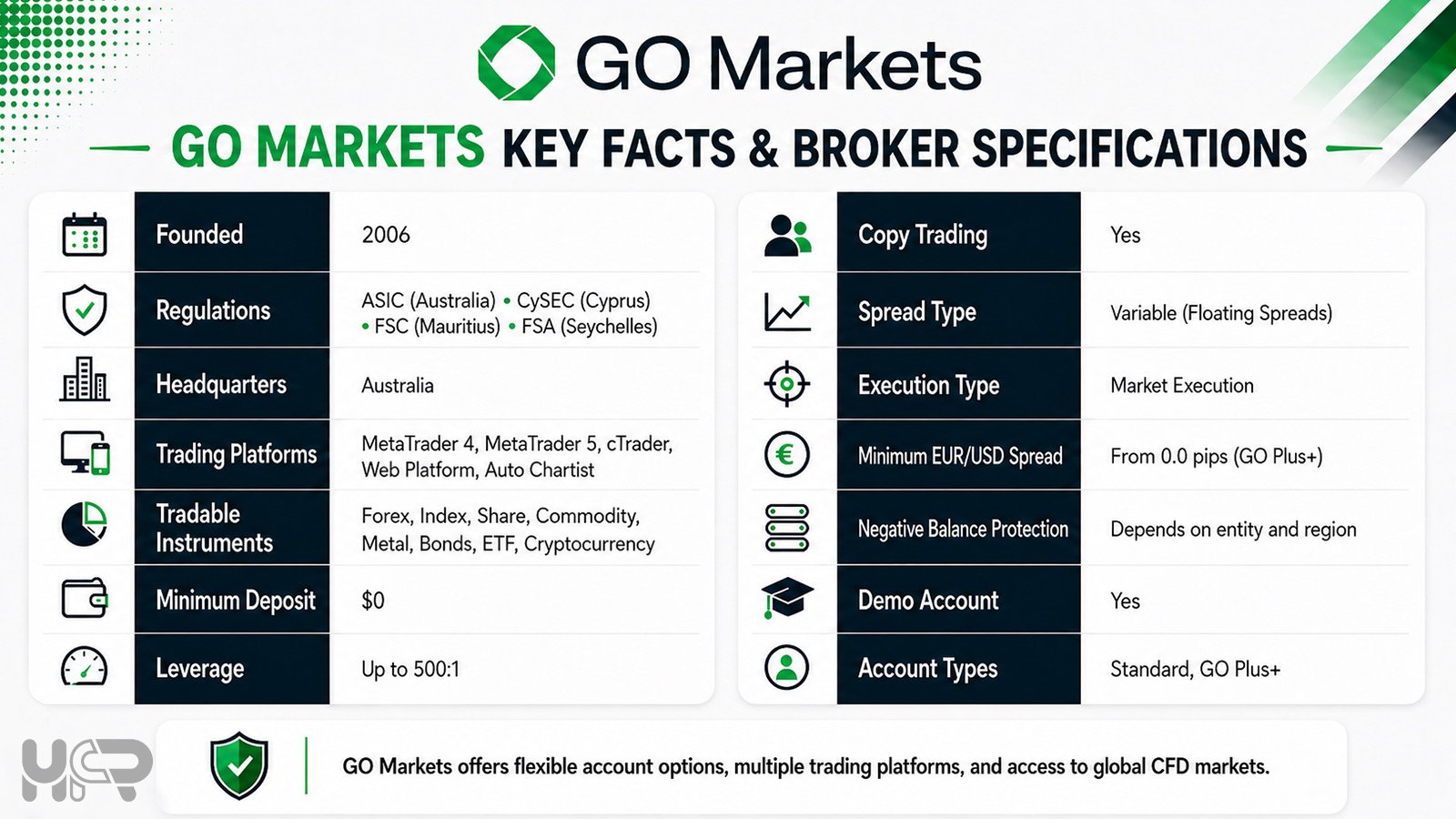
GO Markets is a forex and CFD broker that provides access to multiple markets through different account types and trading platforms. According to GO Markets’ official website, the broker launched in Australia in 2006 and has developed around platform-based forex and CFD trading.
GO Markets offers CFD market access across categories such as forex, indices, shares, commodities, metals, ETFs, and other markets, depending on the trader’s region and available entity. The broker also provides different account structures, including spread-based and commission-based options, so trading costs can vary by account type.
Platform availability is another important part of the broker’s structure. GO Markets may offer access to platforms such as MetaTrader, cTrader, TradingView, and GO TradeX™, depending on the region, entity, and account setup. Traders should confirm the available platforms inside their client area before choosing a trading setup.
The exact products, leverage limits, account conditions, platform access, and client protections can vary depending on the trader’s location and the GO Markets entity used. For this reason, traders should review the official account, platform, and legal information that applies to their region before opening an account.
Is GO Markets Regulated and Safe?
GO Markets operates through different legal entities depending on the client’s location. This means regulation, leverage limits, available products, and client protections may vary from one region to another.
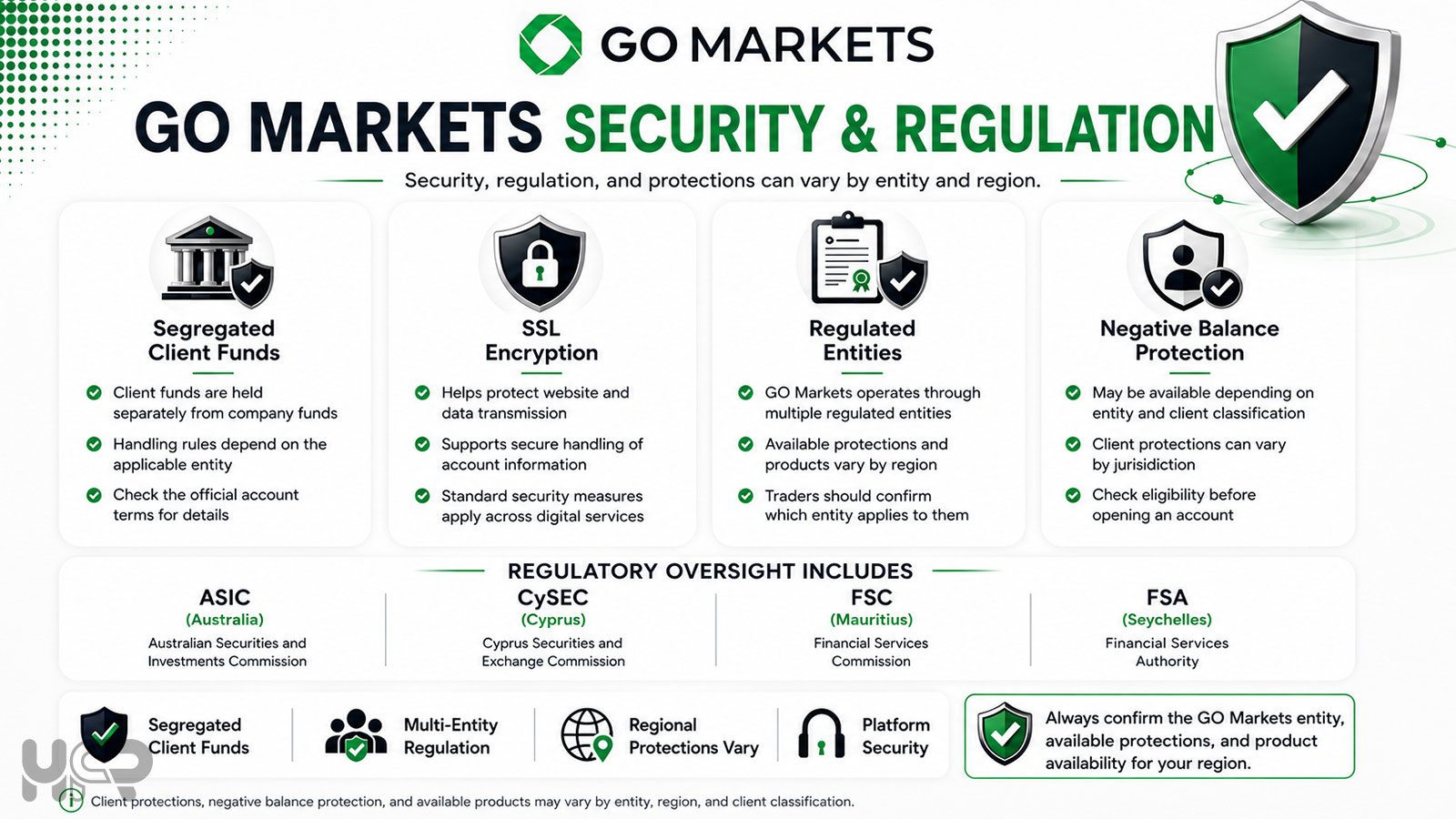
For Australian clients, GO Markets Pty Limited is listed as a CFD issuer with ABN 85 081 864 039 and AFSL 254963, which indicates regulation by ASIC for the relevant Australian entity. GO Markets also refers to other regional entities, including entities regulated, licensed, or authorised by CySEC in Cyprus, FSC in Mauritius, and FSA in Seychelles, depending on the client’s country and registration route.
For European clients, GO Markets may operate through a Cyprus-regulated entity. The applicable protections, product access, and leverage rules can differ from those offered under other GO Markets entities.
Regulation helps define the broker’s operating standards, legal responsibilities, disclosure rules, and client protection framework. However, it does not remove trading risk. Forex and CFD trading still involves market risk, leverage risk, and the possibility of losing money.
Before opening an account, traders should confirm which GO Markets entity applies to them and review the legal documents, product conditions, leverage rules, and client protections for their specific region.
GO Markets Account Types
GO Markets offers different account types for traders with different pricing preferences and trading styles. The main difference is how trading costs are applied. Some accounts include the trading cost inside the spread, while others use lower spreads with a separate commission.
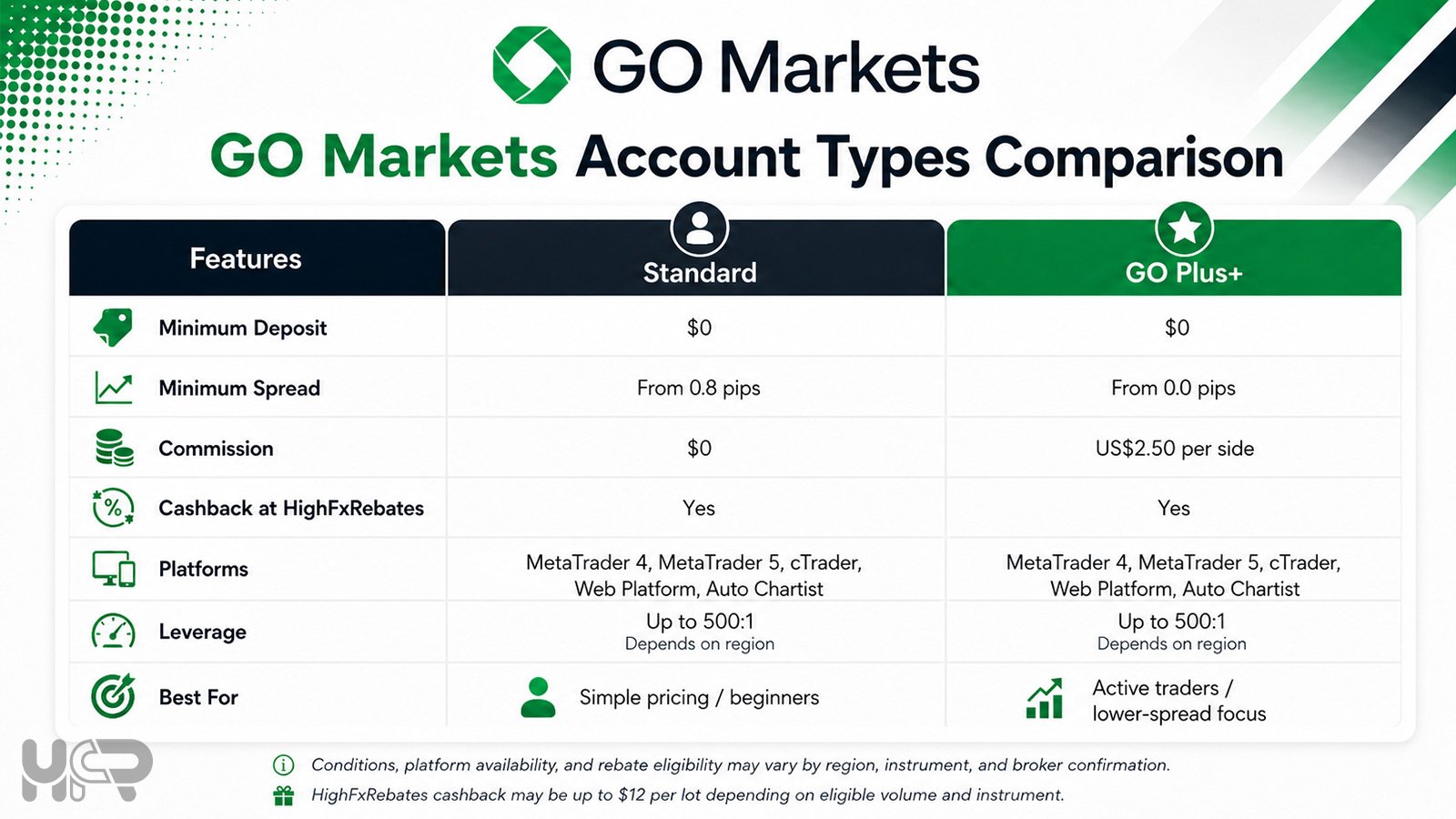
For most traders, the two main account types to compare are the Standard Account and the GO Plus+ Account. Account conditions may vary depending on the trader’s region, GO Markets entity, account currency, platform, and client classification.
Standard Account
The Standard Account uses a spread-included pricing model. This means trading costs are mainly built into the spread, and there is usually no separate commission on standard forex trades.
According to GO Markets’ account information, the Standard Account may show spreads from 0.8 pips with no commission. These figures should be treated as account-page examples, because live spreads can change depending on market conditions, liquidity, and trading session.
This account may suit traders who prefer:
- Simple pricing
- No separate commission calculation
- Easier cost comparison
- Standard forex and CFD trading access
The Standard Account may be more suitable for beginners or traders who want a simpler cost structure.
GO Plus+ Account
The GO Plus+ Account is designed around lower spreads with a separate commission. This means the visible spread may be lower than the Standard Account, but traders need to include commission when calculating the final trading cost.
According to GO Markets’ account information, the GO Plus+ Account may show spreads from 0.0 pips with a separate commission. This account may suit traders who are more active and want to compare spread and commission together.
This account may suit traders who:
- Trade more frequently
- Prefer lower-spread pricing
- Understand commission-based accounts
- Compare total trading cost carefully
A lower spread does not automatically mean a lower total cost. Traders should compare the spread, commission, swap fees, funding costs, trading volume, and possible cashback together.
In some regions, GO Markets may also offer Micro or Professional account options. These accounts can have different contract sizes, eligibility requirements, and trading conditions, so traders should check the account list available under their own GO Markets entity before registering.
Account Type Comparison
| Account Type | Pricing Model | Usually Suits |
|---|---|---|
| Standard | Spread included, usually no separate commission | Traders who prefer simple pricing |
| GO Plus+ | Lower spread + separate commission | Active traders comparing spread and commission |
Before choosing an account type, traders should review the latest GO Markets account conditions for their region. Account availability, spreads, commissions, leverage, and trading conditions may vary by entity, platform, and client classification.
GO Markets Spreads, Fees, and Commissions
GO Markets uses different pricing models depending on the account type. The Standard Account follows a spread-included model, while the GO Plus+ Account uses lower spreads with a separate commission.
On the Standard Account, trading costs are mainly included in the spread. GO Markets lists Standard spreads from 0.8 pips with US$0 commission. This structure may suit traders who prefer simple pricing and do not want to calculate a separate commission on each trade.
The GO Plus+ Account is designed for traders who want lower-spread pricing. GO Markets lists GO Plus+ spreads from 0.0 pips, with a commission of US$2.50 per side on an FX standard lot. Because this account uses a commission-based model, traders should calculate both the spread and commission when comparing total trading cost.
Both account types may show leverage up to 500:1, depending on the trader’s region, entity, account classification, and applicable rules. Leverage conditions should always be checked before opening an account, because they can vary by jurisdiction.
A spread shown as “from 0.0 pips” or “from 0.8 pips” should not be treated as the average cost of every trade. Minimum spreads usually represent the lowest available pricing under certain market conditions. Real spreads can change during news events, low-liquidity periods, volatile sessions, and market open or close periods.
Swap or rollover fees may also apply when positions are held overnight. These charges can depend on the instrument, position direction, market rates, and account conditions. Traders who hold positions for more than one trading day should include swap costs when reviewing total trading cost.
Funding costs should also be checked. Even where GO Markets does not charge an internal fee for certain payment methods, banks, card providers, payment processors, or intermediary institutions may still apply third-party fees. Currency conversion can also affect the final amount if the deposit or withdrawal currency is different from the account currency.
For a clearer cost comparison, traders should look at:
| Cost Factor | What to Check |
|---|---|
| Spread | Standard from 0.8 pips, GO Plus+ from 0.0 pips |
| Commission | Standard US$0, GO Plus+ US$2.50 per side on FX standard lot |
| Swap / rollover | Overnight charges may apply |
| Funding costs | Deposit, withdrawal, third-party, or conversion fees |
| Account type | Pricing differs between Standard and GO Plus+ |
| Cashback | Eligible rebates may offset part of trading costs after confirmation |
To compare cost structures more clearly, traders can review forex rebates vs low spreads and understand how spread-based and rebate-based cost models differ.
Trading Platforms Available at GO Markets
GO Markets provides access to several trading platforms, including TradingView, MetaTrader 4, MetaTrader 5, and cTrader, depending on the trader’s region, GO Markets entity, account type, and client area access.
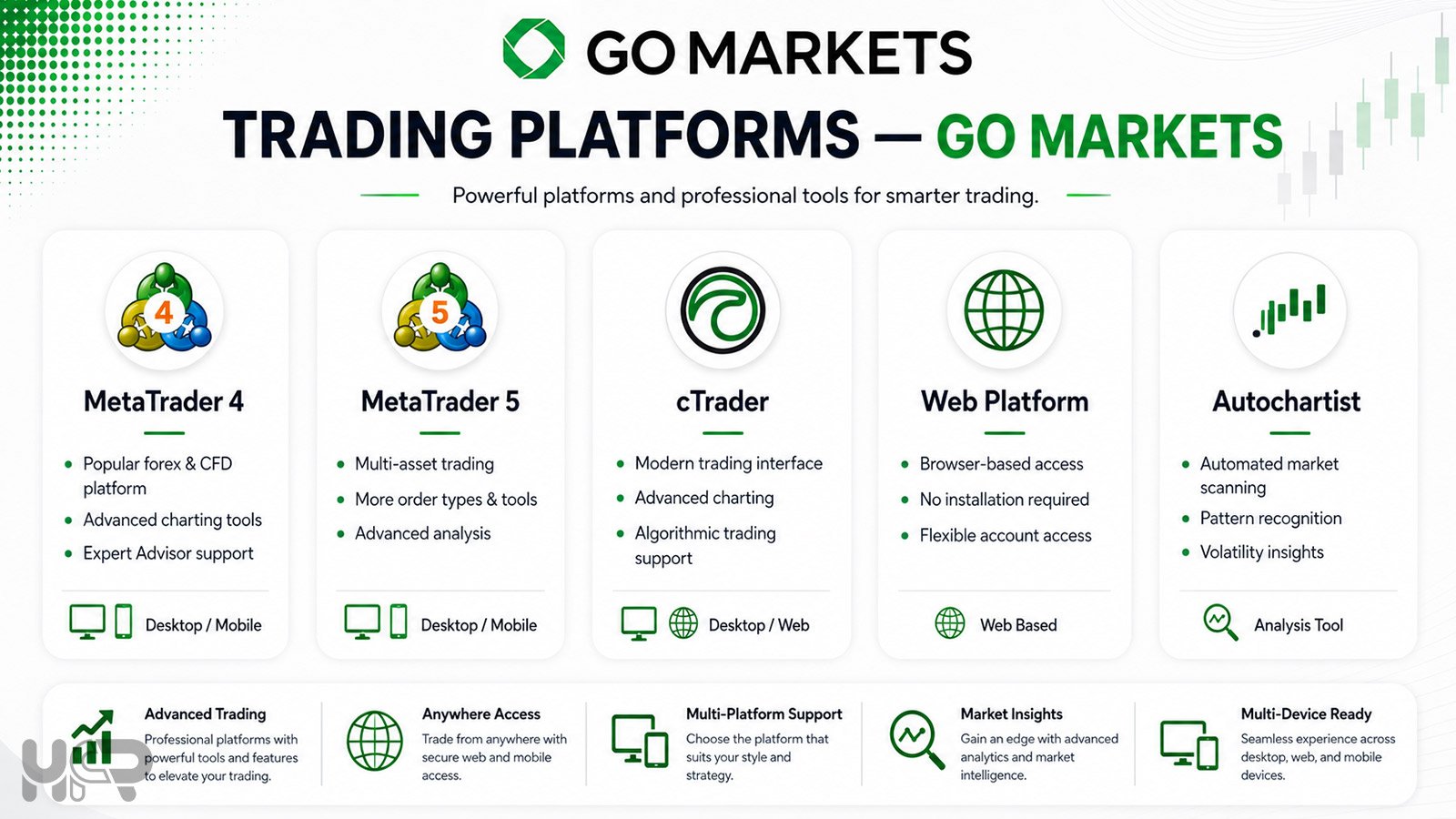
Platform choice matters for charting, automation, copy trading, and trading workflow. However, choosing a different platform does not directly reduce spreads, commissions, swaps, or trading fees. Trading costs still depend mainly on the account type, instrument, market conditions, and broker pricing model.
TradingView may suit traders who prefer browser-based charting, real-time analysis tools, and a large trading community.
MetaTrader 4 may suit forex and CFD traders who want a familiar platform with indicators, charting tools, Expert Advisors, and manual or automated trading options.
MetaTrader 5 may suit traders who want a more modern MetaTrader environment with broader multi-asset functionality and additional tools.
cTrader may suit traders who prefer a clean interface, advanced charting, and algorithmic trading features.
GO Markets may also provide tools such as MetaTrader Genesis, VPS, copy trading, PAMM, Signal Centre, and Autochartist where available. These tools can support analysis, automation, and platform use, but they do not directly reduce trading costs.
Traders should confirm which platforms and tools are available under their own GO Markets entity before choosing a setup.
Instruments Available on GO Markets
GO Markets offers access to a range of CFD markets. According to GO Markets’ official market information, available product categories may include forex CFDs, share CFDs, index CFDs, commodity CFDs, cryptocurrency CFDs, bonds, and ETF CFDs. The broker also refers to CFD markets across forex, indices, shares, commodities, metals, ETFs, and other markets.
Instrument availability can vary depending on the trader’s region, platform, account type, and GO Markets entity. This is especially important for cryptocurrency CFDs, bonds, ETFs, and share CFDs, because access may not be the same for every client.
Traders should check the product list inside their client area before trading. Spreads, leverage, margin rules, trading hours, and contract details may differ between instruments.
Trading Features and Tools
GO Markets may provide trading tools, insights, and educational resources to support analysis, platform use, and trade planning. These may include an economic calendar, market insights, webinars, MetaTrader Genesis, VPS, copy trading tools, PAMM, Signal Centre, and Autochartist where available.
These tools can help traders prepare and manage their workflow, but they do not directly reduce spreads, commissions, swaps, or execution costs. Trading costs still depend mainly on account type, instrument, market conditions, and broker pricing.
Promotions and Bonuses
GO Markets promotions, if available, should be reviewed through the official terms before participating. Bonus availability and campaign rules may vary depending on the trader’s region, account type, GO Markets entity, and promotion period.
Some promotions may include conditions such as minimum deposit requirements, eligible account types, trading volume rules, time limits, or withdrawal restrictions. These conditions can affect how useful a promotion is for a trader.
Bonuses do not directly reduce spreads, commissions, swaps, or execution costs. They may provide promotional value, but the real benefit depends on the terms attached to the offer.
For cost-focused traders, cashback is usually easier to compare as a cost-offset because it is linked to eligible trading volume, account type, traded instrument, and broker confirmation.
How Cashback Works with GO Markets
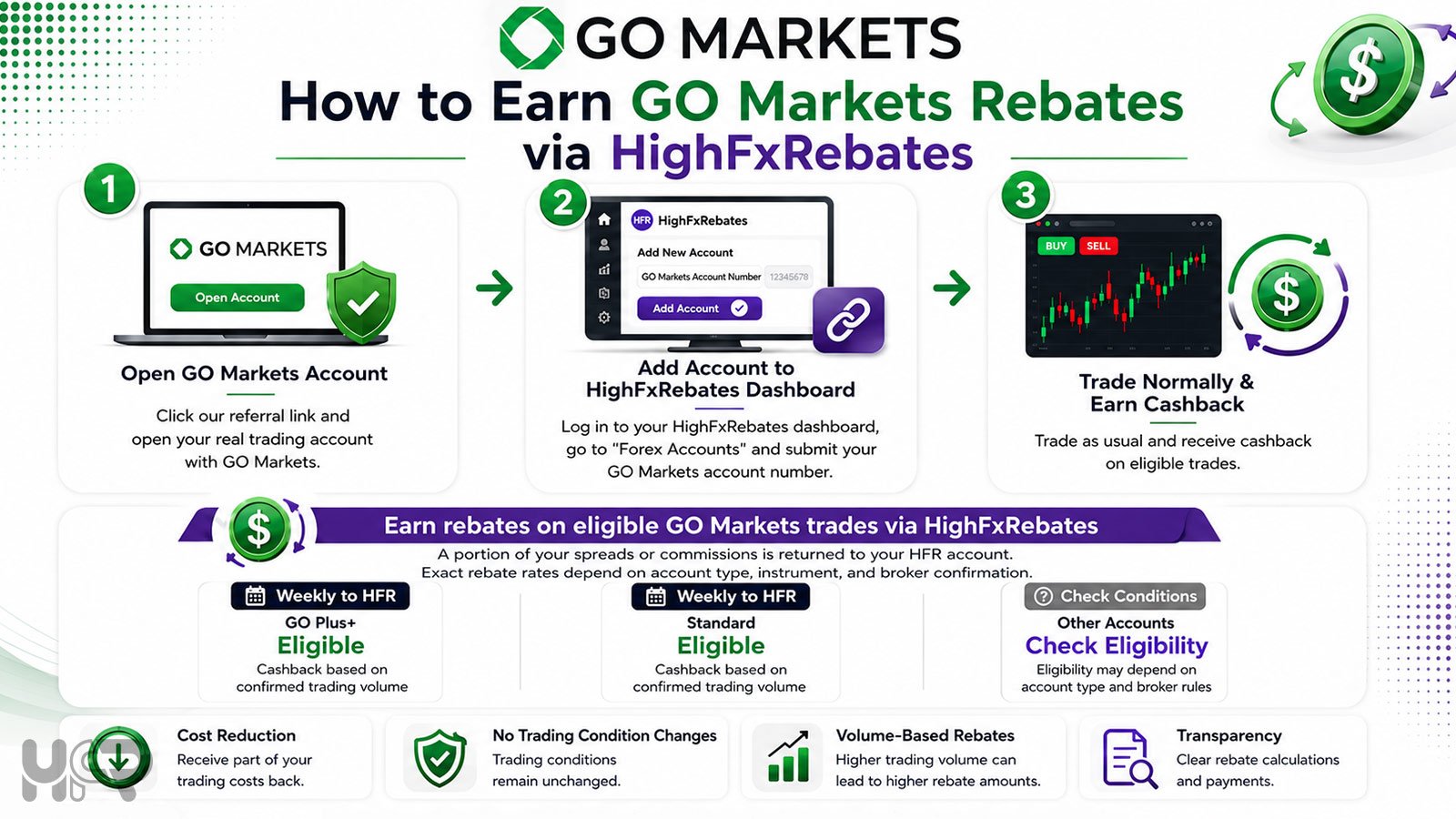
When trading GO Markets through HighFxRebates, eligible traders can receive rebates of up to $12 per lot. The exact rebate amount depends on account type, traded instrument, eligible volume, and broker confirmation. Cashback is calculated separately after trades are completed and does not change spreads, leverage, execution speed, order pricing, or account conditions.
This means traders continue to trade under normal GO Markets trading conditions. The rebate is not applied inside the trading platform at the moment of execution. Instead, eligible trading volume is reported and confirmed by the broker, then cashback is calculated according to the rebate rules.
GO Markets cashback through HighFxRebates may vary depending on:
- Account type
- Instrument category
- Lot size and trading volume
- Broker confirmation
- Rebate eligibility rules
- Payout schedule
Cashback should be viewed as a cost-offset mechanism. It can help offset part of eligible trading costs after trades are confirmed, but it should not be treated as income, profit, or a change in broker pricing.
If you are new to this model, it helps to understand how forex rebates work before comparing broker rebate rates.
Start earning GO Markets rebates with HighFxRebates
Trade GO Markets through HighFxRebates and receive up to $12 per lot in rebates on eligible trading volume, without changing spreads, execution, or account conditions.
Deposits and Withdrawals
GO Markets supports deposits and withdrawals through several funding methods, but availability can vary depending on the trader’s region, account currency, payment provider, and GO Markets entity.
Based on the funding information shown, available methods may include BPay, credit card, debit card, and eWallets. Crypto deposits and withdrawals are not shown as available in the displayed funding table.
Processing times may vary. First-time deposits and withdrawals may take 1–3 business days, while withdrawal requests are generally processed according to the broker’s cut-off times and verification rules.
For security and compliance, funds are usually returned to an account in the same name as the GO Markets trading account. Third-party payments are not allowed, and GO Markets may request additional documents for verification or source-of-funds checks.
Traders should also consider possible third-party fees, intermediary charges, and currency conversion costs. The latest funding details should be checked inside the GO Markets client area before making a deposit or withdrawal.
Pros and Limitations
GO Markets has several points that may appeal to traders, especially those comparing account types, platforms, instruments, and cashback options. At the same time, traders should also understand the limitations before opening or linking an account.
| Pros | Limitations |
|---|---|
| Standard and GO Plus+ account options | Conditions can vary by region and GO Markets entity |
| Choice between spread-included and lower-spread commission pricing | GO Plus+ account has a separate commission |
| MT4 and MT5 support | Platform availability may vary by entity or account setup |
| cTrader and TradingView access, where available | Product availability may differ by region or platform |
| Access to forex and CFD instruments | Minimum spreads are not fixed live trading costs |
| Trading tools such as VPS, copy trading, Signal Centre, and Autochartist, where available | Tools do not directly reduce spreads, commissions, or swaps |
| GO Markets rebates up to $12 per lot through HighFxRebates | Cashback requires correct account linking and broker confirmation |
GO Markets may suit traders who want access to multiple platforms, different account pricing models, and a range of CFD markets. The Standard account may be easier for traders who prefer simple pricing, while GO Plus+ may appeal to traders who compare lower spreads with commission costs.
The main limitations are regional variation, platform/product availability, and rebate eligibility. Cashback through HighFxRebates can help offset part of eligible trading costs, but only when the account is correctly linked and the broker confirms the trading volume.
Is GO Markets Right for You?
GO Markets may suit different types of traders depending on account choice, platform preference, trading volume, and cost sensitivity. The right setup depends on how the trader compares spreads, commissions, swaps, funding costs, and cashback eligibility.
Beginners
Beginners may prefer the Standard account because the pricing structure is simpler. Trading costs are usually included in the spread, so there is no separate commission calculation on standard forex trades.
A demo account can also be useful for beginners who want to test the platform, practice order placement, and understand basic trading tools before using real funds. If a Micro account is available in the trader’s region, it may also help traders start with smaller contract sizes.
This type of setup may suit traders who want:
- Simpler pricing
- Demo account practice
- Standard platform access
- Easier cost calculation
Active Traders
Active traders may prefer the GO Plus+ account because it offers lower-spread pricing with a separate commission. This structure can be useful for traders who place trades more frequently and understand how to compare spread and commission together.
However, lower spreads do not automatically mean lower total cost. Active traders should calculate the full trading cost, including spread, commission, swap fees, and any funding-related charges.
Platform choice can also matter for active traders. GO Markets may support platforms such as MT4, MT5, cTrader, and TradingView, depending on region and entity. Traders should confirm which platforms and tools are available before choosing a setup.
Experienced / Platform-Focused Traders
Experienced traders may value GO Markets for its platform variety, including MetaTrader, cTrader, TradingView, and selected trading tools where available. This can be useful for traders who rely on charting, automation, copy trading, or multi-platform workflows. However, platform availability should be confirmed by region and entity before choosing an account.
Cost-Focused Traders
Cost-focused traders should compare the full trading cost, not only the minimum spread. The main points to check are:
- Spread
- Commission
- Swap or rollover fees
- Funding and withdrawal costs
- Currency conversion
- Account type
- Eligible instruments
- Cashback or rebate availability
GO Markets rebates through HighFxRebates can help offset part of eligible trading costs after trades are completed and confirmed. However, traders should check the rebate table before opening or linking an account, because eligibility can depend on account type, instrument, trading volume, and broker confirmation.
Cost-focused traders should also understand how to reduce forex trading fees by comparing spreads, commissions, swaps, funding costs, and cashback together.
Rebate-focused traders should check the GO Markets rebate table before registering, because the final cashback amount can depend on account type, instrument category, lot size, and broker confirmation.
Conclusion
This GO Markets review shows that the broker may suit traders who want access to forex and CFD markets through different account types, trading platforms, and tools. However, the final value depends on several factors, including the trader’s region, GO Markets entity, account type, spreads, commissions, funding method, platform access, and available instruments.
For traders using HighFxRebates, GO Markets rebates can help offset part of eligible trading costs. Eligible traders may receive rebates of up to $12 per lot, depending on account type, traded instrument, eligible volume, and broker confirmation.
Before opening or linking an account, traders should compare the full cost structure rather than looking only at minimum spreads or headline rebate rates. Spreads, commissions, swaps, funding costs, platform availability, and cashback eligibility should all be reviewed together.
You can also compare GO Markets with other brokers in our forex broker cashback comparison to see how rebate structures differ.
FAQ
Is GO Markets regulated?
GO Markets operates through different entities depending on the client’s region. Regulation, leverage limits, product availability, and client protections may vary, so traders should confirm which GO Markets entity applies to their account before registering.
What account types does GO Markets offer?
GO Markets commonly offers account types such as Standard and GO Plus+. Other account options may be available depending on the trader’s region, entity, and client classification. Traders should check the latest official account list before opening an account.
Does GO Markets charge commissions?
Commission depends on the account type. Standard-style accounts usually include trading costs inside the spread, while GO Plus+ or lower-spread accounts may charge a separate commission. Traders should compare both spread and commission when calculating total trading cost.
What platforms does GO Markets support?
GO Markets may support platforms such as MetaTrader 4, MetaTrader 5, TradingView, cTrader, and broker-supported tools or platforms depending on the trader’s region and account setup. Platform availability should be confirmed inside the client area.
How much cashback can I get with GO Markets through HighFxRebates?
Eligible traders can receive up to $12 per lot in GO Markets rebates through HighFxRebates. The exact cashback amount depends on account type, traded instrument, eligible trading volume, and broker confirmation.
Does GO Markets cashback affect spreads or execution?
No. GO Markets cashback does not change spreads, leverage, execution speed, order pricing, or account conditions. It is calculated separately after eligible trades are completed and confirmed by the broker.
Can I link an existing GO Markets account to HighFxRebates?
Existing account linking or IB transfer depends on GO Markets rules and approval. Traders should check the GO Markets rebate page or contact support before assuming an existing account can qualify for rebates through HighFxRebates.
 5
5
Share Posts


Further Reading
- What is a pip in forex? Pip value explained with examples
- Forex Commission Explained: Per Side, Per Lot and Round Turn
- Weekly Market Recap: U.S. Jobs, Yen Rally and Crypto ETF Inflows — August 31–September 6, 2026
- Bitcoin, Ethereum, Solana, Gold and Silver Technical Outlook: Key Daily Zones — September 7, 2026