





Table of Contents
[ Show/Hide ]- • What Does Crypto Exchange Cashback Mean?
- • Is Crypto Cashback Based on Trading Volume or Trading Fees?
- • Maker and Taker Fees: Why They Matter for Cashback
- • Spot, Futures, and Other Products: What May Be Eligible?
- • Step-by-Step: How Crypto Cashback Is Usually Calculated
- • Simple Cashback Calculation Example
- • Why Your Cashback May Be Lower Than Expected
- • When and Where Is Crypto Exchange Cashback Paid?
- • Does Cashback Change Exchange Fees or Trading Conditions?
- • Cashback vs Fee Discounts vs Bonuses
- • How to Check Cashback Eligibility Before Trading
- • How HighFxRebates Fits In
- • Risk and Compliance Note
- • Conclusion
- • FAQ
Many users see a cashback rate on a crypto exchange rebate page but do not always know what the rate is based on. Some may assume cashback is calculated from total trading volume, while others may think every trade automatically qualifies.
In practice, crypto exchange cashback is usually connected to eligible trading fees or commissions after the exchange confirms the trading activity. It is not based on market profit, price movement, or trading results.
This is why the calculation can vary from one exchange to another. The final cashback amount may depend on the exchange's fee structure, eligible products, maker or taker fees, account status, correct registration or linking process, and payout rules.
Not every trade, product, account, or region may qualify. Some exchanges may include specific products, exclude others, require KYC, apply minimum payout rules, or confirm trading data on a delayed schedule.
Cashback may help offset part of eligible trading costs after confirmation, but it does not reduce market risk, leverage risk, liquidation risk, funding-rate risk, platform risk, or trading losses.
This guide explains how crypto exchange cashback is calculated, what fees may count, why eligibility matters, and how users can review payout conditions before opening or linking an exchange account.
Quick answer: Crypto exchange cashback is usually calculated from eligible trading fees or commissions after the exchange confirms eligible trading activity. The final amount may depend on the exchange's fee structure, maker or taker fees, eligible products, account status, correct linking, and payout rules.
What Does Crypto Exchange Cashback Mean?
Crypto exchange cashback means that part of the eligible trading fees may be returned to the user after confirmed trading activity. It is usually connected to the fees or commissions paid on supported exchange products, not to market profit or trading performance.
In many cases, cashback is calculated separately from the exchange's live trading interface. The exchange may still charge its normal trading fees inside the platform, while cashback is reviewed later based on eligible activity and confirmation.
The calculation may be based on commissions, maker or taker fees, or another eligible fee structure depending on the exchange and cashback program. Eligibility may also depend on account status, correct linking, supported products, region, KYC, minimum payout rules, and exchange confirmation.
Crypto exchange cashback may help offset part of the eligible trading costs after confirmation. It should not be treated as profit, trading income, or protection from market risk.
Users who are new to exchange basics can first read HighFxRebates' guide on what a crypto exchange is before reviewing cashback calculations.
Is Crypto Cashback Based on Trading Volume or Trading Fees?
Some users think crypto cashback is calculated directly from total trading volume. In many cases, the calculation is more closely connected to the trading fees or commissions generated by eligible trading activity.
Trading volume can still affect the cashback amount indirectly. If a user trades more volume, the exchange may charge more trading fees. If those fees are eligible and confirmed, the cashback amount may also increase based on the applicable rate or formula.
For example, a user may trade a certain amount on a supported exchange product. The exchange calculates the maker or taker fee for that trade according to its fee schedule. If that fee is eligible for cashback and later confirmed, the cashback may be calculated from the eligible fee amount.
This means users should not look only at trade size. They should also check the exchange's fee structure, maker and taker rates, eligible products, account status, cashback rate, and confirmation rules.
Higher volume may create more fees, and eligible confirmed fees may result in higher cashback. However, this does not mean users should trade more only to receive cashback. Cashback should be reviewed as part of trading cost, not as a reason to increase trading activity or risk.
Maker and Taker Fees: Why They Matter for Cashback
Maker and taker fees can affect crypto exchange cashback because many cashback programs are linked to eligible trading fees or commissions.
A maker order usually adds liquidity to the exchange order book. This can happen when a limit order does not execute immediately and waits for another user to match it. A taker order usually removes liquidity because it executes immediately against an existing order in the order book.
Crypto exchanges may charge different fees for maker and taker orders. In some cases, maker fees may be lower than taker fees. In other cases, the difference can depend on the exchange, product type, VIP level, trading volume, campaign terms, or account status.
If cashback is calculated from fees paid, maker and taker rates can affect the final cashback amount. For example, if a taker order creates a higher eligible fee than a maker order, the cashback calculation may also be different, subject to the exchange’s rules and confirmation.
This does not mean users should choose an order type only because of cashback. Order type affects execution, price control, slippage, and trading risk. Cashback should be reviewed as part of the total trading cost, not as a reason to change risk behavior.
Users should check the official fee schedule of the exchange they use, because maker and taker rates may differ by spot, futures, options, account tier, and product category.
Spot, Futures, and Other Products: What May Be Eligible?
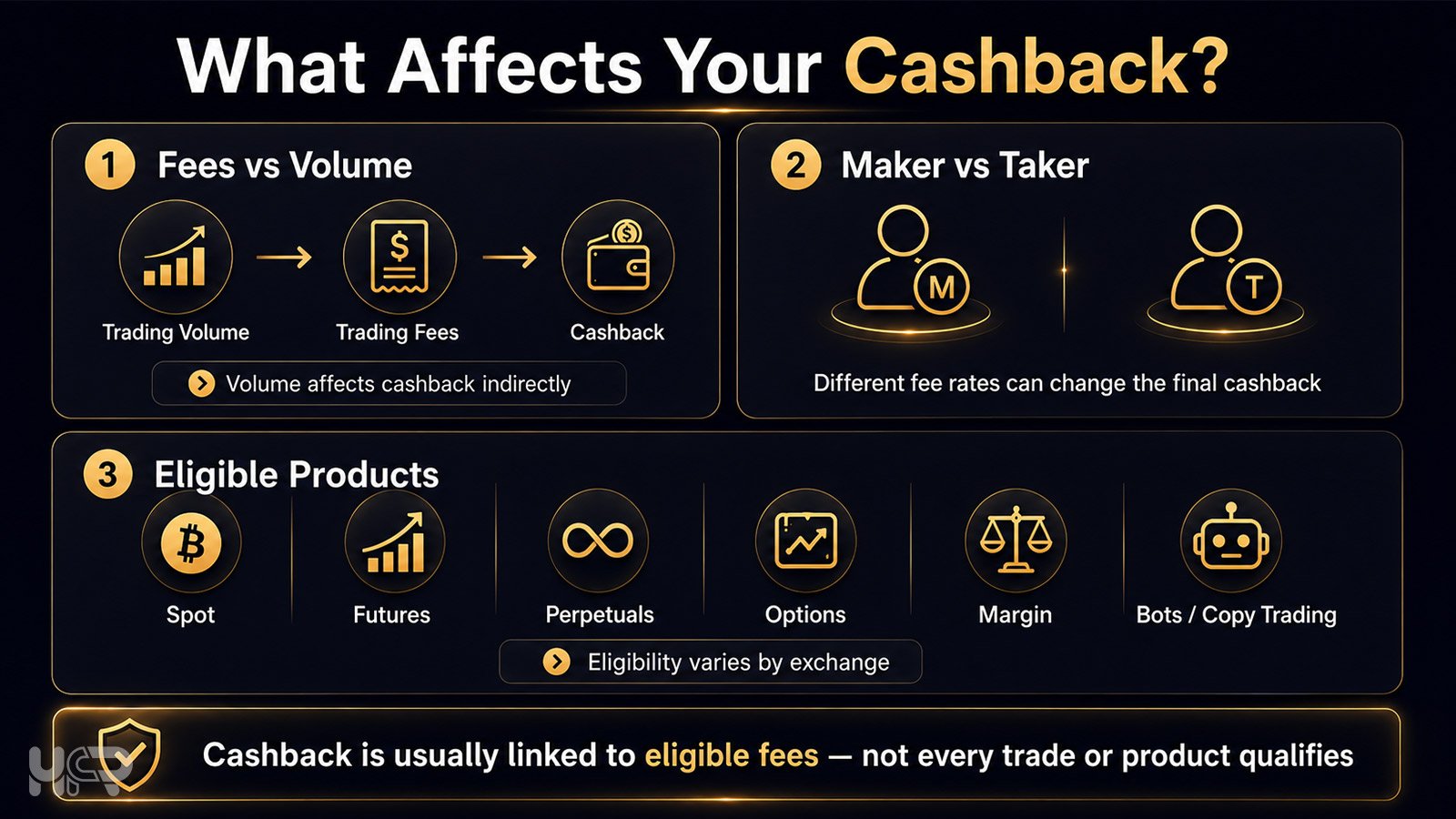
Crypto exchange cashback eligibility depends on the exchange and the cashback program. A product may be available for trading on an exchange, but that does not automatically mean it qualifies for cashback.
Some cashback programs may include spot trading, while others may focus on futures, perpetual contracts, or selected derivatives products. In some cases, only specific trading pairs, account types, or product categories may be eligible.
| Product Type | What Users Should Check |
|---|---|
| Spot Trading | Whether spot trades, selected pairs, and maker or taker fees qualify |
| Futures Trading | Whether futures fees are included and whether specific contracts are excluded |
| Perpetual Contracts | Funding rates, trading fees, eligible contracts, and cashback rules |
| Options | Availability, product eligibility, fee structure, and exchange confirmation |
| Margin Trading | Whether margin trades qualify and whether borrowing-related costs are excluded |
| Copy Trading or Bot Trading | Whether copied trades, bot trades, or strategy-based activity are eligible |
Not all products qualify. One exchange may include futures but exclude spot, while another may include spot trading only for selected pairs. Some exchanges may also exclude bonus-funded activity, internal transfers, sub-accounts, market-maker programs, or campaign-based trades.
Eligibility can also depend on account status, region, KYC level, trading volume, fee tier, or whether the account was opened or linked through the correct process. Users should check the specific exchange cashback page before trading.
Step-by-Step: How Crypto Cashback Is Usually Calculated
Crypto cashback calculation can vary by exchange and cashback program, but the general process usually follows a similar structure. Users should always check the specific exchange cashback page because product eligibility, payout rules, and confirmation timing may differ.
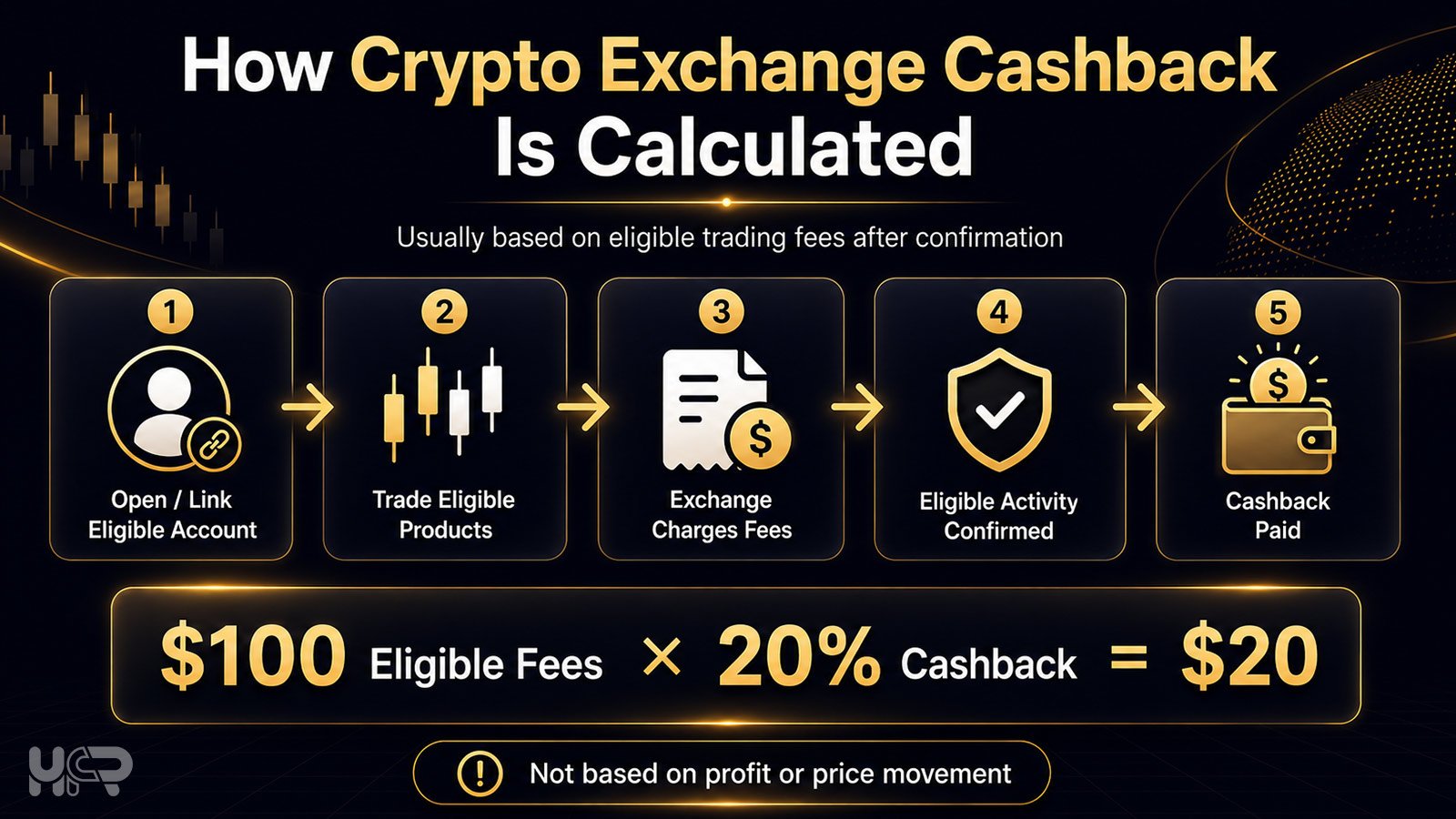
1. The user opens or links an eligible exchange account
The account usually needs to be opened, registered, or linked through the correct process before cashback can apply. If the account is not connected correctly, trading activity may not be tracked.
2. The user trades eligible products
Cashback usually applies only to supported products. Depending on the exchange, this may include spot, futures, perpetual contracts, or selected trading pairs.
3. The exchange records eligible trading activity
After the user trades, the exchange records the activity, including the product traded, order type, fee charged, and account details.
4. Trading fees or commissions are calculated by the exchange
The exchange applies its own fee schedule. Fees may depend on maker or taker order type, product category, VIP level, trading volume, fee discounts, or exchange rules.
5. Eligible activity is confirmed
Cashback is usually calculated only after the exchange confirms the eligible trading activity. This step can create delays if reports are reviewed daily, weekly, monthly, or on another schedule.
6. Cashback is calculated based on the applicable rate or formula
Once the eligible activity is confirmed, cashback may be calculated based on the stated rate or formula. This may be a percentage of eligible fees, a fixed rebate amount, or another structure.
7. Cashback is paid according to the stated payout schedule
Cashback may be paid daily, weekly, monthly, or according to another schedule. It may be paid directly to the user's exchange account, to the user's HighFxRebates account, or according to the applicable payout rules.
This process shows why cashback is not always instant and not always applied to every trade. The final amount depends on account eligibility, product eligibility, trading fees, exchange confirmation, payout rules, and any exclusions listed in the cashback conditions.
Simple Cashback Calculation Example
Here is a simplified example to show how crypto cashback may be calculated.
Assume a user pays $100 in eligible trading fees during a confirmed period. If the applicable cashback rate is 20% of eligible fees, the cashback amount would be: $100 x 20% = $20.
In this example, the user may receive $20 in cashback before any payout rules, minimum payout requirements, exclusions, adjustments, or confirmation conditions are applied.
This example is only for explanation. Actual cashback can depend on the exchange's fee structure, eligible products, maker or taker fees, fee tiers, account status, region, KYC requirements, account linking, reporting schedule, and exchange confirmation.
The final amount may also change if some trades are not eligible, if a fee voucher or bonus reduces the fee paid, if the minimum payout is not reached, or if the exchange applies specific exclusions.
Cashback should always be reviewed through the applicable exchange cashback conditions. It may help offset part of the eligible trading costs after confirmation, but it should not be treated as profit, trading income, or a guaranteed payment.
Why Your Cashback May Be Lower Than Expected
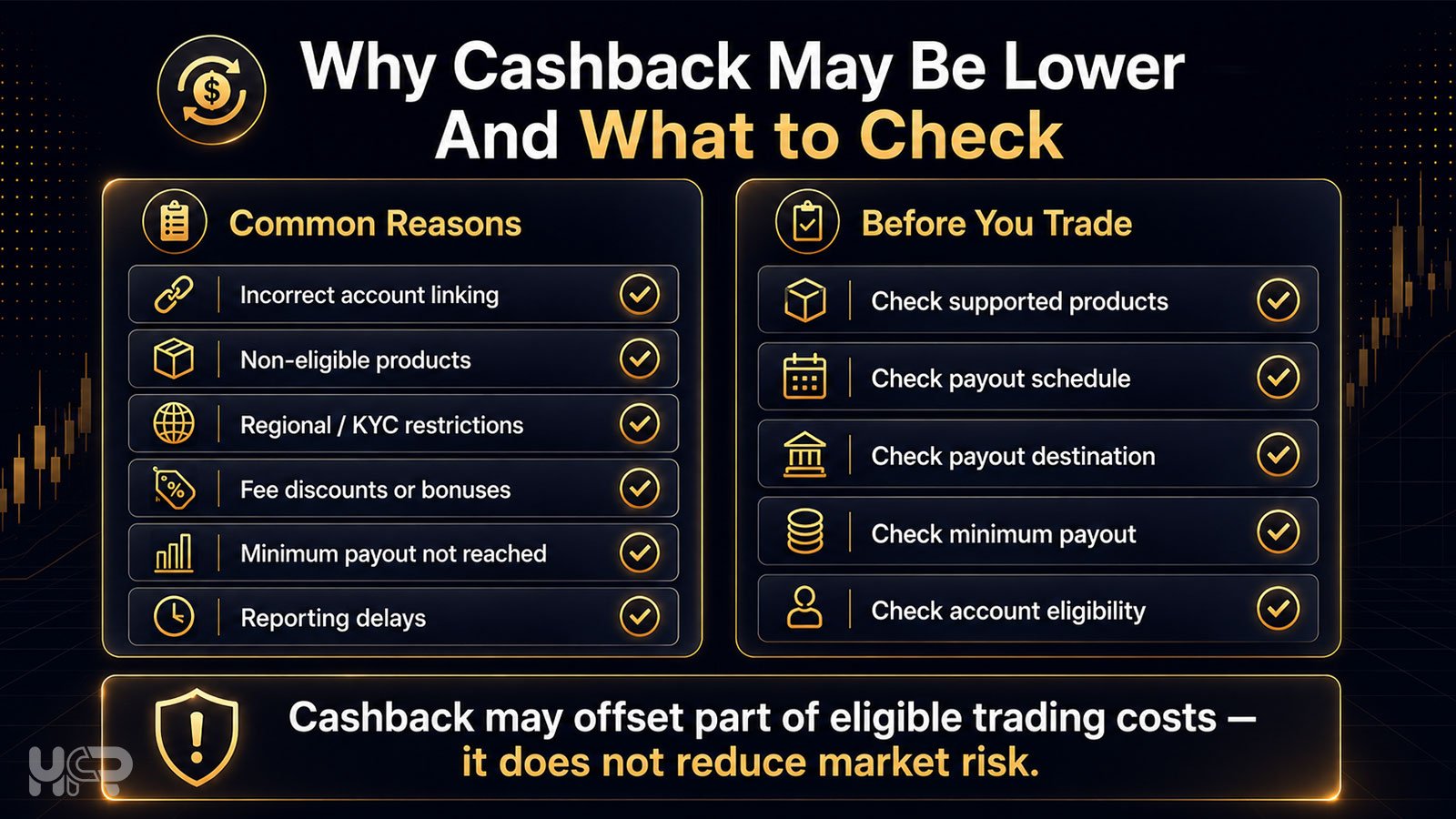
Crypto cashback may sometimes be lower than a user expects. This does not always mean there is an error. In many cases, the final amount depends on eligibility rules, exchange confirmation, fee calculations, and payout conditions.
The most common reason is incorrect account linking. Cashback usually requires the account to be opened or linked through the correct process before eligible trading activity can be tracked. If the account was opened before using the required link, or if the connection was not completed correctly, some activity may not qualify.
Product eligibility can also affect the final amount. A user may trade spot, futures, perpetual contracts, margin, options, copy trading, or bot trading, but not all products may be included in the cashback program. Some exchanges may include selected products only or exclude specific pairs, contracts, campaigns, or account types.
Regional, entity, or KYC restrictions may also apply. A cashback rate shown on a page may not apply to every user in every region. Trading activity may also need to be confirmed by the exchange before cashback is calculated, so reporting delays can affect when the amount appears.
The actual fee paid matters too. If the exchange applies a fee discount, VIP fee tier, voucher, bonus, or promotional credit, the confirmed fee may be lower. Since cashback is often linked to eligible fees or commissions, a lower confirmed fee may result in lower cashback.
Other reasons can include minimum payout rules, sub-account restrictions, internal transfers, copied trades, bot trades, bonus-funded activity, special campaign rules, or exchange data reporting delays.
If the amount looks lower than expected, users should check account linking, eligible products, confirmed fees, payout minimums, regional rules, and reporting timing before assuming cashback was calculated incorrectly.
When and Where Is Crypto Exchange Cashback Paid?
Crypto exchange cashback is usually paid according to the payout schedule listed by the exchange or cashback program. There is no universal payout timing for every exchange, so users should check the specific cashback page before opening or linking an account.
Some cashback programs may pay daily, weekly, monthly, or according to another confirmed schedule. The timing can depend on how often the exchange reports trading data, how quickly eligible activity is confirmed, and whether the cashback amount meets any payout requirements.
The payment destination can also vary. In some cases, cashback may be paid directly to the user's exchange account. In other cases, it may be credited to the user's HighFxRebates account first and then paid according to the available payout options.
Minimum payout rules may apply. A user may have eligible cashback, but if the amount is below the minimum payout level, it may remain pending until the threshold is reached or until the next eligible payout cycle.
Before opening or linking an exchange account, users should check where cashback is paid, how often it may be paid, whether minimum payout rules apply, and what conditions must be met before payment.
Does Cashback Change Exchange Fees or Trading Conditions?
No. In most cases, crypto exchange cashback is separate from the trading conditions shown inside the exchange.
The exchange usually charges its normal trading fees when the user places a trade. These fees may appear inside the exchange platform according to the exchange's own fee schedule, account tier, maker or taker order type, and product category.
Cashback is usually calculated later, after eligible trading activity is confirmed. This means the cashback process does not normally change the fee shown at the time of trading inside the exchange interface.
Cashback also does not change execution quality, order book liquidity, market price, leverage, funding rates, margin requirements, liquidation rules, or platform conditions. These are controlled by the exchange and the market, not by the cashback calculation.
Users should treat cashback as a separate cost-offset mechanism. It may help offset part of eligible trading costs after confirmation, but it does not change how the trade is executed or how risk works on the exchange.
Cashback vs Fee Discounts vs Bonuses
Crypto cashback, fee discounts, and exchange bonuses can all affect how users review trading costs or promotions, but they do not work in the same way.
Cashback may return part of eligible trading fees after confirmed trading activity. It is usually calculated separately from the exchange's live trading interface and depends on eligible products, account linking, confirmation, and payout rules.
Fee discounts may reduce the trading fee directly inside the exchange. For example, an exchange may apply a lower fee because of VIP level, trading volume, platform token use, or a specific fee discount campaign.
Bonuses or vouchers are usually promotional rewards with separate campaign rules. They may be linked to deposits, trading volume, KYC, expiry dates, product restrictions, reward caps, or withdrawal limits. Some vouchers may only be usable inside the platform and may not be withdrawable as cash.
These differences matter because cashback is usually based on eligible fees after confirmation, while a fee discount may reduce the fee before or during the trade. A bonus or voucher may work under a separate promotion and may not be connected to cashback eligibility.
Users who are comparing cashback with vouchers, fee discounts, or promotional rewards can also read HighFxRebates' guide on crypto exchange cashback vs exchange bonuses.
Before choosing an exchange or promotion, users should check whether the offer is cashback, a fee discount, a voucher, or a bonus. Each one may have different eligibility rules, payout conditions, and limitations.
How to Check Cashback Eligibility Before Trading
Before opening, linking, depositing, or trading, users should check the cashback conditions carefully. Crypto exchange cashback usually depends on eligibility, account setup, product rules, confirmation, and payout conditions.
| Eligibility Check | Why It Matters |
|---|---|
| Is the exchange supported by HighFxRebates? | Cashback may apply only to exchanges listed as supported by HighFxRebates. |
| Is the account new or existing? | Some cashback programs may apply only to new accounts, while others may allow existing accounts if they meet the required conditions. |
| Does the account need to be opened through a specific link? | Cashback tracking may require the account to be opened or linked through the correct HighFxRebates process. |
| Are spot, futures, or other products eligible? | Not every product may qualify. Some exchanges may include futures but exclude spot, or include only selected products. |
| Is KYC required? | Some exchanges may require identity verification before cashback can be tracked, confirmed, or paid. |
| Are there restricted countries? | Cashback availability may depend on the user's country, exchange entity, or local restrictions. |
| Is there a minimum payout? | Eligible cashback may remain pending if the amount does not reach the minimum payout level. |
| Where is cashback paid? | Cashback may be paid directly to the exchange account, to the HighFxRebates account, or according to specific payout rules. |
| How often is cashback paid? | The payout schedule may be daily, weekly, monthly, or another schedule, depending on the exchange and cashback program. |
| Are sub-accounts or internal transfers eligible? | Some exchanges may treat sub-accounts, transferred accounts, or internal account changes differently. |
| Are bonuses or fee vouchers allowed with cashback? | Some bonuses, vouchers, or fee discounts may affect the eligible fee amount or cashback eligibility. |
This checklist helps users avoid common cashback issues before trading. The most important points are correct account linking, eligible products, supported regions, confirmation rules, payout schedule, and minimum payout conditions.
Users should check the specific exchange cashback page before opening or linking an account. Cashback conditions may differ between exchanges, and a trade that qualifies on one exchange may not qualify on another.
Cashback should also be reviewed separately from exchange bonuses, vouchers, or fee discounts. A user may qualify for one offer but not another, depending on the account setup, product rules, and campaign conditions.
How HighFxRebates Fits In
HighFxRebates helps users compare cashback conditions for supported crypto exchanges. Depending on the exchange, eligible users may receive cashback based on confirmed trading activity, eligible products, account requirements, and the applicable payout rules.
This is useful because cashback conditions can differ from one exchange to another. One exchange may calculate cashback from eligible futures trading fees, while another may use a different product scope, payout schedule, or confirmation process. Users should not assume that the same rules apply across all exchanges.
Before opening or linking an account, users should review the specific exchange cashback page on HighFxRebates. The page can help explain whether the exchange is supported, which products may be eligible, how cashback may be paid, how often payouts may happen, and whether any account-linking or minimum payout rules apply.
For exchange-specific conditions, users can review Bybit cashback and BloFin cashback separately because rates, eligibility, payout rules, supported products, and account requirements may differ.
HighFxRebates cashback should also be reviewed separately from exchange bonuses, vouchers, or promotional campaigns. A user may qualify for cashback but not a bonus, or may qualify for an exchange promotion but not meet the cashback requirements. Correct account setup, eligible trading activity, and exchange confirmation remain important.
Users can compare supported crypto exchange cashback conditions on HighFxRebates before opening or linking an account, but they should also review the exchange's own fee schedule, product rules, account terms, and campaign conditions separately.
Risk and Compliance Note
Crypto trading involves risk, especially when leverage or derivatives are used. Cashback may help offset part of the eligible trading costs after confirmation, but it does not reduce market risk, leverage risk, liquidation risk, funding-rate risk, platform risk, or the risk of loss. Users should not trade more only to receive cashback.
Conclusion
Crypto exchange cashback is usually calculated from eligible trading fees or commissions after confirmed trading activity. Trading volume may affect cashback indirectly because it can generate fees, but the final amount still depends on eligibility, product rules, maker or taker fees, account linking, payout rules, and exchange confirmation.
Cashback may help offset part of eligible trading costs, but it does not reduce trading risk and should not be treated as trading income or a guaranteed payment. Payout timing and destination can also vary by exchange and cashback program.
Before opening or linking an account, users can compare supported crypto exchange cashback conditions on HighFxRebates and review the exchange’s fee, product, and payout rules separately.
FAQ
How is crypto exchange cashback calculated?
Crypto exchange cashback is usually calculated from eligible trading fees or commissions after the exchange confirms eligible trading activity. The exact formula depends on the exchange, eligible products, cashback rate, account status, and payout conditions.
Is cashback based on trading volume?
Not always directly. Trading volume may create trading fees, and cashback is often connected to eligible fees or commissions generated by that trading activity. Users should check whether the exchange calculates cashback from fees paid, volume, or another formula.
Do maker and taker fees affect cashback?
They can. If cashback is based on fees paid, different maker and taker fee rates may affect the final cashback amount. The result can also depend on the exchange's fee schedule, product type, account tier, and confirmation rules.
Are futures trades eligible for crypto cashback?
Sometimes, depending on the exchange and cashback program. Some exchanges may include futures or perpetual contracts, while others may exclude certain products. Users should check the specific exchange cashback page before trading.
Why did I not receive cashback on a trade?
Possible reasons include incorrect account linking, non-eligible products, regional restrictions, unconfirmed trading activity, minimum payout rules, excluded account types, sub-account rules, bonus or voucher effects, or reporting delays.
When is crypto cashback paid?
The payout schedule depends on the exchange and cashback program. Some programs may pay daily, weekly, monthly, or according to another confirmed schedule after eligible activity is reported and confirmed.
Where is crypto cashback paid?
The payment destination depends on the exchange setup and cashback conditions. Cashback may be paid directly to the user's exchange account, credited to the user's HighFxRebates account, or handled according to the applicable payout rules.
Does cashback reduce trading risk?
No. Cashback does not reduce market risk, leverage risk, liquidation risk, funding-rate risk, platform risk, or the risk of loss. It may help offset part of the eligible trading costs after confirmation, but it should not be treated as risk protection.
Does cashback change exchange fees?
No. Cashback is usually calculated separately after the eligible activity is confirmed. It does not normally change the exchange’s live trading fees, execution, funding rates, leverage, margin rules, or liquidation rules.
 6
6


