





Table of Contents
[ Show/Hide ]- • Crypto Exchange Cashback vs Exchange Bonuses: What Is the Difference?
- • What Is Crypto Exchange Cashback?
- • What Are Crypto Exchange Bonuses?
- • Crypto Exchange Cashback vs Exchange Bonuses: Main Difference
- • Which One Is More Transparent?
- • Common Mistakes Users Make
- • When Cashback May Be More Useful
- • When Bonuses May Be More Useful
- • How to Compare Cashback and Bonuses Before Choosing
- • How HighFxRebates Fits In
- • Risk and Compliance Note
- • Conclusion
- • FAQ
Crypto Exchange Cashback vs Exchange Bonuses: What Is the Difference?
Many crypto exchanges use similar words for different types of offers. Cashback, rebates, bonuses, vouchers, rewards, fee discounts, and campaign offers can sound close to each other, but they do not work in the same way.
This difference matters because users may assume that a bonus is withdrawable, that a voucher works like cashback, or that any reward is connected to actual trading fees. In practice, crypto exchange cashback is usually linked to eligible trading costs, while exchange bonuses are usually promotional offers with separate rules.
Both may depend on eligibility, region, supported products, and platform rules. Neither cashback nor bonuses remove crypto trading risk, especially when leverage or derivatives are used.
This guide explains how crypto exchange cashback and exchange bonuses work, how they differ, what users should check, and why neither should be treated as profit or risk protection.
What Is Crypto Exchange Cashback?
Crypto exchange cashback usually means that part of eligible trading fees may be returned to the user after confirmed trading activity. It is often connected to the fees or commissions paid on supported products, rather than being a one-time promotional reward.
In many cases, users need to register through a supported process, open a linked account, or connect an eligible exchange account before cashback can apply. The exact requirement can vary by exchange, cashback provider, region, account type, and campaign conditions.
Cashback is usually based on eligible trading activity. This means the user must trade supported products, and the exchange or cashback provider must confirm the activity before any cashback is calculated. Not every account, product, trade, or region may qualify.
The payment schedule can also vary. Some cashback programs may pay weekly, monthly, or according to another schedule after eligible trading activity is confirmed. Users should check the rate, payout method, minimum payout rules, and any excluded products before assuming cashback will apply.
Crypto exchange cashback is normally fee-based. For example, it may be calculated from eligible trading fees or commissions paid on supported exchange products. This makes cashback more directly connected to actual trading cost than many one-time bonuses or campaign rewards.
Users who want to understand the fee-based side first can read HighFxRebates’ guide on how crypto exchange cashback works before comparing exchange bonus campaigns.
Cashback should not be treated as a trading signal or a reason to trade more. It may help offset part of eligible trading costs after confirmation, but it does not predict market direction, improve execution, reduce leverage risk, or protect users from losses.
What Are Crypto Exchange Bonuses?
Crypto exchange bonuses are promotional rewards offered by exchanges. They are usually created for specific campaigns, product launches, deposit offers, trading events, referral programs, or user activity targets.
A bonus can take different forms depending on the exchange. It may be presented as a deposit bonus, futures bonus, trading voucher, fee voucher, welcome bonus, campaign reward, volume-based reward, VIP upgrade campaign, or referral reward. The name may sound attractive, but the actual value depends on the rules behind the offer.
Bonuses are usually more condition-based than cashback. A user may need to meet certain requirements before the bonus is issued, unlocked, used, or withdrawn. These requirements can vary widely between exchanges and campaigns.
Common bonus conditions may include minimum deposit amounts, KYC verification, minimum trading volume, time limits, reward caps, eligible products only, restricted countries, withdrawal limitations, expiration dates, and anti-abuse checks.
Some bonuses may only be usable inside the platform. For example, a trading voucher or fee voucher may reduce certain fees or support specific trading activity, but it may not be withdrawable as cash. A futures bonus may be limited to derivatives trading and may expire if not used within the campaign period.
This is why users should read bonus terms carefully before joining any campaign. The headline bonus amount does not show the full conditions. A larger bonus may have stricter rules, while a smaller offer may be easier to understand but still subject to limits.
Exchange bonuses should not be treated as guaranteed benefits, trading income, withdrawable cash, or risk protection. Their real value depends on the campaign terms.
Crypto Exchange Cashback vs Exchange Bonuses: Main Difference
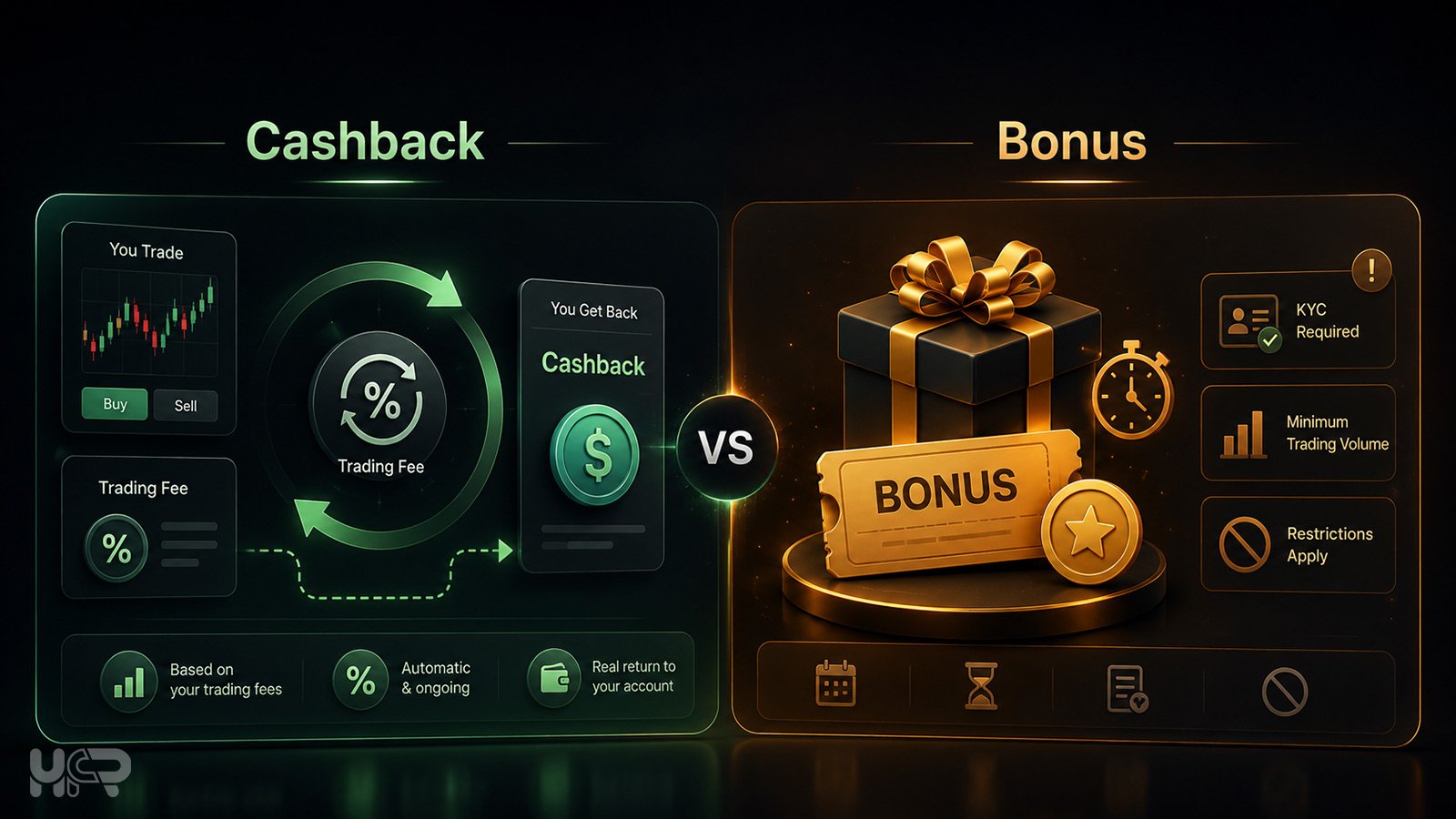
Crypto exchange cashback and exchange bonuses can both appear under rewards or promotion pages, but they are not the same. Cashback is usually linked to eligible trading fees after confirmed activity, while bonuses are usually promotional rewards based on campaign rules.
| Feature | Crypto Exchange Cashback | Exchange Bonus |
|---|---|---|
| Main purpose | May offset part of the eligible trading fees | Promotional reward or campaign incentive |
| Calculation | Usually based on eligible trading fees or commission | Usually based on campaign terms, deposit, activity, or volume |
| Timing | Often paid after trading activity is confirmed | Usually issued after campaign rules are met |
| Predictability | More tied to actual eligible trading cost | More dependent on promotion terms |
| Withdrawal rules | Depends on cashback provider and exchange conditions | Often restricted or subject to usage rules |
| Expiry | Usually depends on provider or exchange rules | Often has campaign expiry or voucher expiry |
| Risk impact | Does not reduce market or liquidation risk | Does not reduce market or liquidation risk |
The main difference is the basis of the reward. Cashback is usually calculated from eligible trading fees or commissions, so it is more connected to the actual trading cost. A bonus is usually linked to a promotion, which may depend on deposits, trading volume, product type, KYC status, region, or campaign approval.
Cashback may be easier to compare when the rate, eligible products, payout schedule, and account requirements are clearly stated. Bonuses usually need closer review because the headline amount may not show product limits, expiry dates, volume requirements, or withdrawal restrictions.
Which One Is More Transparent?
Cashback can be easier to understand when the rate, eligible products, and payment schedule are clearly stated. For example, if a cashback program explains which exchange is supported, which products qualify, how the cashback is calculated, and when payments are made, users can compare it more directly with their trading costs.
However, users should still check eligibility, supported products, payment schedule, minimum payout, and restrictions.
Bonuses usually need closer review because they are campaign-based. One bonus may depend on a deposit, another may depend on trading volume, while another may work only as a fee voucher or trading credit. The rules can change from one promotion to another.
This is why the headline value of a bonus should not be the only comparison point. Users should check whether the bonus can be withdrawn, whether it expires, which products qualify, whether KYC is required, and whether there are reward caps or anti-abuse checks.
In general, cashback may be more transparent when the fee-based calculation is clearly explained.
Common Mistakes Users Make
Many users compare crypto exchange cashback and bonuses by looking only at the headline reward. This can lead to confusion because cashback, vouchers, trading credits, and campaign bonuses may follow different rules.
One common mistake is thinking that every bonus is withdrawable cash. In many cases, an exchange bonus may be a trading credit, futures bonus, fee voucher, or restricted reward. Users should check whether the reward can be withdrawn, used only for trading, or applied only to specific fees.
Another mistake is assuming that cashback is guaranteed on every trade. Crypto exchange cashback usually depends on account eligibility, correct registration or linking, supported products, eligible trading activity, exchange confirmation, and the cashback provider’s conditions.
Users may also miss KYC, regional, account-type, or registration requirements. Cashback may require the account to be opened or linked through the correct process before eligible trading activity can be tracked.
Some users confuse fee vouchers with cashback. A fee voucher may reduce or cover selected trading fees inside the exchange according to campaign rules. Cashback usually works separately and may return part of the eligible trading fees after confirmed activity.
Expiry dates are also easy to miss. Bonus campaigns, vouchers, trading credits, and some reward offers may expire after a fixed period. Users should check the usage period before assuming the reward will remain available.
Volume requirements can also change the real value of a promotion. Some bonuses may require a minimum deposit, minimum trading volume, specific product use, or campaign participation before the reward is issued, unlocked, or transferred.
Another major mistake is assuming cashback reduces liquidation risk. Cashback may help offset part of the eligible trading costs after confirmation, but it does not reduce market risk, leverage risk, funding-rate risk, liquidation risk, platform risk, or the risk of loss.
Users should avoid comparing only the headline bonus size. The real value depends on the full terms, including expiry dates, volume requirements, withdrawal rules, and product limits.
When Cashback May Be More Useful
Cashback may be more useful for users who already trade eligible products and want to understand how part of their trading cost may be returned after confirmation. Since cashback is usually linked to eligible trading fees or commissions, it can be easier to connect with actual trading costs than a one-time campaign reward.
This does not mean cashback is better for every user. The value depends on the exchange, eligible products, trading volume, fee structure, account eligibility, correct registration or linking process, and exchange confirmation.
Cashback may be more relevant for active traders because trading fees can accumulate over time. If a user trades frequently on eligible products, a fee-based cashback structure may help offset part of those confirmed costs.
Users should avoid trading more only to receive cashback. Cashback should be reviewed as one part of the total cost comparison, not as a reason to increase risk.
When Bonuses May Be More Useful
Bonuses may be useful for users who meet the campaign requirements and fully understand the conditions before joining. Some exchange bonuses may help with specific platform activities, fee discounts, trading credits, or promotional campaigns where available.
The key point is that bonuses are usually condition-based. A bonus may require KYC verification, a minimum deposit, minimum trading volume, eligible product use, or approval under campaign rules. Some bonuses may also be limited to futures trading, have expiry dates, include reward caps, or be unavailable in certain regions.
Users should also check whether the bonus can be withdrawn directly. Some bonuses may only work as trading credits, fee vouchers, futures credits, or platform rewards. In those cases, the headline bonus amount may not represent withdrawable cash.
Bonuses should not be treated as guaranteed benefits, trading income, or risk protection. They are only useful when the user understands the terms, restrictions, expiry date, and product limits.
How to Compare Cashback and Bonuses Before Choosing

Before choosing between crypto exchange cashback and an exchange bonus, users should compare the conditions behind each offer. The headline amount or reward name is not enough to understand the real value, restrictions, or risk.
| Checklist Question | Why It Matters |
|---|---|
| Is the account eligible? | Cashback and bonuses may apply only to specific account types, regions, or registration paths. |
| Is KYC required? | Some rewards may require identity verification before they can be used, unlocked, or paid. |
| What products qualify? | Cashback or bonuses may apply only to spot, futures, options, or selected trading pairs. |
| Is the reward cash, fee rebate, voucher, or trading credit? | Different reward types have different usage and withdrawal rules. |
| Can it be withdrawn? | Some bonuses may only be used inside the platform and may not be withdrawable directly. |
| Is there a minimum deposit? | Some campaigns require a deposit before the reward is issued or activated. |
| Is there a minimum trading volume? | Some bonuses or rewards require users to meet volume targets before they become usable. |
| Is there an expiry date? | Vouchers, trading credits, and campaign rewards may expire after a set period. |
| Are there restricted countries? | Regional restrictions may prevent some users from joining a campaign or receiving cashback. |
| Does the reward change trading conditions? | Users should check whether the offer affects fees, account rules, product access, or promotion eligibility. |
| Does it reduce risk? | No. Cashback and bonuses do not reduce market risk, leverage risk, liquidation risk, funding-rate risk, platform risk, or the risk of loss. |
Cashback and bonuses should be compared as separate conditions. Cashback may be easier to review when the rate, eligible products, and payment schedule are stated, while bonuses often need closer reading because campaign rules may include deposits, trading volume, expiry dates, restricted products, or withdrawal limits.
Users should also check whether both offers can work together. Bonus eligibility does not automatically mean cashback eligibility, and cashback eligibility does not automatically mean bonus eligibility.
How HighFxRebates Fits In
HighFxRebates helps users compare cashback conditions for supported crypto exchanges. Where available, eligible users may receive cashback based on confirmed trading activity, eligible products, account requirements, and the applicable payout rules.
Users can compare supported crypto exchange cashback conditions on HighFxRebates before opening, linking, depositing, or trading.
This cashback process is separate from exchange bonuses. Exchange bonuses are usually promotional campaigns offered by the exchange itself, while HighFxRebates cashback is usually linked to eligible trading fees after activity is confirmed. For example, users comparing exchange fee rebates can review Bybit cashback conditions separately from any Bybit promotional campaign. Users can also compare BloFin cashback conditions separately from BloFin campaign rewards, bonuses, or VIP promotions.
Bonus eligibility and cashback eligibility should be checked separately. A user may qualify for an exchange promotion but not meet HighFxRebates cashback requirements, or may qualify for cashback but not for a specific bonus because of region, KYC status, campaign rules, deposit requirements, trading volume, or expiry conditions.
Users should check both sides before opening or linking an account. The cashback page can explain the eligible exchange, rate, payment schedule, and account requirements, while the exchange bonus page can explain campaign rules, reward type, restrictions, and withdrawal conditions.
HighFxRebates cashback may help offset part of the eligible trading costs after confirmation, but it should not be treated as profit, income, a bonus, or risk protection. Exchange bonuses should also be reviewed separately and should not be assumed to be withdrawable or automatically available.
Risk and Compliance Note
Crypto trading involves risk, especially when leverage or derivatives are used. Cashback may help offset part of the eligible trading costs after confirmation, but it does not reduce market risk, leverage risk, liquidation risk, funding-rate risk, platform risk, or the risk of loss.
Exchange bonuses also do not remove trading risk and should not be treated as guaranteed profit or withdrawable cash unless the exchange terms clearly allow it.
Users should review all cashback conditions and bonus campaign terms before registering, depositing, linking an account, or trading. This includes account eligibility, KYC requirements, supported products, regional restrictions, expiry dates, withdrawal rules, and confirmation requirements.
Conclusion
Crypto exchange cashback and exchange bonuses are not the same. Cashback is usually linked to eligible trading fees after confirmed trading activity, while bonuses are promotional rewards based on campaign rules.
Cashback may help users understand how part of eligible trading costs could be returned after confirmation. Exchange bonuses may depend on deposits, trading volume, KYC status, eligible products, expiry dates, reward caps, withdrawal rules, and platform approval.
Users who are still comparing platforms can also use HighFxRebates’ crypto exchange comparison tool to review fees, products, cashback conditions, and platform features together.
Both depend on eligibility and confirmation, and neither removes trading risk. Before opening or linking an account, users can compare supported crypto exchange cashback conditions on HighFxRebates and review the exchange’s bonus terms separately.
FAQ
Is crypto exchange cashback the same as an exchange bonus?
No. Crypto exchange cashback usually returns part of eligible trading fees after confirmed trading activity, while exchange bonuses are promotional rewards subject to separate campaign rules.
How does crypto exchange cashback work?
Crypto exchange cashback may return part of eligible trading fees after the exchange confirms eligible trading activity. The cashback rate, payment schedule, eligible products, and account requirements depend on the exchange and cashback program.
Are exchange bonuses withdrawable?
Not always. Some exchange bonuses may be trading credits, vouchers, fee discounts, futures credits, or restricted rewards. Users should check the exchange’s bonus terms before assuming that a reward can be withdrawn.
Is crypto cashback guaranteed on every trade?
No. Crypto cashback is not guaranteed on every trade. It depends on account eligibility, correct registration or linking, eligible products, confirmed trading activity, and the cashback provider’s conditions.
Do exchange bonuses reduce trading risk?
No. Exchange bonuses do not reduce trading risk. They should be reviewed as promotional offers, not as protection from market losses, leverage risk, liquidation risk, or platform risk.
Which is better: cashback or exchange bonuses?
Neither is automatically better for every user. Cashback may be more connected to trading costs, while bonuses may depend on campaign terms. Users should compare eligibility, restrictions, expiry dates, and withdrawal rules before deciding.
Can I receive both cashback and an exchange bonus?
Sometimes, but not always. Cashback and bonuses may have separate eligibility rules. Users should check both the cashback conditions and the exchange’s campaign terms before opening or linking an account.
 6
6


