




Table of Contents
[ Show/Hide ]- • HFM Review: Accounts, Spreads, Fees & Cashback Explained
- • Overview of HFM
- • Is HFM Regulated and Safe?
- • HFM Account Types
- • HFM Spreads, Fees, and Commissions
- • Cost Transparency
- • Trading Platforms
- • Instruments Available on HFM
- • How Cashback Works with HFM?
- • Deposits and Withdrawals
- • Pros and Limitations
- • Is HFM Right for You?
- • Conclusion
- • FAQs
HFM Review: Accounts, Spreads, Fees & Cashback Explained
This HFM review provides a clear, structured overview of how the broker operates, focusing on costs, account types, and overall trading conditions. HFM, previously known as HotForex, is a multi-asset broker offering access to forex and CFD markets through different account structures and platforms. For traders comparing brokers, understanding how fees are applied is often more important than headline features.
Many broker reviews focus on promotions or platform tools, but trading costs such as spreads, commissions, and execution conditions have a more consistent impact over time. This is especially relevant for traders who are active or cost-conscious.
In this review, we break down HFM’s accounts, pricing model, and available instruments. We also explain how cashback works as a cost-offset mechanism, helping traders better understand the full picture before making decisions.

Overview of HFM
HFM, previously known as HotForex, is an online broker that offers access to forex and CFD markets. The company started operations in 2010 and has gradually expanded into multiple regions, offering trading services to both new and experienced traders.
HFM Background: At its core, HFM provides access to a range of financial instruments, including:
- Forex pairs
- Commodities like gold and oil
- Indices
- Share CFDs
Instead of offering a single setup for all users, the broker uses different account types with varying cost structures. Some accounts rely only on spreads, while others combine tighter spreads with commissions. This allows traders to choose based on how often they trade and what kind of pricing they prefer.
Over time, HFM has built its offering around flexibility rather than a one-size-fits-all model.
Rebranding: HotForex to HFM: The move from HotForex to HFM was mainly a branding change. The company did not introduce a completely new service or platform. Instead, it updated its name and identity to create a more consistent global presence.
For existing users, the rebrand mainly affected the name and visual identity. Trading accounts, platforms, and core services continued under the HFM brand.
Because of this, many older references to “HotForex” still point to the same broker. When you see a HotForex review, it generally reflects HFM under its previous name.
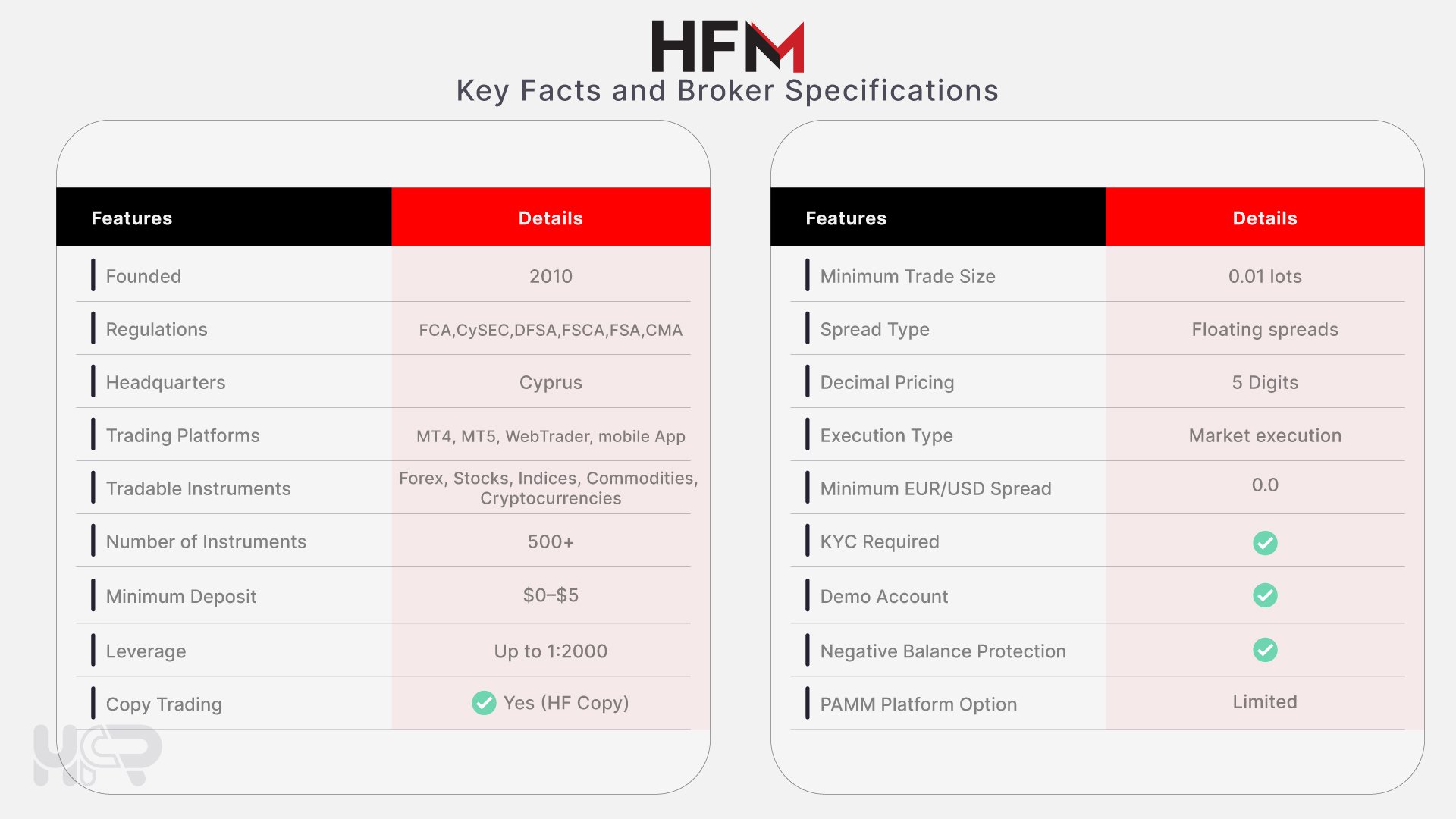
Regions and Availability: HFM operates in many parts of the world, but availability depends on local regulations. The broker uses different legal entities to serve clients in different regions.
In general:
- It supports clients across Europe, Asia, Africa, and Latin America
- Account conditions may vary depending on the registered entity
- Some countries are restricted due to regulatory rules
This is important because trading conditions, protections, and even available features can differ slightly depending on where the account is opened. For that reason, checking the specific entity behind your account is part of understanding overall HFM trading conditions.
Is HFM Regulated and Safe?
When reviewing a broker, regulation is one of the first areas to check. It helps explain how the company operates, what rules it must follow, and what level of protection is available to clients.
- Regulatory Entities
HFM operates through several regulated companies in different regions. This structure allows the broker to offer services globally while complying with local financial laws.
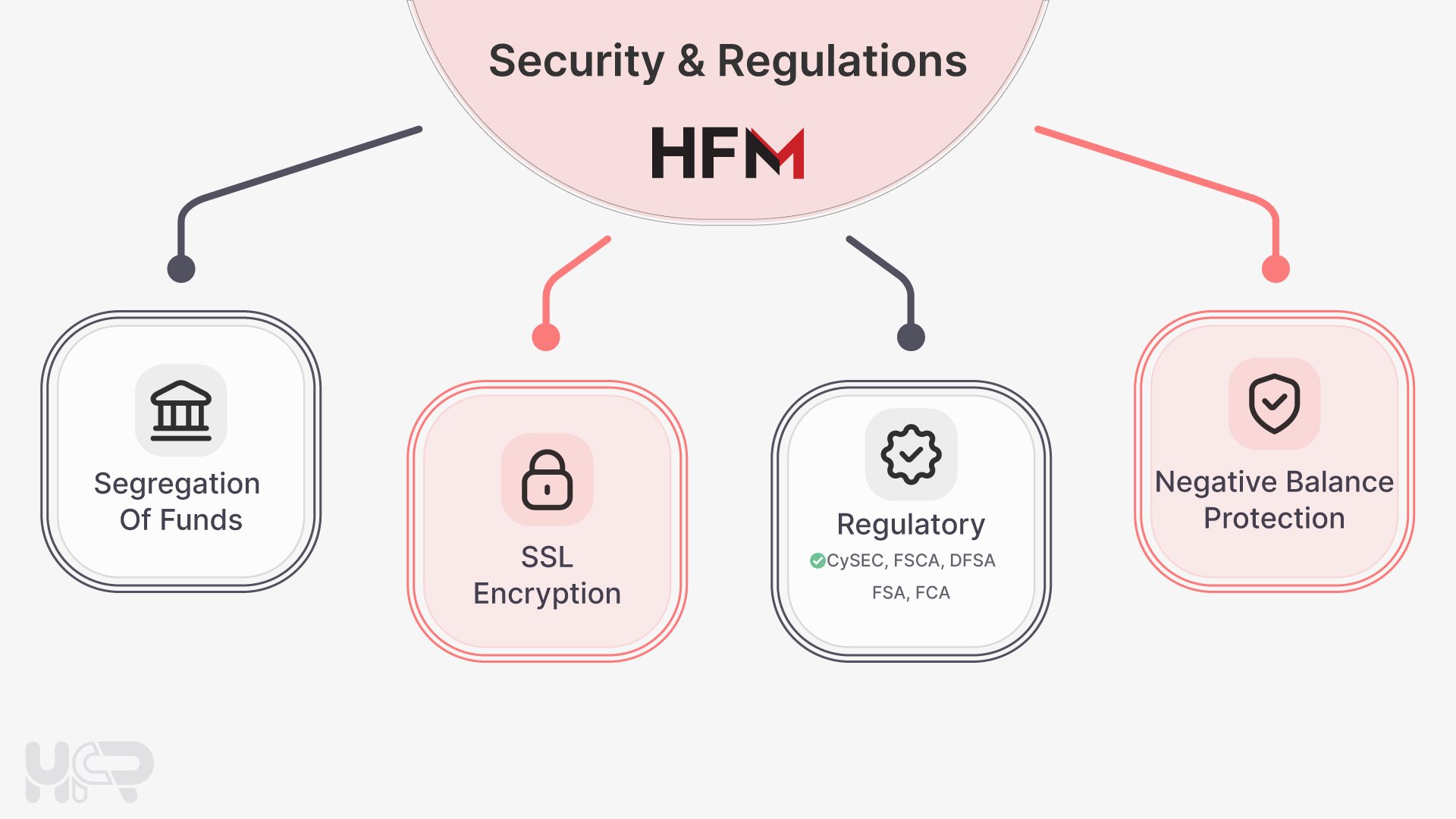
Some of the main regulatory entities include: HFM operates through several entities. According to HFM’s official regulatory pages, the group includes entities regulated by FCA, CySEC, DFSA, FSCA, FSA Seychelles, and CMA Kenya. The exact entity and protection level depend on the client’s region.
Each entity operates under its own regulatory framework. This means that the level of oversight and investor protection can vary depending on where the account is registered.
For example, FCA and CySEC regulations generally involve stricter requirements compared to offshore jurisdictions.
- Client Protection Measures
Regulation is closely linked to how client funds and risks are handled. HFM applies several standard protection mechanisms, though availability may depend on the regulatory entity.
1. Segregation of Funds
Client funds are typically held in separate accounts from the broker’s operational funds. This means:
- Client money is not used for company expenses
- Funds are kept with established banking partners
- In case of financial issues, separation helps protect client balances
2. Negative Balance Protection (NBP)
Negative Balance Protection is designed to prevent traders from losing more than their deposited funds.
- If market volatility causes losses beyond account balance
- The account is reset to zero
- The trader does not owe additional funds
This feature is commonly available under stricter regulatory frameworks, especially in Europe.
3. Additional Safeguards
Depending on the entity, additional protections may include:
- Participation in investor compensation schemes (for certain regions)
- Regular compliance checks by regulators
- Internal risk management policies
Overall, HFM operates under multiple regulatory bodies, which provides a structured level of oversight. However, the exact level of protection depends on which entity the trader is registered with. For this reason, checking the applicable regulator is an important step when evaluating safety in any HFM broker review.
HFM Account Types
HFM offers a combination of standard trading accounts and more specialized options. The exact list can vary depending on the region and regulatory entity, so not every account type is available globally. Some accounts are introduced for specific markets or promotional structures.
Main Account Types
Account availability can vary by country and regulatory entity. Traders should check the account list shown in their HFM registration area before choosing an account.
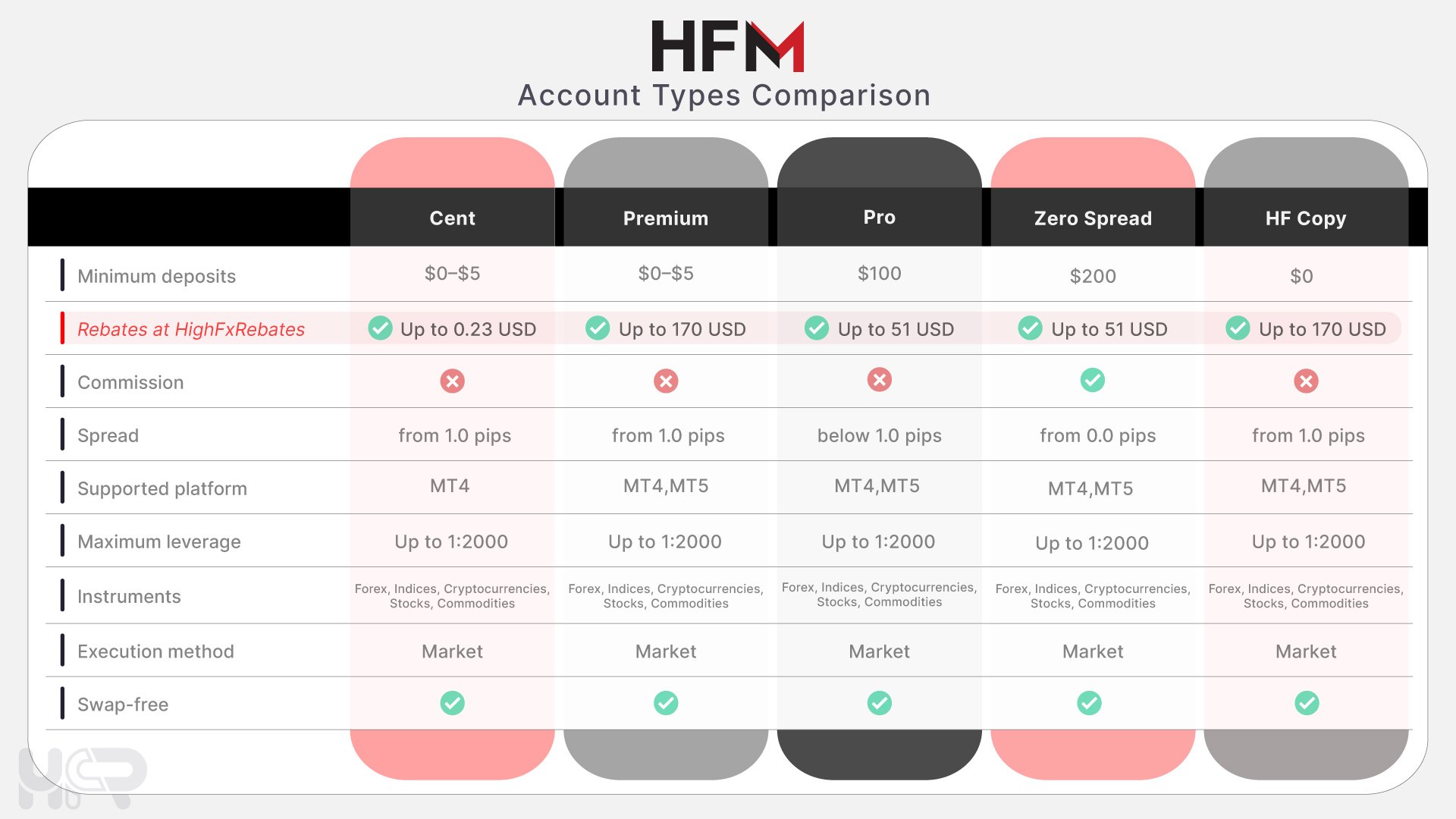
The commonly referenced HFM account types include:
- Cent Account
Designed for smaller trade sizes. Balances are shown in cents, which helps reduce exposure per trade. - Premium Account
A standard account with variable spreads and no direct commission. Often used as a general starting point. - Pro Account
Typically offers tighter spreads than Premium, usually without commission depending on the region. - Zero Spread Account
Provides lower or near-zero spreads, combined with a fixed commission per trade. - HF Copy Account
Built for copy trading. Users can follow other traders or provide strategies. Costs are mainly spread-based, with possible additional performance-related fees. - Crypto Account
A specialized account for cryptocurrency CFDs. Trading conditions, including spreads, may differ from standard forex accounts. - Pro Plus Account
Positioned as an alternative to standard accounts with adjusted pricing conditions. Availability may depend on region and is not always listed under global account structures. - Top-Up Account
A simpler account structure used in some regions, often linked to promotional or balance-adjustment features. It may not be part of the main global offering. - Islamic (Swap-Free) Option
Available on selected accounts. Removes overnight swap charges and replaces them with alternative cost structures where applicable. - Demo Account
A non-live account used for practice with virtual funds.
Important Note on Availability
Not all of the above accounts are part of the global HFM structure. Accounts such as Crypto, Pro Plus, and Top-Up may only be available in certain regions or under specific entities. This is why traders may see different account lists depending on where they register.
Differences in Spreads and Commissions
The key difference between accounts is how trading costs are applied:
- Spread-only accounts (Cent, Premium, Pro)
- No direct commission
- Costs are included in the spread
- Simpler structure
- Commission-based account (Zero Spread)
- Lower spreads
- Fixed commission per lot
- Total cost is a combination of both
- HF Copy account
- Spread-based pricing
- May include additional copy-related fees
- Crypto account
- Typically wider spreads compared to forex pairs
- Costs built into pricing rather than commission
Because of these differences, traders should look at total cost per trade when reviewing HFM spreads and fees, rather than focusing on one element only.
Minimum Deposit Differences
Minimum deposit requirements depend on the account type and region:
- Zero, Cent and Premium accounts
- Lower entry requirements
- Pro account
- Higher minimum deposit
- Specialized accounts (HF Copy, Crypto, Pro Plus, Top-Up)
- Requirements vary depending on structure and availability
Each account type serves a slightly different purpose:
- Some focus on accessibility and simplicity
- Others offer tighter pricing with more detailed cost structures
- Specialized accounts introduce additional features or asset access
Because of this, choosing an account type directly affects overall trading conditions, especially when comparing costs over time across different trading styles.
HFM Spreads, Fees, and Commissions
Understanding pricing is a key part of any HFM review, especially for traders comparing long-term costs. HFM uses a mix of spread-only and commission-based models, depending on the account type. This means the total cost of trading is not defined by one factor alone, but by how spreads and commissions are combined.
To fully understand how pricing works, it’s important to break down the main involved in each trade.
- Spread Ranges
Spreads on HFM accounts are variable and depend on market conditions, liquidity, and the selected account type.
Typical structure:
- Premium / Cent accounts
- Spreads may start around 1.0 pip on major pairs
- No separate commission
- Pro accounts
- Lower spreads compared to Premium
- Often starting below 1.0 pip in normal conditions
- Zero Spread accounts
- Spreads can start from 0.0 pips
- A fixed commission is applied per trade
Actual spreads may widen during:
- High volatility
- News releases
- Low liquidity periods
Because spreads are variable, traders should consider average spreads rather than minimum advertised values when comparing HFM spreads and fees.
- Commission vs Spread-Only Accounts
HFM separates its pricing into two main approaches:
1. Spread-Only Accounts:
- Cent
- Premium
- Pro
Key points:
- No direct commission is charged
- Trading costs are included entirely in the spread
- Easier to understand for newer traders
However, spreads are typically wider compared to raw pricing models.
2. Commission-Based Account:
- Zero Spread account
Key points:
- Spreads are reduced, sometimes close to zero
- A fixed commission is charged per lot
- Total cost = spread + commission
This structure is often more transparent, but requires traders to calculate combined costs.
Cost Transparency
HFM provides a relatively clear pricing structure, but like most brokers, the full cost depends on several variables:
- Account type
- Market conditions
- Trading volume
To understand costs properly, traders should:
- Look at average spreads, not just minimum values
- Include commissions where applicable
- Consider swap charges for longer trades
For traders focused on cost efficiency, it is also common to combine broker pricing with rebate structures. This helps offset part of the trading fees without changing execution conditions. To understand this mechanism in detail, see how forex rebates work.
How to Compare Trading Costs?
When reviewing trading conditions, it is more useful to think in terms of total cost per trade rather than individual fees. Spreads, commissions, and other charges all contribute to the final cost.
Because of this, cost comparison should always be based on:
- The chosen account type
- Typical trading volume
- Holding period
This approach gives a more realistic view of how fees affect trading over time.
Trading Platforms
HFM provides access to widely used trading platforms rather than developing its own proprietary system. This approach allows traders to use familiar tools and standard features across devices.
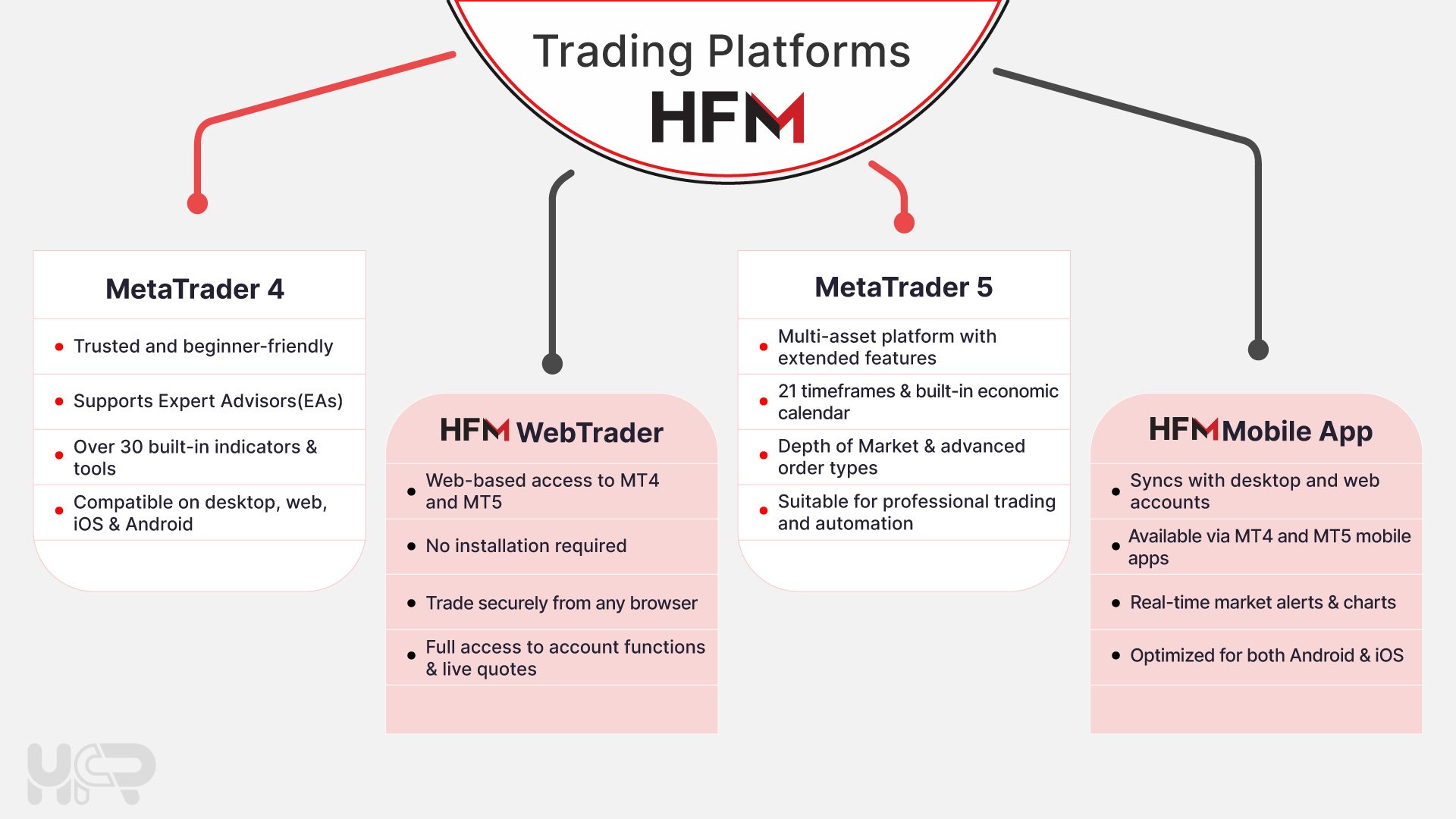
HFM supports both MetaTrader 4 (MT4) and MetaTrader 5 (MT5), offering full-featured desktop platforms suitable for detailed chart analysis and automated trading. Traders can also use WebTrader, a browser-based version that requires no installation and provides essential charting and order functions. In addition, mobile apps for iOS and Android allow users to monitor and manage trades on the go, with access to basic charting tools and order execution.
The platform choice does not change HFM spreads and fees, but it can affect how traders interact with the market. For example:
- Desktop platforms offer more tools for analysis
- Mobile platforms are more convenient for monitoring positions
- Web access provides flexibility without installation
Overall, HFM focuses on providing standard, widely adopted platforms rather than custom-built solutions. This can make the transition easier for traders who have used MetaTrader with other brokers.
Instruments Available on HFM
HFM offers access to a range of CFD instruments across different asset classes. The selection is designed to cover the main markets that retail traders typically use. However, the exact list of instruments may vary depending on the account type, platform, and regulatory entity.
Forex: Forex is the core offering at HFM. Traders can access:
- Major currency pairs (e.g., EUR/USD, GBP/USD)
- Minor pairs
- Some exotic pairs
Forex trading is available on all main account types, with pricing depending on spreads and, in some cases, commissions.
Commodities: HFM provides commodity trading mainly through CFDs. The most common instruments include:
- Precious metals such as gold and silver
- Energy products like crude oil and natural gas
Commodity spreads can differ from forex pairs, especially during volatile market conditions.
Indices: Index CFDs allow traders to access broader market performance rather than individual assets.
Examples include:
- Major global indices (e.g., US, European, and Asian markets)
- Cash and sometimes futures-based index pricing
Indices are often used by traders who want exposure to overall market direction rather than specific companies.
Stocks (Shares CFDs): HFM offers share CFDs from major global exchanges. This includes:
- US-listed companies
- European stocks
- Other regional equities depending on availability
Trading shares as CFDs means traders do not own the underlying asset but trade on price movements.
Cryptocurrencies: HFM also provides cryptocurrency CFDs, although availability may depend on the region and account type.
Common features:
- Access to major cryptocurrencies such as Bitcoin and Ethereum
- Trading through CFDs rather than direct ownership
- Higher spreads compared to forex pairs
The range of instruments at HFM is broad enough to cover most common trading needs. However, access to certain markets can depend on:
- Account type
- Regulatory entity
- Platform (MT4 or MT5)
For this reason, it is useful to check instrument availability alongside HFM trading conditions, especially when comparing accounts or planning to trade across multiple asset classes.
How Cashback Works with HFM?
Cashback, also known as rebates, is a way to return part of the trading costs back to the trader. It does not change how trades are placed or executed. Instead, it works as a separate cost-adjustment layer after trades are completed.
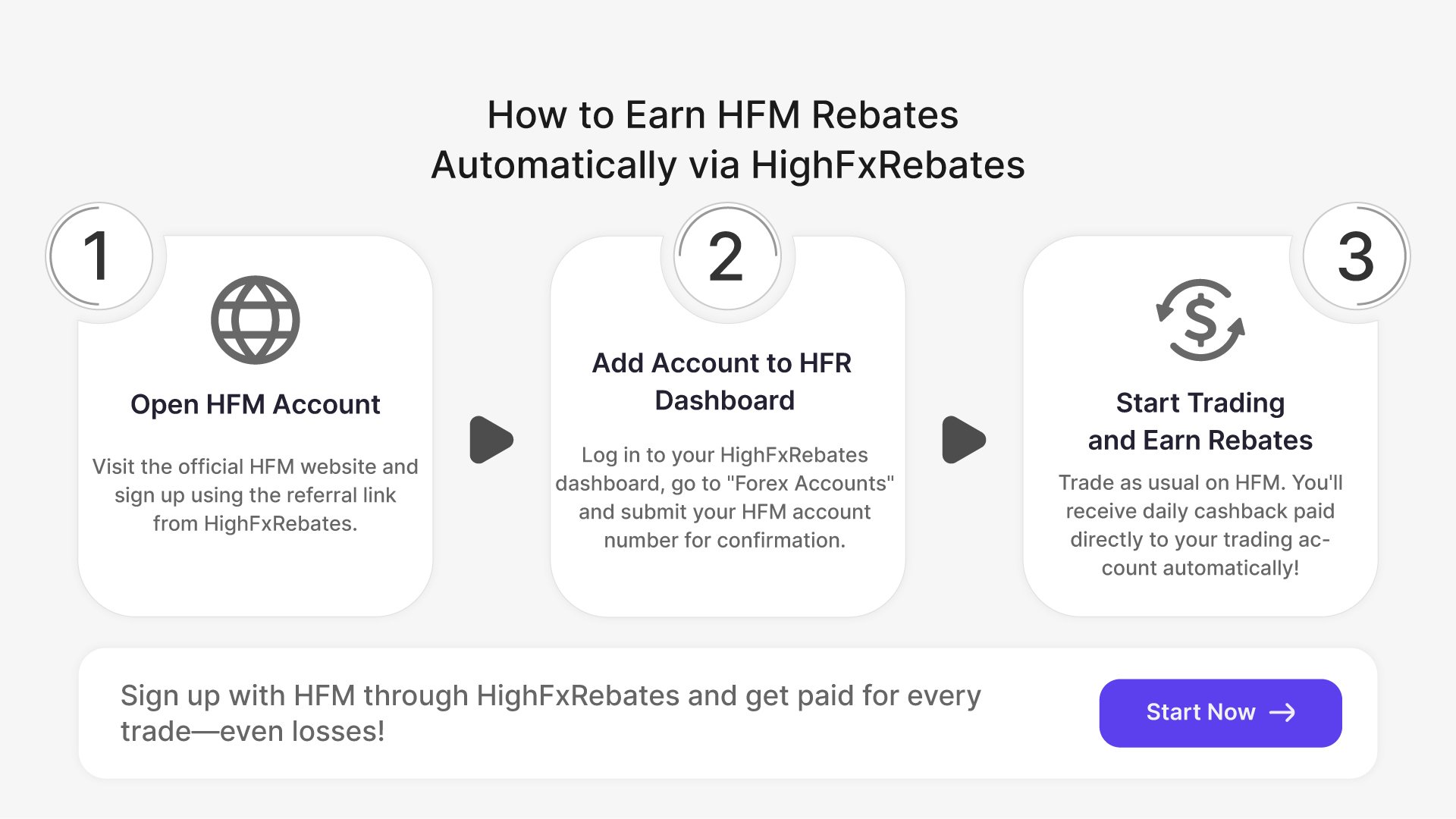
- How the Rebate Structure Works?
HFM uses a standard introducing broker (IB) structure. In this model:
- The trader links their account under a rebate partner like HighFxRebates
- The broker shares part of its revenue (from spreads or commissions)
- A portion of that amount is returned to the trader as cashback
Rebates are calculated based on:
- Trading volume (lots traded)
- Account type
- Instrument category
Depending on the setup, HFM rebates can reach up to USD 170 per round-turn lot traded. The exact rate may vary based on account conditions and instruments traded. To understand the mechanism in more detail, see how forex rebates work.
- Start earning HFM cashback with HighFxRebates
Trade through your linked HFM account and receive up to $170 per round-turn lot in rebates, paid directly according to the eligible account and instrument category. Cashback does not change spreads, execution, or trading conditions. View HFM Rebates
- Cashback Does Not Affect Execution
Cashback is separate from trading conditions and does not interfere with the trading process.
- Spreads remain unchanged
- Execution speed is not affected
- Orders are processed normally by the broker
The rebate is calculated after the trade has been executed.
- Cashback Is Paid Separately
Rebates are not included in the trade result itself. They are handled as a separate transaction.
Typical process:
- Trades are executed normally
- Trading volume is tracked automatically
- Cashback is calculated based on total lots traded
- Payments are credited on a scheduled basis
In many cases, cashback is credited daily and directly to the HFM trading account, depending on the partner structure.
- How Cashback Impacts Trading Costs?
Cashback should be seen as a way to reduce trading costs, not as a trading advantage. It applies to all trades equally, regardless of outcome.
For traders who are active or focused on cost efficiency, this structure helps make trading expenses more visible without changing how trades are executed.
Deposits and Withdrawals
Funding and withdrawing from an account is a practical part of using any broker. HFM provides a range of payment methods, but the exact options depend on the trader’s region and the regulatory entity under which the account is registered.
Deposit Methods
HFM supports several commonly used payment options:
- Bank wire transfer
- Credit and debit cards (Visa, Mastercard)
- E-wallets such as Skrill and Neteller
- Local payment systems in specific regions
Deposits are usually made through the client area, where available methods are shown based on location.
Processing Times
Processing times depend on the selected payment method. Card and e-wallet deposits are typically processed instantly or within a few minutes, while bank transfers usually take between 2 to 7 business days to complete.
Withdrawal requests are generally processed by HFM within one business day. E-wallet withdrawals are often completed faster, while bank withdrawals may take several business days depending on the bank and processing procedures.Fees and Charges
HFM generally does not charge internal fees for most deposits and withdrawals. However, traders should be aware of:
- Third-party fees charged by banks or payment providers
- Currency conversion fees if account and payment currencies differ
- Possible minimum withdrawal limits depending on the method
The deposit and withdrawal process is standard compared to most brokers. However, actual timing and costs can vary based on:
- The selected payment method
- The trader’s country
- The account currency
Therefore, check the exact conditions in the client area before making transactions, especially when transferring larger amounts.
Pros and Limitations
Looking at both strengths and limitations helps create a balanced view of the broker. This section focuses on structure, costs, and practical use rather than promotional points.
Strengths
- Multiple regulatory entities
HFM operates under several regulators, which provide a structured level of oversight. The level of protection depends on the entity. - Flexible account structure
A range of account types allows traders to choose between spread-only and commission-based pricing. - Access to standard platforms
Support for MetaTrader 4 and MetaTrader 5 makes it easier for traders familiar with these platforms to get started. - Wide range of instruments
Includes forex, commodities, indices, and shares, with crypto available in some regions. - Cashback compatibility
The broker structure allows integration with rebate systems, which can help reduce overall trading costs without affecting execution.
Limitations
- Conditions vary by region
Trading conditions, protections, and even account types can differ depending on the regulatory entity. - Spread variability
Spreads are not fixed and may widen during volatile or low-liquidity periods. - Commission structure on some accounts
For Zero Spread accounts, traders need to consider both spread and commission together to understand the total cost. - Limited transparency on average costs
Like many brokers, minimum spreads are advertised, but average spreads are more relevant in practice. - Crypto and some account types are not globally available
Access to certain instruments or accounts (such as Crypto or specialized accounts) may depend on location.
Overall, HFM offers a flexible structure with multiple ways to access the market. However, understanding the full picture requires looking at:
- Account type
- Regional entity
- Total trading costs
This approach provides a clearer view than focusing on individual features alone.
For comparison, you can also read our detailed FBS review to see how pricing and account structures differ.
Is HFM Right for You?
Whether HFM is suitable depends less on features and more on how a trader approaches costs, platform use, and trading frequency. Below is a practical breakdown based on different trader profiles.
1. Beginners
For newer traders, HFM offers a relatively simple entry point:
- Access to familiar platforms like MetaTrader 4 and MetaTrader 5
- Availability of lower-deposit accounts such as Cent or Premium
- Straightforward spread-based pricing on standard accounts
However, beginners still need to understand how forex trading costs work, especially spreads, as these are applied to every trade. Simpler account types can make this easier to follow in the early stages.
2. Active Traders
For traders who place trades frequently, cost structure becomes more important over time.
HFM may be relevant for active traders because:
- It offers both spread-only and commission-based accounts
- Zero Spread accounts provide tighter pricing with a clear commission
- Execution is handled through standard MetaTrader environments
At the same time, active traders should pay attention to:
- Average spreads rather than minimum values
- Combined cost (spread + commission)
- How costs accumulate with volume
3. Cost-Focused Traders
For traders who pay close attention to fees, the key consideration is total cost per trade.
HFM’s structure allows:
- Comparison between different pricing models
- Use of commission-based accounts for clearer cost breakdown
- Integration with rebate systems
For example, traders who link their account through services like HighFxRebates can receive part of the trading cost back as cashback. This does not change execution, but it can reduce overall expenses over time.
Choosing Based on Your Trading Style: HFM can suit different types of traders, but the decision depends on:
- Preferred account structure
- Trading frequency
- Sensitivity to trading costs
Rather than focusing on features alone, it is more useful to evaluate how the broker fits into your cost expectations and trading habits.
Conclusion
This HFM review shows that the broker is structured around flexibility rather than a single pricing model. With multiple account types, access to standard platforms, and a range of instruments, HFM provides a trading environment that can suit different approaches. At the same time, conditions such as spreads, commissions, and available features vary depending on the account type and regulatory entity.
From a cost perspective, it is important to look beyond minimum spreads and consider total trading expenses over time. This includes how spreads, commissions, and swap fees combine in practice. For traders focused on cost efficiency, tools such as cashback can help offset part of these expenses without affecting execution. can also compare HFM with other brokers in our guide to the best forex brokers with rebates.
Overall, HFM may be suitable for traders who want a flexible account structure and are willing to review costs carefully before choosing an account.
FAQs
Is HFM a regulated broker?
Yes. HFM operates through multiple regulated entities depending on the client’s region. These include regulators such as the FCA (UK), CySEC (EU), DFSA (UAE), FSCA (South Africa), and offshore entities like FSA Seychelles and CMA Kenya.
What account types does HFM offer?
HFM provides several account types designed for different trading styles. These typically include Cent, Premium, Pro, and Zero accounts, along with Demo and Islamic (swap-free) options. Availability may vary depending on the trader’s region.
How much cashback can I earn with HFM?
When trading through HighFxRebates, you can receive up to $170 per round-turn lot in cashback. The exact amount depends on your account type, trading volume, and instrument category.
Does HFM cashback affect spreads or execution?
No. Cashback through HighFxRebates does not change spreads, commissions, leverage, or execution speed. It is calculated after trades are completed and paid separately, meaning your trading conditions remain exactly the same.
How are HFM rebates paid?
Rebates are typically calculated based on your trading volume and credited on a regular basis according to the broker’s confirmation.
Does HFM charge deposit or withdrawal fees?
HFM generally does not charge internal fees for deposits or withdrawals. However, your bank, card provider, or e-wallet may apply processing fees. Processing times depend on the selected payment method and verification status.
Is HFM suitable for beginners?
HFM can be suitable for beginners due to its Cent and Demo accounts, which allow traders to start with smaller position sizes and practice trading strategies.
Educational resources and simple account structures also help new traders understand how the platform works before moving to more advanced account types.
 6
6
Share Posts


Further Reading
- Why Forex Spreads Widen: News, Rollover, Liquidity and Volatility
- What is Proof of Reserves on a crypto exchange? What it shows and what it does not
- ActivTrades Review 2026: Accounts, Fees, Platforms, Regulation and Cashback
- Weekly market recap, 12–18 October 2026: Inflation, yields, gold and crypto